How to Check Your K-Electric Load Shedding Schedule in Karachi
Check your K-Electric load shedding schedule by SMS 8119, ke.com.pk or KE Live, see why high-loss feeders get 12 hours, and how to complain to KE and NEPRA.
To check your K-Electric load shedding schedule, text LS and your 13-digit account number to 8119, or enter the account number on KE's Load-Shed Schedule page at ke.com.pk. You can also open the Power tab in the KE Live app, or call 118.
Karachi has two kinds of street when the power goes out. On one, the lights come back after an hour and a half. On the next, the same cut lasts three hours. The K-Electric load shedding schedule explains why, because KE does not cut every area equally. It cuts by feeder, and each feeder gets hours based on its losses.
We read KE's own schedule page, its current schedule PDF and its list of loadshed feeders on 1 October 2026. In that list, 623 feeders across Karachi and KE's areas outside it are marked for load shedding. If your feeder is not one of them, KE does not plan regular cuts for you.
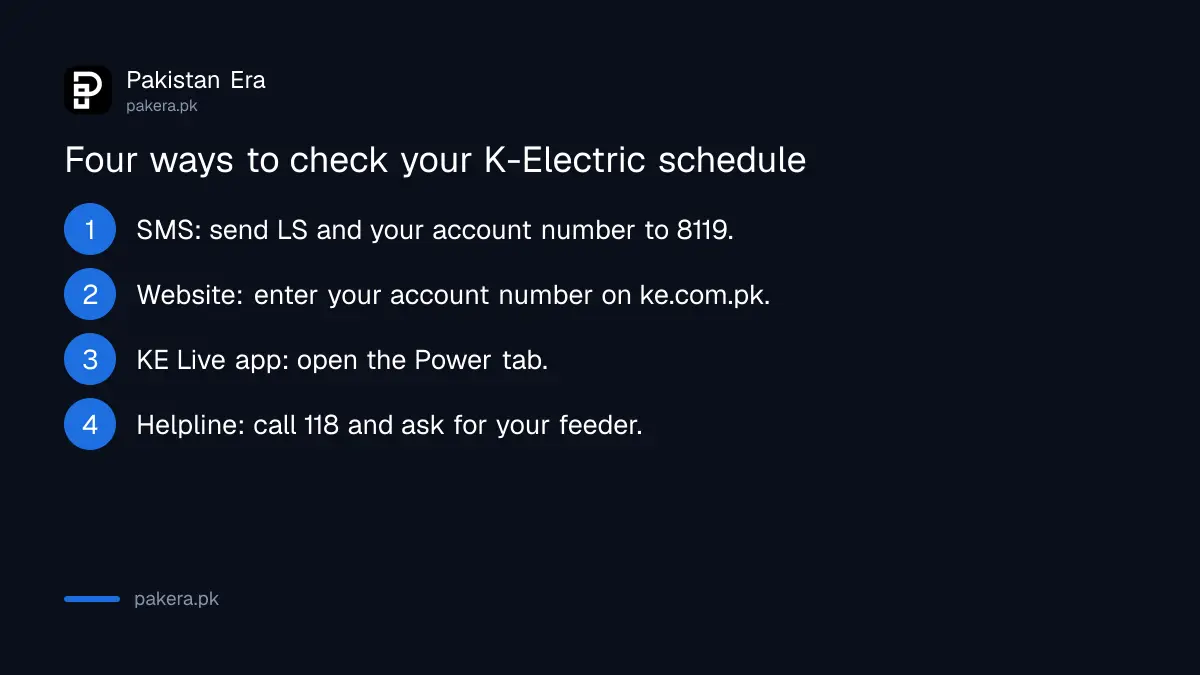
Four official ways to check the K-Electric load shedding schedule
K-Electric offers four official ways to see your schedule: SMS to 8119, the account number search on ke.com.pk, the Power tab in KE Live, and the 118 helpline. All four need either your account number or your feeder name, both printed on your bill.
| Method | What to do | What you need |
|---|---|---|
| SMS 8119 | Send LS, a space, then your account number. If your number is registered, send LS only. | 13-digit account number |
| KE website | Open the Load-Shed / Maintenance Schedule page and enter your account number | Account number from your bill |
| KE Live app | Tap the Power tab at the bottom | A KE Live login |
| Helpline 118 | Ask the agent for your feeder name and its timings | Account number |
| Schedule PDF | Download it from the same page and find your feeder name | Feeder name |
The SMS route is the quickest on a basic phone. KE's contact page says you can register once by sending REG, a space and your 13-digit account number to 8119. After that, LS on its own returns your schedule. Without registering, you add the account number every time.
The same 8119 service also handles bills and complaints, and the full list of codes is with the K-Electric bill check methods. We did not test the SMS or the account search with a real account, so we cannot say how fast the reply comes.
How to find your feeder name before you read the PDF
Your feeder is the power line that supplies your street. KE says you can find its name at the top of your KE bill, on the Power tab of the KE Live app, or by calling 118. You need that exact name to use the schedule PDF.
The PDF is a long table. Each row gives a feeder name, the grid station that feeds it, and four time slots, called cycles. A cycle is one load shedding window.
- Find the feeder name on the top part of your bill.
- Open ke.com.pk and go to Customer Service, then Load-Shed / Maintenance Schedule.
- Download the Load Shed Schedule PDF.
- Search the PDF for your feeder name. Feeders are grouped by grid station.
- Read the four cycles. A time such as 1035~1335 means 10:35 am to 1:35 pm.
Feeder names change. Several rows carry an old name in brackets, such as "Ex-Police Station", so search for both if you know the old one. If your feeder is missing from the PDF, check the separate feeder list on the same page before you assume you are exempt.
Why some Karachi areas get more load shedding
KE's PDF says load shedding is based on the losses on each feeder, measured from electricity theft and unpaid bills. Feeders with higher losses get more hours. So two streets a few hundred metres apart can have very different schedules.
KE publishes a separate "List of Feeders under the Loadshed Category". It gives each feeder a loss percentage, which KE labels ATC. ATC loss means aggregate technical and commercial loss: power lost in the wires, plus power used but never paid for. Each feeder then gets a category.
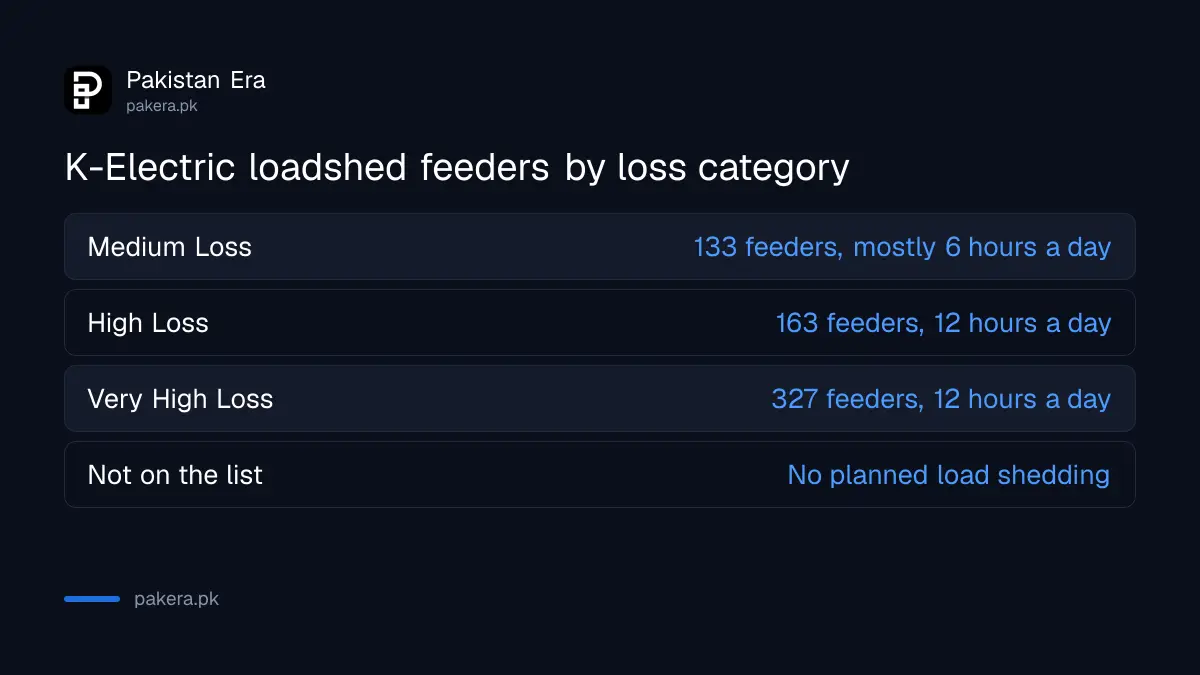
We counted the list. It has 133 Medium Loss feeders, 163 High Loss feeders and 327 Very High Loss feeders, 623 in all. Losses on the list run from 8.6 per cent on one Bin Qasim feeder to over 99 per cent on a Surjani feeder.
The schedule PDF, which KE says applies from 5 August 2026, then sets the hours. We added up the four cycles for every feeder we could read in it.
| Feeder example | KE category | Loss on list | Cut time on paper |
|---|---|---|---|
| Raza Residency, Malir | Medium Loss | 24.2% | 4 slots of 1.5 hours, 6 hours a day |
| Northern Electric, Baldia | Medium Loss | 28.2% | 6 hours a day |
| Block 5 RMU, Shah Faisal | High Loss | 46.2% | 4 slots, 12 hours a day |
| Ghazi Town, Malir | Very High Loss | 73.6% | 12 hours a day |
Across the whole PDF, 125 feeders had six hours of cuts a day and 493 had twelve. When we matched the two documents by feeder name, every High and Very High Loss feeder we could match had 12 hours, and almost every Medium Loss feeder had 6. KE says the timings "may slightly vary" and stay valid until further notice.
That rule is hard on paying customers in a high-loss area. You pay your bill, but you share a feeder with people who do not, so you get the same cuts. KE's answer is that the feeder's numbers decide, not the house. The way out is collective: if losses on a feeder fall, it can move to a lower category when KE next updates the list.
Planned maintenance shutdowns are a separate check
Maintenance shutdowns are not part of the load shedding schedule. KE's same page has a second account number search for planned maintenance. It shows the feeder, date, time and scope of any planned shutdown, or "No maintenance shutdown planned".
Check both before a long day of work at home or an exam. A feeder can be exempt from load shedding and still be shut for a few hours for repairs.
NEPRA's new service standards for power companies say companies must give affected consumers at least 48 hours' notice of planned outages, by text, email or other electronic means. Keep your mobile number updated with KE so the notice reaches you.
KE also warns that local faults on transformers or feeders can cut power outside the schedule. Those are faults, not load shedding, and you report them to 118.
Complain to K-Electric first, then NEPRA, when cuts exceed the schedule
If your power goes off outside your listed cycles, or stays off longer, complain to K-Electric first on 118 or WhatsApp 0348-0000118. If KE does not fix it, take it to NEPRA's online complaint system with your complaint numbers.
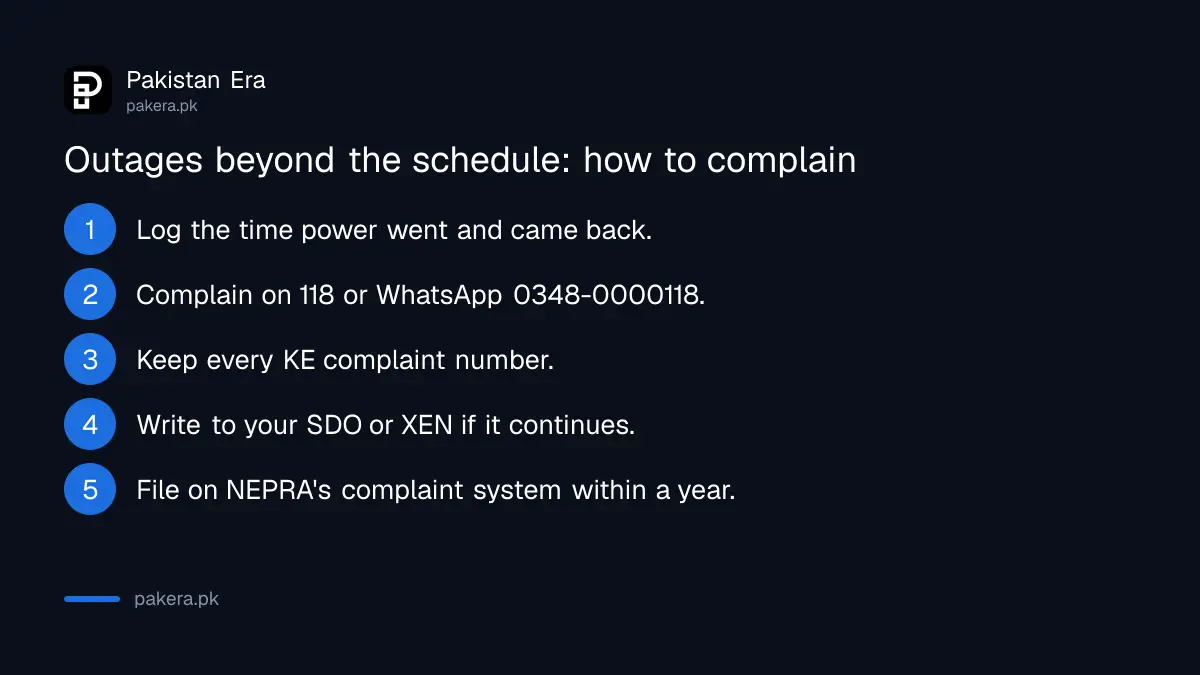
Note the date, the time the power went and the time it came back. Compare it with your cycles. Then report it. KE lists these channels, all open 24 hours:
- Call 118, or (021) 99000.
- Send "Hi" on WhatsApp to 0348-0000118 and register a technical complaint.
- Send COMP to 8119 if your number is registered.
- Log it in the KE Live app, where you can also track it.
Write down every complaint number. Every channel, office and escalation step is covered with the K-Electric complaint on 118 and NEPRA process.
NEPRA comes next. Its complaint form at nepra.org.pk advises you to go to the concerned SDO or XEN, the KE officers for your area, before filing with NEPRA. NEPRA says it cannot process a complaint older than one year under its 2015 complaint rules. Attach your outage log and KE complaint numbers. NEPRA's complaint system lists +92 51 2013200, 9 am to 5 pm, Monday to Friday.
The same NEPRA route works for a bill dispute too, as set out in how to complain about a wrong electricity bill.
Common questions
How do I check K-Electric load shedding by SMS?
Send LS, a space and your 13-digit account number to 8119. If you have registered your number with REG first, send LS on its own.
Where is my feeder name?
KE says it is in the top section of your bill. You can also see it on the Power tab of the KE Live app, or ask on 118.
Why does my area get more load shedding than the next one?
KE sets load shedding by the losses on each feeder, from theft and unpaid bills. A High or Very High Loss feeder gets longer cuts than a Medium Loss one.
How many hours of load shedding does K-Electric schedule?
In the schedule from 5 August 2026, Medium Loss feeders had 6 hours a day on paper and most other loadshed feeders had 12. Your own row in the PDF is the answer for your street.
Is my area exempt if my feeder is not on the list?
KE's PDF says the listed feeders are the ones expected to have load shedding. A feeder that is not listed is not in the loadshed category, but it can still have faults or planned maintenance.
Can I complain to NEPRA about load shedding?
Yes, after you complain to K-Electric. Keep the complaint numbers and your outage times, and file within one year.
How we verified this
What we checked, where we read it, and what we could not confirm.
Last checked on 1 October 2026. We read K-Electric's Load-Shed / Maintenance Schedule page, downloaded its Load Shed Schedule PDF (applicable from 5 August 2026) and its List of Feeders under the Loadshed Category, and counted the categories and cycle hours ourselves. We read KE's contact page for 118, 99000, WhatsApp and the 8119 codes, and NEPRA's complaint registration page for the one-year limit and the SDO or XEN advice. We did not test the account search or SMS with a real account. KE updates its schedule and feeder list from time to time, so download the current PDF before relying on any timing here.
About the author

Tax, Bills and Technology Writer
Ali Akhtar is a young and curious voice here at Pakistan Era. He is currently pursuing his A-Levels and has a growing interest in Pakistan’s changing industrial landscape and educational trends. Ali likes to write in a way that helps him explain and explore the world around him. His writing reflects the perspective of the new generation navigating the evolving trends of Pakistan where technology, youth innovation, and shifting opportunities are reshaping the country’s future.