NEPRA Sets New Deadlines for Every Electricity Company
New regulations set restoration times, same day reconnection and compensation. What binds now, and what does not start for two years.
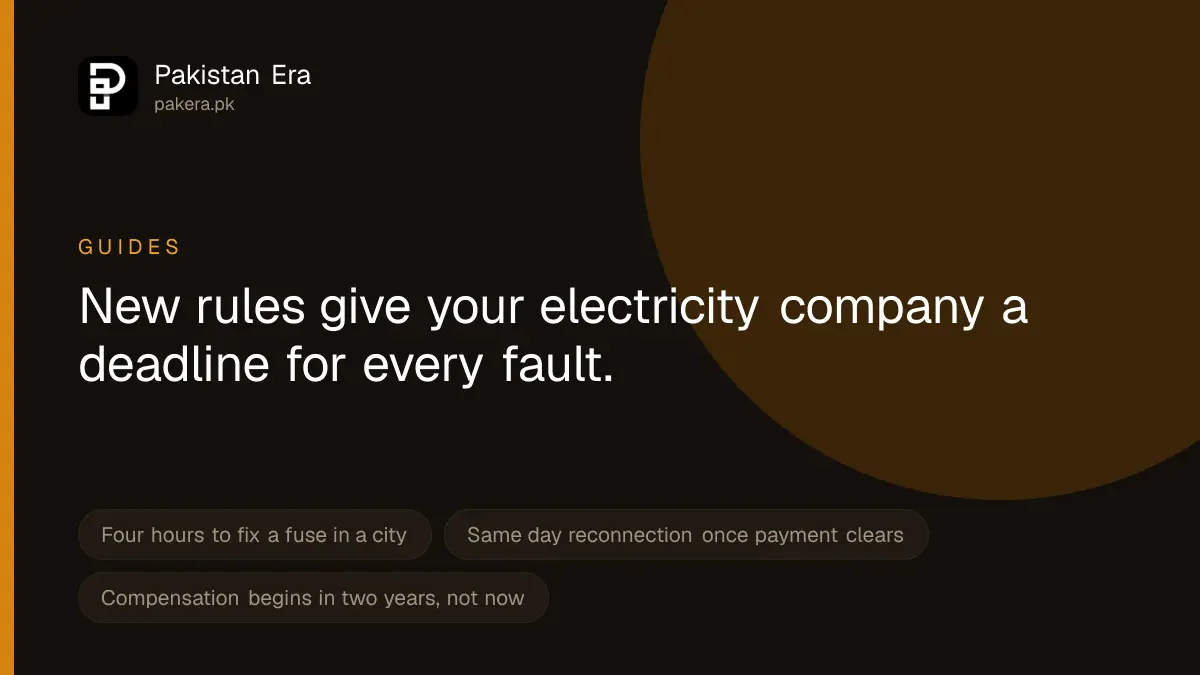
Your electricity company now has four hours to fix a blown fuse in a city, two hours to restore a cable breakdown where an alternate supply exists, and must reconnect you the same day your payment clears. These are not service promises. They are regulations notified on 25 August 2026.
The same regulations also publish the order in which load shedding must happen, and residential consumers are first in that order.
We downloaded and read the National Electric Power Regulatory Authority Performance Standards (Distribution) Regulations 2026, notified as SRO 1430(I)/2026 dated 25 August 2026, from nepra.org.pk on 7 September 2026.
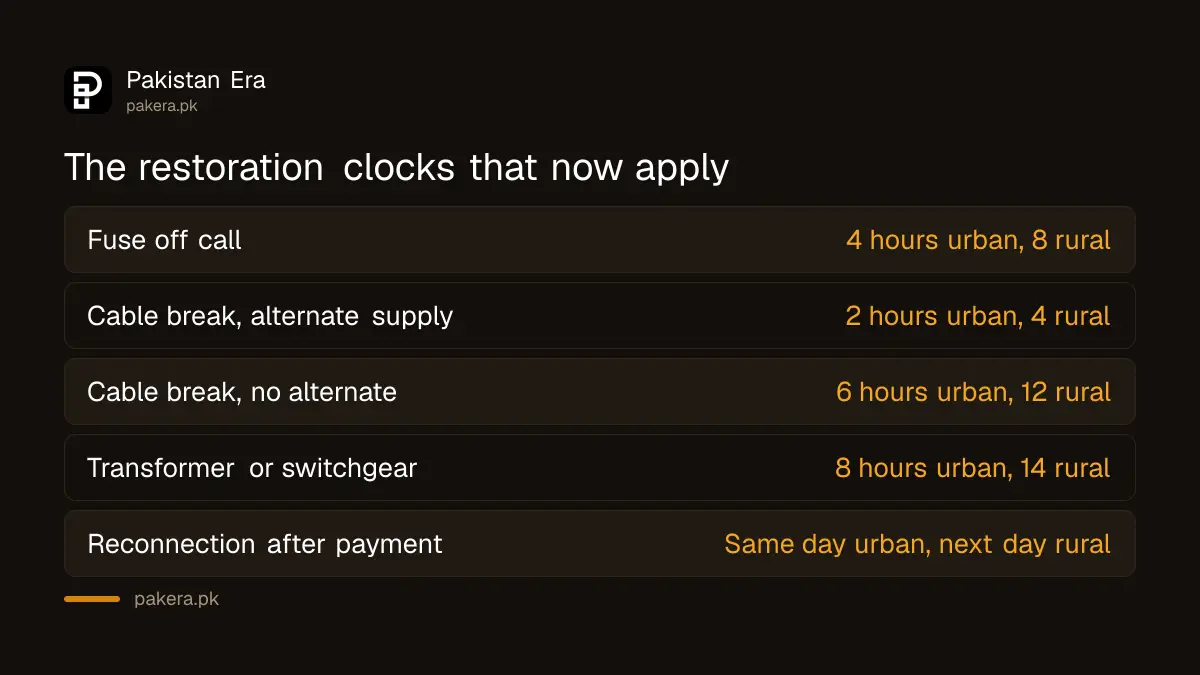
The clocks that now apply
| Fault or request | Urban | Rural |
|---|---|---|
| Normal fuse off call | 4 hours | 8 hours |
| Line or cable breakdown, alternate supply available | 2 hours | 4 hours |
| Line or cable breakdown, no alternate supply | 6 hours | 12 hours |
| Transformer or switchgear failure | 8 hours | 14 hours |
| Streetlight complaint | 8 hours | 14 hours |
| Voltage fluctuation, no network work needed | 24 hours | 24 hours |
| Reconnection after paying an overdue bill | Same day payment clears | Next day |
The restoration standards carry a compliance target of one hundred per cent of cases, not a majority. Streetlight complaints carry ninety per cent.
Notice before a planned outage
For a planned interruption, the distribution company must serve notice to every affected consumer at least forty eight hours in advance, by text message, email or other electronic means. The area wise schedule of planned outages must also be published on its consumer application.
Industrial consumers in category B3 and above, and captive power plants, get a further protection. For an unscheduled interruption they must be given at least thirty minutes notice by text, call or email, plus continuous restoration updates, unless it is a genuine emergency recorded in the outage management system at the time.
That recording requirement matters. An emergency has to be logged as it happens and reported to the Authority in the next quarterly performance report, so it is not a label that can be applied afterwards.
New connections have a deadline and a price
This is where the money appears. A new connection, load extension or temporary connection that needs the network expanded or reinforced now has a fixed timeline, and a daily compensation figure if it is missed.
- At 400 volts with load up to 15 kW, within 30 days, then Rs 200 per day.
- At 400 volts above 15 kW and up to 70 kW, within 44 days, then Rs 300 per day.
- At 400 volts above 70 kW and up to 500 kW, within 58 days, then Rs 400 per day.
- At 11 or 33 kV above 500 kW and up to 7500 kW, within 106 days, then Rs 500 per day.
- At 66 kV and above, within 496 days, then Rs 1,000 per day.
A new net billing connection follows the timeline in the Prosumer Regulations 2026, with Rs 200 per day if it is missed.
Our guide to applying for a new electricity connection covers the application itself. The thirty day figure is the one to hold the company to.
The compensation, and the catch we are not going to bury
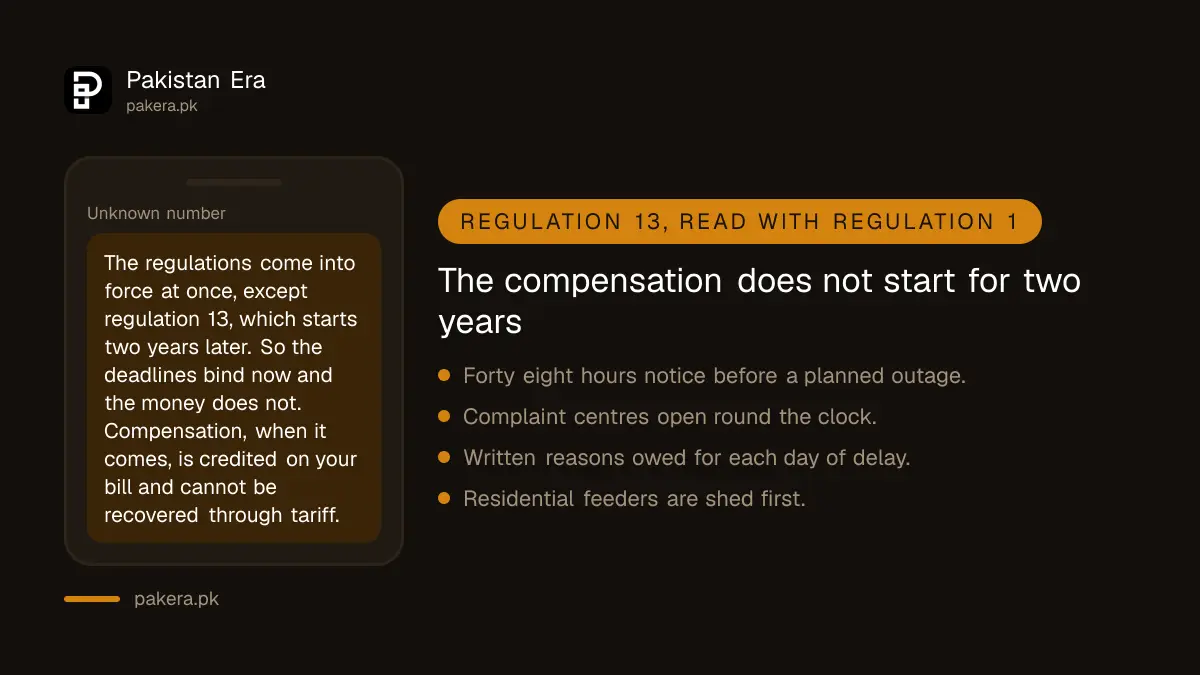
Regulation 13 says non compliance makes the distribution company liable to pay compensation to the applicant or consumer, in the amounts set out in Schedule I, and that payment is made through the electricity bill.
It also says something worth quoting. Any compensation, fine or penalty paid for missing these standards shall not be claimed, recovered or allowed through tariff, and shall be borne by the company from its allowed return. In other words the cost cannot be passed back to consumers.
Here is the catch. Regulation 1 says the regulations come into force with immediate effect, except regulation 13, which comes into force two years from that date.
So the deadlines bind now. The compensation does not begin for two years. Anybody telling you that you can claim Rs 50 a day from your distribution company today is reading the schedule without reading regulation 1.
The published order of load shedding
The regulations require every distribution company to keep plans for shedding up to thirty per cent of its connected load on the system operator's instruction, and they set the order in which it happens.
The order runs from first to be cut to last. Dedicated feeders serving residential or commercial consumers. Then common feeders primarily serving residential and commercial. Then common feeders primarily serving agriculture. Then common feeders primarily serving industry. Then dedicated feeders serving agriculture. Then dedicated feeders serving industry. Then dedicated feeders serving educational institutions and hospitals. Then defence and strategic installations.
A feeder counts as primarily serving a category when more than fifty per cent of the connected load on it belongs to that category.
Two protections sit alongside that list. Load shedding must be carried out on a rotational basis in discrete blocks, and consumers within the same category must be treated equitably so that no particular category carries a disproportionate share.
What your company must give you
Every distribution company must maintain consumer complaint or customer service centres at sub division, division, circle and company level, and keep them accessible round the clock on all days of the week.
Each must have a toll free telephone or mobile helpline with enough lines, and that number must be printed on your electricity bill as well as published on the company website. If the address or number changes, the company must circulate the change to consumers.
There is also a rule that closes a familiar gap. Where a complaint is lodged directly with any official of any sub division, that official must immediately pass it to the complaint centre for recording and registration. A complaint made in person is not supposed to disappear because it was never entered.
Companies must also run a Consumer Facilitation Application as a one window service, aligned to the requirements in Schedule V within twelve months of notification, with failure to meet that timeline treated as non compliance.
If the deadline is missed
Where a complaint or application is not dealt with in the stipulated time, the company must, on your written request, give you written reasons for each day of delay. The regulation adds that the delay does not release it from completing the work in the minimum possible time.
Ask in writing. A verbal complaint produces nothing you can use later, and the written reasons are what an escalation is built on.
Unresolved complaints go to the Authority, decided under the NEPRA Complaint Handling and Dispute Resolution (Procedure) Rules 2015. Our guide to complaining to NEPRA covers that route, our guide to overbilling covers the most common dispute, and our guide to disputing a detection bill covers the hardest one.
Common questions
How long does my electricity company have to fix a fuse?
Four hours for urban consumers and eight hours for rural consumers, in one hundred per cent of cases.
How quickly must I be reconnected after paying?
The same day the payment is realised for urban consumers at 400 volts or below, and the next day for rural consumers.
Can I claim compensation now?
No. Regulation 13, which creates the compensation, comes into force two years after the regulations commence.
How much notice must I get before a planned outage?
At least forty eight hours, by text message, email or other electronic means.
Who is cut first in load shedding?
Dedicated feeders serving residential or commercial consumers, under the priority order in the regulations.
What if my complaint is ignored?
Ask in writing for the reasons for each day of delay, then escalate to the Authority under the 2015 dispute resolution rules.
How we verified this
What we checked, where we read it, and what we could not confirm.
Last checked 7 September 2026. We downloaded the National Electric Power Regulatory Authority Performance Standards (Distribution) Regulations 2026, notified as SRO 1430(I)/2026 dated 25 August 2026, from the legislation section of nepra.org.pk, and read it. Regulation 1 providing that the regulations come into force with immediate effect save that regulation 13 comes into force after two years; regulation 3 setting the Guaranteed Performance Standards, including forty eight hours advance notice of planned interruptions by text message, electronic mail or other electronic means, thirty minutes notice to industrial consumers of category B3 and above and to captive power plants for unscheduled interruptions with continuous restoration updates except in a recorded emergency, and the requirement to achieve the restoration standards in one hundred per cent of cases and streetlight complaints in ninety per cent; regulation 4 setting the Overall Performance Standards including the reliability indices and, at Overall Performance Standard 9, the requirement to plan for shedding up to thirty per cent of connected load, the priority order of load shedding across dedicated and common feeders serving residential, commercial, agricultural, industrial, educational, hospital, defence and strategic loads, the fifty per cent connected load test for what a feeder primarily serves, and the requirements that shedding be rotational in discrete blocks and equitable within a category; regulation 5 requiring consumer complaint or customer service centres at sub division, division, circle and company level accessible round the clock on all days, a toll free helpline published on bills and the website, and the passing of complaints lodged with any official to the complaint centre; regulation 6 on the Consumer Facilitation Application and its twelve month alignment deadline; regulation 13 on compensation, its payment through the electricity bill and the bar on recovering it through tariff; and regulation 15 referring unresolved complaints to the Authority under the NEPRA Complaint Handling and Dispute Resolution (Procedure) Rules 2015, are all taken from that text. The timelines and compensation figures for fuse off calls, line and cable breakdowns, transformer and switchgear failure, streetlights, voltage fluctuations, reconnection after disconnection for non payment, and new connections at each load band, are taken from Schedule I to the same regulations. The document is a scanned notification and parts of it read poorly through text extraction, so we have quoted only figures and provisions we could read cleanly, and we have not reproduced the schedule in full. Confirm any figure against the notification itself before relying on it in a dispute. Nothing here is legal advice.
About the author

Tax, Bills and Technology Writer
Ali Akhtar is a young and curious voice here at Pakistan Era. He is currently pursuing his A-Levels and has a growing interest in Pakistan’s changing industrial landscape and educational trends. Ali likes to write in a way that helps him explain and explore the world around him. His writing reflects the perspective of the new generation navigating the evolving trends of Pakistan where technology, youth innovation, and shifting opportunities are reshaping the country’s future.