How to Apply for a New Electricity Connection
Apply for a new electricity meter at enc.com.pk for LESCO, IESCO and the rest. Documents, the demand notice, and what blocks it.
A new electricity connection starts on one website, whichever company supplies your area. The Electricity New Connection portal at enc.com.pk handles applications for the distribution companies, including LESCO, IESCO, MEPCO, GEPCO and the rest. We opened it on 26 August 2026 and it responded.
You apply online, the company inspects, it issues a demand notice telling you what to pay and where, you pay that, and the meter is installed. The single most useful thing to know is that the demand notice is the bill. Money asked for outside it is not part of the process.
What you need before you open the form
Most rejected applications fail on documents rather than on eligibility, so gather these first.
| Document | Why it is needed | Note |
|---|---|---|
| CNIC of the applicant | Identity of the account holder | Must be valid, not expired |
| Proof of ownership or occupancy | Registry, fard, baynama or allotment letter | Tenants need the owner's consent |
| Undertaking on stamp paper | That no connection exists and no dues are owed | Attested by an oath commissioner |
| Neighbouring reference number | To locate the premises on the network | Any nearby meter's bill helps |
| Test report by a licensed electrician | Internal wiring is safe to energise | Required for most categories |
Scans need to be small. The portal is reported to cap uploads at about 300KB per file in JPG or PDF, so photograph documents in good light and compress rather than uploading a full resolution scan.
How the application actually runs
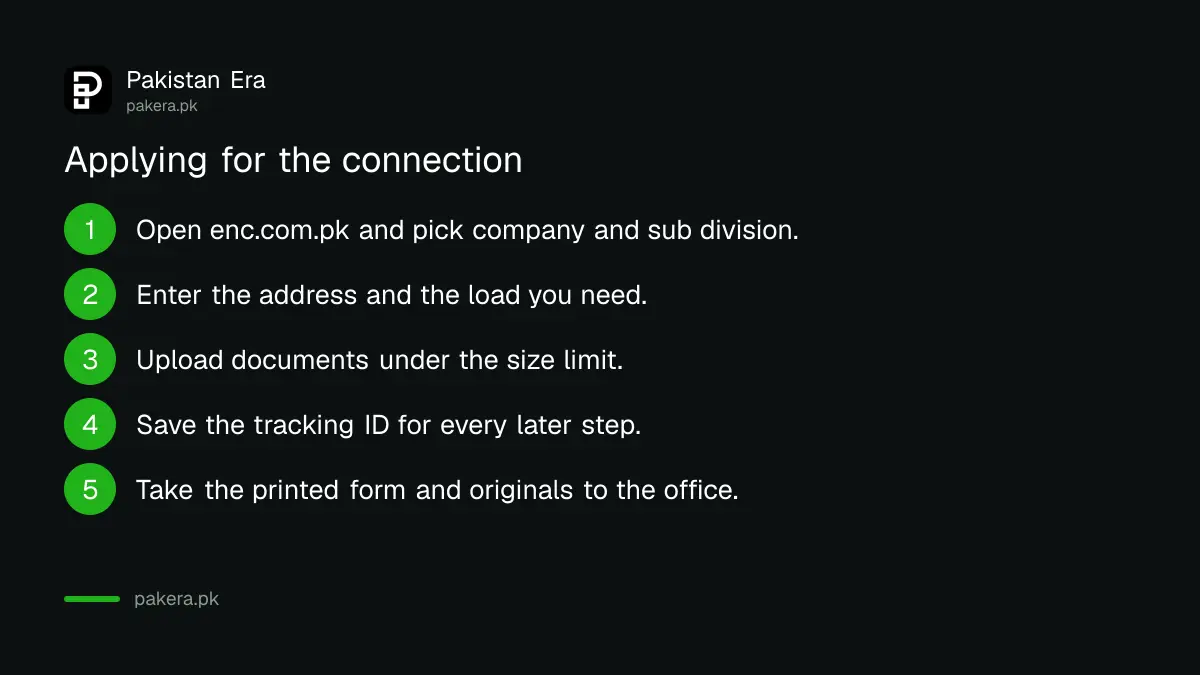
- Open enc.com.pk and choose your supply company and sub division.
- Fill the application with the premises address and the load you need in kilowatts.
- Upload the documents within the size limit and submit.
- Save the tracking ID, because every later step is looked up with it.
- Print the submitted form and take it with the originals to your sub division office.
An inspection follows. The company checks the premises, confirms the load and the wiring, and confirms there is no outstanding amount attached to the address. That last check is the one that surprises people, and we come back to it below.
The demand notice is the only payment
When the survey is done the company issues a demand notice. It sets out the charges and names the bank where they are paid. You pay at that bank and keep the receipt, then submit the paid receipt to the sub division.
Amounts vary by company, by load and by how far the premises sit from the existing network, and a connection that needs a pole or a transformer costs considerably more than one next to an existing line. Figures circulating for a single phase domestic connection in 2026 are around Rs 21,300, but that is reported rather than read on a company page, and we would not budget from it. The number that matters is the one on your own demand notice.
Nothing else is payable. If a fee is requested in cash, without a notice, or to move you up a queue, it is not part of the procedure.
Old dues on the address will stop you
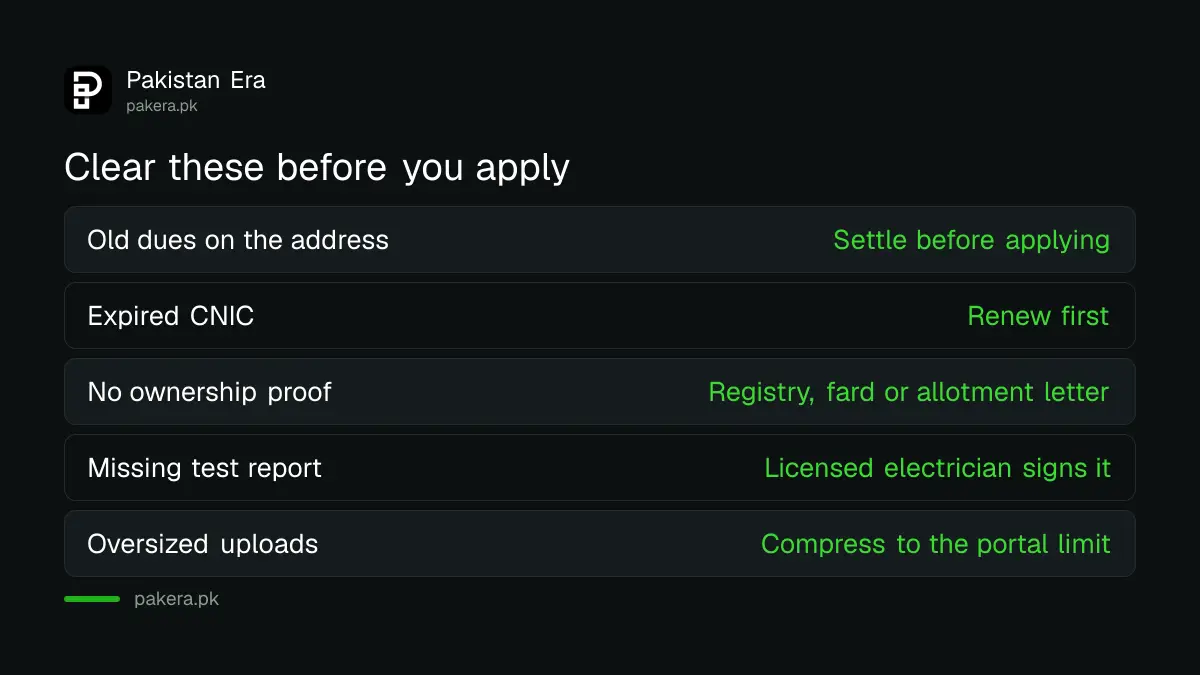
Buying or renting a property does not clear what a previous occupant owed on it. Distribution companies check the premises, not just the person, and an unpaid balance or a disconnection recorded against that address will hold up a fresh connection until it is settled.
Check before you apply rather than after. Pull the last bill for the address using the nearby reference number, and if you cannot find one, our guides to checking a LESCO bill and checking an IESCO bill show how to look a reference up. If a bill exists and is unpaid, resolve it with the sub division before you spend anything on an application.
Ask for the right load, not the biggest one
The sanctioned load is the maximum you are approved to draw. Asking for far more than you need raises the connection cost and can move you into a different category. Asking for too little means an extension application later, which is a second round of the same process.
Add up what will actually run at the same time, allow headroom for an air conditioner or a motor if one is planned, and ask the sub division what is normal for a property of your size. Understanding what you are being charged for afterwards is easier if you know what the entries mean, which we cover in our breakdown of electricity bill line items.
Common questions about a new electricity connection
Can a tenant apply for a connection?
Generally yes, with the owner's documented consent alongside the ownership proof. The account carries obligations, so the owner is entitled to know it is being opened.
How long does it take?
It depends on the survey and on whether network work is needed. A straightforward domestic connection next to an existing line is much faster than one requiring a pole or transformer, and no single timeline covers both.
Do I have to visit the office at all?
Yes. The application is online, but the printed form, the original documents and the paid demand notice receipt are submitted at the sub division.
What if my application is rejected?
Ask for the reason in writing at the sub division. Most rejections are document or dues problems that can be fixed and resubmitted rather than permanent refusals.
Is enc.com.pk the right site for every company?
It presents itself as the shared new connection portal for the distribution companies. If your company's own website routes you somewhere else, follow your company's own link.
How we verified this
What we checked, where we read it, and what we could not confirm.
Last checked 26 August 2026. We requested enc.com.pk on that date and it responded, and LESCO's own website lists New Connection and an ENC online form among its services, which we also read on that date. The document list, the 300KB upload limit and the Rs 21,300 figure come from reporting rather than from a page we could read on a company site, so the body marks the amount reported and tells the reader to rely on their own demand notice instead. We did not submit an application, so nothing here describes a connection we obtained.
About the author

Tax, Bills and Technology Writer
Ali Akhtar is a young and curious voice here at Pakistan Era. He is currently pursuing his A-Levels and has a growing interest in Pakistan’s changing industrial landscape and educational trends. Ali likes to write in a way that helps him explain and explore the world around him. His writing reflects the perspective of the new generation navigating the evolving trends of Pakistan where technology, youth innovation, and shifting opportunities are reshaping the country’s future.