Your Electricity Bill Has 12 Lines. You Can Claim One of Them Back.
FPA, QTA, TR and FC surcharge, NJ surcharge, PTV fee. What each line actually is, who levies it, and which one is not really a tax at all.
Look at your electricity bill. Find the line that says how many units you used and what they cost.
Now look at everything underneath it. On most Pakistani bills that second part is enormous, and almost none of it is electricity.
Here is what each line actually is, who charges it, and the one line that is not a charge at all.
The acronyms, translated
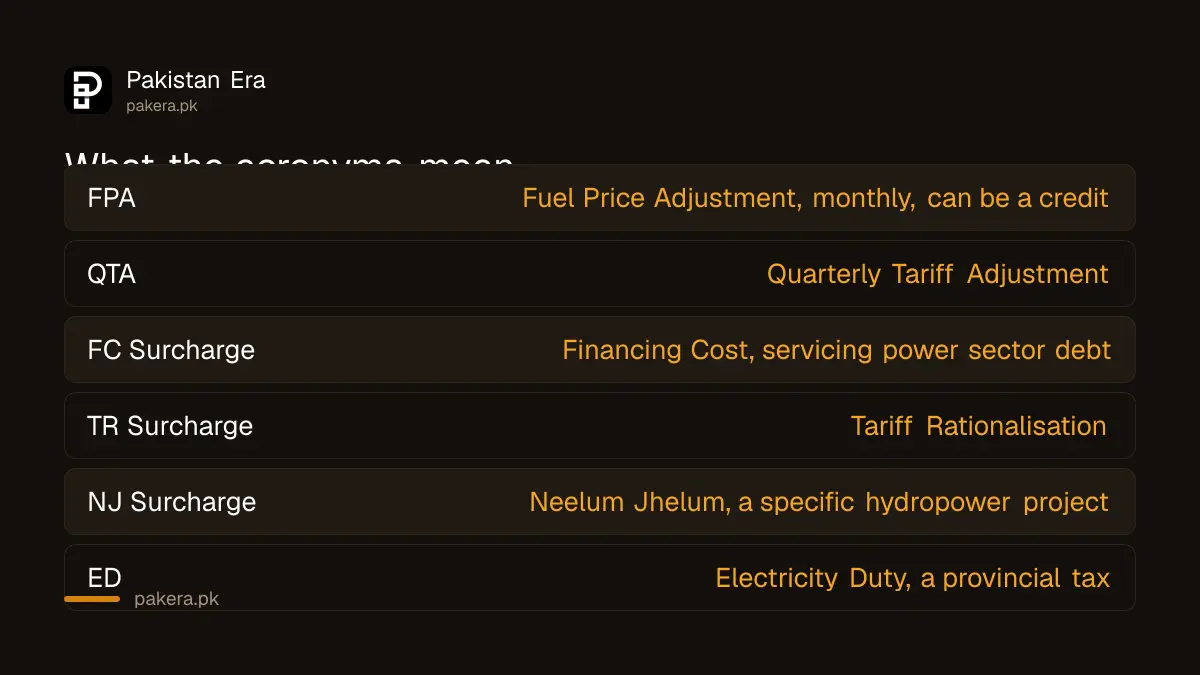
| On the bill | What it is | Who levies it |
|---|---|---|
| Cost of electricity | Units used, at your slab rate | Your distribution company |
| FPA | Fuel Price Adjustment | NEPRA notified, monthly |
| QTA | Quarterly Tariff Adjustment | NEPRA notified, quarterly |
| FC Surcharge | Financing Cost, power sector debt | Federal |
| TR Surcharge | Tariff Rationalisation | Federal |
| NJ Surcharge | Neelum Jhelum hydropower project | Federal |
| ED | Electricity Duty | Your provincial government |
| GST | General Sales Tax | Federal |
| Income tax | Advance tax, not a fee | Federal |
| PTV Fee | Television licence, Rs 35 | Federal; announced as removed from bills in June 2025 |
| LPS | Late Payment Surcharge | Your distribution company |
Three different levels of government appear on one page. That is why the bill is confusing: it is not one organisation's document, it is a collection point.
We are not printing the rates, on purpose
You will find sites quoting exact per unit figures for FPA, QTA and the surcharges. We are not repeating them.
Every source offering those numbers was a bill checking site rather than the regulator, and they contradicted each other while we were reading. One gave GST as 17 per cent, another as 18.
More importantly, these rates are designed to change. FPA moves monthly. QTA moves quarterly. A figure published today is wrong within weeks, and wrong in a way a reader would trust because it came from an article.
What does not change is what each line is for. That is the useful part and that is what this is.
FPA can be a credit, not just a charge
Fuel Price Adjustment is the one people notice, usually because it is large.
It exists because the cost of generating electricity moves with fuel prices, and tariffs are set in advance. FPA reconciles the difference after the fact. When generation cost more than the tariff assumed, you pay the gap. When it cost less, FPA appears as a credit.
That second case does happen and people miss it, because they have learned to read FPA as bad news and stop looking. Check the sign on yours.
You are paying for a named dam
The NJ Surcharge is the most specific line on the bill.
NJ stands for Neelum Jhelum, the hydropower project in Azad Jammu and Kashmir. The surcharge was introduced to help fund it. So every month, a small identifiable slice of your bill goes to one particular piece of infrastructure.
The FC Surcharge is the other one worth understanding. FC is Financing Cost, and it services debt held by the entity that carries the power sector's circular debt. In plain terms, it is you paying the interest on money the electricity sector borrowed.
Neither of these is hidden. They are printed on your bill. They are just written in initials, which comes to the same thing for most readers.
The line that is not a charge
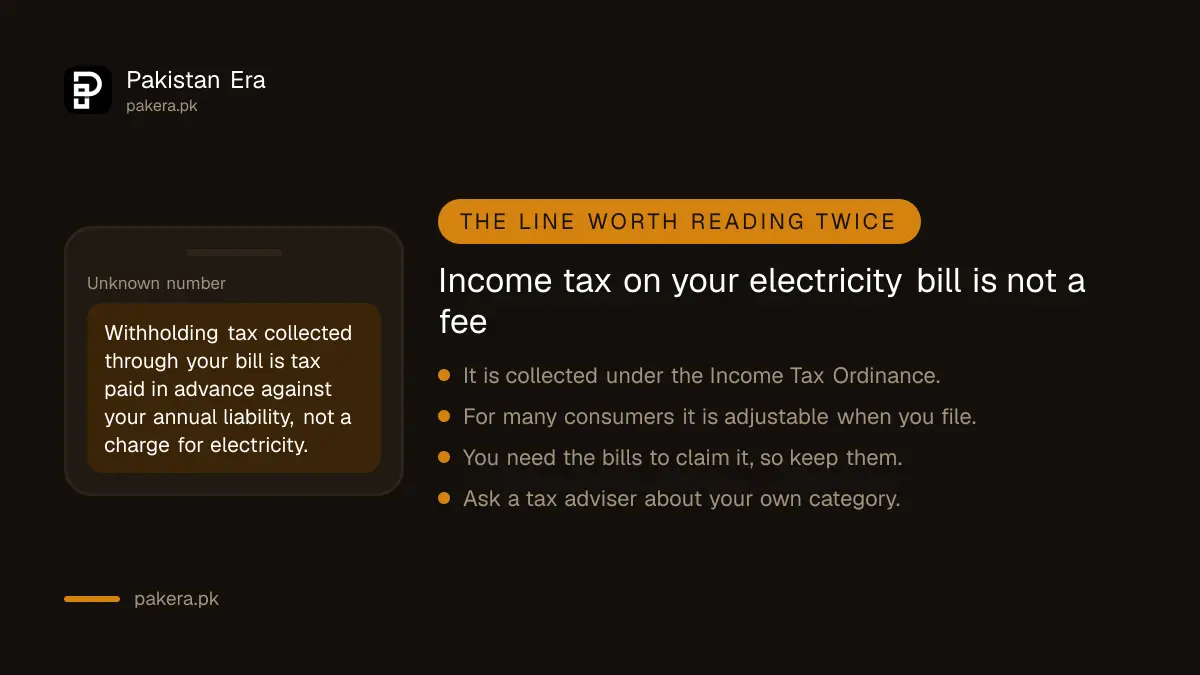
This is the part worth reading twice.
The income tax line on your electricity bill is not payment for electricity, and it is not a government fee in the way GST is. It is tax collected in advance against your annual income tax liability, under the Income Tax Ordinance.
For many consumer categories that amount is adjustable. It counts toward what you owe when you file your return, and where it exceeds your liability it can be claimed.
Most people never do, for a simple reason: they read it as another unavoidable charge, and they throw the bill away.
Two honest caveats. Domestic, commercial and industrial connections are treated differently, and thresholds apply, so we are not telling you that you personally can reclaim it. And you cannot claim what you cannot evidence.
What we would do: keep the bills, and ask specifically about adjustable tax deducted on utilities when you file. Returns are due 30 September, and the process is in our guide to filing your income tax return.
The one charge that is entirely avoidable
Late Payment Surcharge is the only line on the bill that is your decision.
Everything else is a rate, a tax or a policy. LPS is a penalty for paying after the due date, and paying on time removes it completely.
If you routinely pay late because of queues, the online routes are in our guide to paying utility bills online, which removes the usual excuse.
How to read yours tonight
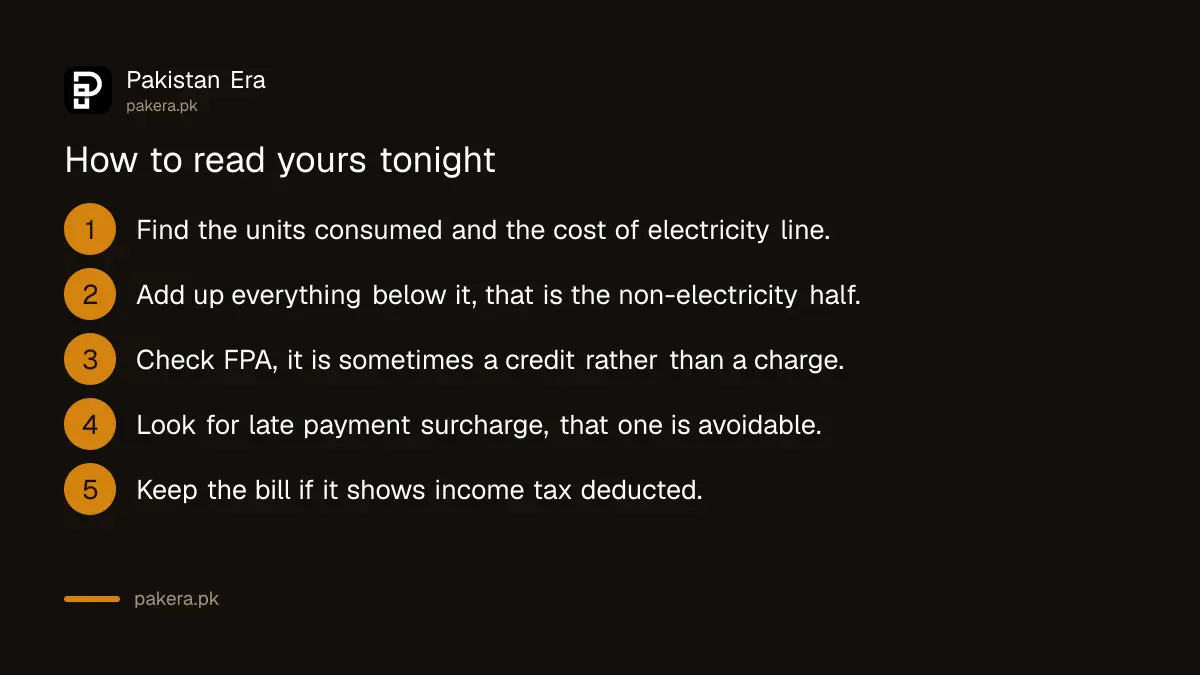
- Find the units and the cost of electricity. That is the actual electricity.
- Total everything below it. That is what you pay to have electricity rather than for electricity.
- Check whether FPA is a charge or a credit this month.
- Look for Late Payment Surcharge. If it is there, that one was avoidable.
- If income tax is shown, file the bill rather than binning it.
If the total looks wrong rather than merely high, that is a different problem, and overbilling has its own remedy set out in what to do about electricity overbilling. If your distribution company will not fix it, the escalation route is in our NEPRA complaint guide.
Why the bill is written this way
It is tempting to assume the initials are deliberate obfuscation. The more likely explanation is duller.
Each line was added at a different time, by a different authority, for a different reason, and nobody has ever redesigned the document as a whole. The bill is an archaeological record of two decades of power sector policy, printed monthly.
That does not make it acceptable. A document sent to tens of millions of households every month could reasonably be expected to say what its charges are in words. But it does explain why nobody can tell you who to complain to about the format.
Questions readers are asking
What does FPA mean on an electricity bill?
Fuel Price Adjustment. It reconciles the difference between the fuel cost assumed in your tariff and what generation actually cost. It can be a charge or a credit, and it is notified monthly.
What is QTA?
Quarterly Tariff Adjustment, a periodic adjustment to recover differences in the cost of supplying electricity. It is revised quarterly.
What is the NJ Surcharge?
Neelum Jhelum Surcharge, associated with funding the Neelum Jhelum hydropower project.
What is the FC Surcharge?
Financing Cost Surcharge, which goes toward servicing debt in the power sector.
Can I get the income tax on my electricity bill back?
It is advance tax against your annual liability rather than a fee, and for many categories it is adjustable when you file. Thresholds and categories differ, so keep the bills and ask about adjustable tax deducted on utilities when filing.
Why is there a PTV fee on my electricity bill?
It was a fixed Rs 35 television licence fee collected through the electricity bill. The government announced in June 2025 that it would stop collecting it this way, reportedly from July 2025, but we could not find the official notice, and at least one company's sample bill still showed it. Our PTV fee page explains how to check your own bill and complain if it is still charged.
Which charge can I avoid?
Late Payment Surcharge. Paying before the due date removes it entirely. Everything else is a rate, tax or policy charge.
About the author

Tax, Bills and Technology Writer
Ali Akhtar is a young and curious voice here at Pakistan Era. He is currently pursuing his A-Levels and has a growing interest in Pakistan’s changing industrial landscape and educational trends. Ali likes to write in a way that helps him explain and explore the world around him. His writing reflects the perspective of the new generation navigating the evolving trends of Pakistan where technology, youth innovation, and shifting opportunities are reshaping the country’s future.