Estimate Your Monthly Electricity Units in Pakistan With K-Electric's Appliance Watt List
Work out your monthly electricity units in Pakistan: watts times hours, with K-Electric's watt list for AC, fans and fridge, plus a sample home worked out.
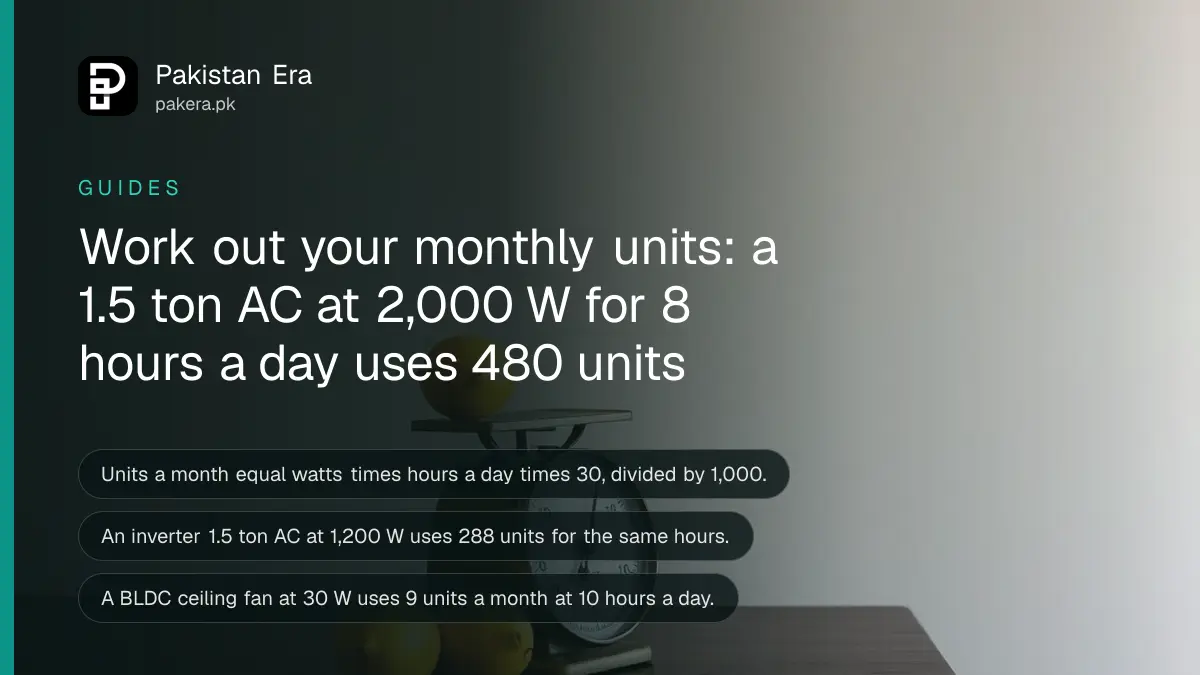
Short answer: Multiply an appliance's watts by the hours you run it each day, then by 30, and divide by 1,000. The answer is units a month. K-Electric's own calculator lists the watts, for example 2,000 W for a 1.5 ton AC and 1,200 W for an inverter AC. Add the appliances to see your total.
Your bill is not a mystery number. It is the sum of a few big appliances running for many hours. Most households can find the culprit in ten minutes with a pen and a phone.
We read K-Electric's Energy Consumption Calculator page on 13 October 2026. It asks you to enter the number of each appliance and the hours you use it daily. It lists the watts for each one. The watt values below are K-Electric's, not our measurements, and your own appliance may differ. The label on the back of the appliance is always better.
Units equal watts times hours, divided by 1,000
A unit on your bill is one kilowatt hour (kWh). That is 1,000 watts used for one hour. A 100 W bulb that stays on for 10 hours uses one unit.
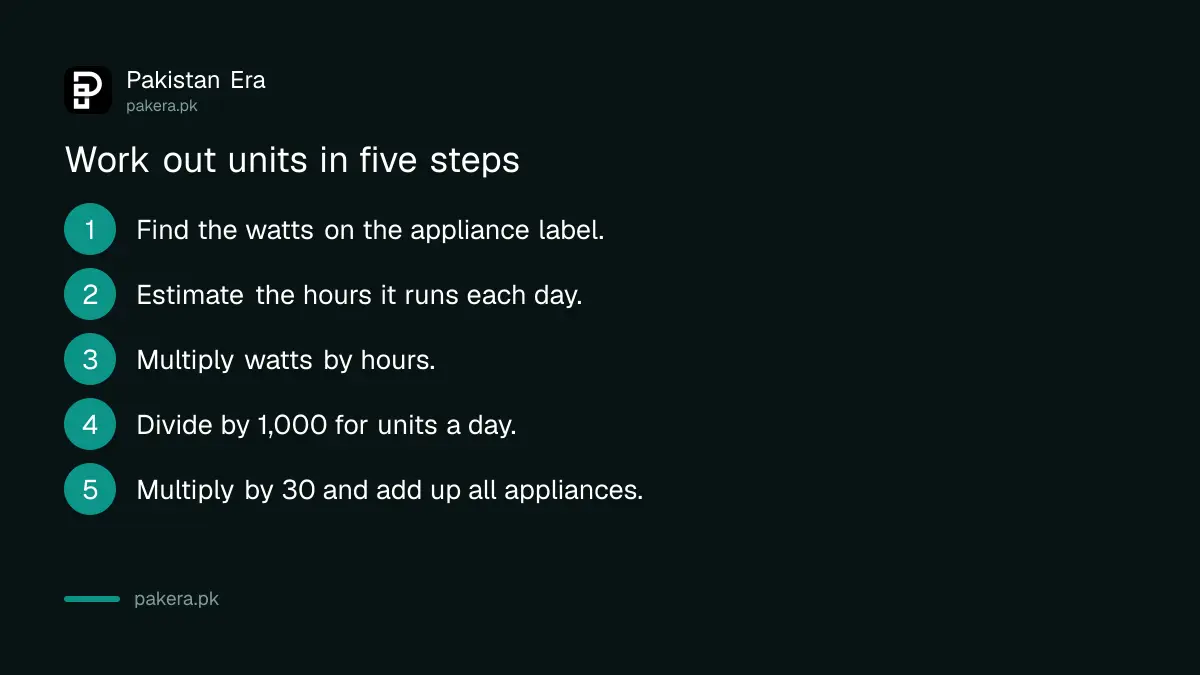
- Find the watts of the appliance on its label, or on the list below.
- Estimate the hours it runs in a day.
- Multiply watts by hours to get watt hours a day.
- Divide by 1,000 to get units a day.
- Multiply by 30 for a month, and add up all your appliances.
Example: a 1.5 ton AC at 2,000 W running 8 hours a day is 2,000 times 8, which is 16,000. Divide by 1,000 and you get 16 units a day, or 480 units in a 30 day month.
K-Electric's list gives the watts, and an efficient version of each
K-Electric pairs many ordinary appliances with an efficient one. The gap is the saving. For the 1 ton air conditioner, its page says an inverter model saves 40% of the power. The figures below are from its list.
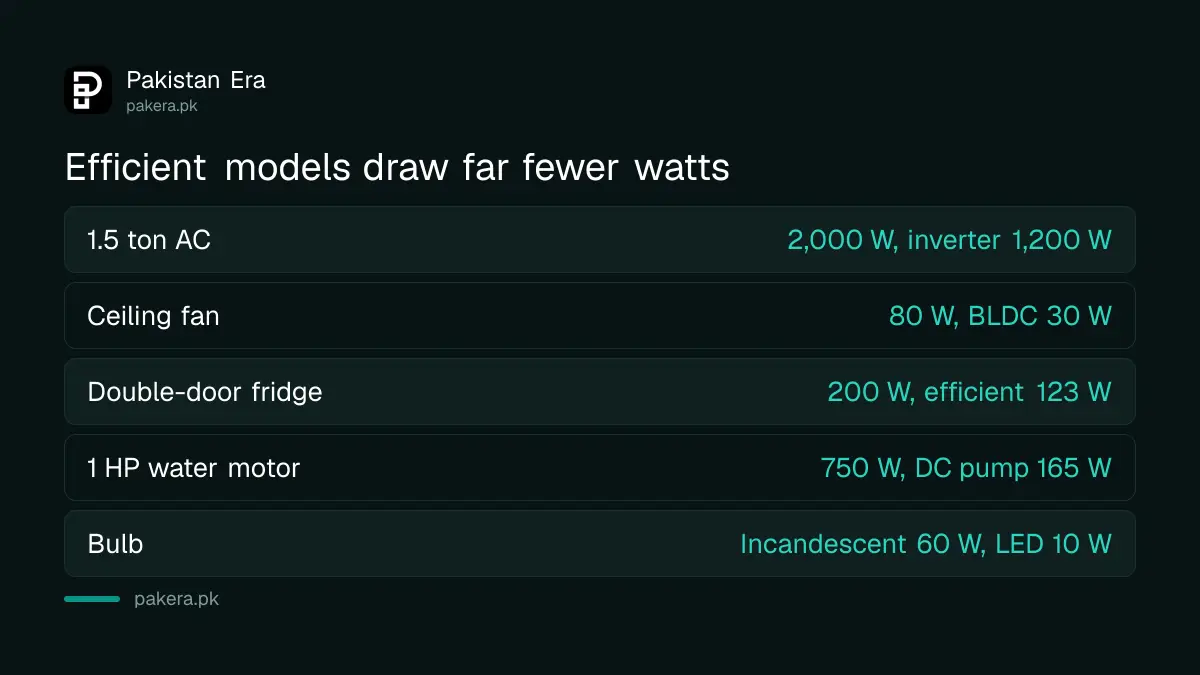
| Appliance | Ordinary (watts) | Efficient (watts) |
|---|---|---|
| 1 ton air conditioner | 1,500 | 900 inverter |
| 1.5 ton air conditioner | 2,000 | 1,200 inverter |
| 2 ton air conditioner | 2,500 | 1,500 inverter |
| Ceiling fan | 80 | 30 BLDC |
| Double-door refrigerator | 200 | 123 energy efficient |
| 1 HP water motor | 750 | 165 with DC motor |
| Incandescent bulb | 60 | 10 LED |
Other values on the list are an electric iron at 1,020 W, an electric geyser at 2,000 W, a heater at 1,500 W, a washing machine at 900 W, an electric kettle at 1,500 W and a desktop PC with accessories at 250 W.
One summer month in a sample home
Here is a sample home in a 30 day month, using K-Electric's watts. The hours are our assumptions, so change them to match your house. The total is an estimate, not a bill.
| Appliance | Watts | Hours a day | Units a month |
|---|---|---|---|
| 1.5 ton AC | 2,000 | 8 | 480 |
| 4 ceiling fans | 80 each | 10 | 96 |
| Double-door refrigerator | 200 | 24 | 144 |
| Water motor, 1 HP | 750 | 1 | 22.5 |
| Electric iron | 1,020 | 1 | 30.6 |
| LCD TV, 40 inch | 100 | 5 | 15 |
| Washing machine | 900 | 0.5 | 13.5 |
| 6 LED bulbs | 10 each | 6 | 10.8 |
| Total | 812.4 |
One caution. A fridge compressor switches on and off, so running it at full watts for 24 hours overstates the use. Treat the fridge line as an upper limit.
The AC decides which slab you land in
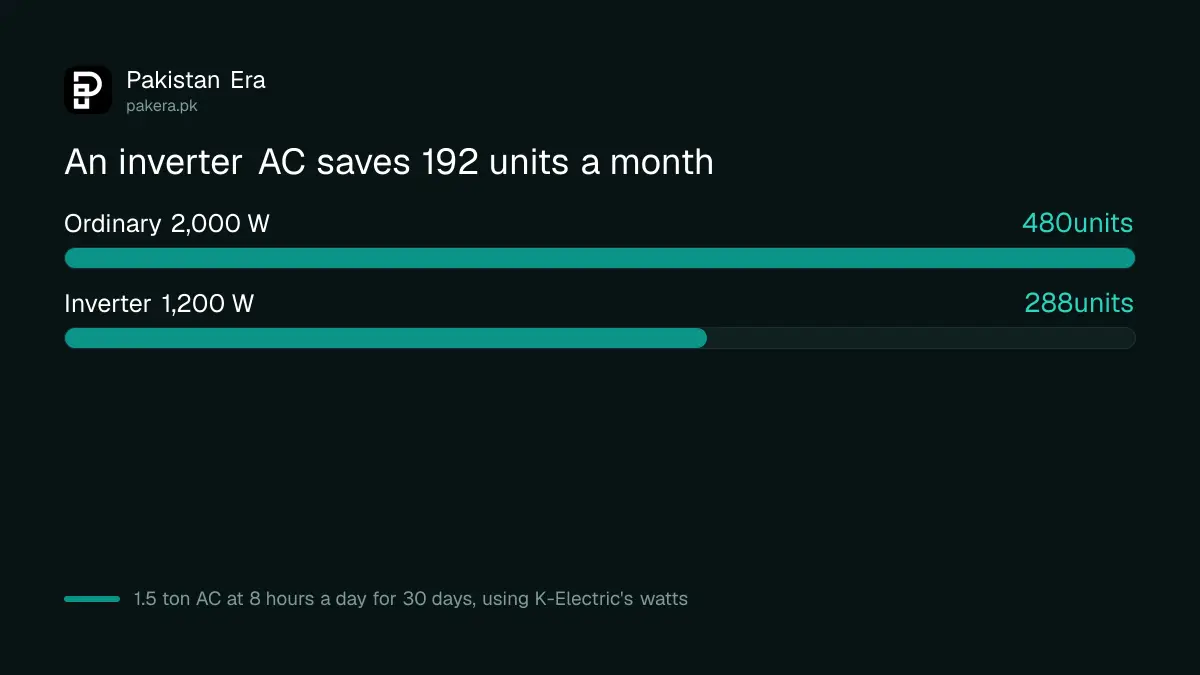
In the sample home the AC is 480 of 812 units. Swap it for a 1,200 W inverter model and the AC drops to 288 units. The home falls from about 812 to about 620 units a month.
That matters because the price per unit climbs with each slab. The rates are in the table of home electricity slab rates for 2026. A home that stays under 200 units for six months can become a protected consumer, which is a much cheaper tariff.
Cut the biggest items first
Do not start with the bulbs. Start with the AC, the geyser, the iron and the water motor. In the table above, they are the four largest lines per hour of use.
Fans are the easy second step. A BLDC ceiling fan at 30 W uses 9 units a month at 10 hours a day. An ordinary 80 W fan uses 24. The PM fan replacement programme lets you get 5 star fans and pay through your electricity bill. When you buy a new AC or fridge, read the energy label first, as shown in the guide to the Energy Star label on AC and fridge.
Common questions
Where is the wattage printed on an appliance?
It is on the rating plate or sticker, usually on the back or the base. It shows watts (W) or kilowatts (kW). Use that number in place of the list.
Why does my estimate differ from the bill?
Rated watts are a maximum. Real use depends on load, temperature and age. Your bill also adds taxes, fixed charges and fuel adjustments. Our estimate covers only the energy units.
How many units does a 1.5 ton AC use in a month?
At 2,000 W and 8 hours a day it is about 480 units in 30 days. An inverter model at 1,200 W is about 288 units.
Does the calculator work for any electricity company?
The watts are the same for any company, because they describe the appliance. The slab rates are the same across companies under the uniform tariff, but check your own bill.
How can I find which appliance uses the most?
Use the sum above, then check against your meter. Switch everything off, note the reading, run one appliance for an hour and read the meter again.
How we verified this
What we checked, where we read it, and what we could not confirm.
Last checked on 13 October 2026, Pakistan time. We read the appliance and watt list on K-Electric's Energy Consumption Calculator page. We did not run the calculator's own sums, and the hours in the sample home are our assumptions. The unit prices are in the linked slab table, not on this page.
About the author

Senior Writer, Public Services and Technology
Shahid joined us in 2024 as an author. He is a senior contributor to Pakistan's leading technology websites. He writes detailed articles, mostly covering his expertise in the latest tech, mobiles, apps, gadgets, and step-by-step guides. His ideology is to help people understand the latest trends and explain complex methods through very easy-to-understand guides.