Check Your Transformer Before Solar Net Metering in Pakistan: PITC's Free Overloading Check and the 80% Rule
Check your transformer before buying solar in Pakistan: PITC's free overloading check shows if net metering fits under the 80% rule. Use your reference number.
Before you buy solar panels for net metering in Pakistan, check your transformer on PITC's net billing portal: open nmp.pitc.com.pk, click "Check Transformer Overloading", enter your 14 digit reference number, and type the system size you plan. The DISCO cannot accept your application if solar on that transformer, with yours added, would pass 80% of its rating. The check is free and takes about two minutes.
This is the rule that catches people after they have paid an installer. Your sanctioned load can be large enough, your installer can be certified, and the application can still stop because the neighbours got there first. The NEPRA (Prosumer) Regulations, 2026 say the DISCO "shall not entertain" an application once distributed generation on the transformer reaches 80% of its rated capacity.
What the 80% transformer rule means for your solar system
Every house is fed by a distribution transformer, usually on a pole in the street. All the solar systems connected to it count towards one limit: 80% of the transformer's rating. When that limit is reached, no new net metering application on that transformer can go ahead.
The rule sits in the proviso to regulation 3(5) of the NEPRA (Prosumer) Regulations, 2026, S.R.O. 251(I)/2026. PITC's portal applies it automatically. The form's instruction line reads that net metering capacity "may not be exceeded 80% of concerned T/F including this connection". T/F is short for transformer.
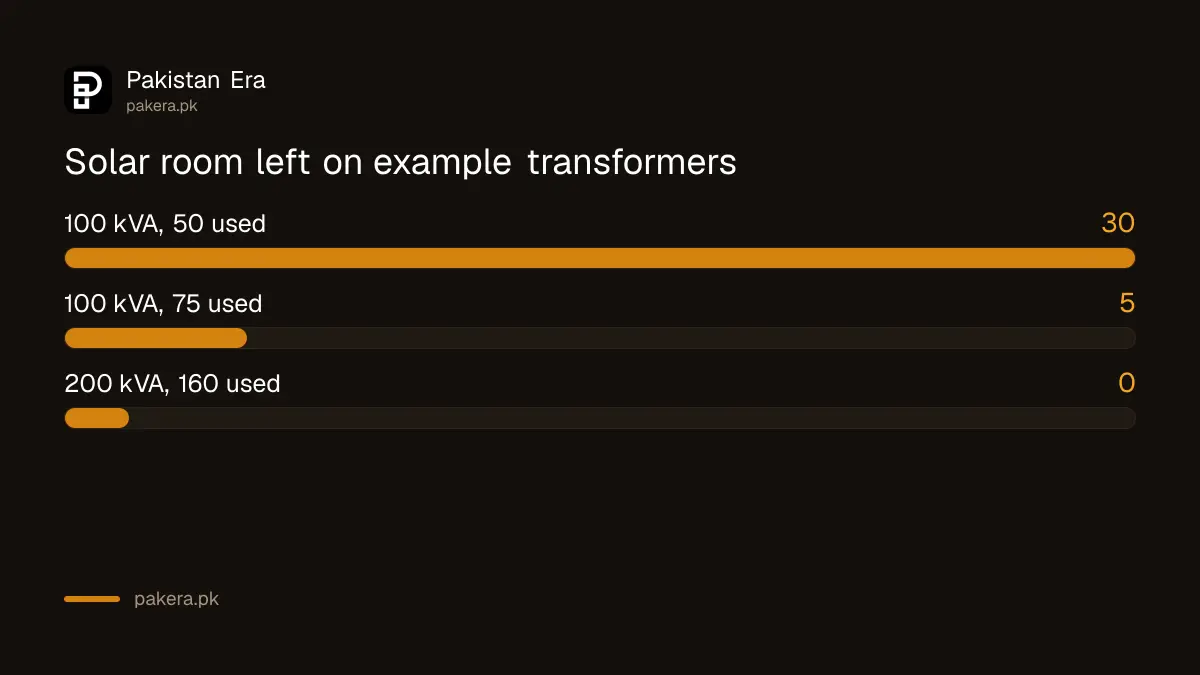
| Example transformer | 80% limit | Solar already on it | Room left |
|---|---|---|---|
| 100 kVA | 80 | 50 | 30 |
| 100 kVA | 80 | 75 | 5 |
| 200 kVA | 160 | 160 | 0, no new applications |
The examples are simple sums to show how the room shrinks. Your real numbers come from the portal, which reads the transformer rating and the solar already connected from the DISCO's records.
How to check transformer overloading on the PITC portal in 6 steps
You need your electricity bill and the size of the system you want. The portal finds your transformer from the reference number, then tells you whether your planned system fits. Do it before you sign with an installer.
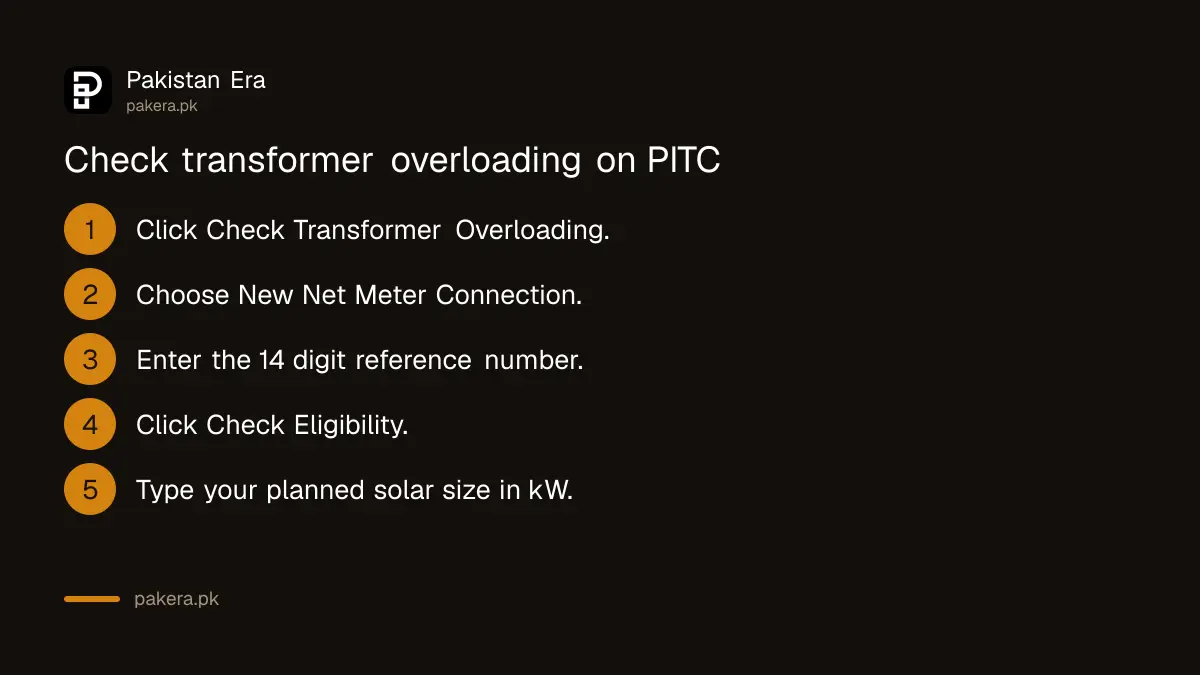
- Open nmp.pitc.com.pk and click the red Check Transformer Overloading button.
- Choose New Net Meter Connection for an existing connection, or Connection Applied in ENC if your new connection is still being processed.
- Pick Reference No and type the 14 digits from your bill, or pick Consumer ID and type the 10 digits.
- Click Check Eligibility for net metering. The portal reads your sanctioned load and transformer details.
- Type the solar size you plan in DG Installed Capacity (kW). DG means distributed generation.
- Click Proceed and read the result. If the system is too big for the transformer or your load, the portal says so on screen.
The check works for LESCO, GEPCO, FESCO, IESCO, MEPCO, PESCO, HAZECO, SEPCO, HESCO, QESCO and TESCO customers. K-Electric customers in Karachi follow K-Electric's own net billing process.
Three limits your system must pass at the same time
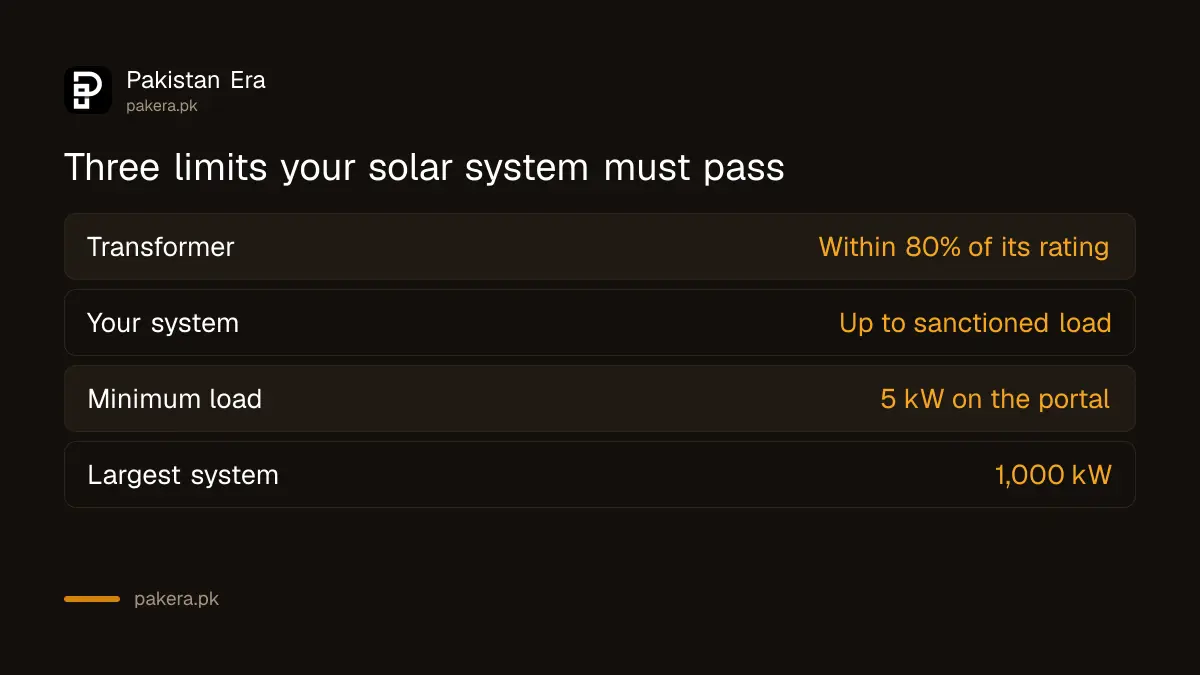
The transformer limit is one of three. Your system must also be no bigger than your sanctioned load, and your sanctioned load must be at least 5 kW on the portal form. Fail any one and the application cannot move forward.
| Limit | Rule | Where it comes from |
|---|---|---|
| Transformer | All solar on it within 80% of its rating | Regulation 3(5), Prosumer Regulations 2026 |
| Your load | System no bigger than the sanctioned load | Regulation 3(2) |
| Minimum load | Sanctioned load of 5 kW or more | PITC net billing form |
| Largest system | 1,000 kW (1 MW) | Regulation 2(1)(ix) |
Raising your sanctioned load does not help if the transformer is full. It is the transformer, not your meter, that sets this ceiling. The other rules are explained in the net metering rules for 2026.
What to do if your transformer has no room left
You have three practical choices: fit a smaller system that fits the room left, run solar without exporting, or ask your SDO in writing whether the transformer will be replaced or the area split. Do not let an installer file an application the portal has already refused.
- Smaller system: if the portal shows some room, size the system to it. A 5 kW system that is approved earns more than a 10 kW one that is stuck.
- Self-use solar: panels with a battery or a zero-export setting cover your own daytime use without net metering. The trade-offs are set out in solar battery storage in Pakistan.
- Write to the SDO: ask whether a bigger transformer or a new one is planned for your street, and keep the reply. Plans change, and a new transformer resets the room.
- Dispute a wrong reading: if you believe the transformer data is wrong, put it to the DISCO in writing first. Regulation 17 sends disputes between you and the DISCO to NEPRA.
Some DISCOs also publish feeder-wise solar capacity
HESCO and QESCO publish feeder-wise sheets showing solar capacity available for net metering on each 11 kV feeder. A feeder serves many transformers, so these sheets are a wider view. The transformer check on the portal is the one that decides your case.
Use the feeder sheets for a first idea of how crowded your area is. A feeder with almost no capacity left is a warning that the transformers on it may be close to their limit as well. Then run the portal check for your own reference number.
Common questions
What is the 80% transformer rule for net metering?
Under the NEPRA (Prosumer) Regulations, 2026, a DISCO cannot accept a new net metering application once solar on the transformer reaches 80% of its rated capacity, including the new system.
Where can I check my transformer capacity?
On PITC's net billing portal, nmp.pitc.com.pk, with the "Check Transformer Overloading" button and your 14 digit reference number.
Does the check cost anything?
No. It is free and needs no login.
Will raising my sanctioned load fix a full transformer?
No. The sanctioned load limits your own system. The transformer limit applies to everyone on that transformer together.
Does the rule apply to K-Electric?
The Prosumer Regulations apply to K-Electric too, but K-Electric customers apply through K-Electric's own net billing system, not the PITC portal.
Can the DISCO refuse me if the transformer has room?
Only for a reason the rules allow, such as the system being larger than your sanctioned load or not technically feasible. Approval must not be unreasonably withheld.
How we verified this
What we checked and where we read it.
Checked on 15 November 2026 on PITC's Net Billing Portal: the "Check Transformer Overloading" form and its instruction line, the consumer application form, and the installer guidelines, which state the 80% and sanctioned load limits. The regulation numbers come from the NEPRA (Prosumer) Regulations, 2026, S.R.O. 251(I)/2026, on nepra.org.pk. The feeder-wise sheets are on the HESCO and QESCO net metering pages. The table of examples is our own arithmetic.
About the author

Tax, Bills and Technology Writer
Ali Akhtar is a young and curious voice here at Pakistan Era. He is currently pursuing his A-Levels and has a growing interest in Pakistan’s changing industrial landscape and educational trends. Ali likes to write in a way that helps him explain and explore the world around him. His writing reflects the perspective of the new generation navigating the evolving trends of Pakistan where technology, youth innovation, and shifting opportunities are reshaping the country’s future.