How to Check a Punjab e-Stamp Paper Is Genuine Before You Sign
Check a Punjab e-stamp paper before you sign: how Challan 32-A works, who can verify it in the database, the 3 percent duty on the official page and red flags.
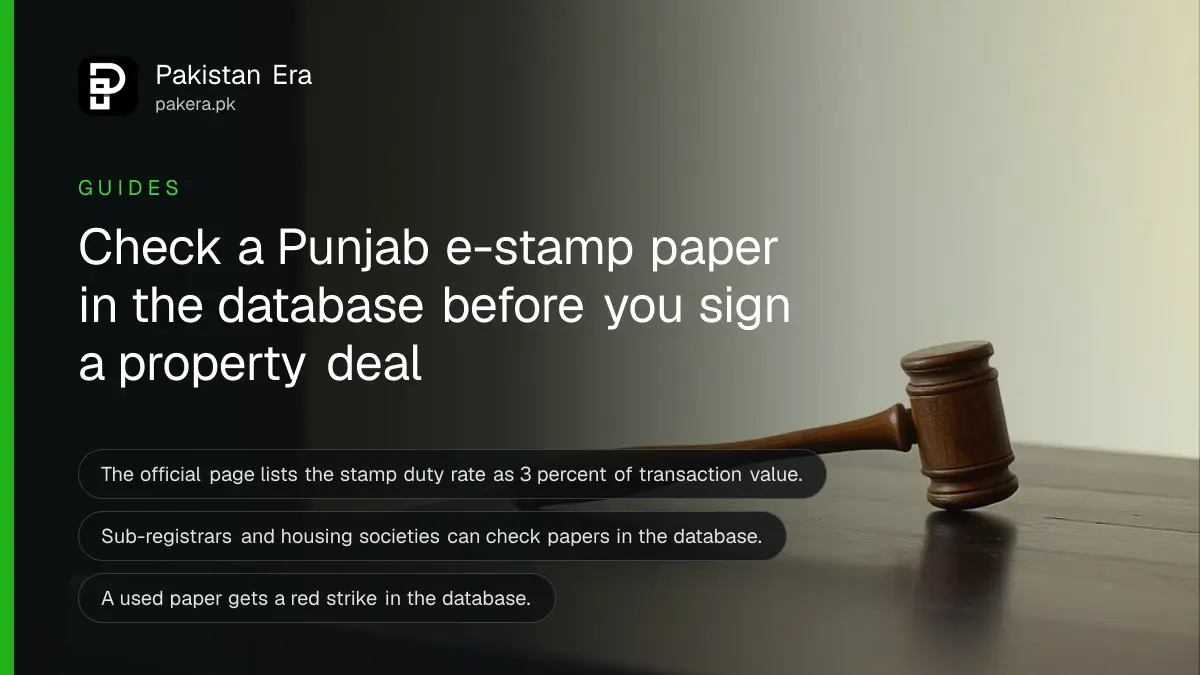
Short answer: A genuine Punjab e-stamp paper comes from the e-stamping system after a Challan Form 32-A is paid at a bank. The system keeps a record, and the Punjab government says sub-registrars, housing societies and other authorities can check it in the database. Ask the receiving office to verify it before you sign.
Fake stamp paper has cost Punjab families their plots and their savings. The e-stamping system was built to stop this. Every paper is created online, tied to a verified CNIC and recorded in a central database. A paper that is not in that database is not a safe paper.
We read the e-Stamping page of the Punjab Information Technology Board (PITB) and the Punjab Government on 13 October 2026. The e-stamping website itself did not load for us, so we could not test the portal. We say below what the official page confirms and what it does not.
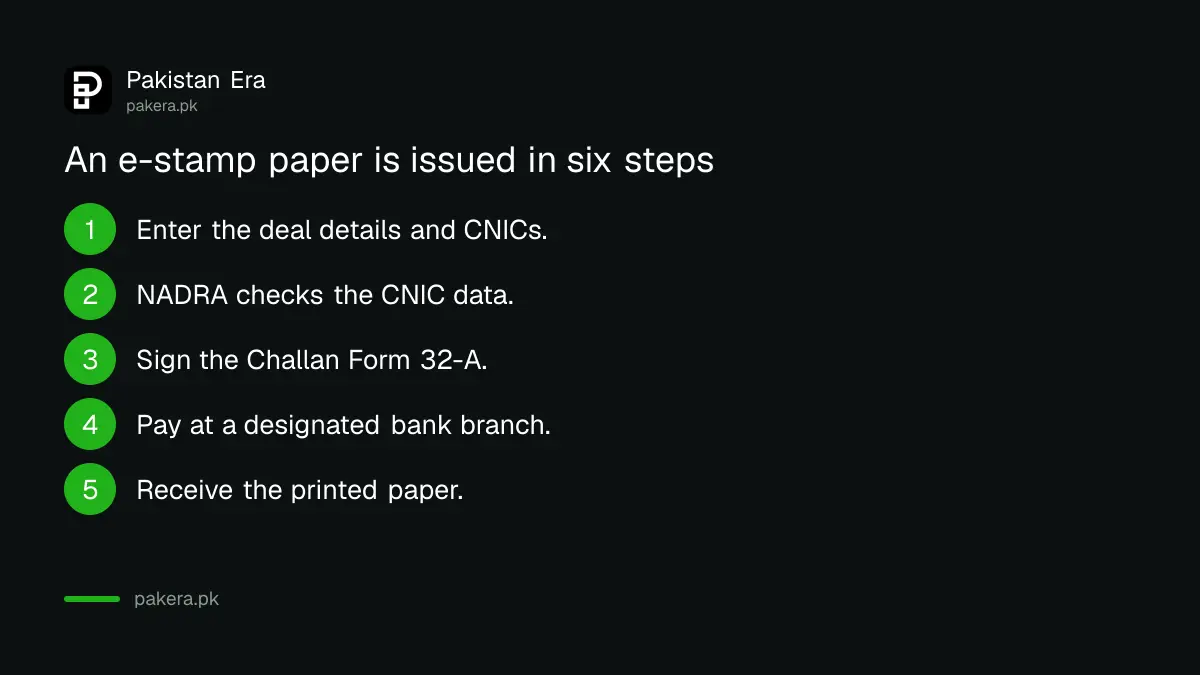
An e-stamp paper starts with a Challan Form 32-A
The official page says the buyer enters the details of the deal, and the system works out the stamp duty from the area, location, covered area, type of property and the DC valuation tables. The buyer's details are checked with NADRA. Then a Challan Form 32-A is made.
The citizen signs the challan and pays at a designated bank branch. The page names the National Bank, the Bank of Punjab and other scheduled banks, and the sub-registrar office counters. After payment, the stamp paper is printed on legal-size paper.
- Enter the details of the deal, the names and CNIC numbers of the parties.
- The system checks the CNIC data with NADRA.
- The system makes the Challan Form 32-A and you sign it.
- Pay at a designated bank branch or sub-registrar counter.
- Receive the printed stamp paper.
- Give it to the sub-registrar, housing society or other authority.
The database is the proof, not the paper
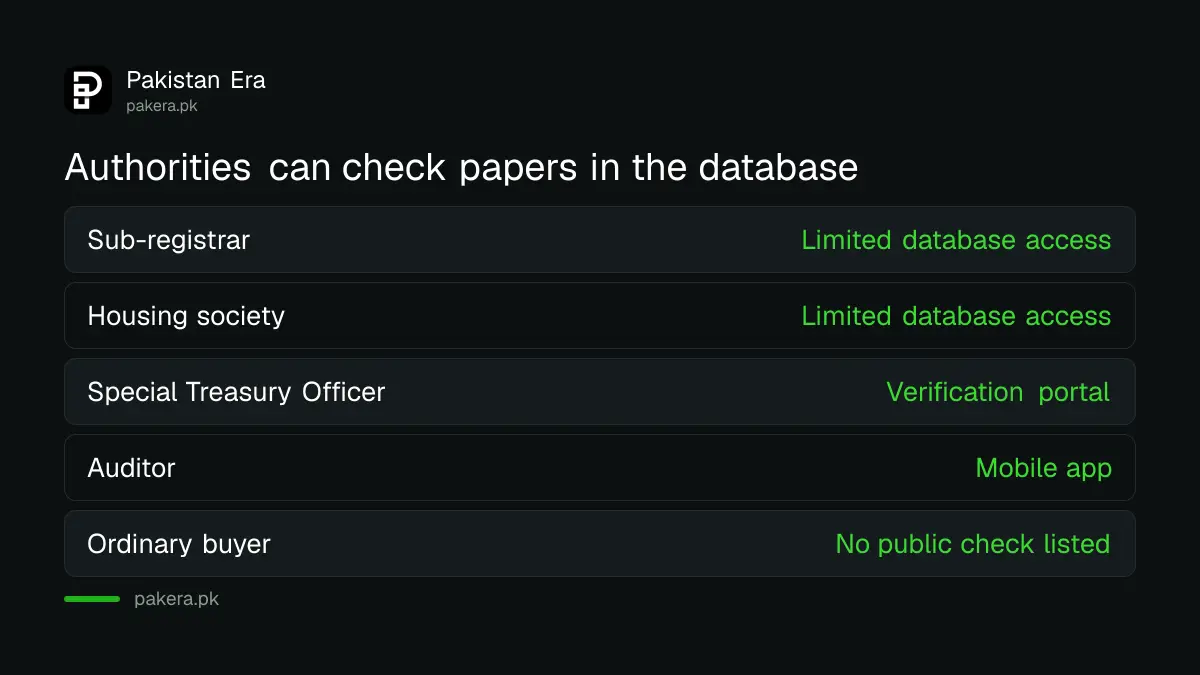
The official page says authorities such as sub-registrars and housing societies get limited access to the e-stamping database, and can verify a stamp paper there. After a paper is used, the database marks a red strike against it, which stops reuse.
This means a printed paper alone proves little. A good copy can be printed anywhere. The record in the database is what counts.
| Who | Can check the database |
|---|---|
| Sub-registrar | Yes, limited access, per the official page |
| Housing society and similar authorities | Yes, limited access, per the official page |
| Special Treasury Officers | Yes, through a verification portal |
| Auditors | Yes, through a mobile app, per the official page |
| An ordinary buyer | The page does not list a public check |
Ask the receiving office to verify before you sign
Because an ordinary buyer has no public check listed, use the office that will receive the paper. Ask the sub-registrar or the society to confirm the paper in the database. If they cannot confirm it, do not sign.
Ask for the Challan Form 32-A and the bank receipt as well. The challan should carry the same names and CNIC numbers as your deal. If any name or amount is different, stop and ask the issuing counter to explain.
Match the amount to the deal
The official page gives the stamp duty rate as 3 percent of the total value of the transaction. It also says the same challan collects Capital Value Tax, registration fees and mutation fees. Rates change each budget, so check the figures on your own challan.
Work out the total from the deal value before you pay. A paper for a much smaller amount than the real price is a warning sign. For the other Punjab land fees, see our page on Punjab land record fees.
Warning signs of a fake paper
Watch for a paper that was not made from a challan, a paper sold outside a bank or sub-registrar counter, and a paper that the office cannot find in the system. Another sign is a seller who rushes you to sign before verification.
Do not accept a handwritten or old-style stamp paper for a property deal when the office asks for an e-stamp. If you are unsure, report it to the police, and later you can check the FIR online.
Other Punjab and national routes
For the general steps, see how to issue an e-stamp paper in Pakistan. For Sindh, the system is different, see how to verify a Sindh e-stamp paper. For a rented home, read about rent agreements and stamp paper.
If the whole deal is a plot in a housing society, the page on transferring a plot through PLRA shows the next step.
Common questions
Where is the Punjab e-stamping portal?
The official page gives es.punjab.gov.pk as the public portal. It did not load for us on 13 October 2026, so we could not test it.
Can I check an e-stamp paper myself?
The official page lists verification for authorities and officers. It does not list a public check, so ask the receiving office to verify.
What is a Challan Form 32-A?
It is the payment form the system makes for the buyer to sign and pay. It collects stamp duty and other fees in one challan.
Where do I pay for e-stamp paper?
The official page names designated branches of the National Bank, the Bank of Punjab and other scheduled banks, and the sub-registrar counters.
What is the stamp duty rate?
The official page gives 3 percent of the transaction value. Rates change, so check the rate on your own challan.
How do I contact the e-stamping team?
The official page lists the email info.es@punjab.gov.pk. It does not list a phone number.
How we verified this
What we checked, where we read it, and what we could not confirm.
Last checked on 13 October 2026, Pakistan time. We read the Punjab e-Stamping page and the PITB e-Stamping page. The e-stamping portal itself did not load for us, so portal screens, fees per document type and the exact printed features of a paper are not verified. We did not buy a test paper.
About the author

Tax, Bills and Technology Writer
Ali Akhtar is a young and curious voice here at Pakistan Era. He is currently pursuing his A-Levels and has a growing interest in Pakistan’s changing industrial landscape and educational trends. Ali likes to write in a way that helps him explain and explore the world around him. His writing reflects the perspective of the new generation navigating the evolving trends of Pakistan where technology, youth innovation, and shifting opportunities are reshaping the country’s future.