How to Transfer a Plot in a Punjab Housing Society Through PLRA's Property Transfer System
How a housing society plot transfer runs in PLRA's Property Transfer System in Punjab: documents, four tax and fee checks, biometrics and the final letter.
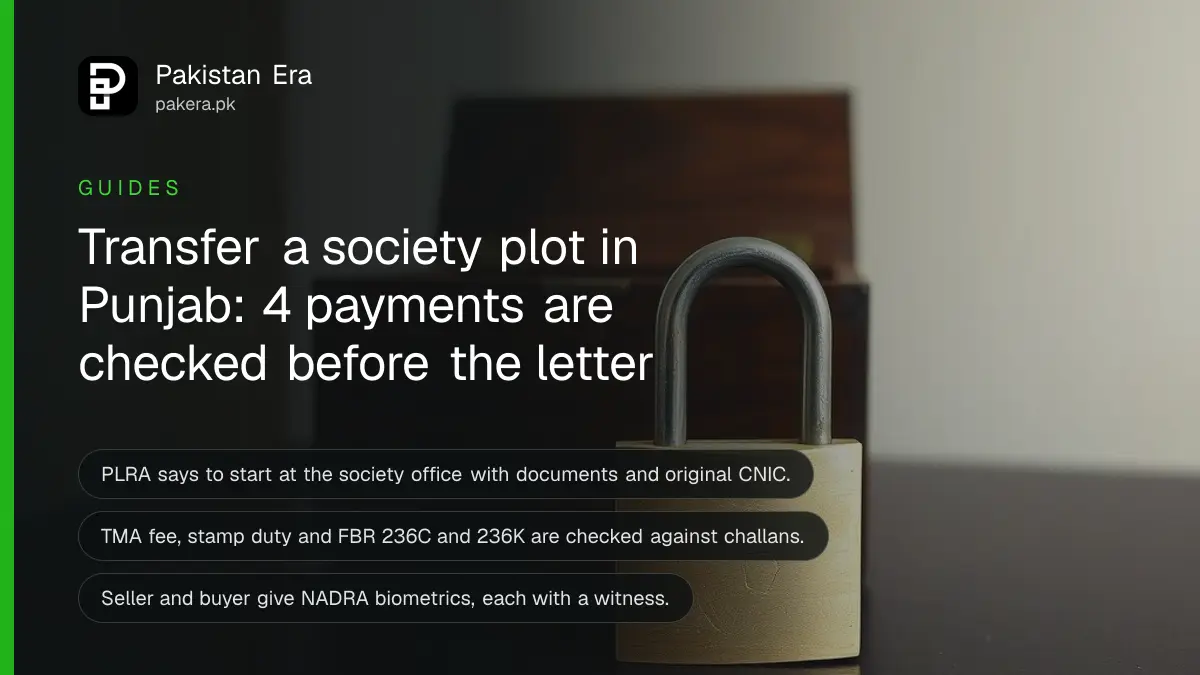
Short answer: To transfer a plot in a Punjab housing society, the buyer and seller go to the society office with the property papers and original CNICs. The society staff run the deal in PLRA's Property Transfer System. You pay PLRA dues and government taxes by challan, then give biometrics.
A plot file changes hands in a society office every day, and most buyers have never seen what happens on the screen behind the counter. That matters, because each step on that screen is a point where a fee, a tax or a document can go missing.
We opened the Punjab Land Records Authority (PLRA) page for the Property Transfer System (PTS), its frequently asked questions and its user manual. The manual is version 1.0 and is dated 5 August 2026. We did not run a transfer ourselves, because the system is used by society staff with their own logins.
PTS is PLRA's central system for society plot transfers
The Property Transfer System is a central digital system that holds owner records, plot details and transfer requests for housing societies. PLRA says citizens start a transfer by visiting their society office with the property documents and the original CNIC.
Before PTS, each society kept its own file and its own register. Now the transfer record sits in one PLRA system, with the seller, buyer, fees and photographs attached to it. The manual was written by PULSE, the Punjab Urban Land System Enhancement project, for PLRA.
Check first that your society is on the approved list. We explain how in checking whether a housing society is approved in Punjab.
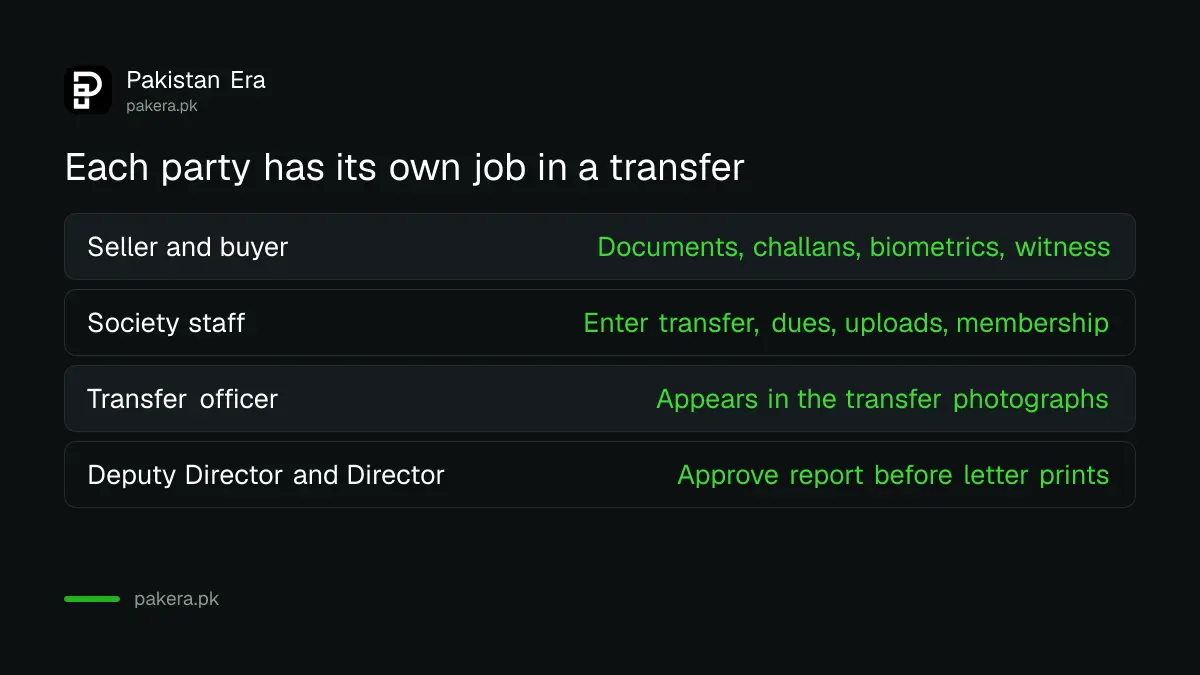
| Who | What they do in PTS |
|---|---|
| Seller and buyer | Bring documents and original CNIC, pay challans, give biometrics, name a witness |
| Society staff | Enter the transfer, generate dues, upload documents, assign membership number |
| Transfer officer | Appears in the transfer photographs with the parties and witness |
| Deputy Director and Director | Approve the transfer report before the transfer letter is printed |
The transfer runs in a fixed order of steps
The manual shows one order: pick seller and buyer, set the transfer type and date, pay PLRA dues, record government dues, upload documents, assign a membership number, add photographs, verify biometrics, then print the transfer letter once it is approved.
- The staff select the plot and the seller. The area being sold must be entered, and it is mandatory.
- The buyer is chosen from the member list or added as a new member. The buyer's area must match the seller's area exactly.
- The staff choose the transfer type and set the transfer date.
- The system creates a PLRA dues voucher. The amount depends on the transfer type. A PSID, the payment code for the challan, then appears.
- You pay the challan. After payment, the screens for government dues and transfer documents open.
- The staff record the government dues and upload the documents.
- A membership number is assigned, and a power of attorney or guardian is added if needed.
- Photographs and biometric checks are taken, and the application moves to Ready for Print.
PLRA does not publish one fixed fee for every case on these pages, so ask the society for the exact challan before you pay.
Four government payments are checked against challans
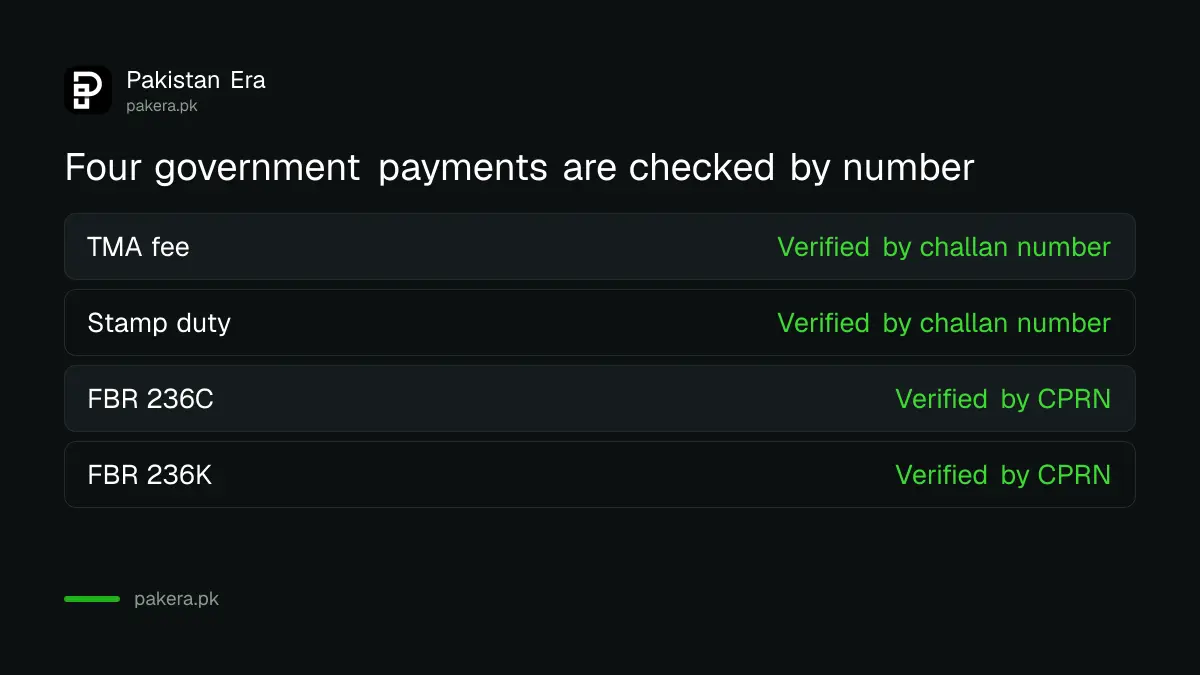
The manual names four payments that the system verifies: the TMA fee, stamp duty, and FBR advance tax under sections 236C and 236K. The first two are matched by challan number. The two FBR taxes are matched by a CPRN, the payment slip number FBR issues.
TMA is the Tehsil Municipal Administration, the local government office that charges its own fee on a transfer. Stamp duty is a provincial charge. The FBR taxes are federal. Keep all four paid challans together, because the staff cannot move on without the numbers.
The manual does not print the rates, and we do not state any here. Rates change each budget. Work out your own figure from the official valuation, as explained in checking the DC valuation of a property, and from the current FBR rules in property taxes when you sell in Pakistan.
Documents, witnesses and biometrics decide the finish
The manual says the uploaded documents are mainly the NOC and the sub-engineer report. Both seller and buyer are verified with NADRA fingerprints, each with a witness. A power of attorney holder or guardian can stand in, and a biometric exemption needs administrator approval.
A guardian is asked for only when the seller or buyer is under 18. A power of attorney is entered with its type: GPA (general), SPA (special), guardian or representative. If a verified power of attorney is on file, the manual says no seller biometric is needed, and the attorney holder's name is used.
Photographs are taken of the seller with the witness and transfer officer, of seller and buyer together, and of the buyer with the witness and officer. The camera permission prompt on the screen is part of this step.
The PLRA pages differ slightly on where you give biometrics. The PTS page says to visit the society office. The FAQ says both parties visit the Arazi Record Center for biometric verification. Ask your society which one applies to you before you travel.
The transfer is complete when the letter is approved and printed
When every step is done, the application shows Ready for Print. The transfer report must be approved by a Deputy Director and a Director before the transfer letter is printed. Collect the letter and keep the paid challans with it as proof.
The FAQ says you collect the transfer report or ownership document from the Arazi Record Center where you gave biometrics, or it may be available through the online portal, depending on the service type. A society transfer letter is not the same as a registered deed. For the registry itself, see how to register property online in Punjab.
Before paying a seller, read how to verify a property registry before buying. A transfer letter is only as good as the plot file behind it.
Common questions
Can I start a society plot transfer online by myself?
No. PLRA says to visit the society office with documents and your original CNIC, and the society staff enter the transfer in PTS. Its FAQ also says you can apply through the PLRA website or an Arazi Record Center.
Do both buyer and seller need to be present?
Yes, for biometrics, unless an exemption or a verified power of attorney applies. PLRA's FAQ says biometric verification is mandatory and both parties must attend in person.
What documents are needed?
PLRA lists full details of buyer and seller with CNIC numbers, and property details such as the khewat, khasra or registry. The manual adds the NOC and the sub-engineer report as the main uploads.
How long does a transfer take?
PLRA gives no fixed time. Its FAQ says it depends on document checks and on finishing every step, including fees and biometrics.
Can a minor buy or sell a plot?
The manual asks for a guardian when the seller or buyer is under 18. The guardian's CNIC and biometrics are recorded.
Who do I call if the society delays the transfer?
PLRA lists a complaints line at (042) 111-22-22-77, open Monday to Saturday, 8:00 AM to 5:00 PM.
How we verified this
What we checked, where we read it, and what we could not confirm.
We read the PLRA Property Transfer System page, its FAQ and its home page on 11 October 2026. We also read the PTS User Manual PDF on the same site, version 1.0 dated 5 August 2026. The manual lists a second version as in progress, so screens may change.
About the author

Senior Writer, Public Services and Technology
Shahid joined us in 2024 as an author. He is a senior contributor to Pakistan's leading technology websites. He writes detailed articles, mostly covering his expertise in the latest tech, mobiles, apps, gadgets, and step-by-step guides. His ideology is to help people understand the latest trends and explain complex methods through very easy-to-understand guides.