How to Check the DC Valuation of Property in Pakistan
Check the official DC valuation of any Punjab property free on punjab-zameen.gov.pk, and Karachi rates on Sindh Zameen. See each step and rule.
In Punjab, check the DC valuation of any property free on the Board of Revenue's e-Stamping portal. Open punjab-zameen.gov.pk, choose Calculate DC Valuation, and pick the district, tehsil, town and plot details. In Karachi, use the Sindh Zameen calculator at sindhzameen.gos.pk. No documents are needed.
DC valuation is the property value officially notified by the District Collector, usually the Deputy Commissioner. The Punjab Land Records Authority (PLRA) describes it as "the basis for calculating stamp duty, registration fees, and other government charges". There is no single national rate. Each district sets its own, so the only safe source is the official table for your district.
Where to find the official DC rate, by province
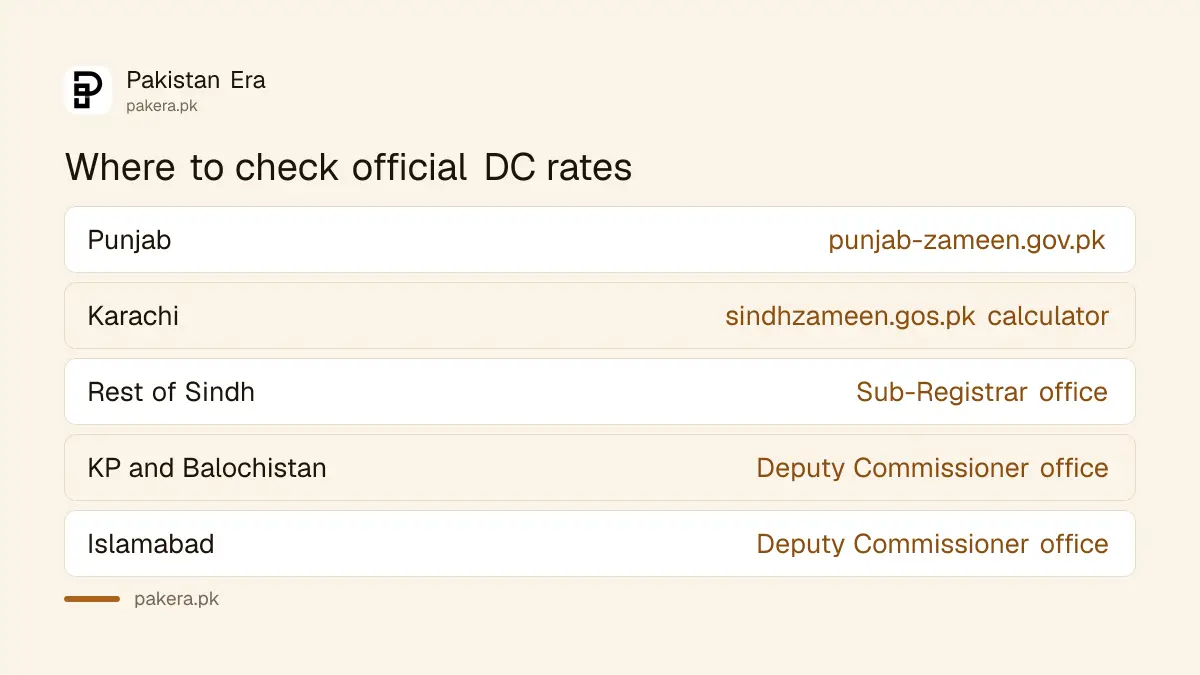
| Area | Official route | Status on 8 November 2026 |
|---|---|---|
| Punjab, all districts | punjab-zameen.gov.pk, then Calculate DC Valuation | Opens the e-Stamping Property DC Valuation form |
| Karachi | sindhzameen.gos.pk, then Online Calculator | Marked "ONLY FOR KARACHI", rates with effect from 1 July 2016 |
| Rest of Sindh | Sub-Registrar or Deputy Commissioner's office | Ask the office for the valuation table |
| Balochistan | The district Collector's valuation table, published in the Gazette | Drafts can be inspected at the Collector's office |
| Khyber Pakhtunkhwa, Islamabad | Deputy Commissioner or Sub-Registrar of the district | Ask the office for the rate list |
In Balochistan, the Collector divides each town into zones and publishes a draft table that anyone can object to, as set out in checking and objecting to Balochistan land valuation tables.
The Karachi calculator still says its valuations apply "with effect from 1st July 2016" as of 8 November 2026. That is the date the page itself shows. If you are dealing in Karachi, ask the Sub-Registrar whether a newer notification applies before you rely on it.
How to check DC valuation in Punjab
The link on punjab-zameen.gov.pk opens the Property DC Valuation form on the e-Stamping portal at es.punjab-zameen.gov.pk.
- Open punjab-zameen.gov.pk and choose Calculate DC Valuation. Type the address yourself.
- Pick Urban or Rural. The form changes with your choice.
- Choose the district, tehsil and town or city.
- For rural land, choose the qanoongoee circle and the mouza, which is the revenue village. For urban property, choose the revenue circle, the floor and the property area.
- Choose how to locate the land: by khasra number, by square and qila number, or by property area. You can add several khasras if the plot spans more than one.
- Pick the land classification and location the form offers for that area, and enter the area.
- Press Find Land Rate. The form shows the DC rate per marla, the rate per square foot, and the total DC value.
If you are not sure of the khasra number, it is on your fard. A built-in area calculator on the form converts acres, kanals, marlas and square feet.
If the form shows "Not Found" next to the rate, no rate is loaded for that combination. Check the mouza and land type first. If it still fails, call the e-Stamping help line.
How the DC value is worked out
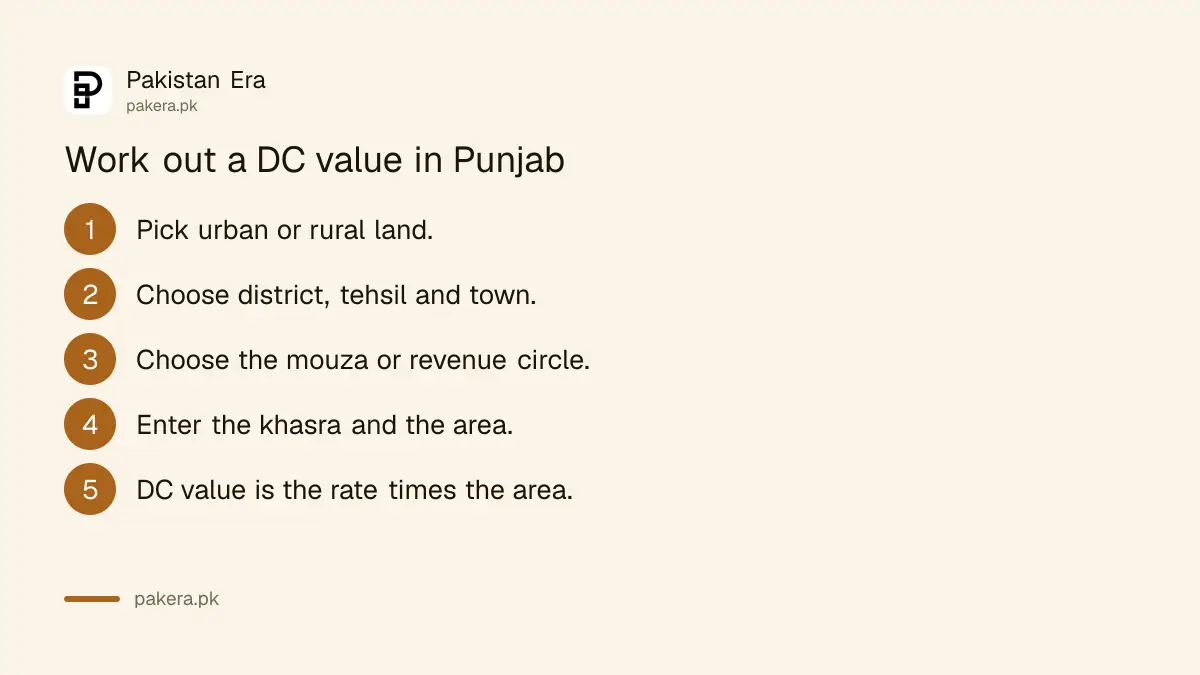
The sum itself is simple:
DC value = DC rate per unit x area in the same unit
For example, if a rate were Rs 400,000 a marla and the plot were 5 marlas, the DC value would be Rs 2,000,000. That rate is made up to show the method. It is not the rate for any real place.
Two rules matter more than the sum:
- The higher value is used. PLRA's own FAQ says the system calculates stamp duty "based on the declared or DC valuation, whichever is higher". If you declare a price below the DC value, you still pay on the DC value. The Punjab form even warns when your figure is lower.
- Buildings can change the figure. The urban form asks for the floor and the property type, because a shop, a flat and a house on the same street are valued differently.
What DC valuation is used for
DC value is a provincial figure. It mainly decides:
- Stamp duty on the sale deed, paid through e-stamp paper.
- Registration fees charged when the deed is registered.
- Other provincial charges on the transfer, which the e-Stamping system works out from the same value.
Federal income tax on a sale works differently. FBR collects advance tax from the seller and the buyer under its own rules, and publishes its own property valuation tables for major cities. Those are a separate list from DC rates, explained in checking FBR property valuation rates for your area, and a profit on the sale can also bring capital gains tax.
A seller who has lived in a home for 15 years may be able to stop the advance tax on its sale with a certificate, as shown in getting a section 159 exemption certificate. Owning land of 500 square yards or more in a rating area is also one of the tests that make you file a yearly return, as set out in how to file your income tax return.
Common mistakes and how to avoid them
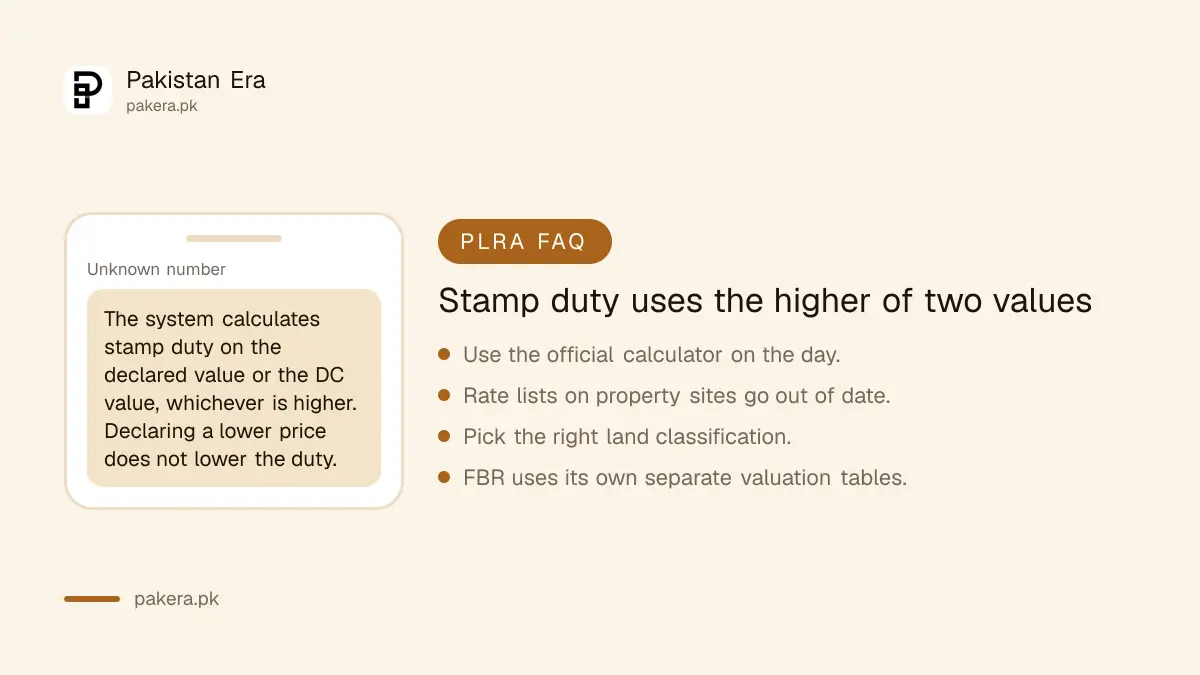
- Using a rate from a property website. Many sites publish "DC rate lists" copied from old notifications. Rates change by notification, so use the official calculator on the day.
- Using the wrong land type. Picking agricultural for a plot inside a housing scheme can give a far lower rate than the one the registrar will apply.
- Declaring below DC value to save tax. It does not work for stamp duty, because the higher value is used anyway.
- Mixing up property tax. The annual property tax paid to the Excise department, in Punjab or Sindh, is separate.
Before paying anything on a deal, check the seller really owns the land.
Common questions
What is DC valuation?
It is the official property value notified by the District Collector for each area. It is used to charge stamp duty and registration fees.
How do I check DC rate online in Punjab?
Open punjab-zameen.gov.pk, choose Calculate DC Valuation, and enter the district, tehsil, town, mouza or revenue circle, and the khasra or area.
Do I need documents to check DC valuation?
No. PLRA says you only need the location, land type, area and category. The khasra number from your fard helps.
Is DC value the same as market value?
No. DC value is the government's notified figure. The sale price between buyer and seller can be higher or lower.
Which value is used if my sale price is lower than the DC value?
The higher of the two. PLRA says stamp duty is based on the declared or DC value, whichever is higher.
Is there an online DC calculator for all of Sindh?
No. The online calculator covers Karachi only, on sindhzameen.gos.pk. For other Sindh districts, ask the Sub-Registrar's office.
How we verified this
What we checked and where we read it.
Last checked 8 November 2026. We loaded punjab-zameen.gov.pk, whose app still shows the Calculate DC Valuation card and the FAQ line on the declared or DC value "whichever is higher", then opened the Property DC Valuation form on the e-Stamping portal, HTTP 200, with the same fields and the Find Land Rate button. The e-Stamping help line on that page is (042) 111-22-22-77, Monday to Saturday, 8am to 5pm, and its email is estamp-support@punjab-zameen.gov.pk. We loaded the Karachi calculator at sindhzameen.gos.pk/eval, HTTP 200.
Work out your own figure
Once you know the value that will be used, work out the advance tax and stamp duty that come with the transfer.
Property Transfer Tax Calculator →About the author

Public Services and Education Journalist
Fajr Riaz is a journalist and content writer at Pakistan Era, based in Lahore. She covers the questions people meet in everyday life in Pakistan: how a public service works, what a change in the rules means, and where to find a reliable answer.