How to Check and Object to Balochistan Land Valuation Tables Used for Stamp Duty
Balochistan stamp duty on land follows the Collector valuation table. See how zones are set, where to inspect the draft free and how to object in writing.
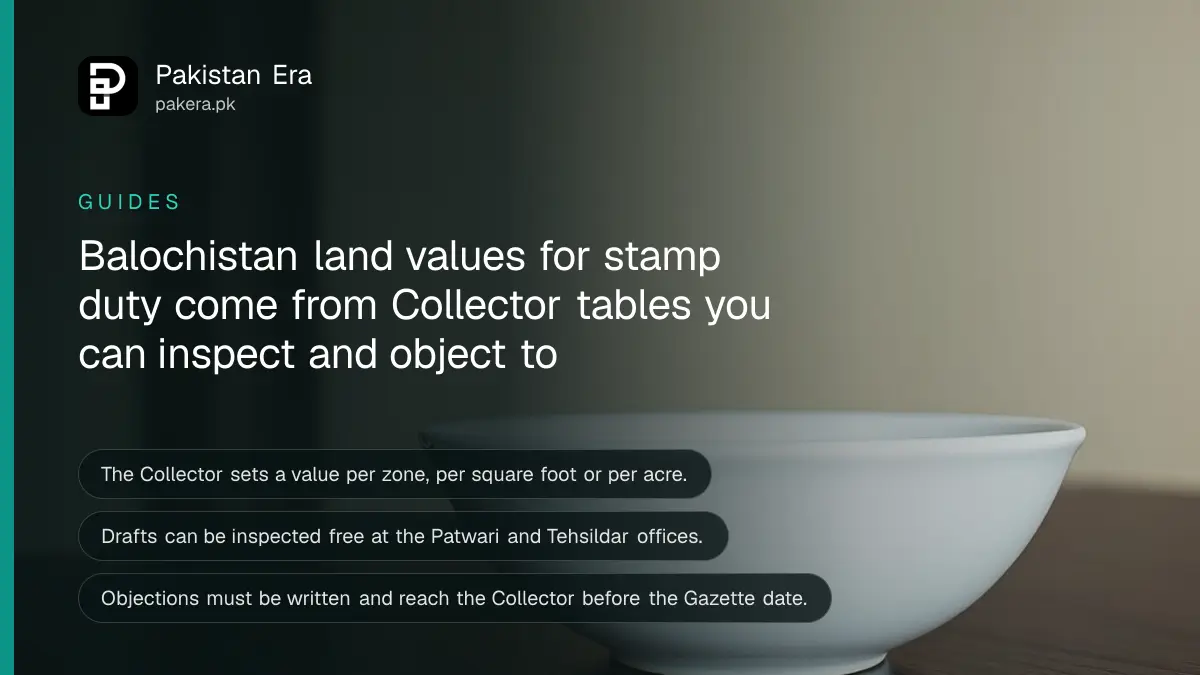
In Balochistan, the district Collector sets the land values used for stamp duty by dividing each town into zones, publishing a draft valuation table in the Gazette, and inviting written objections before it is final. Anyone can inspect the draft free at the Collector's, sub-division or Tehsildar's office, and objections go to the Collector in writing, in person or by post.
The rules are the Balochistan Stamp (Valuation Tables in respect of Land) Rules, 2013, notified on 5 March 2015 under section 75 of the Stamp Act, 1899. We read their full text on the Balochistan Code, the provincial law portal, on 21 October 2026. If you buy, sell or gift land, the table can change your stamp bill, so it pays to know how it is made.
The Collector divides land into zones and fixes an average value for each
Rule 2 says the Collector divides land in a locality into zones. For each zone he sets an estimated market value, which is the average of the highest and lowest rates he considers right for that zone. Urban land is valued per square foot, agricultural land per acre.
The rules require separate values for commercial and residential land in a town or city. Elsewhere there are separate values for agricultural, industrial, commercial and residential land and for housing colonies. The same road can therefore carry different rates for a shop and a house.
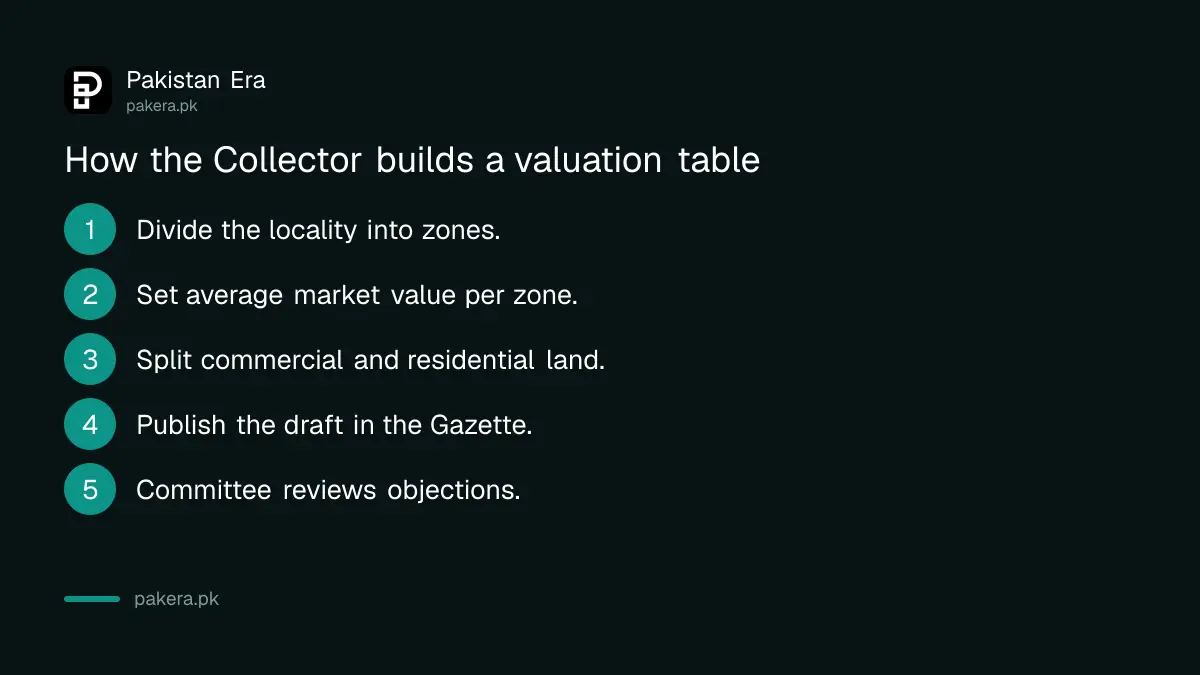
The draft table goes into the Gazette with a deadline for objections
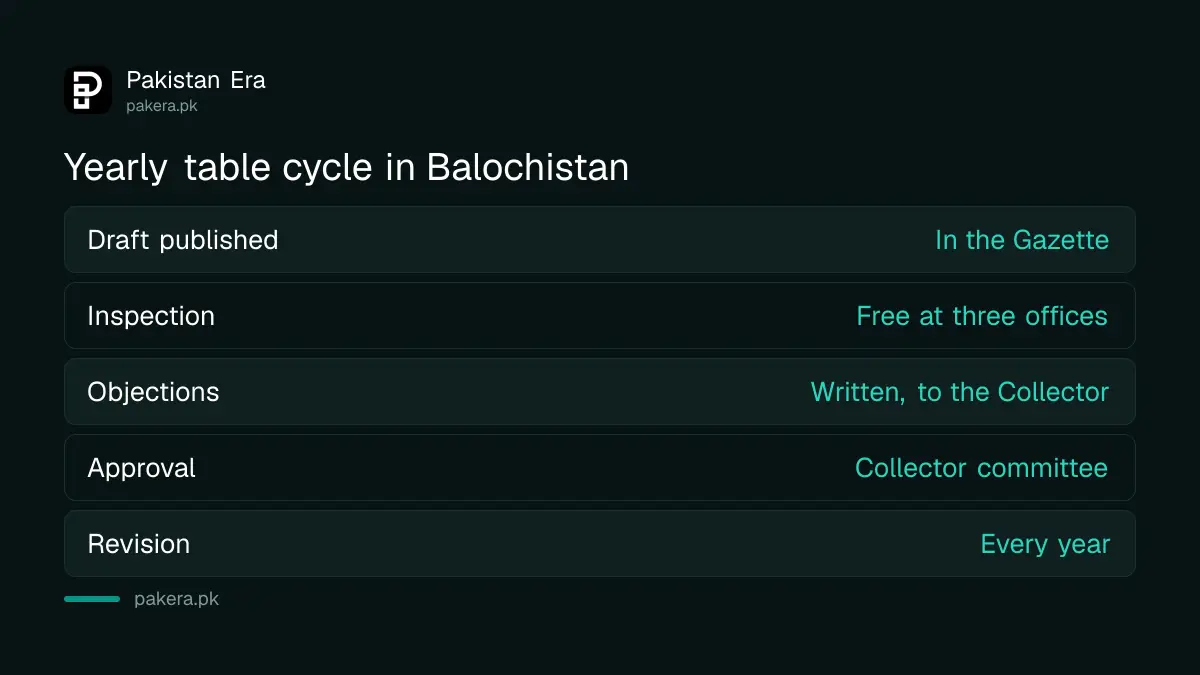
The draft table must be published in the official Gazette with a date by which objections must reach the Collector (rule 2(5)). A copy is placed at the offices of the Collector of the district, the Collector of the sub-division and the Tehsildar, open to the public.
A copy also goes to the Patwari of the area, who must let you inspect it on demand, free of charge (rule 2(6)). That last rule is useful in a village: you do not need to travel to the district office to see the rate for your mouza.
| Type of land | Unit of value | Table used |
|---|---|---|
| Commercial, town or city | Per square foot | Urban table (Appendix I) |
| Residential, town or city | Per square foot | Urban table (Appendix I) |
| Agricultural | Per acre | Rural table (Appendix II) |
| Rural residential, commercial, industrial, housing colony | Per square foot | Rural table (Appendix II) |
Objections must be in writing and go to the Collector
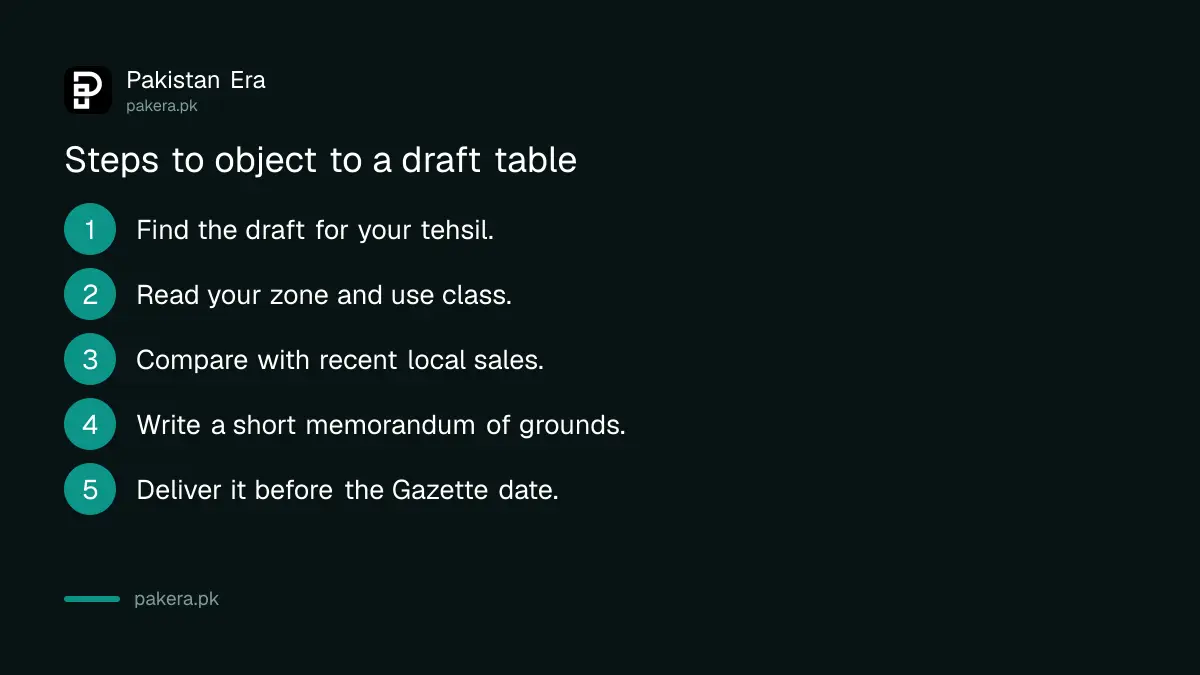
Rule 2(7) says an objection is a written memorandum stating briefly the grounds. You can hand it to the Collector or post it. Each one is entered in a register kept for the purpose. After the last date, a committee considers the draft and the objections.
The committee has the Collector as chairman, the Assistant Commissioner of the sub-division, the Executive Engineer of Communications and Works, the Excise and Taxation Officer, and anyone else the Collector co-opts. Its approved table is then notified in the Gazette (rule 2(8) and (9)).
- Find the notified draft table for your district and tehsil.
- Read the rate for your zone and the use class, such as residential.
- Compare it with recent sale prices of similar plots nearby.
- Write a short memorandum with your grounds, such as a wrong zone or an inflated rate.
- Deliver it to the Collector before the date in the Gazette notice, or post it.
- Ask for the receipt number from the objection register.
You can only object before the table is notified. The rules give no appeal after notification, so read the Gazette notice for the last date as soon as it appears. We could not find the notice dates for any district.
Tables are revised every year, so check the current one
Rule 3 says the notified tables are subject to periodic revision by the Collector on a yearly basis, following the same steps. An old table stays in force until the revised one is notified in the Gazette (proviso to rule 2(3)).
In practice this means the rate used on your deed is the one in force on the day you register, not the one from last year. Ask the sub-registrar or the Collector's office for the notified table before you agree a price, and compare it with the tax figure explained in the guide to DC valuation of property in Pakistan. Federal tax on a purchase uses a separate FBR figure, covered in the guide to checking the FBR property valuation.
Before any purchase, also run the checks in the guide to verifying a property registry before buying. A low valuation does not make a bad title good.
Common questions
Who sets land values for stamp duty in Balochistan?
The Collector of the district, using a valuation table made under section 27-A of the Stamp Act, 1899, after a committee reviews the draft and objections.
Can I see the draft table for free?
Yes. Copies are kept at the Collector's, sub-division Collector's and Tehsildar's offices, and the Patwari must let you inspect his copy free on demand.
How do I object to a rate?
Present a short written memorandum of your grounds to the Collector of the district, in person or by post, before the date given in the Gazette notice.
How often is the table revised?
Rule 3 says on a yearly basis, using the same procedure. The old table continues until the new one is notified.
Is the table the same for shops and houses?
No. Commercial and residential land in a town are valued separately, and in rural areas agricultural, industrial, commercial, residential and housing colony land are valued separately.
Do these rules give a rate per square foot?
No. They set the method and the forms only. The rates are in the district tables, which we could not read for any district.
How we verified this
What we checked, where we read it, and what we could not confirm.
We read the full text of the Balochistan Stamp (Valuation Tables in respect of Land) Rules, 2013 on the Balochistan Code on 21 October 2026. We did not read section 27-A of the Stamp Act itself, any district valuation table, or any Gazette notice, so we state no rates, dates or stamp duty percentages. This is general information, not legal advice.
About the author

Tax, Bills and Technology Writer
Ali Akhtar is a young and curious voice here at Pakistan Era. He is currently pursuing his A-Levels and has a growing interest in Pakistan’s changing industrial landscape and educational trends. Ali likes to write in a way that helps him explain and explore the world around him. His writing reflects the perspective of the new generation navigating the evolving trends of Pakistan where technology, youth innovation, and shifting opportunities are reshaping the country’s future.