How to Get a Lower Rate or Exemption Certificate From FBR Under Section 159
A section 159 certificate tells payers to deduct less tax or none. See who qualifies, the 15 day rule for companies, the special certificates and how to apply.
Short answer: Under section 159 of the Income Tax Ordinance, you can apply in writing to the Commissioner for an exemption certificate or a lower rate certificate. Once it is in force, the person paying you must follow it instead of deducting the full rate. For a company, the certificate is deemed issued if the Commissioner does nothing for 15 days.
A company receives a Rs 3 million payment for a project that will lose money this year. The payer deducts tax at the full withholding rate anyway. The company then waits months for a refund of cash it never really earned. A section 159 certificate exists to stop that, before the money is taken.
We read section 159 of the Income Tax Ordinance, 2001, as amended up to 30 June 2026, on FBR's own website on 12 October 2026. We did not open the IRIS application screens or the prescribed form, so this guide stops where the law stops. It is a plain reading, not tax advice.
A certificate makes the payer deduct less or nothing
Section 159(1) lets the Commissioner issue a certificate when a payment is exempt, or is taxable at a rate lower than the First Schedule rate, or carries a full tax credit. It applies to advance tax collected and tax deducted at source under Divisions II and III of Part V, and to Chapter XII.
The payer is bound by it. Section 159(2) says a person who must collect or deduct tax has to take the full amount unless a certificate is in force, and if one is in force, must comply with it. So the certificate is something you hand to the payer, not a refund claim you make later.
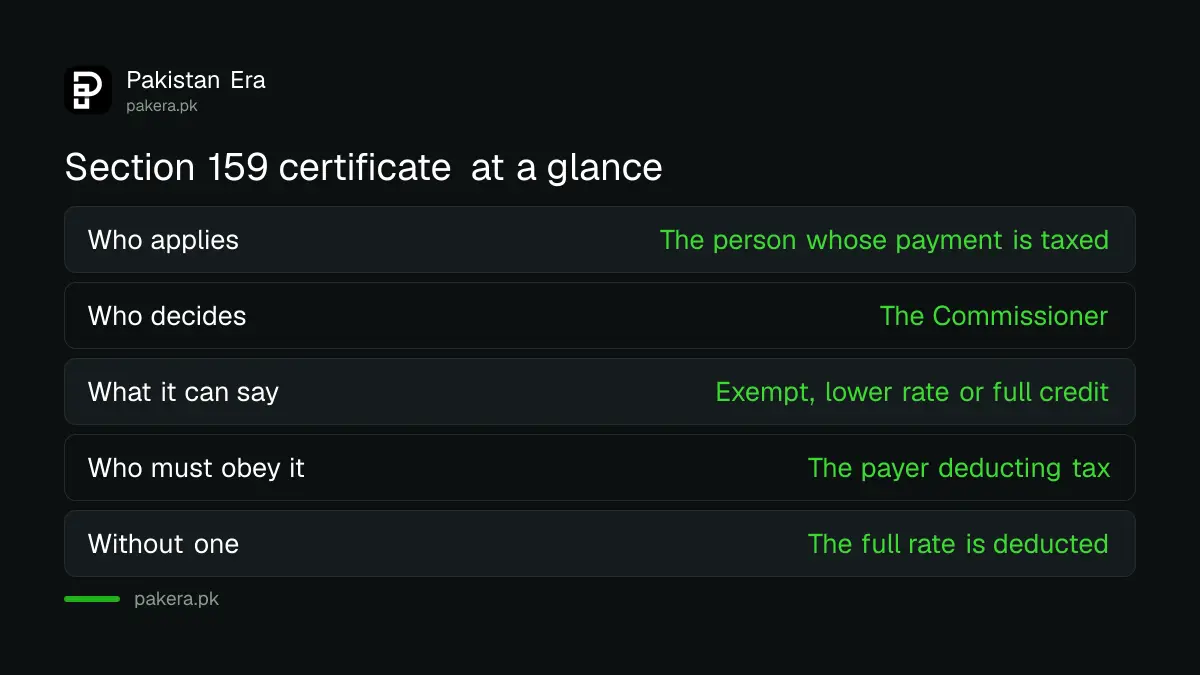
| Question | What section 159 says |
|---|---|
| Who applies | The person whose payment would be taxed, in writing, in the prescribed form |
| Who decides | The Commissioner |
| What the certificate can say | Exempt, a lower rate, or a full tax credit |
| Who must obey it | The person collecting or deducting the tax |
| Without a certificate | The full rate must be deducted |
A company gets the certificate within 15 days or it is deemed issued
Section 159(1) has three provisos for companies. The Commissioner must issue the certificate within 15 days of the application. If the 15 days pass, the certificate is deemed issued and IRIS processes it automatically. The Commissioner can later modify or cancel it with written reasons after hearing the company.
Notice what this does and does not give you. It gives a company a firm clock. It does not promise the certificate says what you asked. If you ask for a rate you cannot support, the Commissioner can still cancel it. Attach the contract, the likely tax computation and the last return so the application stands on documents.
The provisos speak only of a company. For an individual or an association of persons, the Ordinance sets no 15 day clock in this section, so follow up in writing and keep proof of the date you applied.
Four special certificates sit in the same section
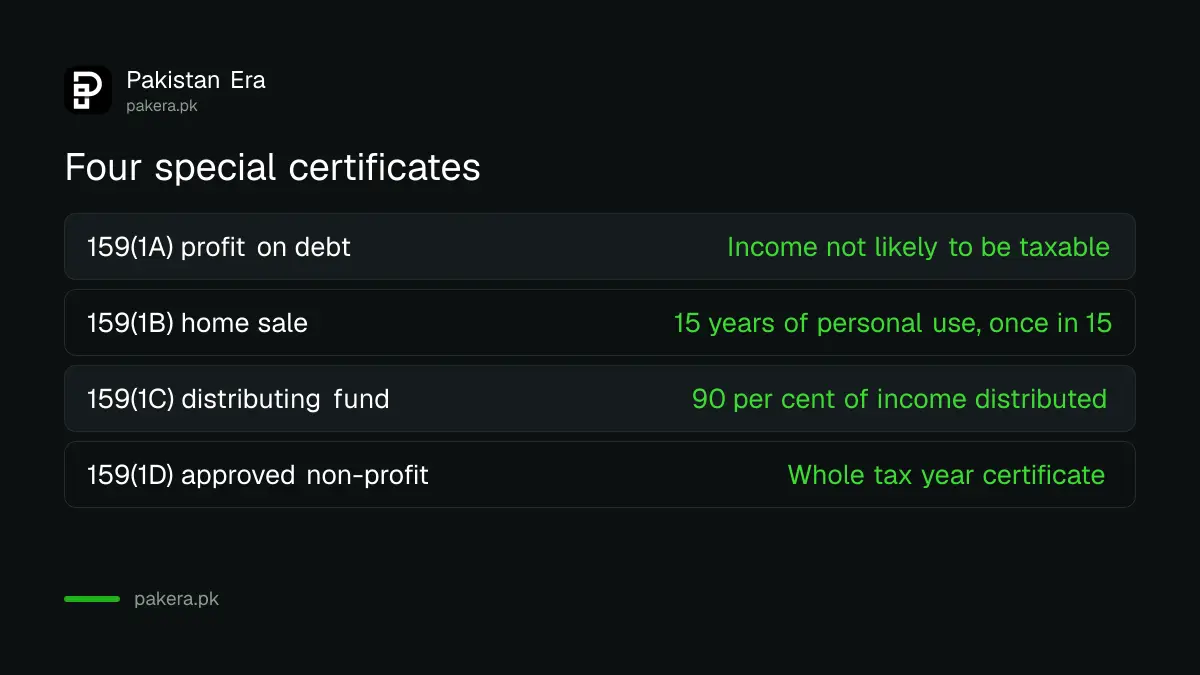
Besides the general certificate, section 159 has narrower ones for profit on debt, for sale of a long held home, and, added by the Finance Act 2026, for funds that distribute their income and for approved non-profit organisations. Each has its own test.
- Profit on debt, section 159(1A). For a person whose income is not likely to be chargeable to tax, on profit on debt under section 151(1)(c). This is the certificate a low income saver asks the bank for. See tax on bank profit and savings.
- Home sale, section 159(1B). An exemption from advance tax under section 236C on a residential property that was in personal use for the last 15 years, declared in the wealth statement for the last 15 years, and shown as a residence in tax records. It is issued once in 15 years.
- Distributing funds, section 159(1C). A person who has distributed 90 per cent or more of its accounting income to unit or certificate holders or shareholders qualifies, and the certificate runs for the whole next tax year.
- Approved non-profit, section 159(1D). A person approved under section 2(36)(c) gets a certificate for the whole tax year.
The Finance Act 2026 added subsections (1C) and (1D) according to the footnotes in the amended text. The home sale certificate was added by the Finance Act 2025. For the tax that applies to property transfers, see capital gains tax on property and tax on buying or selling property.
How to apply for a certificate
Apply in writing in the prescribed form to the Commissioner who handles your file. Say which payment you mean, which section applies, what rate or exemption you want, and why. Attach documents. Keep a copy, because the payer will ask to see the certificate before it changes the deduction.
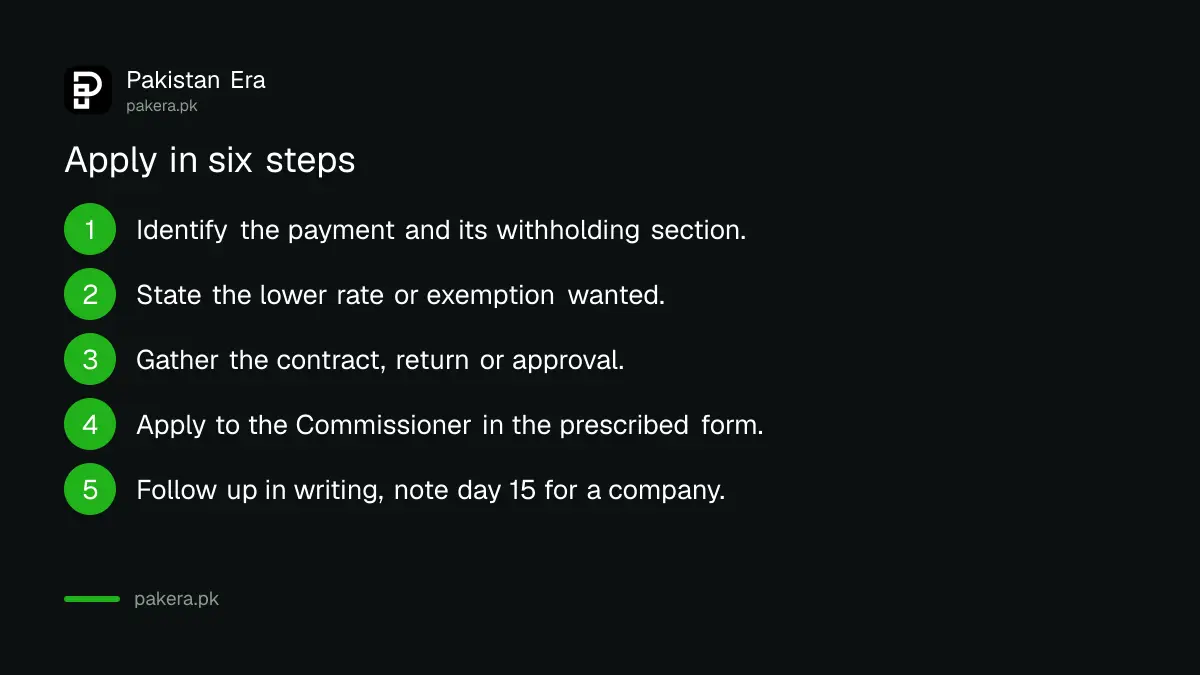
- Work out which payment is affected and which withholding section applies to it.
- Write down the lower rate or the exemption you want, and the reason.
- Gather the contract, last return, wealth statement or approval letter that supports it.
- Apply to the Commissioner in the prescribed form, through IRIS if your office takes it that way.
- Follow up in writing, and for a company note the 15th day.
- Give the certificate to every payer before the next payment, and keep the date you did.
The certificate only works from the day the payer holds it. A certificate dated after a payment will not undo a deduction already made. For that, you claim the tax back through an income tax refund claim.
What the certificate does not do
It does not remove your duty to file a return or declare the income. It does not change tax you owe on the same income on a different basis. And it can be modified or cancelled. A certificate for a lower rate is an instruction to the payer, not a final settlement of what you owe.
For payments to a contractor or supplier, the deduction rules themselves are in why your client pays less than the invoice. If you are the payer, check that you hold a copy of a valid certificate before you deduct less. Without one, the full rate is the safe course, and section 161 can make a payer personally liable for tax not deducted.
Common questions
What is an exemption or lower rate certificate?
It is a certificate issued by the Commissioner under section 159 that tells a payer to deduct no tax, or less tax than the First Schedule rate. The payer must comply with it while it is in force.
How long does the Commissioner take?
For a company, 15 days, and if nothing happens the certificate is deemed issued and IRIS processes it. For others, section 159 sets no fixed period, so apply early and follow up.
Can the certificate be cancelled?
Yes. For a company, the Commissioner may modify or cancel the certificate for reasons recorded in writing after giving an opportunity of being heard.
Can I get an exemption on selling my home?
Possibly. Section 159(1B) covers a residential property in personal use and declared for 15 years, and it is issued once in 15 years. The advance tax it covers is under section 236C.
Does the payer have to accept it?
Yes. Section 159(2) says a person collecting or deducting tax shall comply with a certificate that is in force. Without one, the full rate applies.
Do funds and non-profits get certificates?
Yes, since the Finance Act 2026. A fund that distributes 90 per cent or more of its income, and a person approved under section 2(36)(c), qualify for a whole year certificate under subsections (1C) and (1D).
How we verified this
What we checked, where we read it, and what we could not confirm.
We read section 159 and its footnotes in the Income Tax Ordinance, 2001, as amended up to 30 June 2026, published at fbr.gov.pk, on 12 October 2026. We did not read the prescribed application form or the Income Tax Rules, and we did not apply through IRIS, so form numbers and screens are not described. FBR can change any rule in a later Finance Act.
About the author

Senior Writer, Public Services and Technology
Shahid joined us in 2024 as an author. He is a senior contributor to Pakistan's leading technology websites. He writes detailed articles, mostly covering his expertise in the latest tech, mobiles, apps, gadgets, and step-by-step guides. His ideology is to help people understand the latest trends and explain complex methods through very easy-to-understand guides.