FBR Tyre Production Monitoring: All Tyre Makers Must Go Live by 30 November 2026 (STGO 32, 9 Firms Listed)
FBR STGO 32 of 2026 orders every tyre maker to install production monitoring at each curing press by 30 November 2026. See the 9 listed firms, vendor and steps.
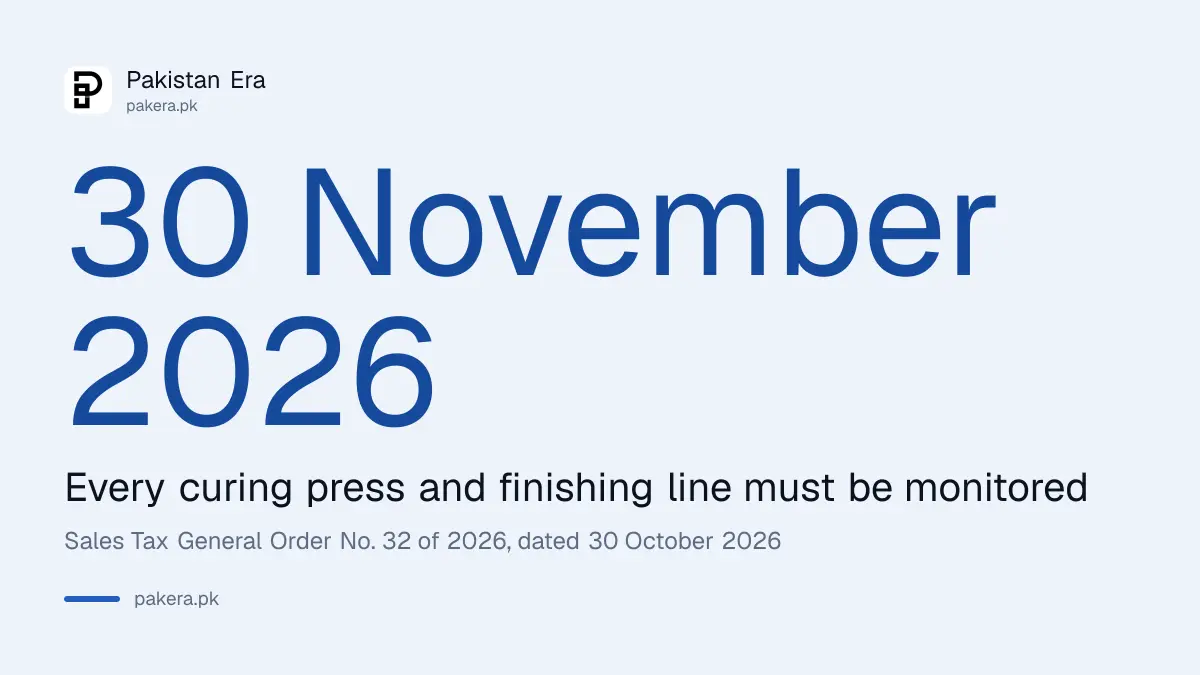
Every registered tyre manufacturer in Pakistan must install the Federal Board of Revenue's (FBR) electronic production monitoring system at each curing press and finishing line by 30 November 2026. The order is Sales Tax General Order (STGO) No. 32 of 2026, dated 30 October 2026, and it names nine tyre makers by tax office, though the list is not complete.
We read the four-page order on the FBR website on 4 November 2026. Below is who it covers, what the system must count, the one authorised vendor, the nine listed companies, and the steps a tyre maker has to finish before the deadline. It also explains the rule that matters most day to day: after the system is in place, tyres cannot leave the factory unless they have been counted by it.
Tyre makers have until 30 November 2026 to go live
The order gives tyre manufacturers until 30 November 2026 to install, connect and switch on the system. The order itself came into force at once on 30 October, so the clock is already running. That leaves 31 days from the date of the order.
The FBR issued the order under section 40C(2) of the Sales Tax Act, 1990, and the production monitoring rules in Chapter XIV-BA of the Sales Tax Rules, 2006. It covers all registered persons who make tyres, which are goods at serial number 44 of the Third Schedule to the Sales Tax Act. That schedule is the list of goods on which sales tax is charged on the printed retail price.
Tyres join a wider push. The government wants production monitoring across many sectors, as set out in the plan to monitor production in all sectors by 31 December 2026. Poultry hatcheries got a similar order in October, covered in the hatchery monitoring order.
The system must count every cured tyre at the press
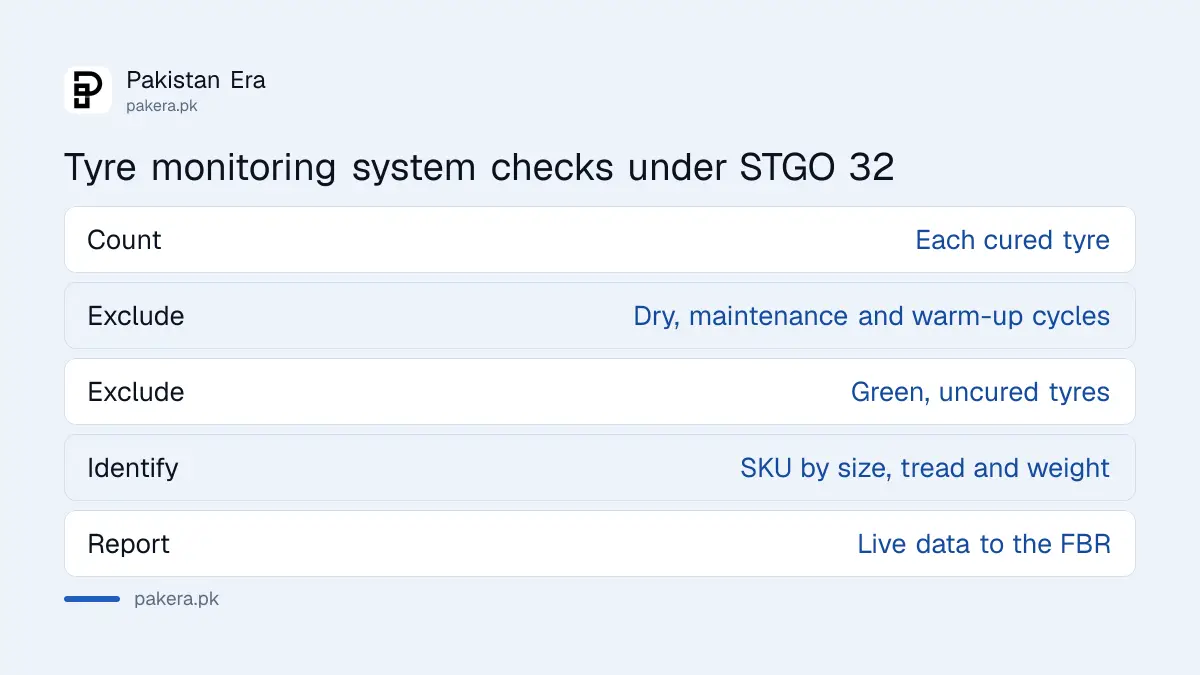
The order is specific about what has to be counted. Hardware and software go on the curing press and on the takeaway conveyor or finishing line of every factory. The system must count each cured tyre and tell real production apart from other cycles.
| What the system must do | What it means in practice |
|---|---|
| Count each cured tyre | Every finished tyre off a curing press is recorded |
| Separate valid cycles | Dry, maintenance and warm-up cycles are not counted as output |
| Separate green tyres | Uncured tyres are not counted as finished tyres |
| Identify the SKU | Each tyre is matched by diameter, width, tread pattern and weight |
| Report in real time | Data goes to the FBR's central system as it happens |
| Flag problems | Stops, tampering, faults, bypass and other abnormal events are reported |
The SKU, or stock keeping unit, is the product code for each tyre size and design. The order says tyres are matched against "approved SKU master data", so each maker needs its full product list ready for the vendor. The system must also keep audit logs and give the FBR dashboards and reports.
No tyre may leave the factory without being monitored
Paragraph 7 of the order is the one with teeth. Under rule 150ZQT(2) of the Sales Tax Rules, no tyre maker may remove tyres from its business premises unless their production has gone through monitoring. In plain terms, once the system is meant to be live, tyres that the system has not counted should not be sent out.
The same paragraph says each maker must provide access, IT equipment, internet connection and power for the system, under rule 150ZQZE. It must also pay the fee and charges set under rule 150ZQZD. The order does not state the fee amount, and we could not find it on the FBR website, so ask the vendor and your tax office for the figure in writing.
Nine tyre makers are named, but the list is not complete
Annex A of the order lists nine registered tyre manufacturers by tax office. The FBR calls it "non-exhaustive", and the order tells field offices to find and bring in any tyre maker that is not on it.
| No. | Tax office | Company |
|---|---|---|
| 1 | LTO Karachi | Ghandhara Tyre and Rubber Company Limited |
| 2 | LTO Lahore | Service Long March Tyres Limited |
| 3 | LTO Lahore | Service Tyres (Private) Limited |
| 4 | LTO Lahore | Panther Tyres Limited |
| 5 | LTO Lahore | Diamond Tyres Limited |
| 6 | LTO Lahore | Service Industries Limited |
| 7 | LTO Lahore | Ghauri Tyre and Tube (Private) Limited |
| 8 | LTO Multan | Crown Tyres Limited |
| 9 | RTO Peshawar | United Rubber (Private) Limited |
Six of the nine are under the Large Taxpayers Office (LTO) in Lahore. If you make tyres and your name is missing, the order still applies to you. Being left off the list is not an exemption.
One vendor is authorised for the tyre sector
The FBR has authorised one vendor for tyre monitoring so far: M/s ISSM Labelling Solutions (Pvt) Ltd, NTN A033994. Its authorisation is Order No. 1(7)/IR/TDU/2026, also dated 30 October 2026. The order lists the vendor's contact people, phone numbers and email addresses on page 1, so take them from the order itself rather than from any other list.
Each Chief Commissioner Inland Revenue must also name a focal person to work with tyre makers, the vendor and the FBR on installation. Your tax office is the first place to ask who that person is.
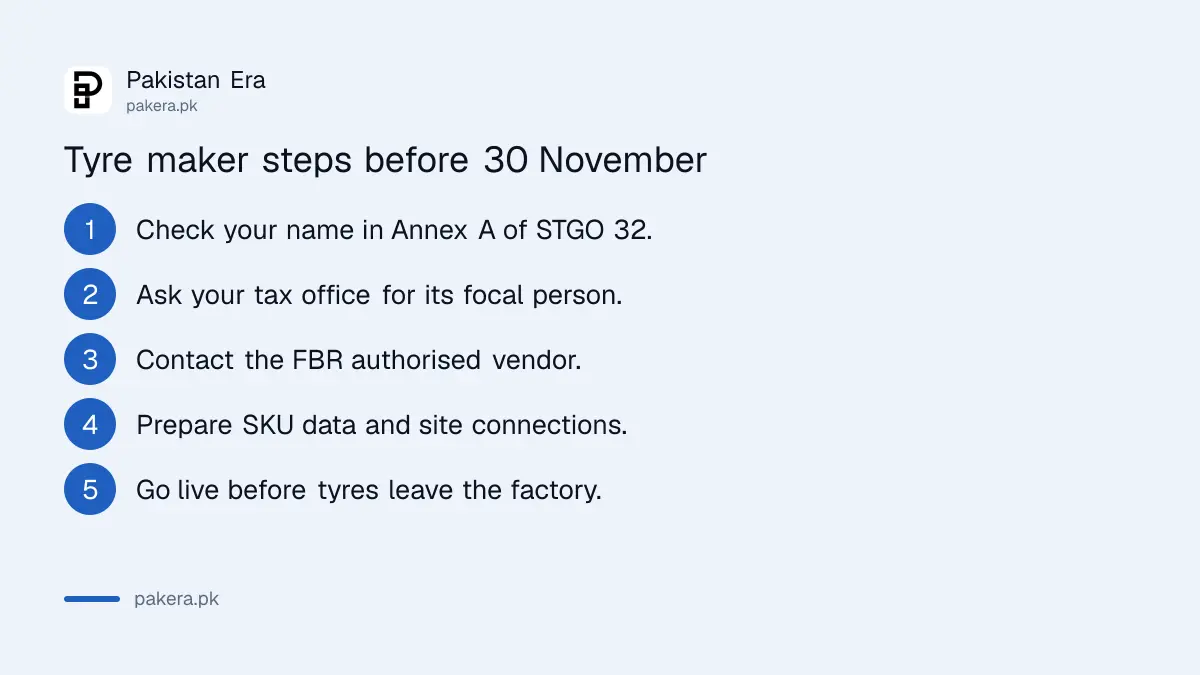
Steps for a tyre maker before 30 November
The order sets the outcome, not the order of work. From what it requires, these are the steps to finish in time:
- Download STGO 32 of 2026 from the FBR website and check whether your company is in Annex A.
- Ask your tax office for the name of the focal person nominated by your Chief Commissioner.
- Contact the authorised vendor, using the details printed in the order.
- Prepare your SKU master data: every tyre by diameter, width, tread pattern and weight.
- Arrange IT equipment, internet and power at every curing press and finishing line.
- Ask in writing for the fee and charges under rule 150ZQZD.
- Test the system so it is counting live by 30 November, before tyres leave the factory.
Tyre importers and dealers are not covered by this order, which is about manufacturing. Duty on imported tyres is a separate matter, covered in the October tyre tariff changes.
Common questions
What is STGO 32 of 2026?
It is the FBR's Sales Tax General Order No. 32 of 2026, dated 30 October 2026. It orders all registered tyre makers to install electronic production monitoring.
What is the deadline for tyre production monitoring?
The system must be installed and working at every curing press and finishing line by or before 30 November 2026.
Which tyre companies are covered?
All registered tyre manufacturers. The order names nine, including Ghandhara, Service, Panther, Diamond and Crown, but says the list is not complete.
Who installs the system?
A vendor authorised by the FBR. For tyres, the order names ISSM Labelling Solutions (Pvt) Ltd, authorised on 30 October 2026.
How much is the monitoring fee?
The order says makers must pay the fee and charges under rule 150ZQZD, but does not state an amount. We could not find the figure, so ask the vendor and your tax office.
How we verified this
What we checked, where we read it, and what we could not confirm.
Last checked 4 November 2026. We read the FBR home page, which lists the order, and the order itself, Sales Tax General Order No. 32 of 2026, Electronic Monitoring of Production in the Tyre Sector (C.No. 2(17) ST-L&P/2026/123588-R, 30 October 2026), including Annex A. We did not read the text of rules 150ZQR to 150ZQZE or the vendor's authorisation order, and we did not find the fee amount. The plain-language explanations of each requirement are ours.
About the author

Global Affairs & Political Economy Writer
Muhammad Hatim is a book lover who started writing because he enjoys it. At Pakistan Era he writes about international relations, geopolitics and the global economy, with a particular interest in South Asia and the forces behind current events.