PM Orders FBR to Monitor Production in All Manufacturing Sectors by 31 December 2026
The Prime Minister told FBR to finish production monitoring in all manufacturing sectors by 31 December 2026. See which sectors are live and which are due soon.
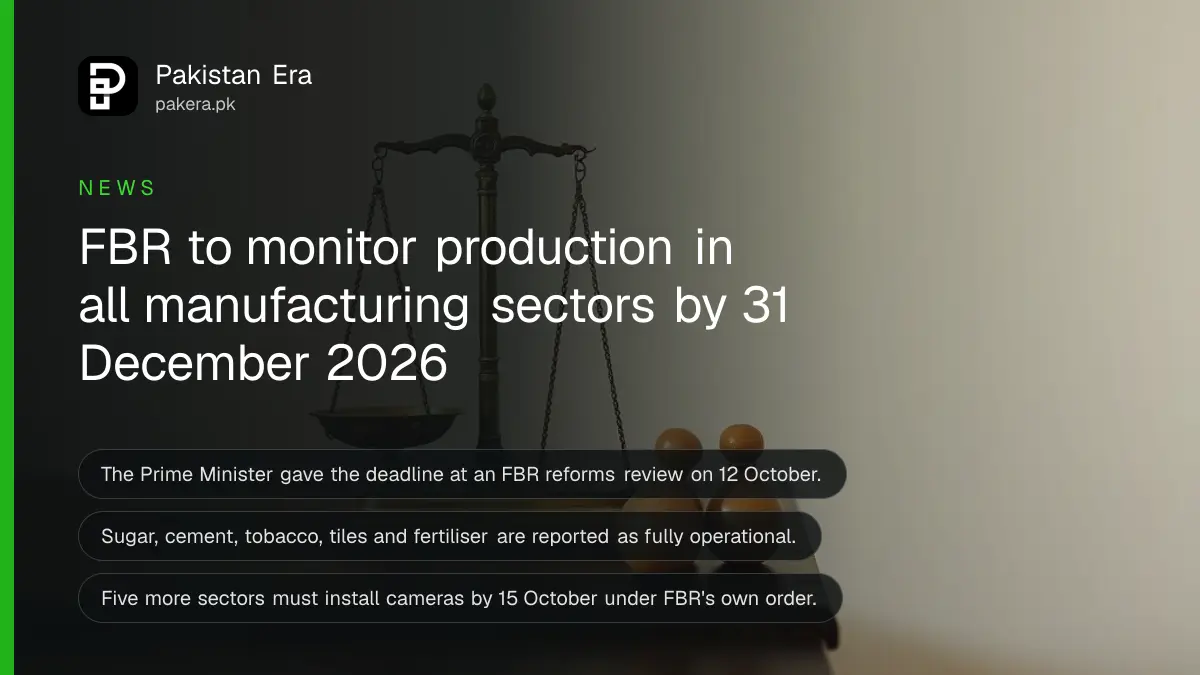
Prime Minister Shehbaz Sharif has told the Federal Board of Revenue (FBR) to finish production monitoring in every manufacturing sector by 31 December 2026. He gave the order at a review of FBR reforms in Islamabad on 12 October 2026, according to the state broadcaster's report of the meeting.
Update, 4 November 2026: FBR's Sales Tax General Order 32 of 2026, dated 30 October, now brings every registered tyre maker under electronic production monitoring, with systems to go live by 30 November 2026. Our guide to the FBR tyre production monitoring order sets out who is covered and what to do.
Production monitoring means cameras and counting systems that record what a factory makes, so that sales tax is paid on every unit. For a factory owner, this is the date to plan around. For a shopper, it is the reason prices of branded goods may stop hiding untaxed output.
Where a figure below comes only from the report of the meeting, we say "reported".
The Prime Minister set one deadline for all factories
The Prime Minister asked FBR to bring every manufacturing sector under production monitoring by 31 December 2026. He said camera monitoring is becoming more effective, and that firms which collect tax from buyers but keep it deserve no relief.
He also said that manufacturers who adopt monitoring on their own deserve recognition. The meeting also looked at an audit report on the cement sector's monitoring system, and at an FBR report on the gap between what each sector should pay and what it does pay.
This was a policy direction, not a new legal notice. The legal orders for each sector are issued by FBR separately, as the next section shows.
Five sectors are already running, and four more are being installed
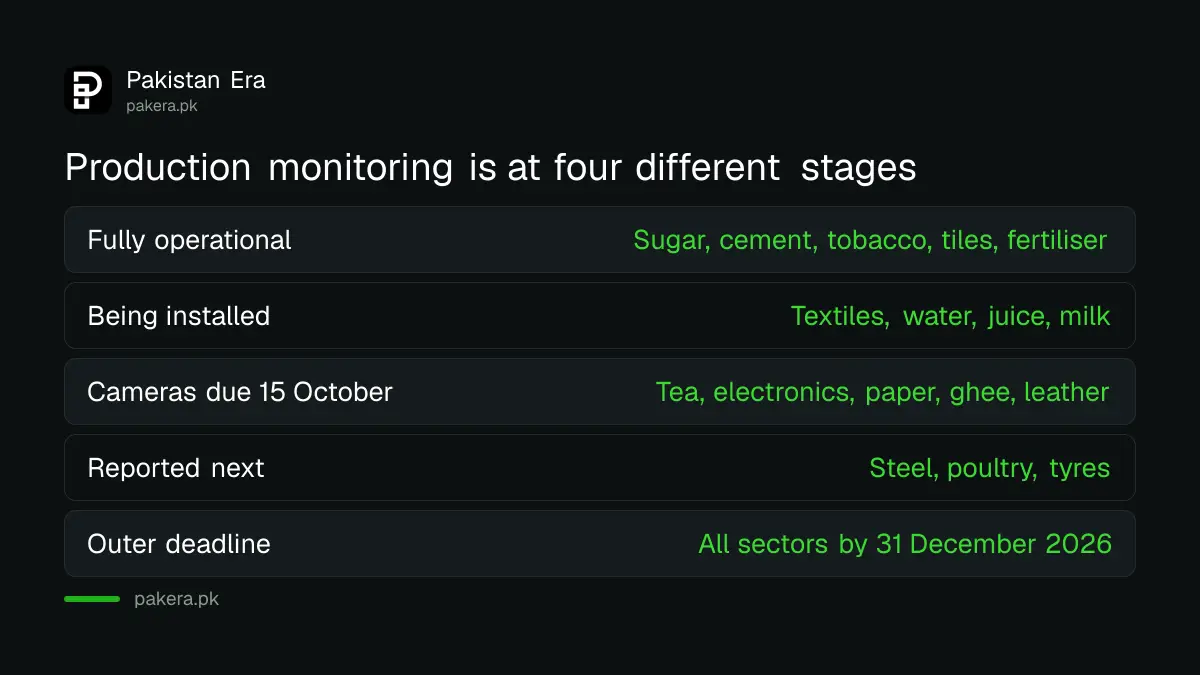
The report says monitoring is fully operational in sugar, cement, tobacco, tiles and fertiliser. Installation is under way in textiles, packaged water, packaged juice and packaged milk, and the equipment for those has already been bought.
A separate press report of the briefing lists 18 sectors in all, and adds steel, poultry, tyres, tea, household electronics, leather, paper and paperboard, and edible oil and ghee. The count of 18 is as reported. Tyres are the exception now: FBR's own order of 30 October covers them.
| Stage | Sectors | Basis |
|---|---|---|
| Fully operational | Sugar, cement, tobacco, tiles, fertiliser | Reported from the meeting |
| Installation under way | Textiles, packaged water, juice, milk | Reported from the meeting |
| Camera deadline 15 October 2026 | Packaged tea, household electronics, paper and paperboard, edible oil and ghee, leather | FBR's own order, read at source |
| Go live by 30 November 2026 | Tyres | FBR's Sales Tax General Order 32 of 2026, read at source |
| Named in the press report | Steel, poultry | Reported |
FBR's own order already gives five sectors until 15 October
The first official deadline is FBR's Sales Tax General Order 27 of 2026. It tells packaged tea, household electronics, paper and paperboard, edible oil and ghee, and leather makers to install video cameras on every production line by 15 October 2026.
A notification of the same week, S.R.O. 1751(I)/2026, brings leather and paper makers under electronic monitoring with immediate effect. The full detail of cameras, vendors and recording rules is in our guide to the FBR video camera order for five sectors.
The Prime Minister's date of 31 December is therefore the outer limit for the sectors that have no order yet. It does not move the 15 October date in the order itself.
What happens to a factory that is not ready
Under the order, goods made in a factory without a working monitoring system may not leave the premises after the deadline. FBR can also seal a factory or seize goods that do not comply, and the procedure is set out in S.R.O. 1662 on sealing and seizure.
For shopkeepers and buyers, the practical change is slower. A monitored factory cannot sell untaxed output through unofficial channels, so branded goods can become more fully taxed.
What manufacturers should do now
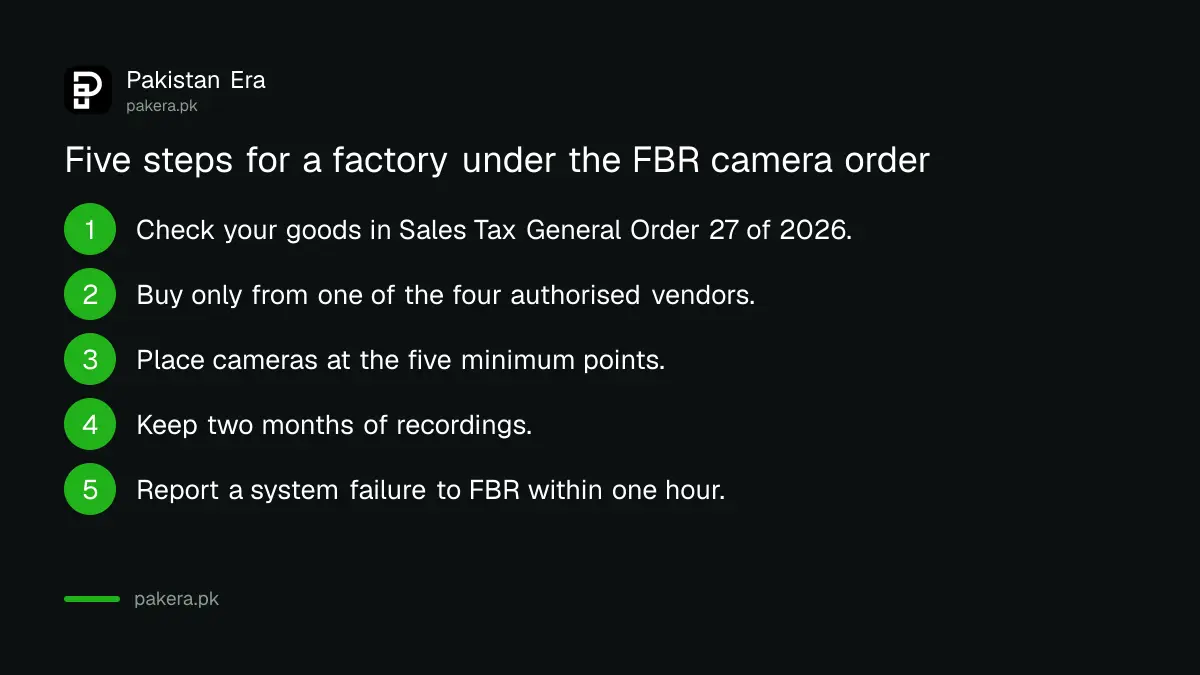
A registered manufacturer in one of the named sectors can use the steps below. They follow the FBR order, not the press reports.
- Check whether your goods are named in Sales Tax General Order 27 of 2026 on fbr.gov.pk.
- Buy a system only from the four vendors FBR has authorised in that order.
- Place cameras at the five minimum points: gate, hall, line start and end, packing, and loading bay.
- Keep recordings for at least two months and keep the system running at all times.
- Report a failure of the system to FBR within one hour, as the order requires.
Businesses that also sell through shops should check the number of retailers already integrated with FBR, which shows how far the same push has reached the retail end.
Common questions
Is 31 December 2026 an official legal deadline?
Not yet. It is a direction the Prime Minister gave at a meeting. FBR must still issue an order or notification for each sector, as it did for five sectors on 7 October 2026 and for tyre makers on 30 October 2026.
Which sectors have to install cameras by 15 October 2026?
Packaged tea, household electronics, paper and paperboard, edible oil and ghee, and leather. FBR's Sales Tax General Order 27 of 2026 names them and sets the 15 October date.
Does this affect small shopkeepers?
No. Production monitoring applies to registered manufacturers, not to retailers. Retailers have a separate point of sale integration rule.
Who pays for the cameras?
The manufacturer pays the authorised vendor, according to the FBR order. The order says no fee may be charged to FBR or its field offices.
Is the list of 18 sectors confirmed?
No. The count comes from a press report of the briefing. The official sources name only the sectors listed in the table above.
How we verified this
What we checked and where we read it.
Last checked on 13 October 2026, Pakistan time. We read the state broadcaster's report of the 12 October meeting, and the FBR documents S.R.O. 1751(I)/2026 and Sales Tax General Order 27 of 2026 on the FBR site. The sector stages and the 31 December date are as reported from the meeting.
About the author

Global Affairs & Political Economy Writer
Muhammad Hatim is a book lover who started writing because he enjoys it. At Pakistan Era he writes about international relations, geopolitics and the global economy, with a particular interest in South Asia and the forces behind current events.