What Happens If FBR Seals Your Factory or Seizes Goods Under S.R.O. 1662
S.R.O. 1662 lets FBR seal non-integrated factories and seize unmonitored goods and trucks. See who must sign, the 7 and 30 day limits and how to reopen a unit.
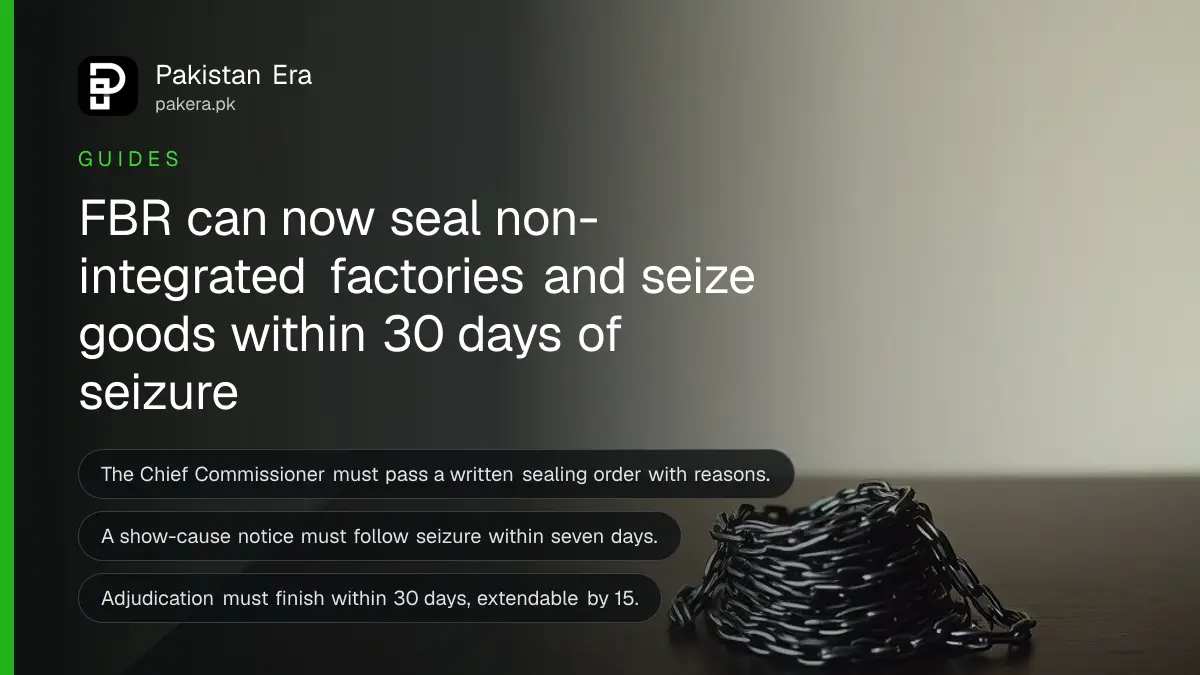
Short answer: Under S.R.O. 1662(I)/2026, dated 29 September 2026, the FBR can seal the premises of a sales tax registered person who must connect to its monitoring system and does not. It can also seize goods and trucks that move without monitoring or tax stamps. To get a sealed unit reopened, you must pay a penalty and complete the integration.
A factory owner who ignores a camera order or a production monitoring order now faces a written, step by step process, with named officers and fixed days. We read the notification on the FBR website and set out what it says, in order.
The rules cover people who must connect to FBR systems and do not
The new sub-chapter applies to a person who is required to connect his business to the FBR's computerised system for tracking sales, production, stock or clearance, and fails to do so. The system can be a production monitoring system, video surveillance, a "digital eye" or another prescribed method.
It is a second sub-chapter in the sealing rules. The first covers Tier-1 retailers. The new one covers non-integrated persons other than Tier-1 retailers, so factories and other registered businesses are its main target.
The notification also widens the base rule 150ZQR. The Board can now monitor any registered person or class, any manufacturer or class, any goods in the Third Schedule, or any other taxable goods it names. It can set different start dates for different sectors. A separate notification, S.R.O. 1751(I)/2026 of 7 October, brings leather, paper and paperboard makers under monitoring with immediate effect. The camera order for five sectors is explained in the FBR video camera order for factories.
Sealing needs a written order from a Chief Commissioner
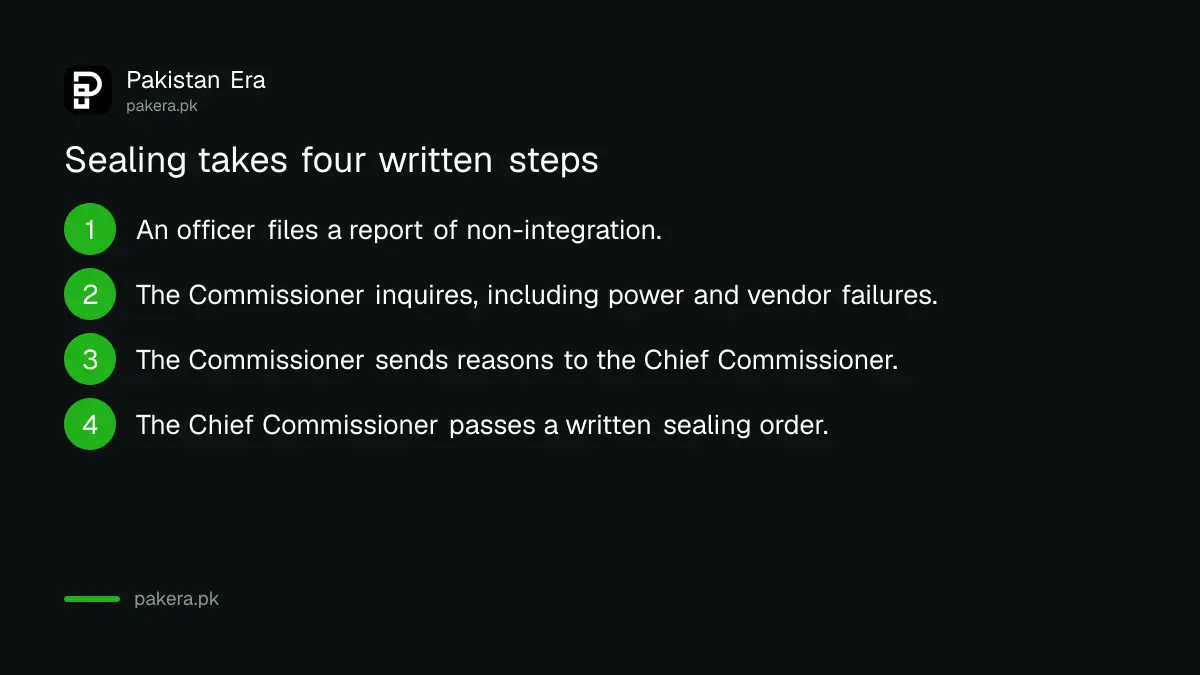
A sealing cannot happen on one officer's word. The rule sets a chain of four steps, and the owner must be served a copy of the order before it is carried out.
- An Officer Inland Revenue, not below the rank of Assistant Commissioner, writes a report that the person has not integrated.
- The Commissioner Inland Revenue makes an inquiry. This includes checking any claim that the failure was caused by the FBR's own system, the authorised vendor, or a power or telecom outage.
- The Commissioner sends the report to the Chief Commissioner with reasons for or against sealing, and the team proposed.
- The Chief Commissioner passes a written order. It must say whether the whole premises or only a part, a production line or a filling line, is to be sealed, and give reasons if the whole is sealed.
The Commissioner can ask the police for help. If the premises fall in another field office's area, the Chief Commissioner asks the Board to name the team.
De-sealing needs a penalty and a working connection
The premises stay sealed until the penalty under section 33 of the Sales Tax Act is paid and the monitoring system is integrated. The rules do not state the amount of the penalty. They leave it to the Commissioner's order under section 33.
The integration happens in front of an FBR team that must include a technical person. Within three days, the Commissioner gives the Chief Commissioner a written certificate that the system is installed, working and free of technical and functional errors.
Equipment must come from a vendor approved by the Board. Buying a camera system elsewhere does not meet the rule. Each approved vendor must also make sure its systems match the Board's specifications.
Unmonitored goods and their trucks can be seized
A new Sub-Chapter 7 says goods made, removed, moved or sold without going through the monitoring system, or without the prescribed tax stamps, labels or barcodes, are liable to seizure and confiscation under section 40C. The vehicle that carries them can be seized too.
Goods in the Third Schedule that are taxed on retail price can also be confiscated if supplied without the retail price printed on them. The owner pays the storage cost of seized goods.
| Stage | What the rule says |
|---|---|
| At seizure | An inventory signed by the officer and the person, or a witness. A seizure memo with the grounds is given to the person. |
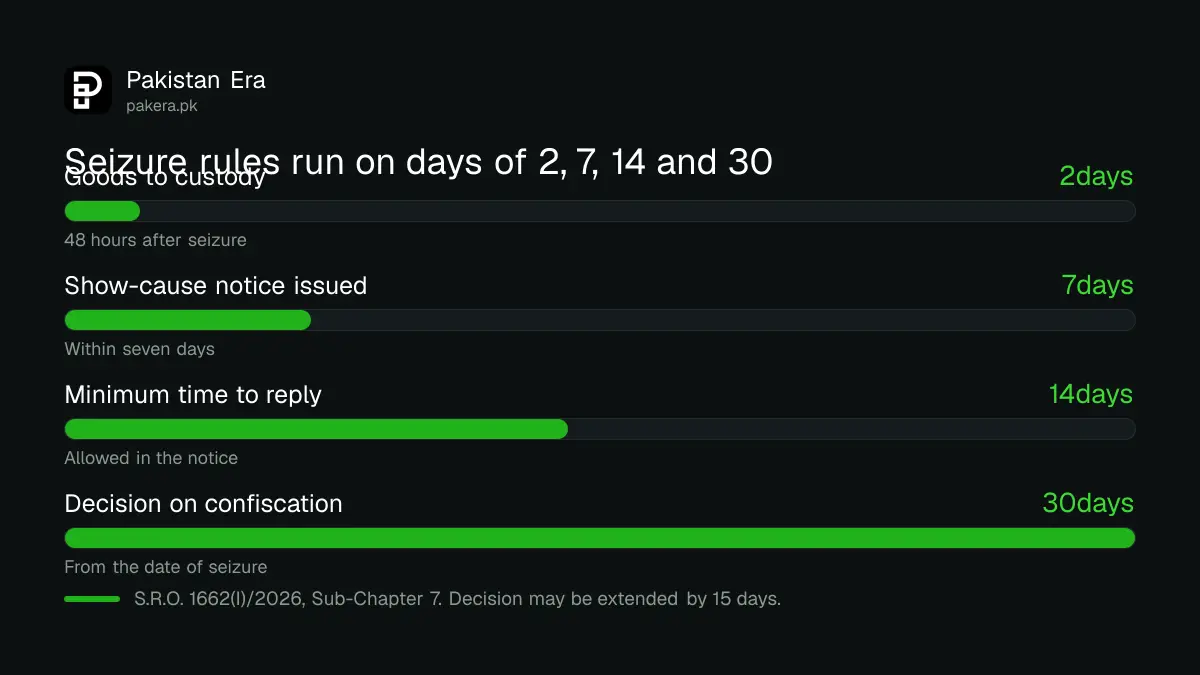
| Custody | Goods go to an authorised Inland Revenue officer within 48 hours. |
| Show-cause notice | Within seven days of seizure, with at least 14 days to reply. |
| Decision | Within 30 days of seizure, extendable by up to 15 days with written reasons. |
| Redemption | The authority may allow goods to be redeemed on a fine of at least 20 per cent of their total retail price. |
| Appeal | As provided in the Sales Tax Act. |
What an owner should do now
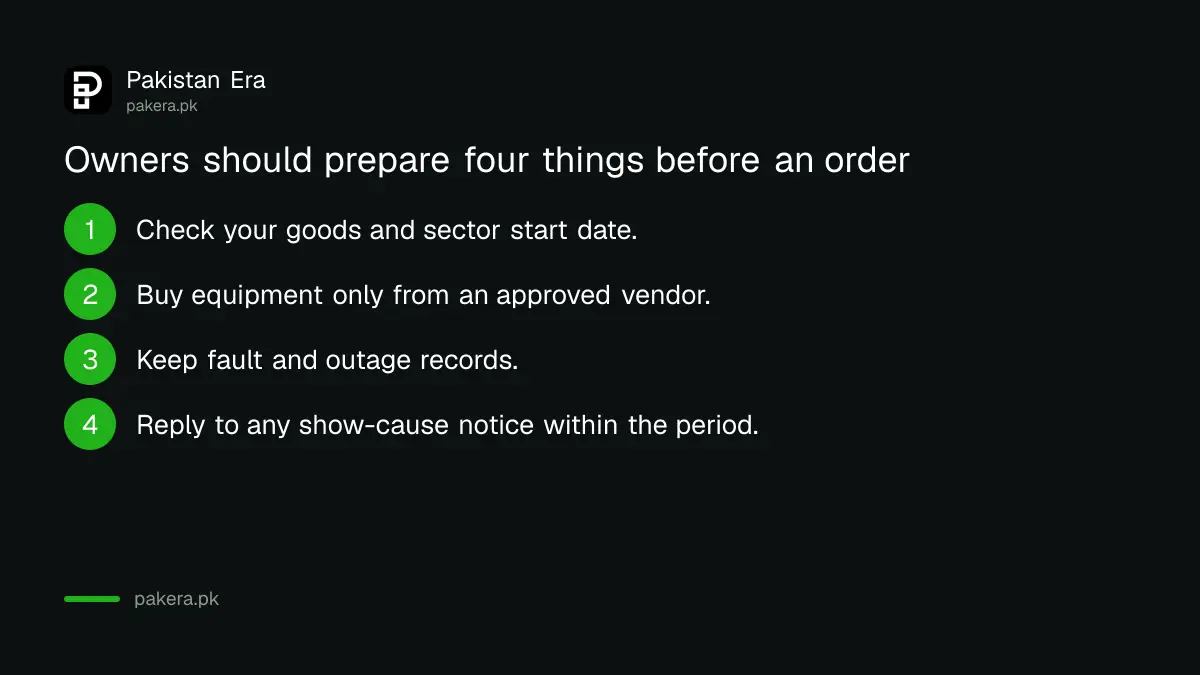
Check whether your goods or sector are named in a notification or order, and what start date applies. Install equipment only from an approved vendor, keep the vendor's installation and fault records, and record any power or telecom outage that stops the feed. The inquiry stage explicitly looks at such claims.
If you receive a show-cause notice, reply within the period it gives and ask for the hearing. Keep your monthly return filing in order too, as covered in how to file a monthly sales tax return. Take legal advice on your own case. This article explains the rule, not your file.
Common questions
Can the FBR seal my factory without a written order?
No. The rule requires a written order from the Chief Commissioner Inland Revenue, with reasons, and a copy must be served on you before the sealing is carried out.
Does a power cut count as a defence?
The Commissioner must verify any claim that non-compliance was due to a failure of the FBR's system, the authorised vendor, or an interruption of power or telecom services. Keep records of such events.
How much is the penalty to reopen a sealed unit?
The notification does not state an amount. The Commissioner imposes a penalty by an order under section 33 of the Sales Tax Act.
Can the FBR seize a truck carrying my goods?
Yes. A conveyance used to carry unmonitored or unstamped goods is liable to seizure and, after adjudication, confiscation.
How long do I have to reply to a show-cause notice?
The notice must give at least 14 days for a reply, and it must be issued within seven days of the seizure.
Is this rule already in force?
It was issued as a final notification dated 29 September 2026. It acts through each sector's start date, which the Board sets by notification or order.
How we verified this
What we checked, where we read it, and what we could not confirm.
Last checked on Sunday 11 October 2026. We read S.R.O. 1662(I)/2026 and S.R.O. 1751(I)/2026 as listed on the FBR sales tax SRO page. We did not see how the rules are applied in any real case, and we give no penalty figure because the notification gives none.
About the author

Senior Writer, Public Services and Technology
Shahid joined us in 2024 as an author. He is a senior contributor to Pakistan's leading technology websites. He writes detailed articles, mostly covering his expertise in the latest tech, mobiles, apps, gadgets, and step-by-step guides. His ideology is to help people understand the latest trends and explain complex methods through very easy-to-understand guides.