Punjab Welfare Schemes 2026 List: 16 CM Punjab Programmes, What Each Pays and Who Qualifies
Punjab welfare schemes 2026 list: Himmat Card, Kissan Card, Apni Chhat Apna Ghar, Dhee Rani and 12 more, with what each pays, who qualifies and status.
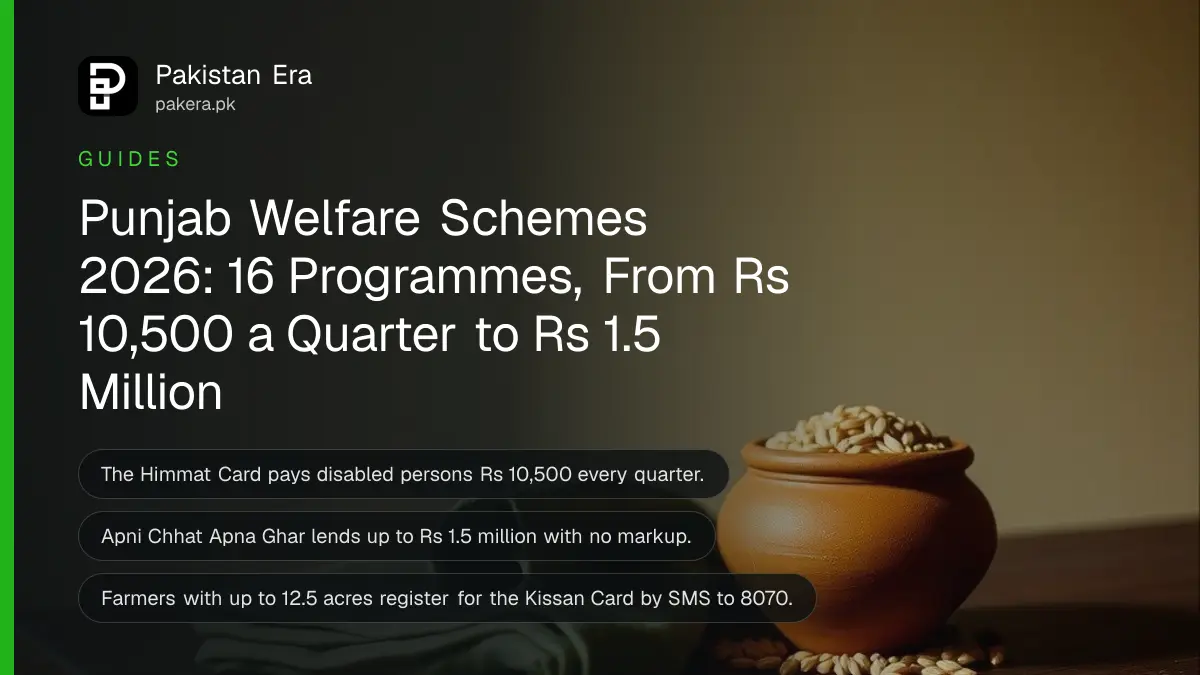
Punjab runs at least 16 welfare schemes for poor families in 2026, from a Rs 10,500 quarterly payment for disabled persons to a Rs 1.5 million interest-free house loan. Most are open to Punjab residents only, and most check your poverty score first. The table below shows what each one pays, who runs it, and whether it is taking applications.
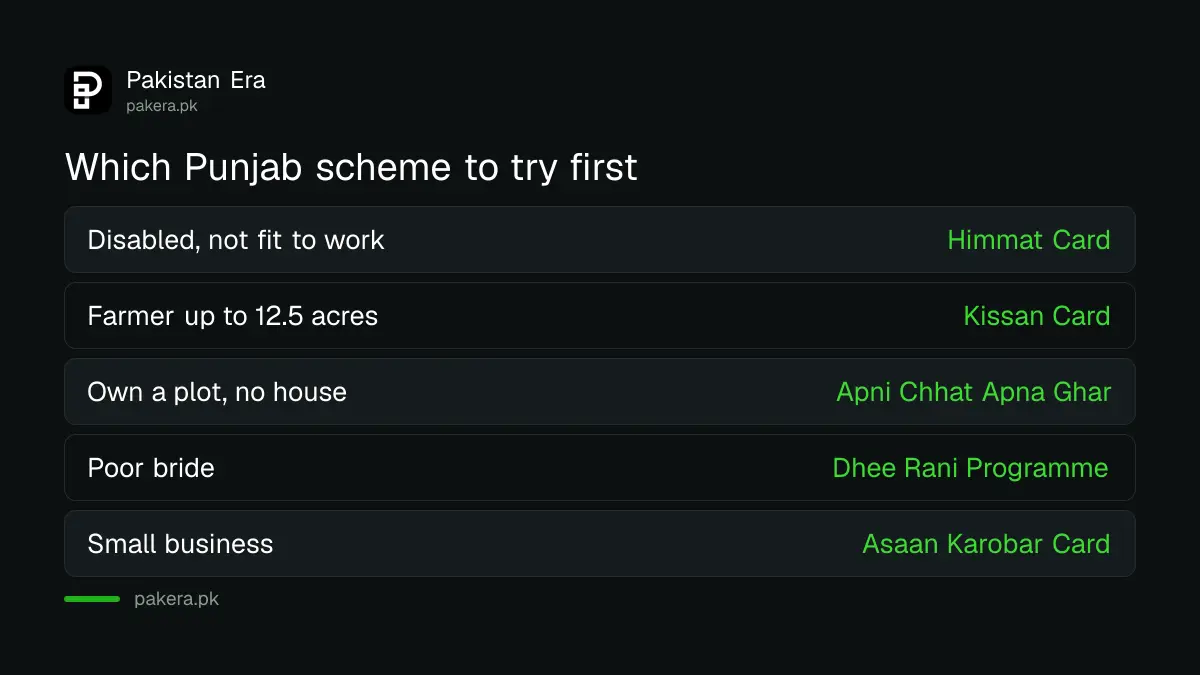
Start with the row that fits your situation: farmer, disabled person, bride, worker, landless family or small business. Then follow the link to the full steps. A scheme marked closed is not a dead end. Most of them reopen in a new phase, and the families who are ready with a valid CNIC, a mobile SIM in their own name and an updated survey get in first.
All 16 Punjab welfare schemes at a glance
Punjab's welfare schemes fall into five groups: cash cards, housing, farmers, business loans and Zakat help. The amounts below are the ones published by the department that runs each scheme. Status is as last shown on each official portal in November 2026.
| Scheme | Who it helps | What it pays | Status |
|---|---|---|---|
| Himmat Card | Disabled persons not fit to work | Rs 10,500 a quarter | Running |
| Minority Card | Poor non-Muslim families | Rs 10,500 a quarter | Last window 15 May to 5 June 2026 |
| Maryam Nawaz Ration Card | Workers registered with PESSI | Rs 3,000 a month | Through employer only |
| Zakat Rashan Card | The poorest adults | Rs 2,000 a month | Through local Zakat committee |
| Rahmat Card | Poor widows, children with no parents | Rs 100,000 to Rs 150,000 once | Payments stopped, phase 2 awaited |
| Dhee Rani Programme | Poor brides | Rs 200,000 salami plus Rs 121,000 gift | Registration open |
| Aaghosh | Pregnant women, mothers of under 2s | Up to Rs 38,000 in stages | 13 districts |
| Masawaat | Elderly and disabled transgender persons | Rs 3,000 or Rs 2,000 a month | Through 1221 helpline |
| Apni Chhat Apna Ghar | Families who own a plot | Up to Rs 1.5 million loan, no markup | Apply online |
| Apni Zameen Apna Ghar | Landless families | Free 3 marla plot by ballot | Ballot rounds |
| Kissan Card | Farmers with up to 12.5 acres | Up to Rs 150,000 a season, no interest | Register by SMS to 8070 |
| Green Tractor Scheme | Farmers with at least 7 acres | Rs 1 million subsidy on a tractor | Phase 5 |
| Livestock Card | Farmers with 5 to 20 male calves | Up to Rs 540,000 for feed, no interest | Season closed |
| Asaan Karobar Card | Small businesses, ages 21 to 57 | Up to Rs 1 million, no interest | Apply online |
| Punjab Bait-ul-Maal grants | Poor people in hardship | Cash aid, marriage, treatment, stipends | Apply online or at district office |
| Free Solar Panel Scheme | Homes using up to 200 units | Free solar system by ballot | Registration closed |
Monthly and quarterly cash goes to disabled, minority and worker families
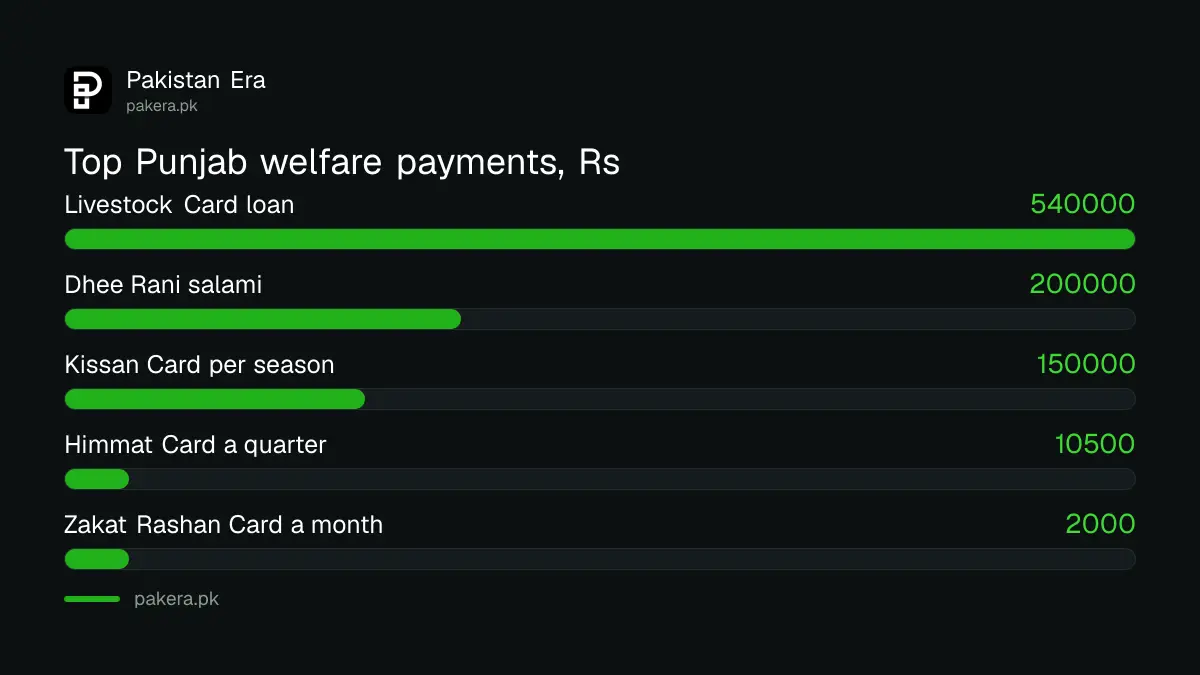
Four Punjab schemes pay regular cash. The Himmat Card and the Minority Card each pay Rs 10,500 every three months. The Ration Card pays Rs 3,000 a month to registered workers, and the Zakat Rashan Card pays Rs 2,000 a month to the very poor.
The Punjab Himmat Card needs a disability certificate from Social Welfare Punjab, an assessment that the person is not fit to work, and a poverty score of 45 or less. You check status with the disabled person's CNIC on the DPMIS portal. The helpline is 1312.
The Minority Card is for Christian, Hindu, Sikh and other non-Muslim families with a poverty score of 45 or below. It is run by the Human Rights and Minorities Affairs Department, and the number of cards went up from 75,000 to 100,000 families.
The Ration Card has no open form. A worker gets it by being on the Punjab Employees Social Security Institution (PESSI) register through the employer. The Zakat Rashan Card works the other way: you apply at the Local Zakat and Ushr Committee where you live. The committee decides if you are a mustahiq, a person entitled to Zakat.
Housing schemes give a loan on your own plot or a free plot
Punjab has two housing schemes for poor families. Apni Chhat Apna Ghar lends up to Rs 1.5 million with no markup to build on a plot you own, repaid over 7 years. Apni Zameen Apna Ghar gives a free 3 marla plot to landless families by computer ballot.
Both are run by the Punjab Housing and Town Planning Agency, and both use the same helpline, 0800-09100. There is no fee for either. A second window, Apni Chhat Mehfooz Chhat, lends for roof repairs or an extra room on a house you already have. The Apni Chhat Apna Ghar loan is applied for online at acag.punjab.gov.pk.
Plots under Apni Zameen Apna Ghar are never sold. Anybody who asks for money to move you up the ballot is running a scam.
Farmers have three cards and a tractor subsidy
The Kissan Card gives Punjab farmers with up to 12.5 acres an interest-free loan of up to Rs 150,000 a season for seed and fertiliser. The Livestock Card lends up to Rs 540,000 for feed. The Green Tractor Scheme pays Rs 1 million towards a tractor.
To join the Punjab Kissan Card, send PKC and your CNIC number to 8070. The card buys inputs only. It does not give cash. Each season's loan must be repaid before the next one is credited.
The Green Tractor Scheme needs verified ownership of at least 7 acres. It covers tractors of 75 to 125 horsepower. The Livestock Card is first come, first served, and its season was closed in late September 2026. For the full set of farm loans and machinery schemes, the Punjab agriculture schemes for farmers list every one.
Brides, widows and mothers get one-time or staged payments
The Dhee Rani Programme pays each poor bride Rs 200,000 as salami and Rs 121,000 as a gift at a mass wedding. The Rahmat Card paid widows Rs 100,000 to Rs 150,000 once, but payments stopped on 18 September 2026. Aaghosh pays mothers up to Rs 38,000.
Dhee Rani registration is at cmp.punjab.gov.pk, with help on 1312. Both Dhee Rani payments come on a Bank of Punjab ATM card.
The Rahmat Card is run by the Punjab Zakat and Ushr Department. The department says a second phase is expected but has not given a date. Its help line is 1077.
Aaghosh pays in seven parts, tied to clinic visits, a safe delivery and vaccines. It runs in 13 districts only. You register at the nearest public health centre with a valid CNIC. The helpline is 1221. The Punjab Social Protection Authority runs it, along with Masawaat and other cash programmes in the Punjab Social Protection Authority programmes.
Business owners can borrow up to Rs 1 million with no interest
The Asaan Karobar Card gives a small business an interest-free limit of up to Rs 1 million on a Bank of Punjab card. Applicants must live in Punjab and be 21 to 57. The processing fee is Rs 500, and the helpline is 1786.
The annual card fee of Rs 25,000 plus FED is taken from the limit. Only 25 per cent can be drawn as cash. The rest must go to suppliers, bills and taxes. Full rules are in the Asaan Karobar Card details.
How to apply for any Punjab welfare scheme
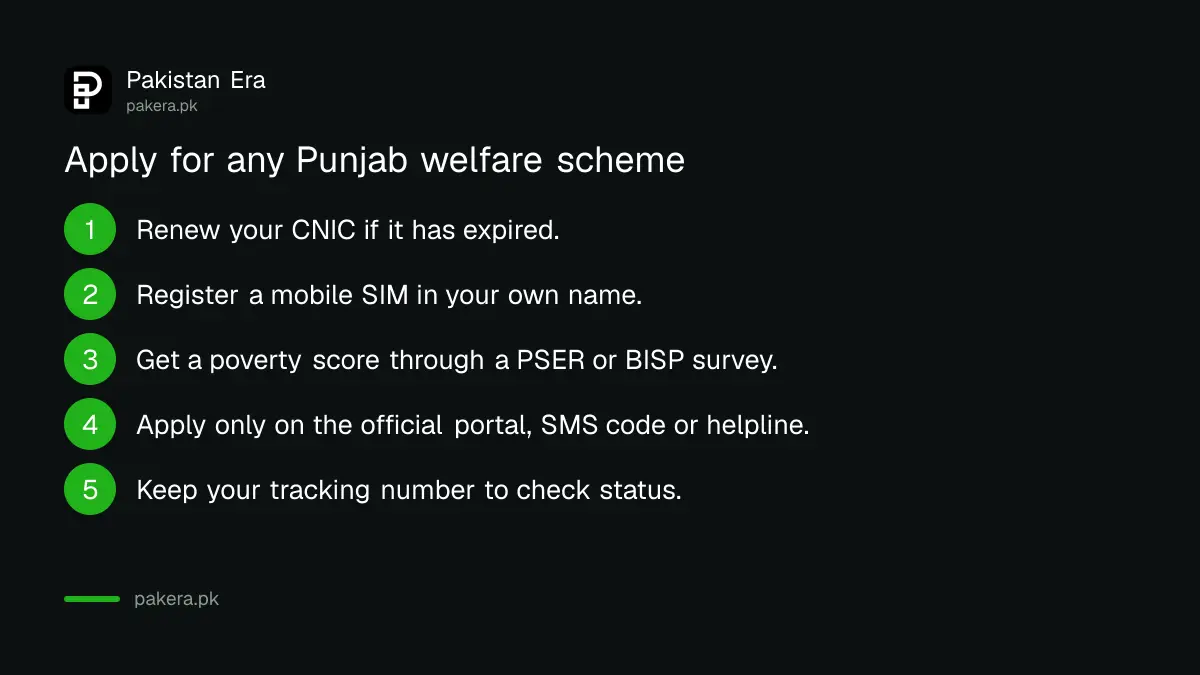
Most Punjab schemes need a valid CNIC, a SIM in your own name and a poverty score from the Punjab Socio-Economic Registry (PSER) or BISP. Get those three in order before a window opens, then apply only on the official portal or helpline.
- Renew your CNIC if it has expired. An expired card stops most payments.
- Register a mobile SIM in your own name. Selection messages go to that number.
- Get your household surveyed in PSER, or update your BISP survey, so you have a poverty score.
- Pick the scheme from the table above and use only its official portal, SMS code or helpline.
- Keep your tracking number or SMS. You need it to check status later.
Never pay an agent. No Punjab scheme on this list charges a registration fee, except the Rs 500 Asaan Karobar processing fee paid through the bank. Calls asking for a fee to release a Himmat Card or a ballot plot are fraud.
Common questions
Which Punjab scheme pays the most?
As a loan, Apni Chhat Apna Ghar at up to Rs 1.5 million with no markup. As a grant, the Dhee Rani Programme, with Rs 200,000 salami and a Rs 121,000 gift for each bride.
Can I get BISP and a Punjab scheme together?
Often yes, because BISP is federal and these are provincial. But some Punjab schemes, such as the Himmat Card, exclude people who recently took a grant from BISP, Zakat or Bait-ul-Maal. Check each scheme's own rules.
What is a PMT or poverty score?
It is a number from a household survey that ranks how poor a family is. A lower score means poorer. The Himmat Card and Minority Card need 45 or less.
Is the CM Punjab Free Solar Scheme open?
No. Registration is closed. If you registered, check your ballot result on the scheme portal with your electricity bill reference number.
Is the Punjab Rahmat Card paying now?
No. Payments stopped on 18 September 2026. The Zakat department says a second phase is expected. Call 1077 for status.
Where do I complain if a Punjab scheme ignores me?
Use the scheme's own helpline first, such as 1312 for Social Welfare or 0800-09100 for housing. If that fails, complain on the Pakistan Citizen's Portal or the Maryam Ko Batayn line, 1000.
How we verified this
What we checked and where we read it.
This list was compiled on 17 November 2026 from our individual Punjab scheme guides, each checked against the department's own portal or notice between 28 September and 12 November 2026: the Social Welfare Department's Himmat Card page and DPMIS portal, mcard.punjab.gov.pk, PESSI, the Punjab Zakat and Ushr Department (zakat.punjab.gov.pk, rahmatcard.punjab.gov.pk), cmp.punjab.gov.pk, the Punjab Social Protection Authority, acag.punjab.gov.pk and the Apni Zameen Apna Ghar portal, the Agriculture Department's Kissan Card, Green Tractor and Livestock Card portals, the Punjab Small Industries Corporation and the Punjab Energy Department's solar scheme portal. Official sources: Government of Punjab and Punjab Zakat and Ushr Department.
About the author
Public Services and Education Journalist
Fajr Riaz is a journalist and content writer at Pakistan Era, based in Lahore. She covers the questions people meet in everyday life in Pakistan: how a public service works, what a change in the rules means, and where to find a reliable answer.