How to Report Police Torture in Pakistan: FIA Complaint, Magistrate Medical Order and Court of Sessions
Police torture in Pakistan goes to the FIA under the 2022 Act, not the police. Call 1991, ask the magistrate for a medical order, or go to a Sessions Court.
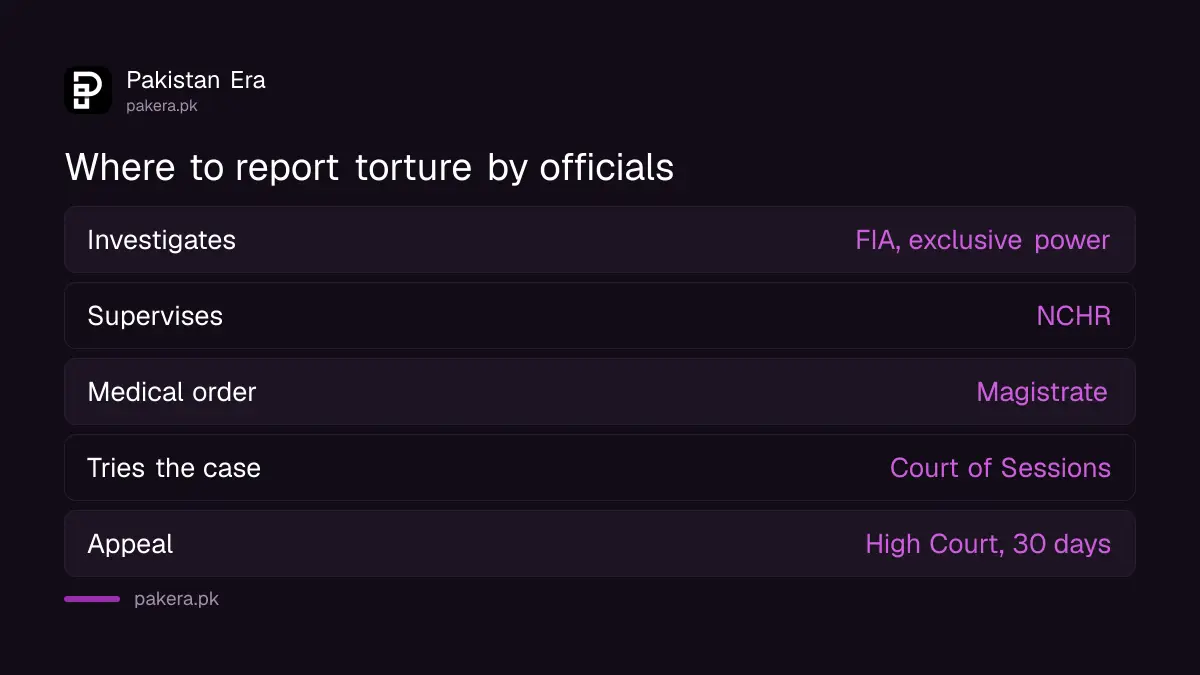
To report torture by the police or any official in Pakistan, complain to the Federal Investigation Agency (FIA), not to the police. The Torture and Custodial Death (Prevention and Punishment) Act, 2022 gives the FIA exclusive power to investigate it, under the supervision of the National Commission for Human Rights (NCHR). Call the FIA helpline 1991 or 051-111-345-786, or email complaints@fia.gov.pk.
If the FIA drops the case, you can still file a private complaint in the Court of Sessions, which alone tries these offences. The Lahore High Court confirmed that route in a ruling uploaded on 11 November 2026. Each step is set out below.
Who investigates police torture in Pakistan
The FIA investigates every complaint of torture by a public official under section 5(1) of the 2022 Act, "notwithstanding anything" in any other law. The NCHR supervises that work. The idea is that police officers are not investigated by their own department.
"Public official" in the Act means anyone whose office lets them hold a person in confinement, and any officer whose duty is to prevent or investigate crime. So it covers police, but also jail staff and other officials with power to detain. "Custody" is wide too: it includes judicial custody, any restraint on movement, and a person being searched, arrested or having property seized.
| Offence under the 2022 Act | Punishment | Bail status |
|---|---|---|
| Torture (section 8) | Same as the matching hurt offence in Chapter XVI of the Pakistan Penal Code | Cognizable, non-compoundable, non-bailable |
| Custodial death (section 9) | Same as section 302 PPC (murder) | Cognizable, compoundable, non-bailable |
| Custodial rape (section 10) | Under the law for rape | Cognizable, compoundable, non-bailable |
| Using a confession taken by torture (section 3) | Up to 1 year or fine up to Rs 100,000, or both | Not stated in the Act |
How to file a torture complaint with the FIA
Under the Act a complaint can be oral or written, and any person with reliable information can file it, not just the victim. Put it in writing if you can, with dates, places, names or ranks of officials, and any medical report. Keep a copy with the FIA's receipt.
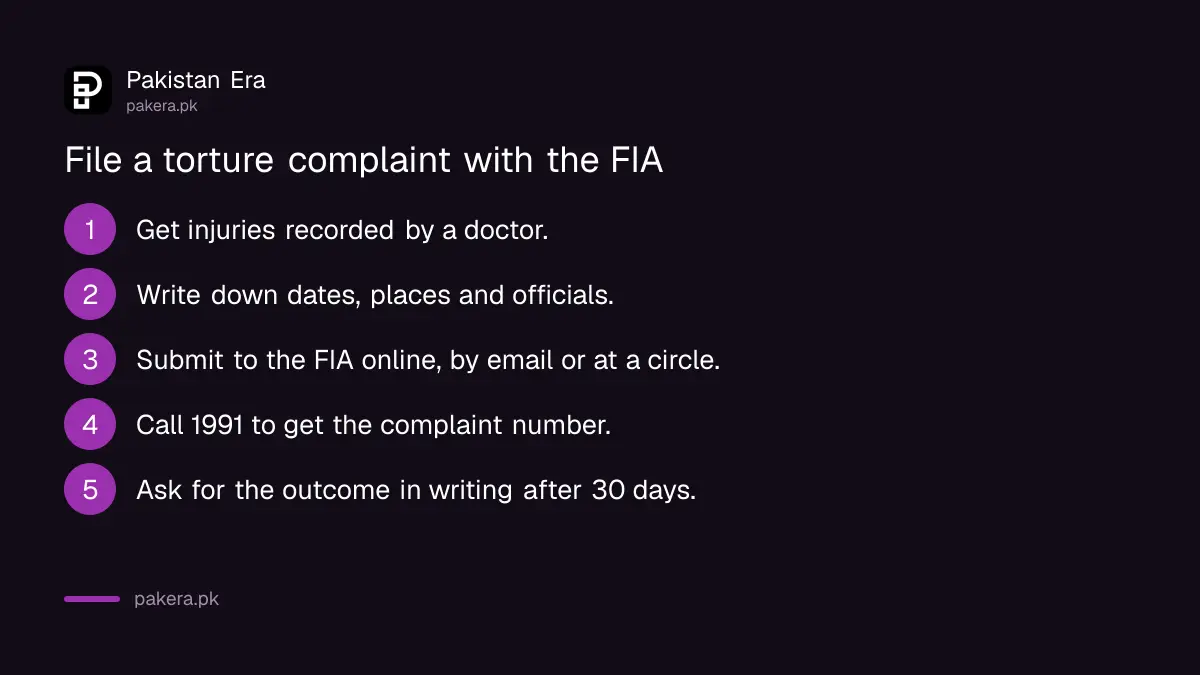
- Get medical help first. Ask the doctor to record every injury and the date.
- Write down what happened: the date and time of arrest, where the person was held, who was present, and what was done.
- Submit the complaint to the FIA through its online complaint portal on fia.gov.pk, by email to complaints@fia.gov.pk, or at an FIA circle office.
- Call 1991 or 051-111-345-786 to ask which circle has your complaint and its number.
- Attend when the FIA calls you, and hand over your evidence and witness names.
- Ask for the outcome in writing. Under the Act, the investigation must finish within 30 days of the complaint.
If the delay runs past 30 days, section 13 lets the FIA give at most five more days or move the case to another officer. It must also file an interim report in the Court of Sessions, which can start the trial on that basis.
A magistrate must order a medical check
If a person in custody tells a magistrate they were tortured, section 5(2) requires the magistrate to order a medical examination. If it shows torture, the magistrate must notify the FIA. This applies at any time, including during a remand hearing.
So if your relative is produced in court for physical remand, tell the magistrate about any torture at that hearing, or ask the lawyer to. Ask for the medical order in writing. Remand limits themselves are covered in checking the 15 day police remand limit.
Two more protections in the Act are worth knowing. A woman cannot be detained to get information about someone else, and only a female official may take a woman into custody. And any confession obtained by torture cannot be used as evidence against the person who made it.
If the FIA drops your complaint, go to the Court of Sessions
The Court of Sessions has exclusive power to try offences under the Act. If the FIA closes the inquiry, you can file a private complaint there with your evidence. The court can record witnesses and summon the accused officials if a case is made out.
The Lahore High Court spelled this out in a case from Faisalabad (Writ Petition No. 8238 of 2026). A man said his brother was abducted and tortured by police officers in May 2024. The FIA held an inquiry and its Director in Faisalabad dropped it. The High Court refused to order the FIA to register a case, but said the family was free to file a private complaint in the Court of Sessions, to be decided on its own merits.
The court also explained how the FIA decides. Under the FIA's 2002 inquiry rules, a designated authority, graded by the accused official's pay scale, must give permission before a case is registered. If it refuses, it must record its reasons, and that refusal can be challenged in court. A medical certificate on its own proves injuries, the court added, but not who caused them.
| Your situation | Where to go |
|---|---|
| Torture just happened, person still in custody | Tell the magistrate at the next hearing; FIA complaint |
| Person released with injuries | Medical record, then FIA complaint |
| FIA inquiry dropped | Private complaint in the Court of Sessions |
| Witness or victim threatened | Protection petition in the Court of Sessions, decided in 3 days |
| Death in custody | Magistrate inquiry and FIA complaint |
A death in custody has extra steps, set out in what a family must do after a death in police custody.
Protection, appeals and false complaints
A victim, complainant or witness who is threatened can petition the Court of Sessions for protection, and the court must decide within three days. Appeals go to the High Court within 30 days. A complaint proved to be malafide is punished like torture itself.
Trial must finish within three weeks of the challan reaching the court, and an appeal must be decided within 30 days. An official accused of torture can be suspended or transferred once a departmental enquiry, finished within seven days, finds prima facie evidence. The Act also keeps any civil claim for damages open alongside the criminal case. If you cannot afford a lawyer, see getting a free lawyer through legal aid in Punjab.
Common questions
Can I file a torture complaint at the police station?
The 2022 Act gives the FIA exclusive power to investigate torture complaints against public officials. A complaint of custodial torture is not handled as an ordinary FIR at a police station, the Lahore High Court said.
What is the FIA helpline for complaints?
The FIA lists 1991 and 051-111-345-786 as its helpline, and complaints@fia.gov.pk as its complaints email. It also runs an online complaint portal on its website.
Can the High Court order the FIA to register a torture case?
In the Faisalabad case, it refused. It said the FIA's designated authority decides on registration, and the right remedy after a closure was a private complaint in the Court of Sessions.
Is torture a bailable offence?
No. Section 8 makes torture by a public official cognizable, non-compoundable and non-bailable. Custodial death and custodial rape are also non-bailable.
How long does the FIA have to investigate?
Thirty days from the complaint under section 13, with at most five more days if the delay is explained. The FIA must also file an interim report in the Court of Sessions.
What is the role of the NCHR?
The National Commission for Human Rights supervises the FIA's investigation of these complaints under section 5(1), and can also receive human rights complaints itself.
How we verified this
What we checked and where we read it.
We read the full text of the Torture and Custodial Death (Prevention and Punishment) Act, 2022 (Act XXVIII of 2022) on 17 November 2026 in the updated copy published by the Sindh Judicial Academy. The helpline, email and complaint portal are from the FIA's own website, read the same day. The Lahore High Court judgment in W.P. No. 8238 of 2026, Justice Muhammad Jawad Zafar, hearing 30 October 2026, was uploaded on 11 November 2026 to the court's reported judgments page as file 2026LHC8659. Section numbers follow the Act; note that the Act's contents list in that copy skips section 5, which appears in the text.
About the author

Global Affairs & Political Economy Writer
Muhammad Hatim is a book lover who started writing because he enjoys it. At Pakistan Era he writes about international relations, geopolitics and the global economy, with a particular interest in South Asia and the forces behind current events.