How to Check Police Remand in Pakistan: The 15 Day Limit Explained
A relative sent on police remand? Section 167 allows 15 days in total and the magistrate must record reasons. Check the dates, the order and what to ask for.
Police can hold an arrested person for at most 24 hours before a magistrate must see them. After that, a magistrate can allow detention for no more than 15 days in total. That is the rule in sections 61 and 167 of the Code of Criminal Procedure. If your relative is in remand, check three things: the date, the magistrate's reasons and the days used so far.
This guide explains what remand is, how to count the days, and what a family can ask for. It is general information and not legal advice, so use a lawyer for the actual application.
Understand what remand means after the first 24 hours
Remand means the court allows an arrested person to stay in custody while the police investigate. It is not a finding of guilt. A magistrate gives it for a limited time, and the police have to justify each request.
Section 61 says a person arrested without a warrant cannot be held for longer than is reasonable, and without a magistrate's order not more than 24 hours, not counting the journey to court. Section 167 is the next step. The police send the case diary to the nearest magistrate and produce the accused.
Our guide to your rights when arrested in Pakistan covers the 24 hour rule in Article 10 of the Constitution. This guide starts where that one ends.
Count the 15 days from the magistrate's first order
Section 167(2) says the magistrate may authorise detention from time to time for a term not exceeding fifteen days in the whole. The limit is a total across all orders. Three days now and twelve later is the maximum. Fifteen plus another fifteen is not allowed.
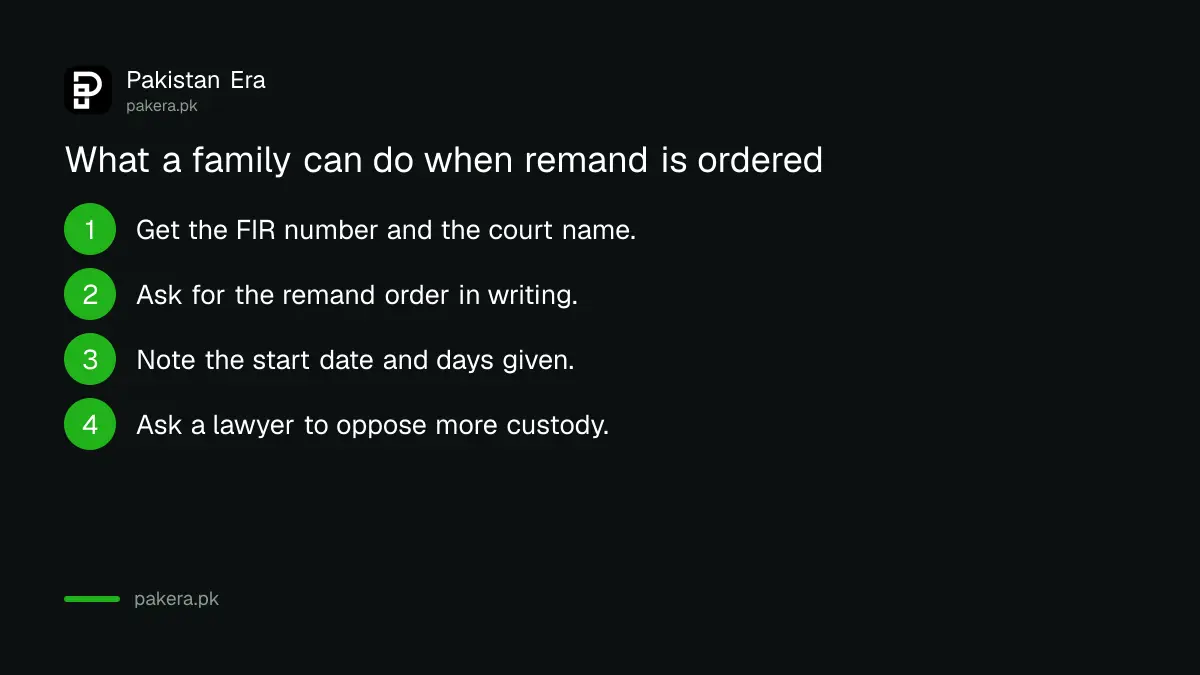
Ask for the remand order and read three things on it: the date it started, the number of days given and whether it says police custody or judicial custody. Write the running total on a piece of paper. Keep every order in one folder.
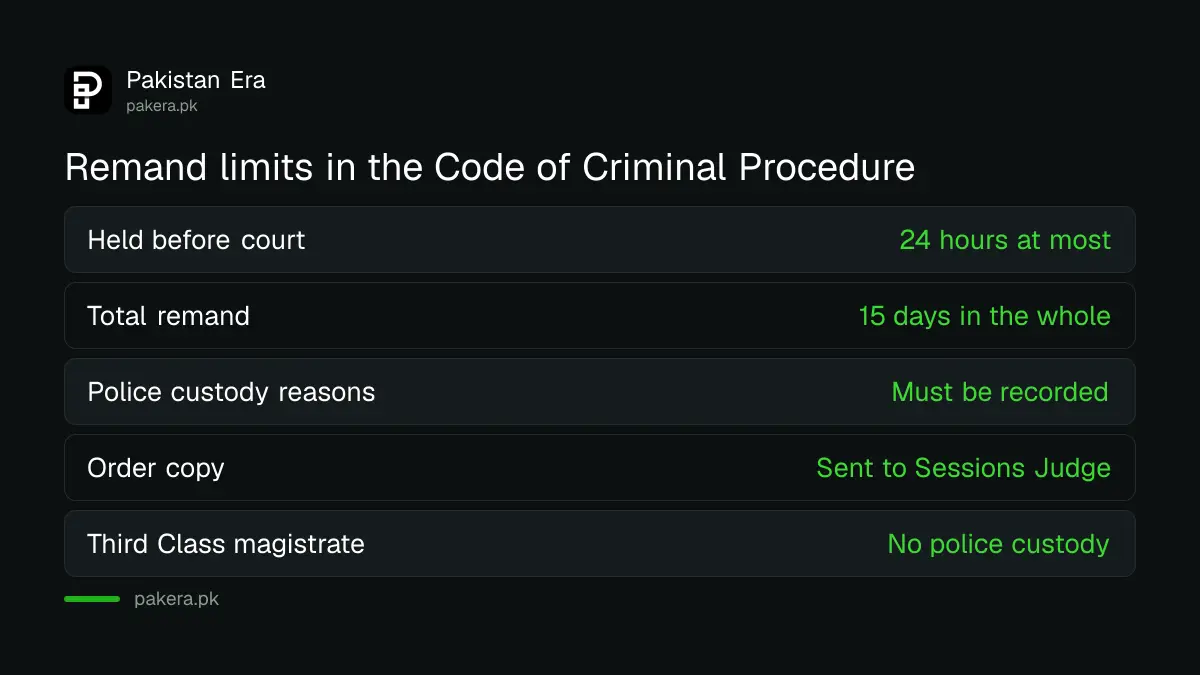
| Question | What section 167 says |
|---|---|
| Longest total detention on remand | 15 days in the whole |
| Reasons for police custody | The magistrate must record them |
| Copy of the order | Sent to the Sessions Judge with reasons |
| Third Class magistrate | Cannot authorise police custody |
| Second Class magistrate | Only if specially empowered by the province |
Ask the right questions at each remand hearing
Section 167(3) says a magistrate who sends a person to police custody must record the reasons. That gives the defence something to examine. A lawyer can ask what the police still need, whether the person has already been questioned and whether jail custody would serve.
The law also adds special rules for women. If the accused is female, the magistrate cannot send her to police custody except in cases of murder or dacoity, and reasons must be written. Police must question her in the prison, with a jail officer and a female police officer present. She cannot be taken out of prison between sunset and sunrise.
Note that these details come from the text of the Code as we read it, and provinces have changed parts of procedure. Check the current wording with a lawyer.
Know what the police must do when evidence is thin
Section 169 says that if the investigation shows no sufficient evidence or reasonable ground of suspicion, the officer shall release the accused on a bond, with or without sureties. Police are expected to apply this before asking for more remand.
If remand ends and the case continues, the usual next step is a bail application. The guide to getting bail in Pakistan explains which offences carry bail as of right. A family can also look up the case with the guide to checking an FIR online.
- Find out the police station, FIR number and the court where the person was produced.
- Get the remand order and note the start date and days given.
- Keep a running count against the 15 day total.
- Ask a lawyer to oppose extra police custody or to seek bail.
- If the limit is passed, raise it in writing with the magistrate and the Sessions Judge.
If you cannot afford a lawyer, see the guides to free legal aid in Punjab and free legal aid in Khyber Pakhtunkhwa. A child has extra protections, covered in the guide to the rights of an arrested child.

Common questions about police remand
Can police keep someone for 15 days without a court?
No. Police can hold a person for 24 hours at most, plus travel time. Any longer detention needs a magistrate's order under section 167. A family should ask for the order if anyone is held beyond a day.
Is 15 days the limit for each hearing or in total?
It is a total. Section 167(2) says a term not exceeding fifteen days in the whole. The magistrate can give it in parts, but all parts together cannot go beyond 15 days.
What is the difference between police custody and judicial custody?
In police custody the accused stays with police for questioning. In judicial custody the accused is held in jail under the court's control. A magistrate must record reasons for police custody.
What happens after remand ends?
The police must forward the matter to court, and the accused is usually sent to jail custody or released on bail. The accused can apply for bail at that stage with a lawyer.
Do these rules apply to every province?
The Code of Criminal Procedure is a national law, but provinces make rules about procedure and some sections have been amended. Ask a local lawyer whether any change applies to your case.
How we verified this
What we checked, where we read it, and what we could not confirm.
Last checked 8 October 2026. We read sections 60, 61, 167 and 169 of the Code of Criminal Procedure 1898 on 8 October 2026 in a published copy of the Code. The Pakistan Code website did not give us the Code on that day, so we could not confirm against the official copy whether later changes affect these sections. The 24 hour rule in Article 10 of the Constitution is covered in our guide to rights on arrest, which cites the text published by the National Assembly.
About the author

Tax, Bills and Technology Writer
Ali Akhtar is a young and curious voice here at Pakistan Era. He is currently pursuing his A-Levels and has a growing interest in Pakistan’s changing industrial landscape and educational trends. Ali likes to write in a way that helps him explain and explore the world around him. His writing reflects the perspective of the new generation navigating the evolving trends of Pakistan where technology, youth innovation, and shifting opportunities are reshaping the country’s future.