How to Get a Free Lawyer in Khyber Pakhtunkhwa
Get a free lawyer in Khyber Pakhtunkhwa through the KP Legal Aid Agency or your district judge's committee, which pays up to Rs 50,000. Who qualifies and how.
There are two official ways to get a free lawyer in Khyber Pakhtunkhwa. The KP Legal Aid Agency, now run by the Director General Prosecution, serves people accused of a crime and women in family cases. The District Legal Empowerment Committee, chaired by your District and Sessions Judge, can pay up to Rs 50,000 for a lawyer in any case. You apply on plain paper with your CNIC.
Update, 10 October 2026: The Supreme Court has started a 1818 call centre for free legal advice. Callers can also ask for a free lawyer through it. Read the update.
Both routes are for people who cannot afford a lawyer. Neither has an online form. You apply in person or through the jail, the court or the prosecutor's office.
We read the Khyber Pakhtunkhwa Legal Aid Act, 2019 on the KP Code, its 2025 amendment in the KP Government Gazette, and the District Legal Empowerment Committee rules on the Law and Justice Commission of Pakistan website. We checked all three on 3 October 2026.
Two free lawyer schemes in KP, compared
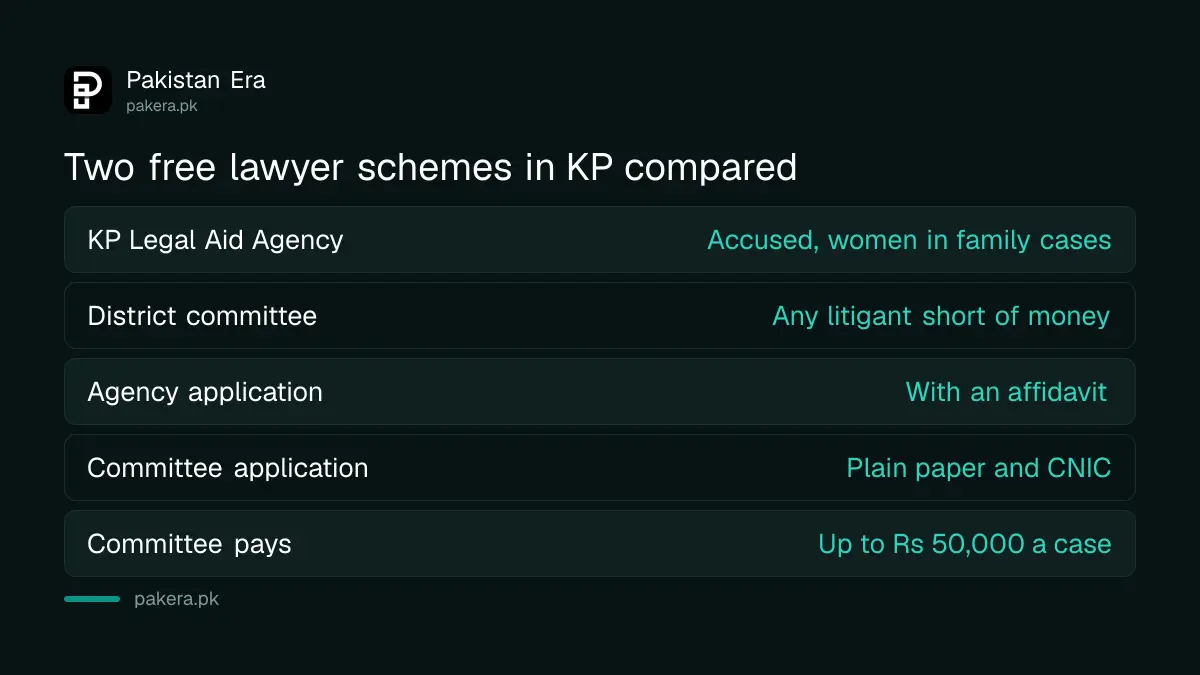
The KP Legal Aid Agency covers two groups: people accused of an offence, and women in family disputes. The District Legal Empowerment Committee, or DLEC, covers any "deserving litigant" in a civil or criminal case. It also pays court fees and copying charges.
| Point | KP Legal Aid Agency | District Legal Empowerment Committee |
|---|---|---|
| Law | KP Legal Aid Act, 2019 | DLEC Rules, 2011, amended 2025 |
| Who it helps | Accused persons, and women in family cases | Any litigant with limited money |
| Who decides | Director General of the Agency | Committee chaired by the District and Sessions Judge |
| How to apply | Application with an affidavit | Plain paper letter with CNIC |
| What it pays | A panel advocate's fee | Lawyer up to Rs 50,000, court fee, copies, process fee |
| If refused | Appeal within 7 days | Decision final, but you can reapply |
You do not have to pick the right one on the first try. If one route turns you down, the other may still help. A woman in a khula case qualifies for both.
Who qualifies under the KP Legal Aid Act
Section 2 of the KP Legal Aid Act, 2019 defines an "indigent person". It means someone involved in an offence, or a woman in a family dispute, who cannot afford an advocate. Family disputes here mean divorce, maintenance, dowry, haq mehr and child custody.
So a man facing a criminal charge qualifies if he cannot pay. A woman claiming maintenance qualifies. A man in a civil land dispute does not, under this Act. For him, the DLEC is the route.
Section 14 puts a duty on officials too. A court, an investigating officer, a prosecutor or a prison officer who learns that a poor person has no lawyer must tell that person they can apply for legal aid. If you are held in a police station and nobody has said this, ask. Seeing a lawyer is one of your rights when arrested.
The Act changed in September 2025. The KP Legal Aid (Amendment) Act, 2025, published in the Gazette on 19 September 2025, made the Director General Prosecution the head of the Agency. It also set up a special legal aid wing inside the Directorate of Prosecution.
How to apply to the KP Legal Aid Agency
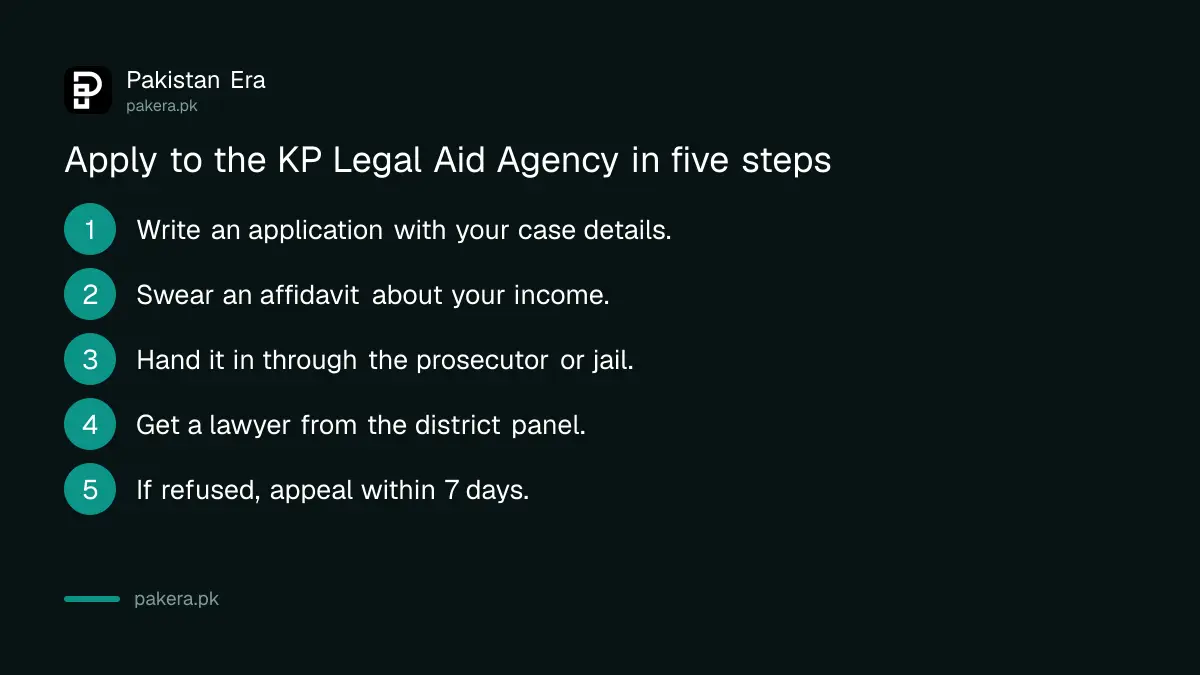
Under section 9, you apply to the Agency with an affidavit and the documents the rules ask for. The Director General decides. If you are refused, you can appeal to the Secretary of the Home and Tribal Affairs Department within seven days of being told.
- Write the application. Give your name, CNIC, address, the case or charge, the court, and why you cannot pay a lawyer.
- Swear an affidavit. Confirm your income and that the facts are true. Do not overstate your need.
- Hand it in. Submit it through the District Public Prosecutor's office, the jail, or as the office directs.
- Wait for the decision. If approved, a lawyer from the district panel is given your case.
- Appeal if refused. Write to the Secretary, Home and Tribal Affairs Department, within 7 days.
Where exactly to hand it in is the one thing we could not confirm on an official page. It was reported in August 2026 that applications are taken at District Public Prosecutor offices, jail superintendents' offices, and Deputy and Assistant Commissioners' offices. The rules under the Act were not on the KP Code when we checked.
A false affidavit is a crime. Section 16 sets a prison term of at least seven days and up to six months. The Agency can also take the lawyer back at any stage if you misstated your means.
How to apply to the District Legal Empowerment Committee
Write a letter on plain paper to the Chairperson, District Legal Empowerment Committee, at the District and Sessions Judge's office. Attach a copy of your CNIC. Say what your case is and what you need paid. The committee meets at least once a month to decide.
Rule 7 of the DLEC rules sets out the process. Your application is given a diary number. The judge may send someone to check your finances. The committee then decides whether you qualify and how much help to give.
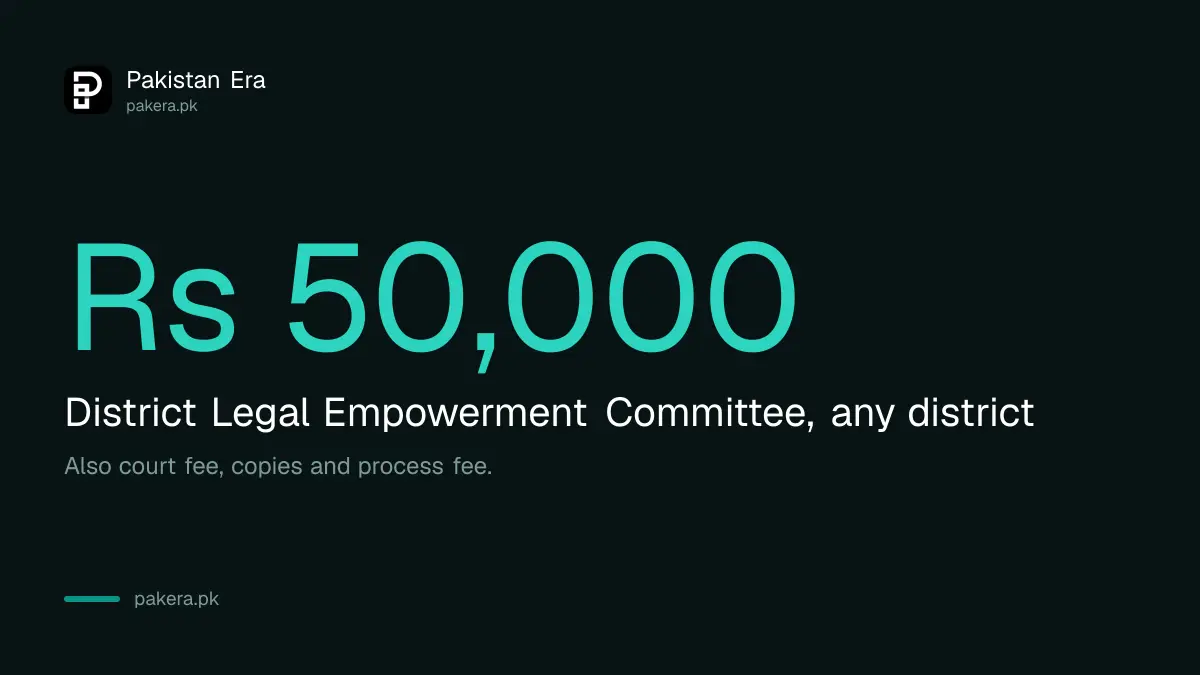
- Lawyer's fee: up to Rs 50,000 per case, set by the committee.
- Court fee: the fee stamped on your case papers.
- Copying charges: certified copies of orders and records.
- Process fee: the cost of sending summons and notices.
Prisoners do not have to write themselves. The jail superintendent can forward an application after checking it. A court can also refer someone whose case is already before it. Ask the judge at your next hearing.
The committee is made up of the District and Sessions Judge, the Deputy Commissioner, the jail superintendent, the president of the district bar association and one civil society member. Lawyers on its list need at least three years at the bar.
One limit matters. You cannot get DLEC help if a lawyer, public prosecutor or government pleader is already appointed for you in the same case. If you are refused, you can apply again later with proof that your money situation has got worse.
Check the lawyer and follow your case
A free lawyer is still your lawyer. Get their name and phone number, check their licence, and attend every hearing. Follow your case dates yourself. If the lawyer does not turn up, tell the committee or the Agency, which can replace them.
The DLEC rules let the committee swap a lawyer whose work is poor and drop them from the list. The Legal Aid Act tells the Agency to monitor each panel advocate's work. The DLEC pays its lawyer in two instalments, the second only after the case is decided, so the lawyer has a reason to finish.
You can verify a lawyer's licence with the bar council before the first meeting. You can also check your court case status online to see hearing dates. If a lawyer takes money from you for free legal aid work, that is a matter for the bar council, and the steps to complain against a lawyer apply.
Common questions
Is legal aid in KP only for criminal cases?
No. The KP Legal Aid Act covers accused persons and women in family disputes. The District Legal Empowerment Committee can help in any civil or criminal case.
How much will the DLEC pay my lawyer?
The committee sets the fee case by case, up to Rs 50,000 per case under the 2025 amended rules. It can also pay court fees, copying charges and process fees.
Can I apply online for a free lawyer in KP?
Not that we found. Neither the Agency nor the DLEC has an online form on an official site. You apply on paper.
Can a man get free legal aid in a family case in KP?
Not under the KP Legal Aid Act, which covers only women in family disputes. A man with limited money can apply to the District Legal Empowerment Committee.
What happens if I lie about my income?
Under section 16 of the KP Legal Aid Act, a false affidavit can mean seven days to six months in prison, and the lawyer can be withdrawn.
Who decides a DLEC application?
The committee, chaired by the District and Sessions Judge, at its monthly meeting. Its decision is final, but you can reapply if your finances get worse.
How we verified this
What we checked, where we read it, and what we could not confirm.
Last checked on 3 October 2026. Who qualifies, the affidavit, the Director General's decision, the 7 day appeal, the district panels, the duty of courts and officials to tell people about legal aid, and the penalty for a false affidavit are read in the Khyber Pakhtunkhwa Legal Aid Act, 2019 on the KP Code, as amended. The Director General Prosecution's role is read in the KP Legal Aid (Amendment) Act, 2025, KP Government Gazette, 19 September 2025, on the Provincial Assembly website. The DLEC process, members, Rs 50,000 cap and what it pays are read in the District Legal Empowerment Committees Rules, 2011, amended 2025 on the Law and Justice Commission website. The offices that take Agency applications are reported, not confirmed on an official page.
About the author

Public Services and Education Journalist
Fajr Riaz is a journalist and content writer at Pakistan Era, based in Lahore. She covers the questions people meet in everyday life in Pakistan: how a public service works, what a change in the rules means, and where to find a reliable answer.