Death in Police Custody in Pakistan: Magistrate Inquiry and Family Steps
When a person dies in police custody, the nearest Magistrate must hold an inquiry into the cause of death under section 176. See the Code and the family steps.
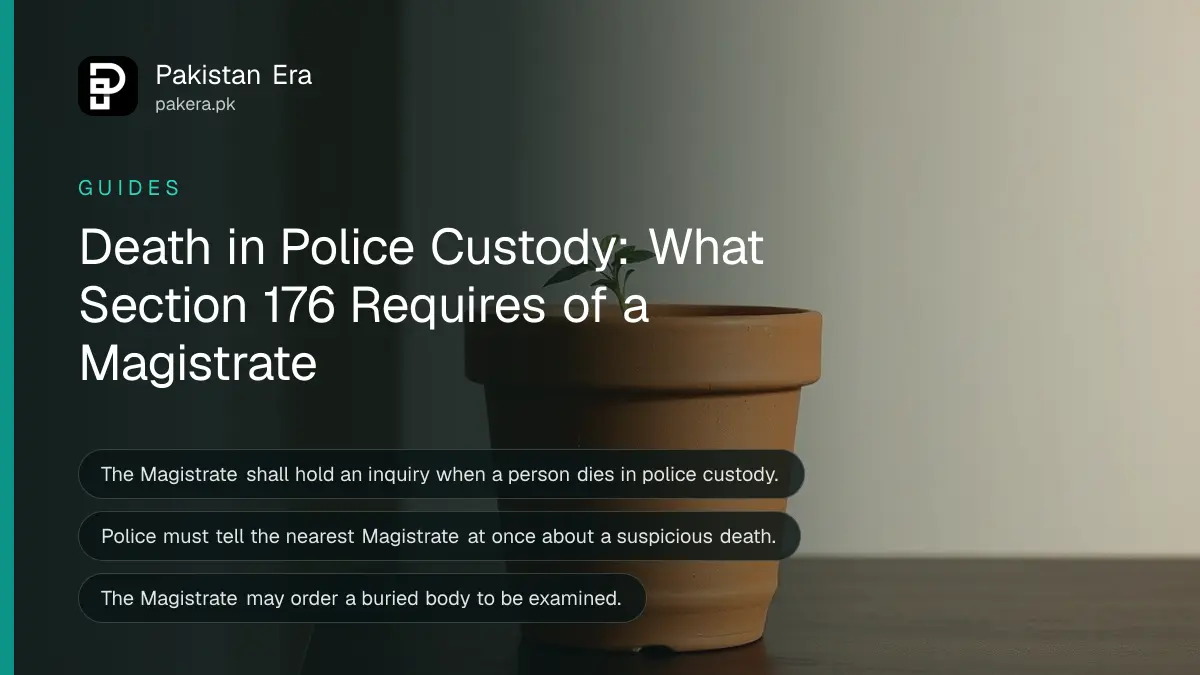
When a person dies in police custody, the nearest Magistrate empowered to hold inquests must inquire into the cause of death under section 176 of the Code of Criminal Procedure. The word in the Code is "shall", so the inquiry is not optional. It is a separate step from any police investigation.
For a family, the first days after such a death are confusing, and papers are easy to lose. We read sections 174, 175 and 176 of the Code of Criminal Procedure, 1898, on 21 October 2026. This page explains what those sections say, not what happened in any case. It states no view on any police force. If you need to report a crime, see how to get an FIR registered when police refuse.
Section 176 makes a Magistrate's inquiry compulsory for custody deaths
Section 176(1) says that when any person dies while in the custody of the police, the nearest Magistrate empowered to hold inquests shall hold an inquiry into the cause of death. In other death cases listed in section 174, a Magistrate may hold an inquiry instead of, or in addition to, the police investigation.
The Magistrate has all the powers he would have in holding an inquiry into an offence. He records the evidence he takes. Section 174(5) says Magistrates of the first class are empowered to hold inquests.
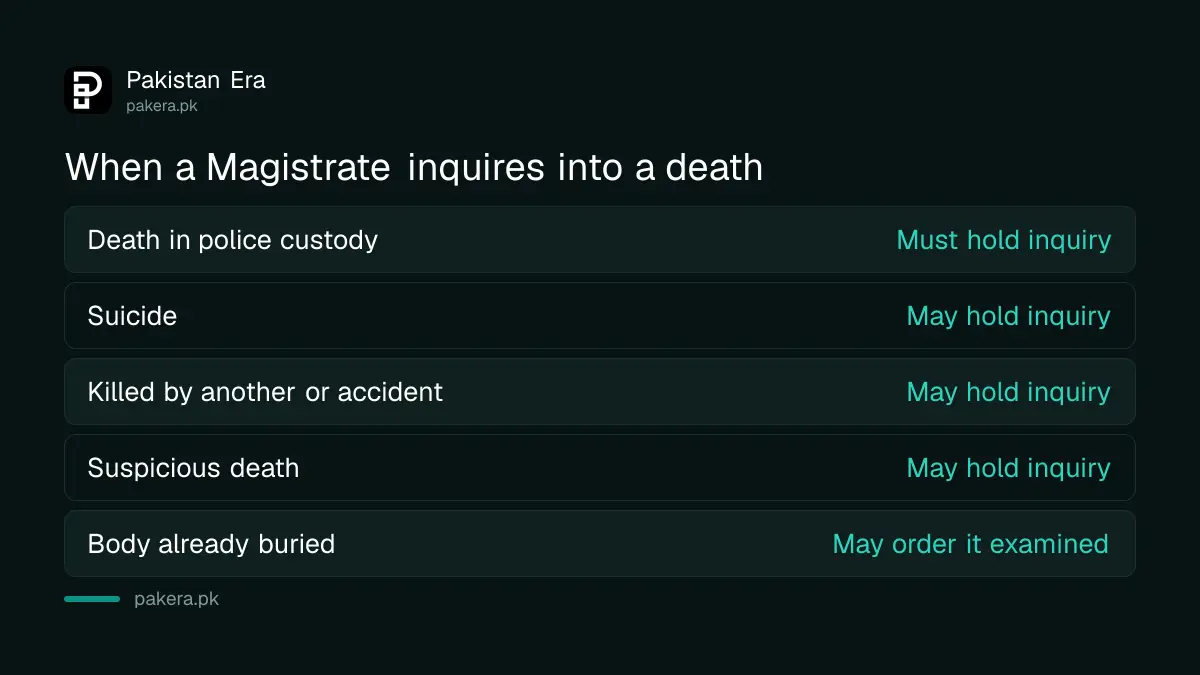
| Death circumstance | Magistrate's inquiry | Section |
|---|---|---|
| Death in police custody | Must be held | 176(1) |
| Suicide | May be held, with or instead of police inquiry | 174(1)(a), 176(1) |
| Killed by another, an animal, machinery or accident | May be held | 174(1)(b), 176(1) |
| Suspicious death | May be held | 174(1)(c), 176(1) |
| Body already buried | Magistrate may order it dug up and examined | 176(2) |
Police must tell the Magistrate at once and record the injuries
Under section 174(1), when police learn of a death by suicide, killing, accident or suspicious circumstances, they must immediately inform the nearest Magistrate empowered to hold inquests. They go to the body and, in the presence of two or more respectable neighbours, draw up a report of the apparent cause of death.
The report must describe wounds, fractures, bruises and other marks of injury and how they appear to have been caused. It is signed by the officer and the others who agree, and sent to the Magistrate. Where the cause is doubtful, the body is sent to a doctor for examination.
Police can summon witnesses for that inquiry, but must not force self-incrimination
Section 175(1) lets police summon two or more such neighbours and anyone who knows the facts. A summoned person must attend and answer truly, except for answers that would expose him to a criminal charge, penalty or forfeiture.
If the facts disclose no cognizable offence of the kind in section 170, section 175(2) says such persons need not attend the Magistrate's court. If you are a family member or neighbour and are summoned, ask for the written order and note the date and time.
A Magistrate can order a grave opened to find the cause
Section 176(2) lets the Magistrate, when he thinks it expedient to examine the body of someone already buried in order to find the cause of death, order the body to be dug up and examined.
If you believe the cause of death is unclear, you can apply in writing to the Magistrate. Do not move or wash the body or alter the scene if you can avoid it. Keep clothing, medical papers, and photographs. These steps are our suggestions, not requirements of the Code.
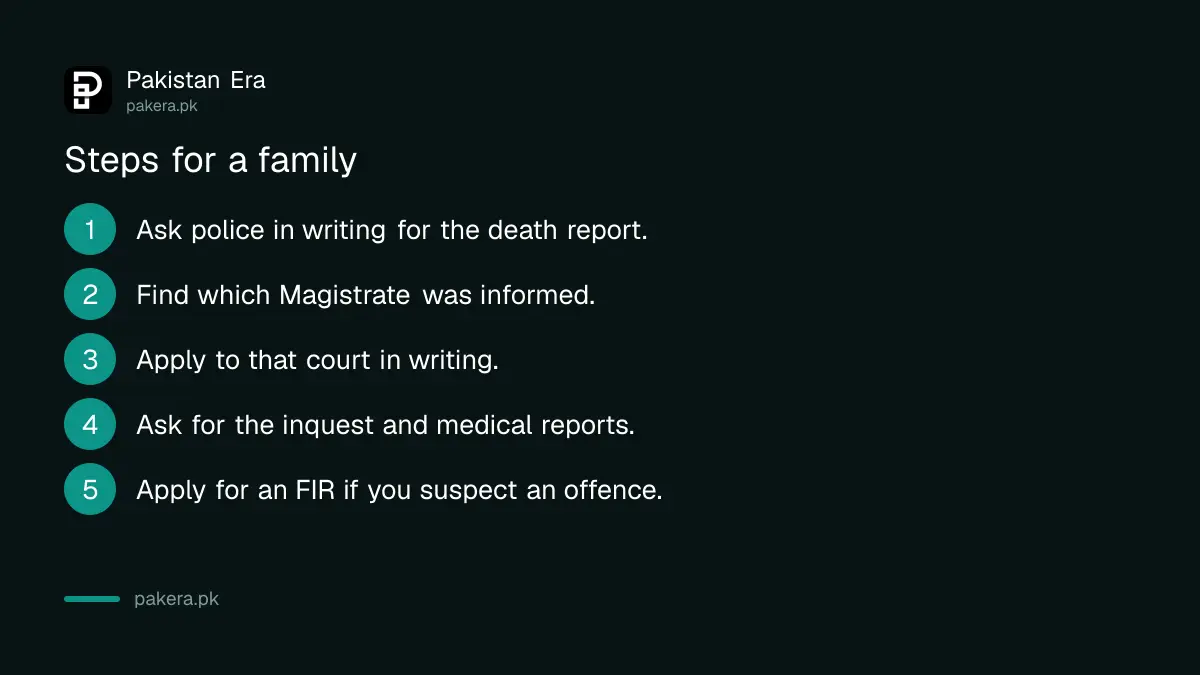
- Ask the police station in writing for the time and place of the death report.
- Find out which Magistrate has been informed and apply to that court in writing.
- Ask for copies of the inquest report and the medical examination.
- Record names of witnesses and the exact times you remember.
- If you believe an offence has occurred, apply to register an FIR.
- Ask a lawyer to appear, or seek free legal aid in Punjab or your province.
Other complaint routes run in parallel
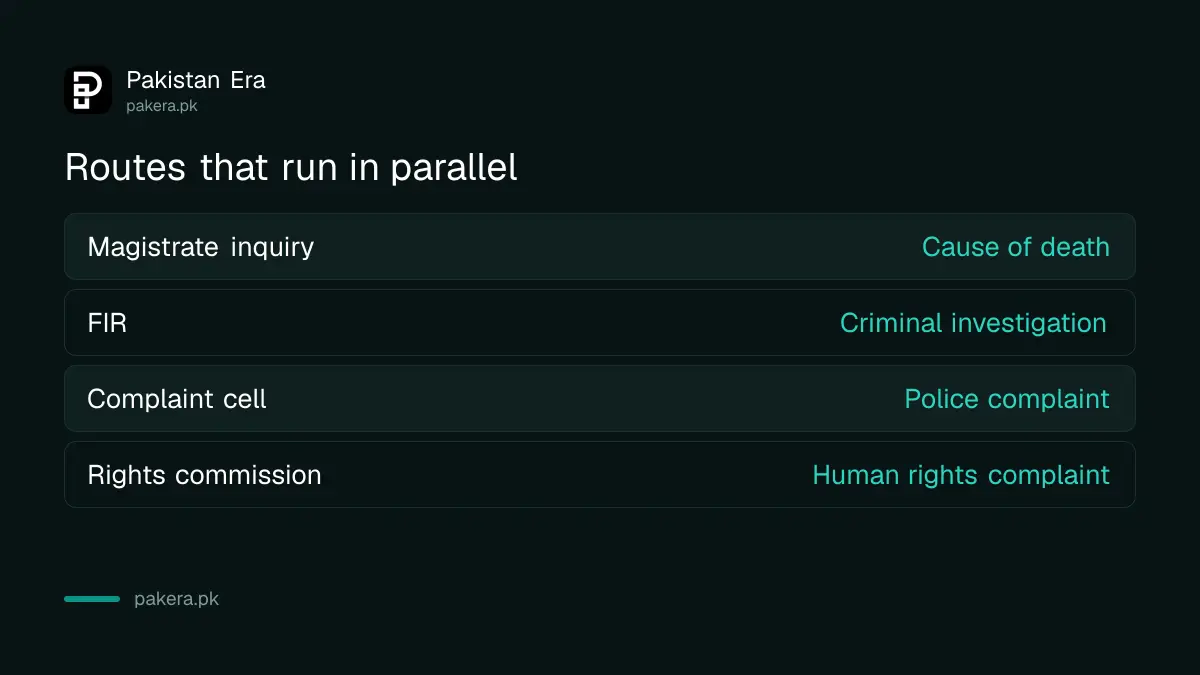
A Magistrate's inquiry does not replace a complaint. You can write to the police complaint cell of your province and to the National Commission for Human Rights. Neither can decide a court's inquiry, and we found no rule that makes one wait for the other.
If you cannot afford a lawyer or need advice, the 1099 human rights helpline gives free legal advice.
Common questions
Who holds the inquiry?
The nearest Magistrate empowered to hold inquests, which section 174(5) says includes Magistrates of the first class.
Is it the same as an FIR?
No. The inquiry examines the cause of death. An FIR starts a criminal investigation. You can ask for both.
Can the grave be opened?
Yes. Section 176(2) lets the Magistrate order it for examination when he thinks it expedient.
Does the Code give a time limit for the inquiry?
Not in the sections we read. We found no deadline.
Where do I get a copy of the report?
Apply to the Magistrate's court. The Code's general section on copies is outside the sections we read, so ask the court office about fees.
How we verified this
What we checked, where we read it, and what we could not confirm.
Last checked 21 October 2026. We read sections 174, 175 and 176 of the Code of Criminal Procedure, 1898, in the Pakistan Code PDF marked as last amended on 16 February 2017, from a copy saved earlier this week. The Pakistan Code portal did not open for us on the day, so later amendments are unchecked. We did not read provincial police rules, court rulings or inquest forms.
About the author

Senior Writer, Public Services and Technology
Shahid joined us in 2024 as an author. He is a senior contributor to Pakistan's leading technology websites. He writes detailed articles, mostly covering his expertise in the latest tech, mobiles, apps, gadgets, and step-by-step guides. His ideology is to help people understand the latest trends and explain complex methods through very easy-to-understand guides.