How to Complain to the National Commission for Human Rights in Pakistan: Free, by Email or at 6 Offices
File a free complaint with Pakistan's National Commission for Human Rights by email, phone or at 6 offices. See what to send and what the NCHR can do next.
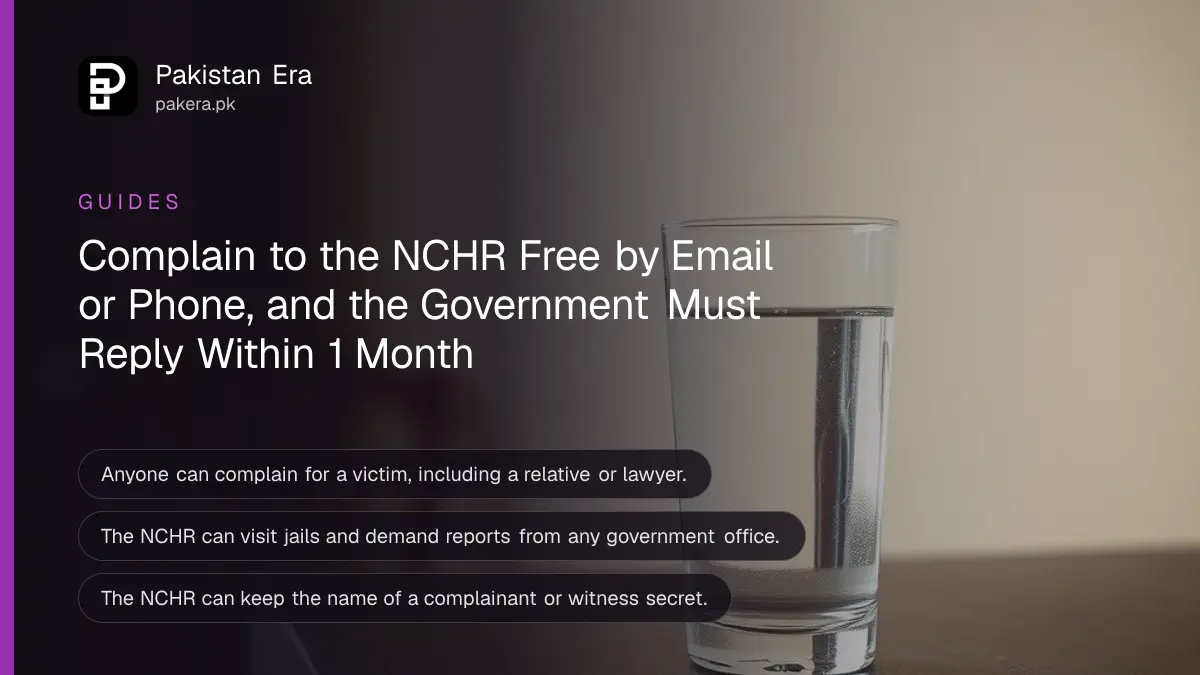
To complain to the National Commission for Human Rights (NCHR) in Pakistan, email complaints@nchr.gov.pk, call the complaint cell on 051-9217340, or write to the NCHR office in your province. There is no fee. The Commission can look into any human rights violation, or a public servant's failure to stop one, and it can ask the government for a report within a deadline it sets.
Most people who reach a human rights body want one thing: someone with power to ask the police, a jail or a department to explain itself. The NCHR is that body at the national level. It was set up under the National Commission for Human Rights Act, 2012, which we read on the Pakistan Code on 20 October 2026, including the changes made by an amending act in 2026.
Anyone can file a complaint, including on a victim's behalf
Section 9 of the Act lets the Commission act on its own or on a petition from a victim or any person on the victim's behalf. So a relative, a neighbour or a lawyer can complain for someone in custody, in hospital or too afraid to come forward.
The Commission inquires into two kinds of complaint. The first is a violation of human rights, or helping someone commit one. The second is negligence by a public servant in preventing a violation. That second part matters. A police station that ignored repeated reports of abuse can be the subject of a complaint, even if an officer did not commit the abuse.
The Act extends to the whole of Pakistan. Only its chapter on special Human Rights Courts is limited to Islamabad.
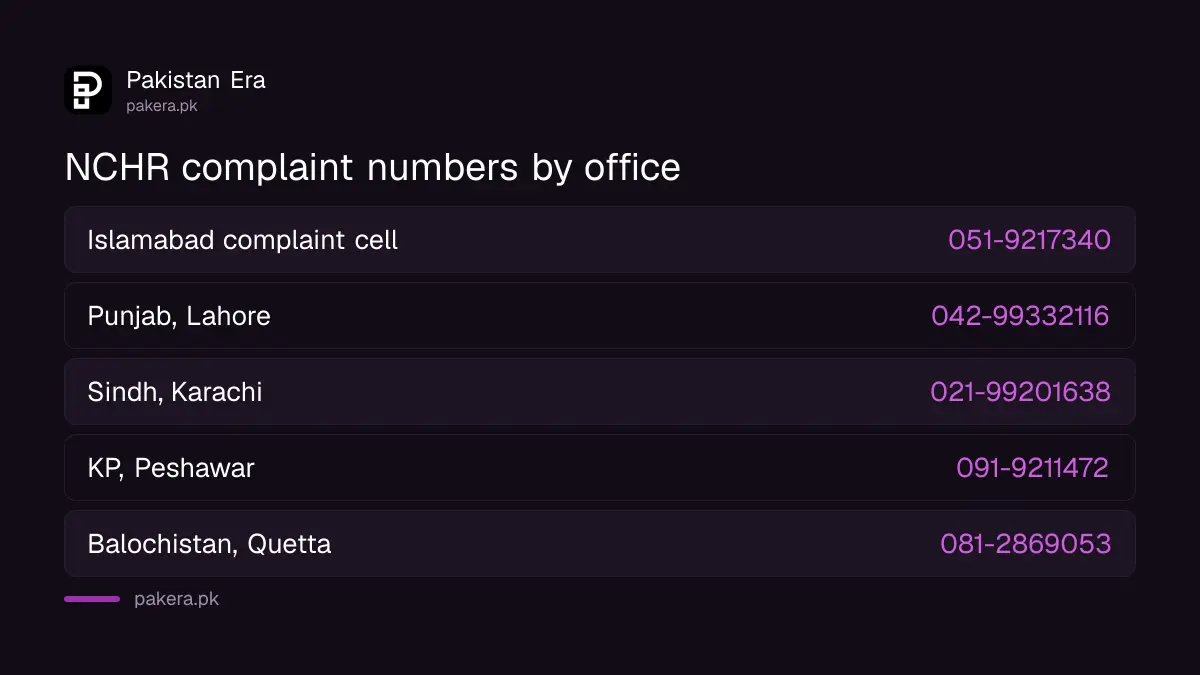
Six NCHR offices take complaints across Pakistan
The NCHR contact page lists a head office complaint cell in Islamabad, four provincial offices and a separate office for minorities. Each provincial office has its own complaints email, so send your complaint to the one nearest the place where the violation happened.
| Office | Phone | Complaints email | Address |
|---|---|---|---|
| Head office complaint cell, Islamabad | 051-9217340 | complaints@nchr.gov.pk | 5th Floor, Evacuee Trust Complex, F-5, Islamabad |
| Punjab | 042-99332116 | punjab.complaints@nchr.gov.pk | 23-D/1, FCC, Syed Muratib Ali Road, Gulberg-IV, Lahore |
| Sindh | 021-99201638 | sindh.complaints@nchr.gov.pk | State Life Building No. 3, Ground Floor, Dr. Ziauddin Ahmed Road, Karachi |
| Khyber Pakhtunkhwa | 091-9211472 | kp.complaints@nchr.gov.pk | First Floor, Benevolent Fund Building, Saddar Road, Peshawar |
| Balochistan | 081-2869053 | balochistan.complaints@nchr.gov.pk | House No. 5-C, Asad Jan Street, near Al Khair Hospital, Zarghoon Road, Quetta |
| Minorities | 051-9216833 | member.minority@nchr.gov.pk | 5th Floor, Evacuee Trust Complex, Agha Khan Road, Islamabad |
The NCHR home page also has a short complaints form. It asks only for your name, email, phone number and a message, then a captcha check. It is fine for a first contact, but it has no space for attachments, so email is better when you have papers to send.
How to write and send the complaint
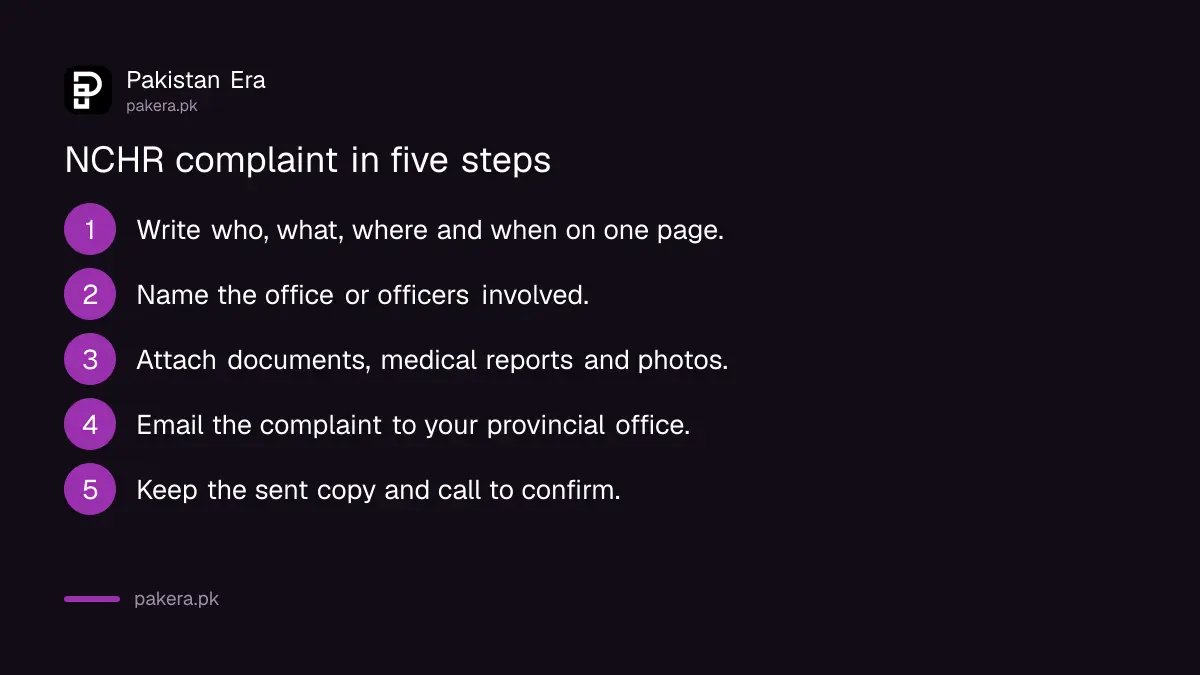
A complaint works best when it answers who, what, where and when on one page, and attaches proof. The Act does not prescribe a form, so a clear letter or email is enough to start.
- Write the victim's name, CNIC number and contact details, and yours if you are filing for them.
- Say what happened, where and on which date, in short numbered points.
- Name the office or officers involved, such as a police station, jail or department.
- List what you have already done, such as an FIR, an application or a court case.
- Attach copies of documents, medical reports, photos or letters.
- Say what you want: an inquiry, relief, or a report from the department.
- Email it to the right provincial address, keep the sent copy, and call to confirm it arrived.
If you need legal advice before you write anything, the federal government's 1099 human rights helpline gives free advice. And if the victim needs money for medical or legal costs, the human rights relief fund is a separate route.
The Commission can demand a report within its own deadline
Under section 12, the Commission can ask the federal or a provincial government, or any office under them, for a report within a time it sets. If the report does not come, it can carry on with its own inquiry. For security sensitive areas, it can proceed on its own if no report arrives within 30 days.
While inquiring, section 13 gives the Commission the powers of a civil court. It can summon people, require documents and take evidence on oath. Section 9 also lets it visit any jail or place of detention to check whether a detention is legal and whether inmates' rights are being respected.
The Commission can protect your identity. Section 20 lets it keep secret the name of a person who complains, gives information, documents or evidence, where it thinks that is needed. Ask for this in your complaint if you fear retaliation. And under section 19, what you tell the Commission cannot be used against you in other proceedings, except for giving false evidence.
Two limits on what the NCHR can investigate
The Act draws two lines. Complaints against the armed forces go through the Defence Division instead of a direct inquiry, and complaints about intelligence agencies are referred to the competent authority. Knowing this early saves time and helps you choose the right forum.
For the armed forces, section 14 lets the Commission ask the Defence Division for a report, then make recommendations. The federal government must tell the Commission what it did within three months, and the Commission publishes the result. For intelligence agencies, section 15 says inquiring into their acts is not part of its functions.
The NCHR is also not a court. It cannot convict anyone or order compensation itself. It recommends. For a case that belongs in court, such as a family dispute over haq mehr and dowry, you still need the court route.
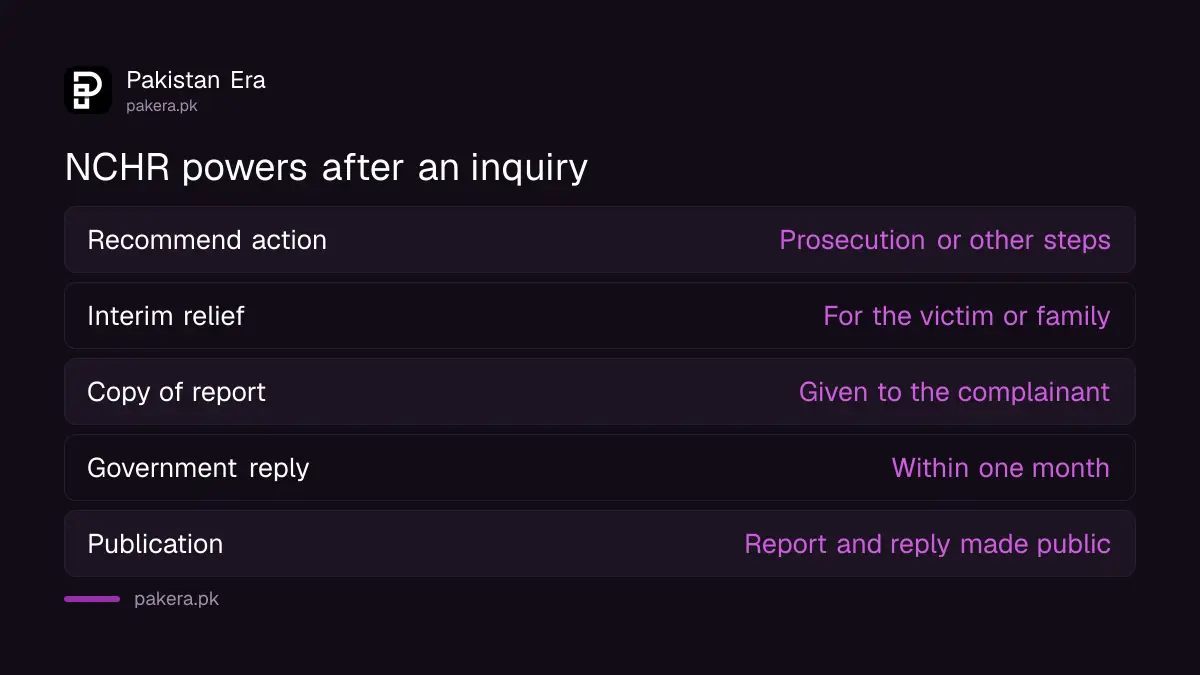
What happens after the inquiry ends
Section 18 lists the steps. The Commission can recommend prosecution or other action against those responsible, and recommend immediate interim relief for the victim or family. It must give the complainant a copy of its report, and the government must reply within one month.
The Commission then publishes its inquiry report, its recommendations and the government's reply. That public record is often the real pressure. A department that ignores a published recommendation has to explain why, in writing.
For women in Punjab with a marriage problem, the NCHR also runs a toll-free matrimonial rights helpline, 1413, from its Punjab office. It works Monday to Friday, 9am to 5pm, and gives legal information, advice and representation on nikah nama clauses, dower and divorce rights. For divorce questions, the steps for khula in Pakistan help too.
Common questions
Is there a fee to complain to the NCHR?
No. Neither the Act nor the NCHR contact page mentions any fee for a complaint.
Can I complain for a family member who is in jail?
Yes. Section 9 allows a petition by any person on the victim's behalf, and the Commission can visit jails and detention places.
Can the NCHR keep my name secret?
Yes, if it considers it necessary. Section 20 allows it to preserve the identity of a complainant or witness. Ask for this in writing.
How long does the government have to answer the NCHR?
One month after receiving the inquiry report, or longer if the Commission allows. For armed forces cases, the federal government has three months.
Can the NCHR investigate the army or an intelligence agency?
Not directly. Armed forces complaints go to the Defence Division for a report, and intelligence agency complaints are referred to the competent authority.
What is the 1413 helpline?
A toll-free NCHR matrimonial rights helpline for women in Punjab, open Monday to Friday, 9am to 5pm, for nikah nama, dower and divorce rights.
How we verified this
What we checked, where we read it, and what we could not confirm.
We read the National Commission for Human Rights Act, 2012 on the Pakistan Code, in the version that shows amendments by Act No. VII of 2026, and the office list on the NCHR contact page, both on 20 October 2026. We also read the NCHR page on the 1413 helpline. We did not file a complaint or call the numbers, so we cannot say how fast the Commission replies. Phone numbers and emails can change, so check the contact page before you send papers.
About the author

Public Services and Education Journalist
Fajr Riaz is a journalist and content writer at Pakistan Era, based in Lahore. She covers the questions people meet in everyday life in Pakistan: how a public service works, what a change in the rules means, and where to find a reliable answer.