Claim Money From the Human Rights Relief Fund in Pakistan: Up to Rs 20,000 for Victims
Pakistan's Human Rights Relief Fund lists up to Rs 10,000 for medical costs and Rs 20,000 for permanent disability. See who qualifies and how to apply.
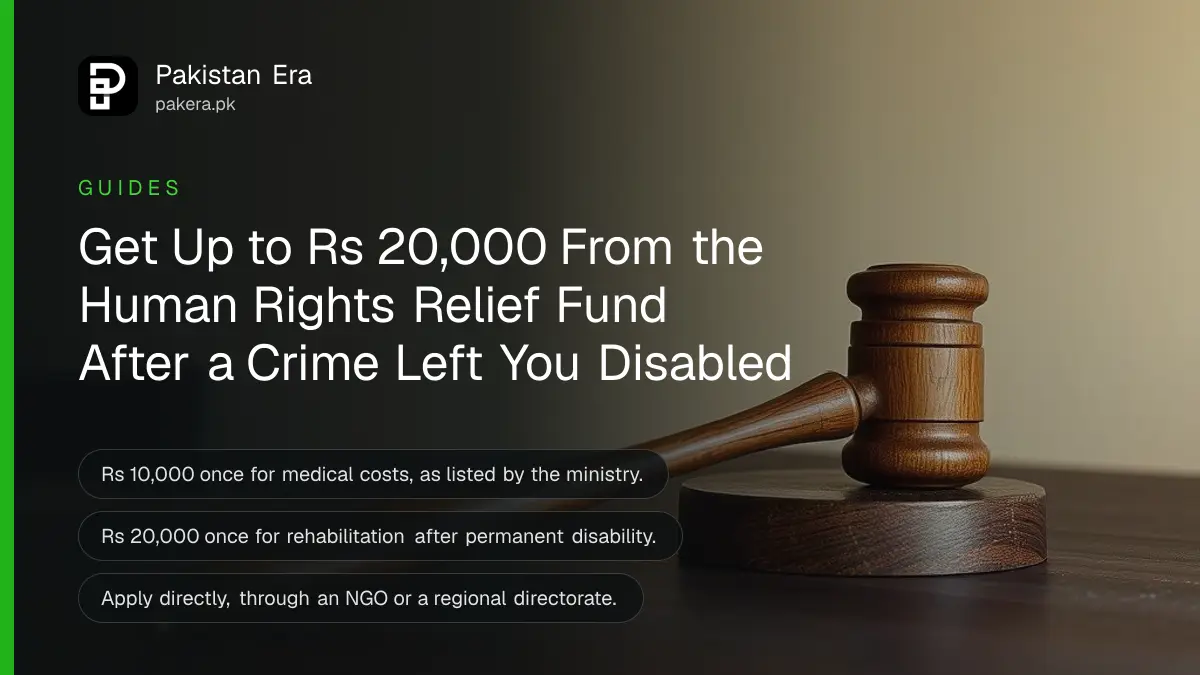
The Ministry of Human Rights runs a Human Rights Relief and Revolving Fund that pays small amounts to victims of kidnapping, rape, police encounters, arrest of women, extra-judicial deaths and torture. The ministry's page lists up to Rs 10,000 once for medical costs and up to Rs 20,000 once for a victim left permanently disabled. You can apply directly, through an NGO or through a Regional Directorate of Human Rights.
We read the fund's page on the ministry website on 14 October 2026. The page has no date for the amounts. Treat them as the ministry's published limits and ask the helpline whether they have changed before you rely on them.
The fund helps victims of six named violations
The ministry says the fund was set up in 1995. It gives financial help to victims and affectees of human rights violations. In its own words, the cases that count are kidnapping, rape, police encounters, arrest of women, extra-judicial deaths and torture. Extra-judicial means a killing outside any court process.
The page also says the purpose is to give legal and financial help. We found no list of lawyers or a legal aid scheme on the page, so we only describe the money. For free legal advice, see the 1099 human rights helpline.
Not every crime qualifies. A theft or a road accident is not on the ministry's list, even though it may be serious. If your case is not on the list, ask before you spend time on papers.
Four kinds of payment are listed
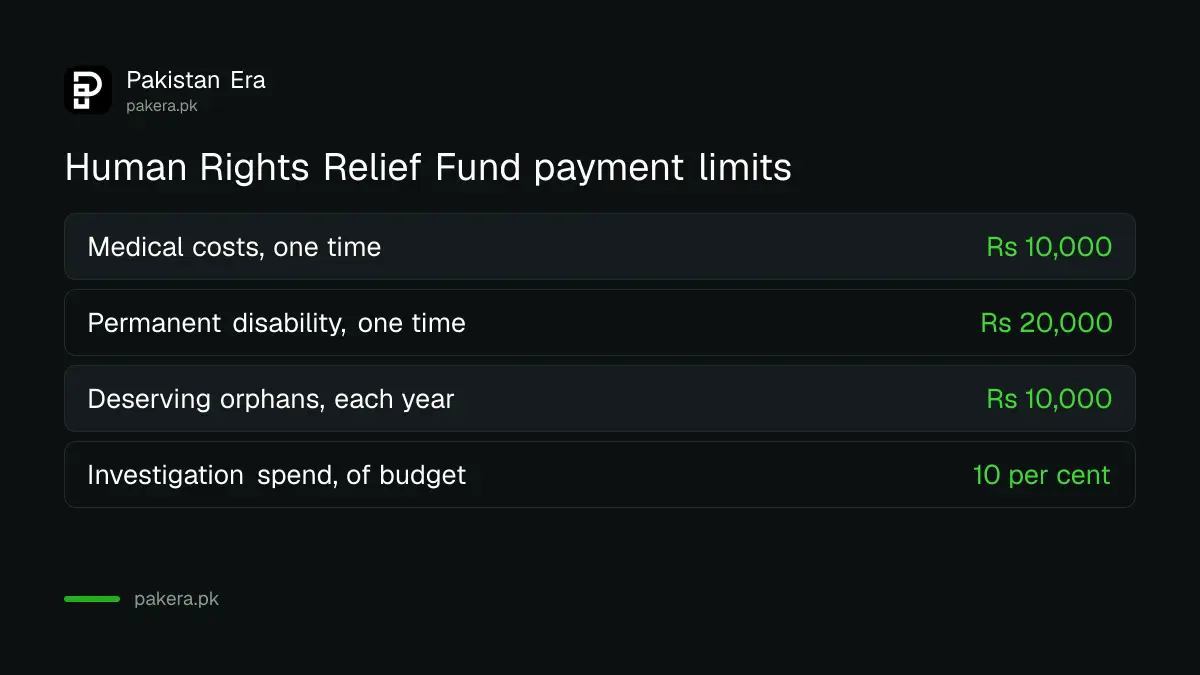
The ministry's page sets out how money is paid. Three are direct help to victims and families. The fourth is for the cost of investigating a case. All amounts are maximums, so a committee may approve less.
| Payment | Limit on the ministry page |
|---|---|
| Medical charges to a hospital or patient | Rs 10,000, one time |
| Rehabilitation after permanent disability from the injury | Rs 20,000, one time |
| Deserving orphans, including those affected by violations | Rs 10,000 a year |
| Investigation by human rights activists engaged by the Human Rights Cell | Up to 10 per cent of the fund's yearly budget |
The small sums say something plain. This fund will not cover a long hospital stay or a lost income. Think of it as a first payment, and victims of terrorism or rape should also look at the Bait-ul-Mal provision, which is a separate scheme with its own rules.
Apply directly, through an NGO or a regional directorate
The page says applications are received directly from victims, from NGOs and through Regional Directorates of Human Rights. The ministry's project list names directorates at Lahore, Karachi, Peshawar and Quetta. We did not find an application form or a document list on the page.
So the first step is to ask. A short call to the helpline can tell you where to send papers and what the committee wants to see. These steps are our suggestion, not an official procedure.
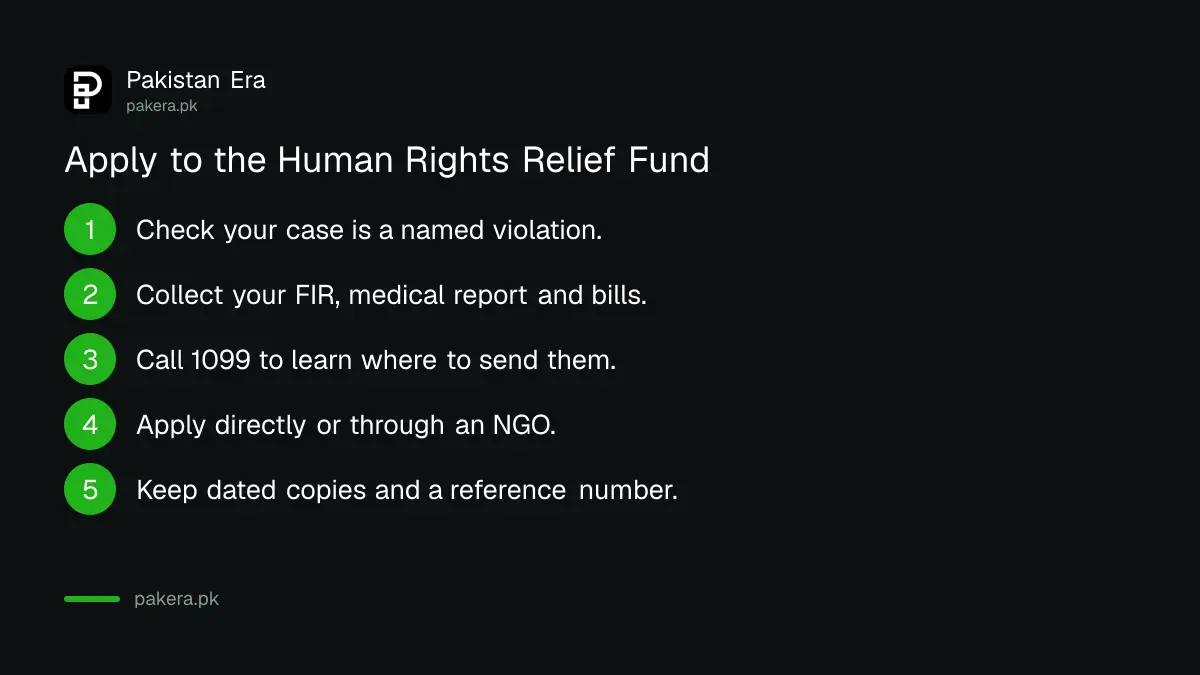
- Check that your case is one of the named violations.
- Collect the FIR copy, medical report and hospital bills you already hold.
- Call 1099 and ask which office takes the application and what papers it needs.
- Send the application directly, or ask a known NGO or the regional directorate to forward it.
- Keep a dated copy of everything you send and write down any reference number.
A committee decides each case
The page says a committee runs the fund within the powers given by the Secretary of the ministry. It names five members: the Director General (Human Rights) as chairman, the Director (Human Rights), the Deputy Secretary (Admin), the Deputy Financial Advisor and the Deputy Director (Human Rights) as secretary.
We found no time limit for a decision. We also found no figure on how many victims the fund has paid. If you apply, expect to follow up. The Wafaqi Mohtasib takes complaints about delay by federal bodies, free of charge, if a federal office sits on your application for months.
Police failure is a separate matter. If the police will not register your case, see how to report an offence as a woman, and for the papers that help your case in court, the guide on free copies of the FIR and witness statements.
Common questions about the Human Rights Relief Fund
How much money does the fund pay?
The ministry's page lists up to Rs 10,000 once for medical costs and up to Rs 20,000 once for rehabilitation after permanent disability. It also lists up to Rs 10,000 a year for deserving orphans.
Who can apply to the fund?
Victims and affectees of the named violations. The page says applications come directly from victims, from NGOs and through Regional Directorates of Human Rights.
Does the fund cover a robbery or a road accident?
Not on the list we read. The page names kidnapping, rape, police encounters, arrest of women, extra-judicial deaths and torture. Ask the ministry if your case is close to these.
Is there an online form?
We did not find one on the fund's page. The ministry does run a resource portal and a helpline, so ask 1099 where to send an application.
Are the amounts still current?
We cannot say. The page gives no date for the limits. Confirm them with the ministry before you plan around them.
How we verified this
What we checked, where we read it, and what we could not confirm.
Last checked 14 October 2026. The fund's purpose, payment limits, application routes and committee come from the Human Rights Relief and Revolving Fund page on the Ministry of Human Rights website, mohr.gov.pk. The page carries no date and no application form. We have not applied to the fund and do not know how long a decision takes. The suggested steps are ours.
About the author

Public Services and Education Journalist
Fajr Riaz is a journalist and content writer at Pakistan Era, based in Lahore. She covers the questions people meet in everyday life in Pakistan: how a public service works, what a change in the rules means, and where to find a reliable answer.