Bait-ul-Mal Provision for Victims of Terrorism and Rape: Up to Rs 200,000
A 2019 Bait-ul-Mal board decision allows up to Rs 200,000, once, to victims of terrorism or rape or their heirs. We could not confirm that it is open now.
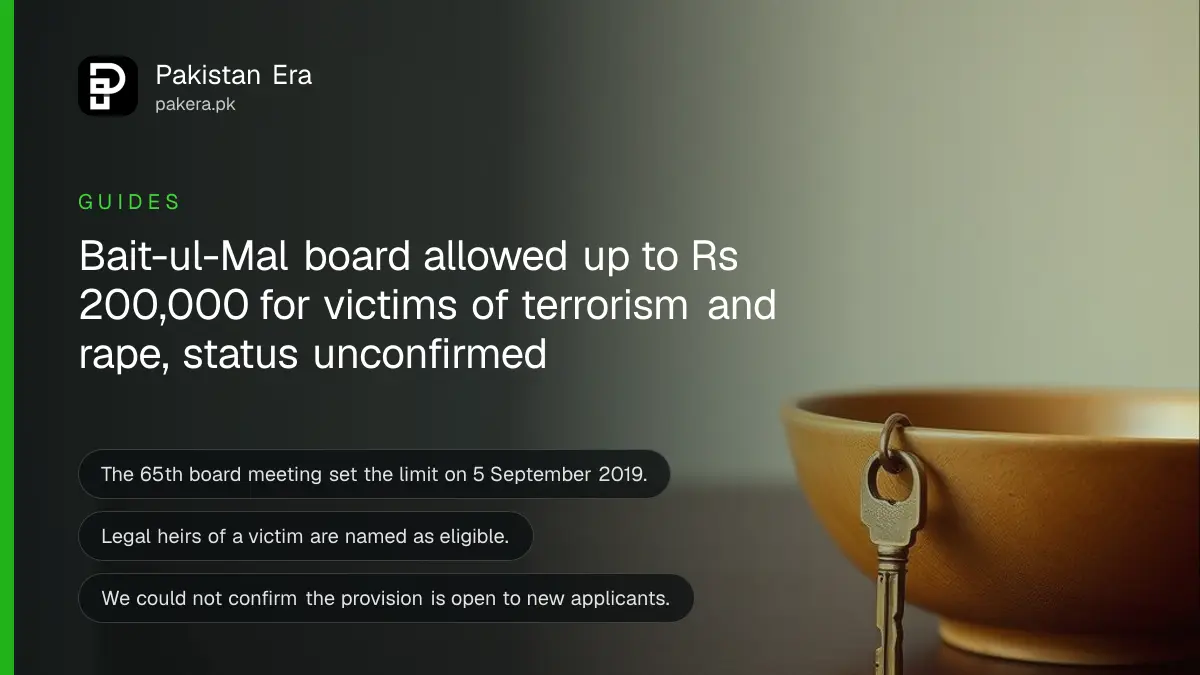
Short answer: A 2019 decision of the Pakistan Bait-ul-Mal board allows up to Rs 200,000, as a one-time payment, to civilians who suffered terrorism or rape, or to their legal heirs. It also allows help with higher education for victims or a deceased victim's children. We could not confirm from PBM's site that it is running in 2026.
Families of people killed in an attack, and survivors of rape, are rarely told that a federal body has a line for them. The line exists on paper. It sits inside a board note in a policy document, not on a public notice, which is why almost nobody asks for it.
We read the Pakistan Bait-ul-Mal Individual Financial Assistance policy PDF on the PBM projects page on 12 October 2026. Below is what the note says, who it covers, and what we could not verify. This is a sensitive subject, so we have kept to what the document states.
The board raised the limit to Rs 200,000 for victims in 2019
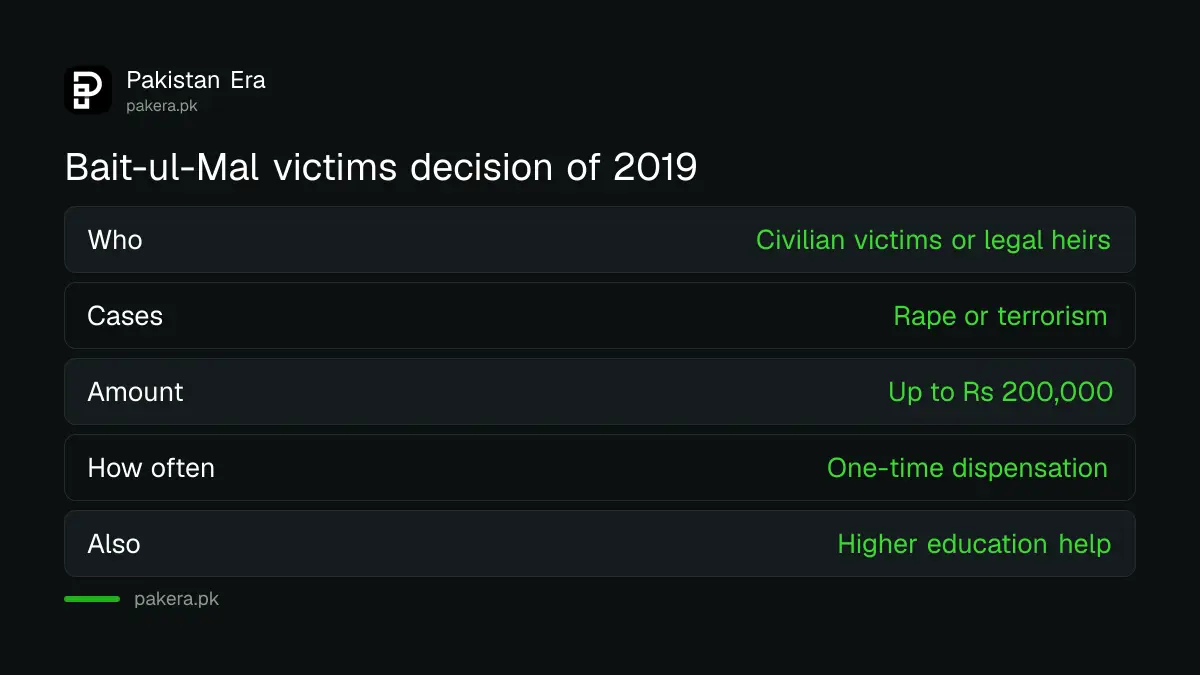
The IFA policy records a decision of the 65th Bait-ul-Mal Board meeting, held on 5 September 2019. The board agreed financial assistance of up to Rs 200,000 to civilians, or their legal heirs, who become victims of rape or terrorism, as a one-time dispensation.
The agenda item in the policy is titled for victims of terrorism, violence and rape. The body of the decision names rape and terrorism. We read the wording as it stands and do not stretch it to every crime.
| Point | What the policy note says |
|---|---|
| Who | Civilians or their legal heirs, victims of rape or terrorism |
| Amount | Up to Rs 200,000 |
| How often | One-time dispensation |
| Education help | Higher education of civilian victims or a deceased's children, at a public or private institution |
| Who sanctions | Managing Director, with powers raised from Rs 60,000 to Rs 200,000 for this purpose only |
Legal heirs can apply when the victim has died
The note names "their legal heir", so the family of a person killed can ask on the person's behalf. A legal heir is a person the law recognises as entitled to the estate of the deceased, such as a spouse, children or parents. A succession or heirship certificate is the usual proof, and PBM's note does not list it.
The same decision opens a second help. It allows assistance for the education of civilian victims, and of the children of a deceased victim, for higher education. The note says the institution can be public or private, which is wider than the education stream, where only public institutions are listed.
That second point matters to a family where the earning parent was lost. The regular education stipend is explained in our note on Bait-ul-Mal education stipends and orphan support. The victims' provision is a separate route, and it names private colleges too.
Apply through the general financial assistance route
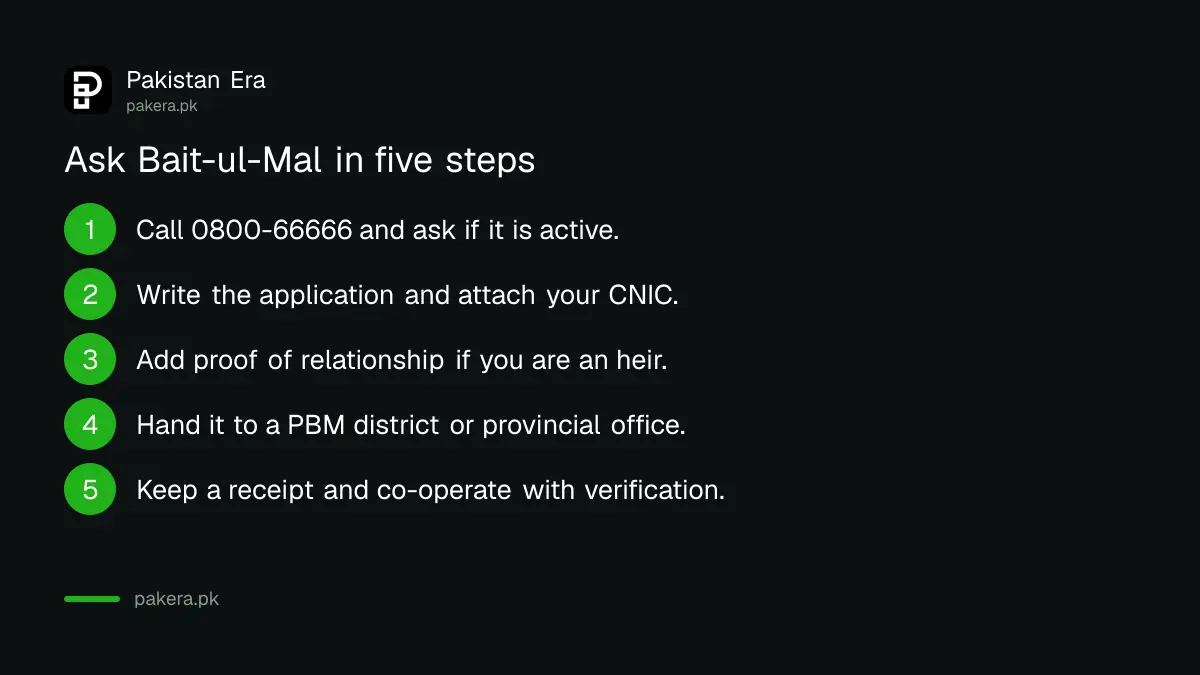
The note raises the Managing Director's power under IFA General, so the application follows the general route. You write on plain paper, attach a CNIC copy, and the district office verifies your case. Payment is by crossed cheque.
- Write a plain paper application describing the event, the date and the place, and who is asking.
- Attach your CNIC copy and, for a legal heir, proof of relationship to the victim.
- Attach any record of the event that you already hold, such as an FIR or a hospital paper.
- Take it to the nearest PBM district office, or send it to the provincial or head office.
- Co-operate with the verification visit, and keep a receipt for what you hand in.
The note does not say that an FIR or a court order is required, and it does not describe any special privacy arrangement for survivors. If privacy is a concern, say so when you contact the office and ask who will handle the file.
The ordinary exclusions in the general stream may still apply
The general stream bars government servants and their families, and people receiving similar subsistence from another government body such as Zakat. The 2019 note does not say whether those bars apply to victims. We read them as still standing unless PBM tells you otherwise.
The policy also warns that a false declaration can lead to recovery and a permanent ban. So state the facts as they are. The standard general grant is explained in Bait-ul-Mal general financial assistance.
What we could not verify about this provision
The decision is seven years old. We did not find the Rs 200,000 victims' help described as a programme on PBM's projects page, and the policy PDF carries board notes up to 2020. So we cannot confirm that it is open to new applicants or that the amount is unchanged.
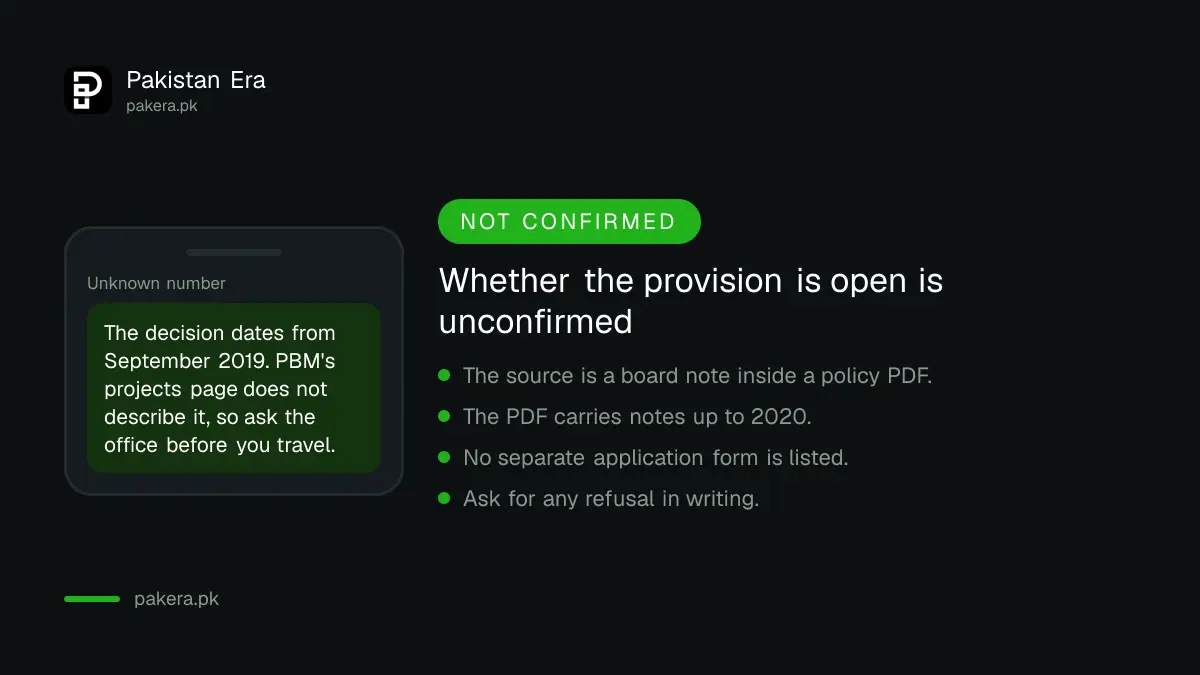
Ask first. Call PBM on 0800-66666 and ask whether the 2019 provision for victims of terrorism and rape is active, who can apply, and what the office needs. Write down the name of the person who answers and the date. If a district office says no, ask for the refusal in writing.
For safety, protection and legal help after violence, the right first step is a different one. Our guide to which complaint route to use in Punjab covers where to report. The Bait-ul-Mal money is financial relief, not a substitute for a police report.
Common questions
How much does Bait-ul-Mal pay victims of terrorism or rape?
Up to Rs 200,000 as a one-time payment, according to a decision of the PBM board recorded in its financial assistance policy.
Can the family of a person killed apply?
Yes. The decision names legal heirs of the victim, so a spouse, child or parent can ask on the victim's behalf.
Does it cover education?
The decision also allows help with higher education for civilian victims and a deceased victim's children, at a public or private institution.
Is the provision still active?
We could not confirm. The decision dates from September 2019 and we did not find it on PBM's projects page. Call 0800-66666 to ask.
Do I need an FIR to apply?
The note does not say so. Ask the district office what proof it wants, and keep a copy of anything you submit.
How we verified this
What we checked, where we read it, and what we could not confirm.
We read the Individual Financial Assistance policy PDF and the projects page on the Pakistan Bait-ul-Mal website on 12 October 2026. The provision is recorded as a decision of the 65th board meeting held on 5 September 2019. We did not speak to a PBM office, so its present status is unconfirmed.
About the author

Public Services and Education Journalist
Fajr Riaz is a journalist and content writer at Pakistan Era, based in Lahore. She covers the questions people meet in everyday life in Pakistan: how a public service works, what a change in the rules means, and where to find a reliable answer.