How to Get Free Copies of the FIR and Witness Statements Before Trial in Pakistan
Claim free copies of the FIR, police report and witness statements under section 265-C in Pakistan, due 7 days before trial, and what to do if they are late.
Short answer: Section 265-C of the Code of Criminal Procedure says that in a case sent up on a police report, the accused must be given free copies of the FIR, the police report, the statements of all witnesses under sections 161 and 164, and the investigator's inspection and recovery notes. The deadline is seven days before the trial starts.
You cannot defend a case you have not read. The law says so in plain words. In cases that begin with a police report, the court must supply the main papers to the accused, free of cost, before the trial begins.
We read sections 161, 162 and 265-C of the Code of Criminal Procedure, 1898 on the Pakistan Code portal (pakistancode.gov.pk) on 14 October 2026, and Article 10A of the Constitution on the National Assembly's published text. This guide follows those texts. It is general information, not legal advice for your case.
Four sets of papers must be supplied free
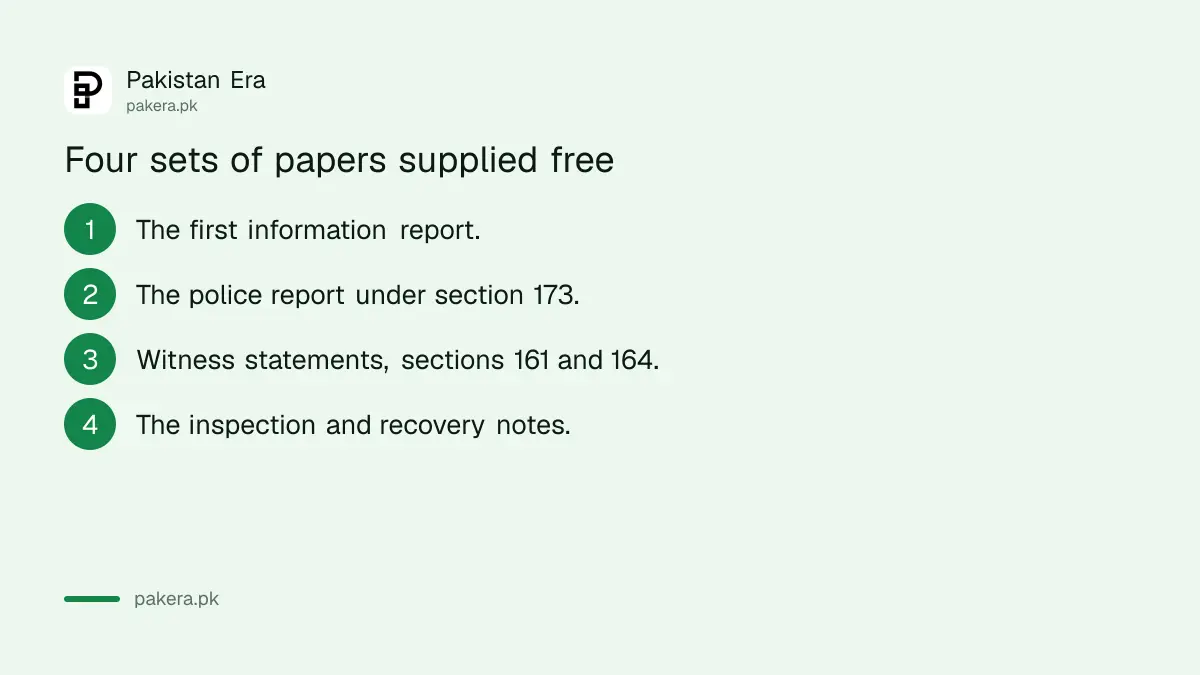
Section 265-C(1) lists the documents. They are the first information reports, the police report, the statements of all witnesses recorded under sections 161 and 164, and the inspection note recorded by the investigating officer on his first visit to the place of occurrence, plus his note on any recoveries.
The section says these copies are supplied "free of cost" and "not later than seven days before the commencement of the trial". You do not pay a copying fee for them, and you should not wait until the hearing to ask.
The police report here is the report under section 173, often called the challan. To see whether police have sent it to court, read our guide on checking if police filed the challan.
The court may hold back a part that would harm the public interest
The proviso to section 265-C(1) says that if a part of a statement under section 161 or 164 is such that its disclosure to the accused would be inexpedient in the public interest, that part is excluded from the copy.
So you may receive a copy with a portion left out. The Code gives no list of what can be left out. If you think a missing part matters to your defence, your lawyer can raise it with the trial court.
A written complaint case has its own list
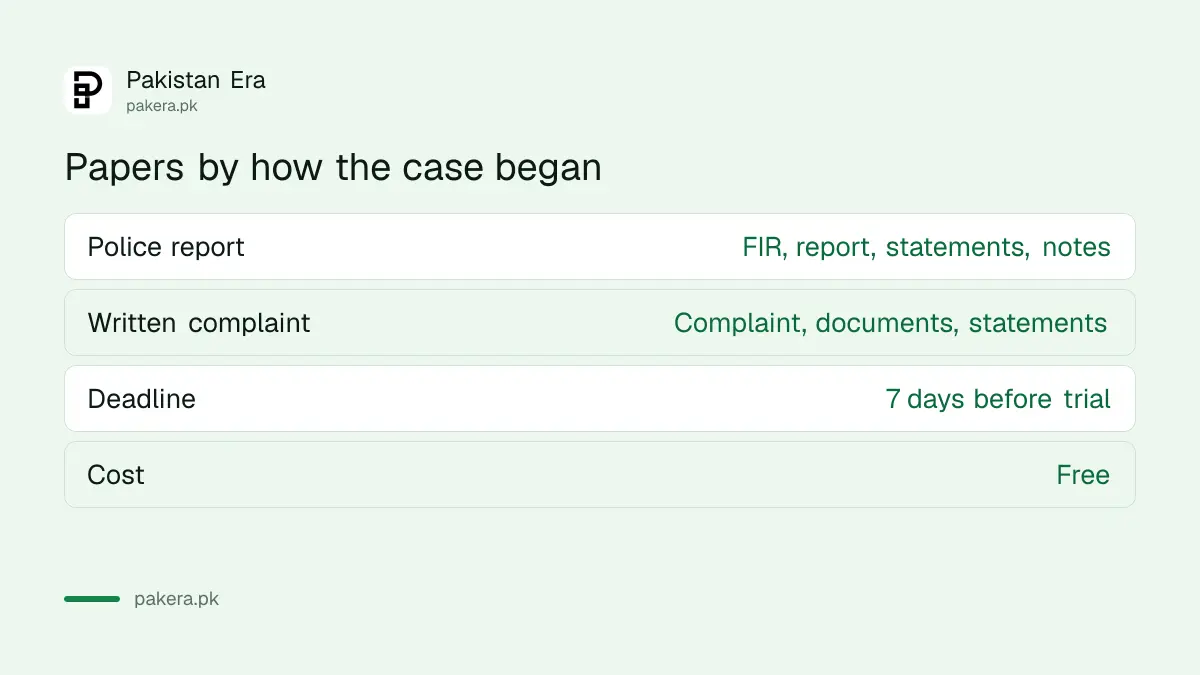
If the case began on a written complaint rather than a police report, section 265-C(2) applies. The accused gets copies of the complaint, the documents the complainant filed, and the complainant's statements under sections 200 or 202, free of cost, at least seven days before the trial.
In that route, the complainant must also file, within three days of the order issuing process, as many copies of the complaint and documents as there are accused. If you started your own case, read our guide on filing a private criminal complaint.
| How the case began | What the accused receives free |
|---|---|
| Police report (s.265-C(1)) | FIR, police report, witness statements under 161 and 164, inspection and recovery notes |
| Written complaint (s.265-C(2)) | Complaint, filed documents, statements under 200 or 202 |
| Deadline for both | Not later than 7 days before the trial begins |
| Cost | Free |
How to ask for the papers if they have not come
If seven days before the trial are near and you have not received the copies, apply in writing to the trial court. Quote section 265-C, give the case number, and list the documents you have not received.
- Note the case number and the court from the summons or bail order.
- Check the court file or ask the reader what has been supplied.
- Write a short application quoting section 265-C and asking for the missing documents.
- Ask the court to record the date of supply.
- Give the copies to your lawyer and note the date of the first hearing.
A lawyer reads the papers for contradictions. Section 162 lets the accused ask the court, when a prosecution witness is called, to refer to that witness's recorded police statement and to give the accused a copy, so that part of it can be used to contradict the witness under section 145 of the Evidence Act. If you need a lawyer, see free legal aid in Punjab or LAJA in Islamabad.
Reading the papers supports your right to a fair trial
Article 10A of the Constitution says that for the determination of his civil rights and obligations or in any criminal charge against him, a person is entitled to a fair trial and due process. Getting the case papers in good time is part of how that works in practice.
It also helps the court. A trial moves faster when the accused and the prosecution have the same set of papers. Do not sign the police statement of a witness or accept that you must; section 162 says statements to police are not signed by the person making them.
Common questions
Do I have to pay for copies of the FIR and witness statements?
No. Section 265-C(1) says these copies are supplied free of cost to the accused.
When must I receive them?
Not later than seven days before the commencement of the trial, as section 265-C says for both police report cases and complaint cases.
What if part of a witness statement is missing?
The proviso allows the court to exclude a part whose disclosure would be inexpedient in the public interest. Your lawyer can ask the court about it.
Does this apply to a case that began as a private complaint?
Yes, with a different list. Section 265-C(2) covers the complaint, the documents filed with it and the statements under sections 200 or 202.
Should I sign my statement to the police?
Section 162(1) says a statement made to police in an investigation shall not be signed by the person making it.
How we verified this
What we checked, where we read it, and what we could not confirm.
We read sections 161, 162 and 265-C of the Code of Criminal Procedure, 1898, in the PDF on the Pakistan Code portal (pakistancode.gov.pk), and Article 10A of the Constitution in the National Assembly's published PDF (na.gov.pk), on 14 October 2026. The Code file says it was last amended on 16 February 2017. We did not verify how courts handle late supply in each district. Confirm the current text and your court's practice with a lawyer.
About the author

Senior Writer, Public Services and Technology
Shahid joined us in 2024 as an author. He is a senior contributor to Pakistan's leading technology websites. He writes detailed articles, mostly covering his expertise in the latest tech, mobiles, apps, gadgets, and step-by-step guides. His ideology is to help people understand the latest trends and explain complex methods through very easy-to-understand guides.