How to File a Private Criminal Complaint Before a Magistrate in Pakistan
File a private criminal complaint before a Magistrate in Pakistan: the sworn statement under section 200, inquiry, dismissal, fee and copies for the accused.
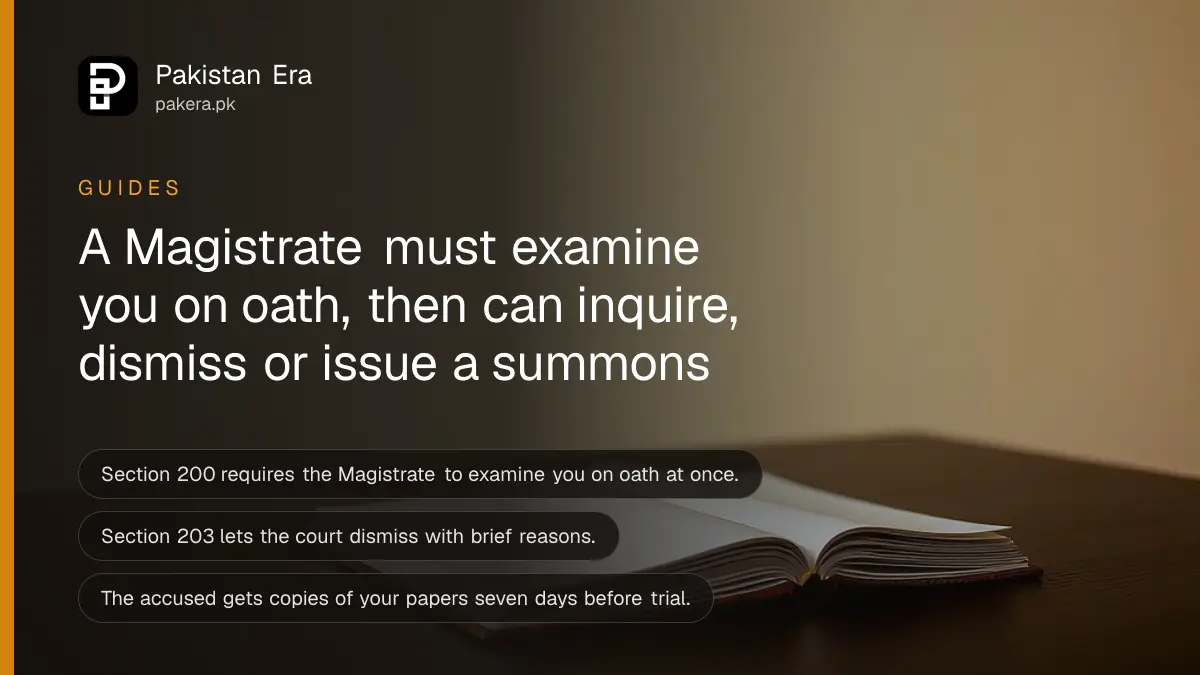
Short answer: You can take a criminal complaint straight to a court under Chapter XVI of the Code of Criminal Procedure. The Magistrate must at once examine you on oath under section 200. He may order an inquiry, dismiss the complaint with reasons, or issue a summons or warrant once you pay the process fee.
Sometimes the police do not act, or the offence is one the police cannot investigate without a Magistrate's order. The law gives you another door. You write a complaint and take it to the court yourself.
We read sections 200 to 205 and section 265-C of the Code of Criminal Procedure, 1898 on the Pakistan Code portal (pakistancode.gov.pk) on 14 October 2026. This guide follows that text. It is general information, not legal advice for your case. If the problem is that police refuse to register an FIR, read our guide on what to do in Punjab when police refuse or delay your FIR first.
A complaint to a court is different from an FIR
An FIR is information given to the police, who then investigate. A complaint is made to a court, and the Magistrate decides how to proceed. Chapter XVI of the Code, titled "Of complaints to Magistrates", sets the steps for the second route.
Section 201 shows that the right court matters. If you give a written complaint to a Magistrate who cannot take cognizance of the case, he returns it for presentation to the proper court with an endorsement. If the complaint was not in writing, he directs you to the proper court.
So write the complaint, and find which court has power over your offence and your area before you file. A lawyer can tell you this in one visit. Our guide on free lawyers in Punjab lists help if you cannot pay.
The Magistrate examines you on oath first
Section 200 says a Magistrate taking cognizance of an offence on a complaint shall at once examine the complainant on oath. The substance of the examination is written down and signed by you and by the Magistrate.
There are exceptions in the provisos. For example, if the complaint is in writing, the Magistrate does not have to examine you before sending the case to the Court of Session or transferring it. And a complaint made by a court or by a public servant in official duty needs no examination.
Go to court with your complaint, your CNIC and the documents. Expect to answer questions on what happened, when and where. Speak from your own knowledge.
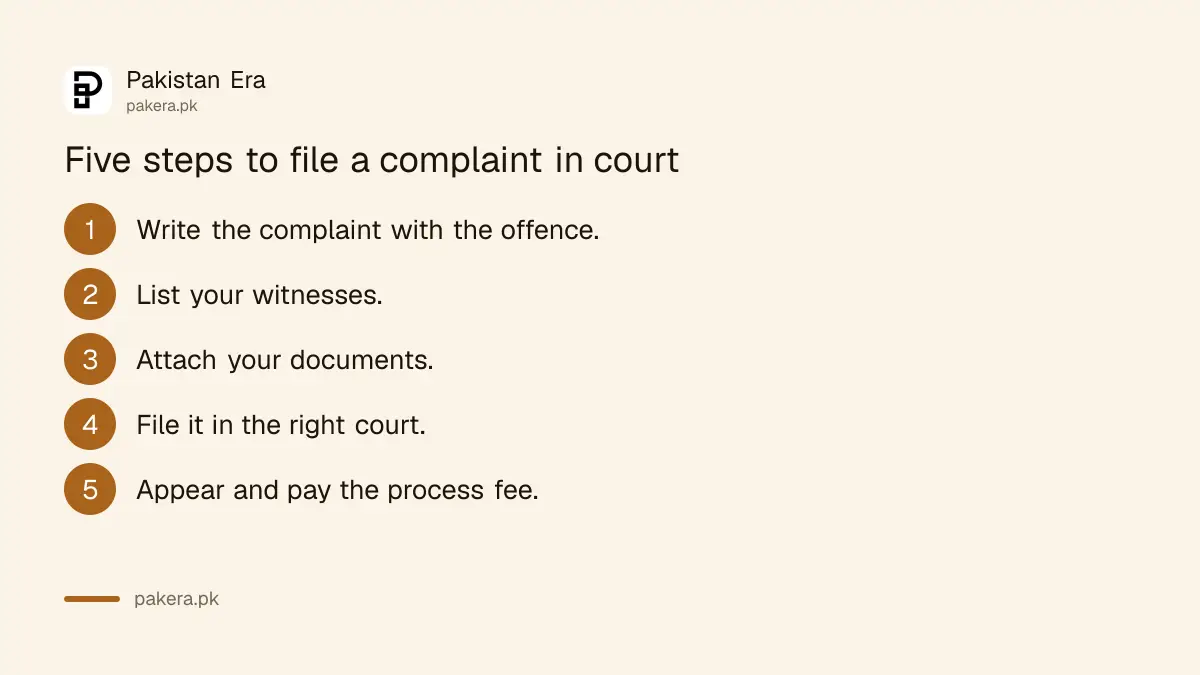
- Write a short complaint: your name, the accused's name, the date and place, what happened and the offence.
- List the names of your witnesses and what each will say.
- Attach documents: receipts, messages, cheques, photographs, medical papers.
- File it in the correct court and appear for your sworn statement.
- Pay the process fee when the court asks.
The court can inquire, dismiss or issue process
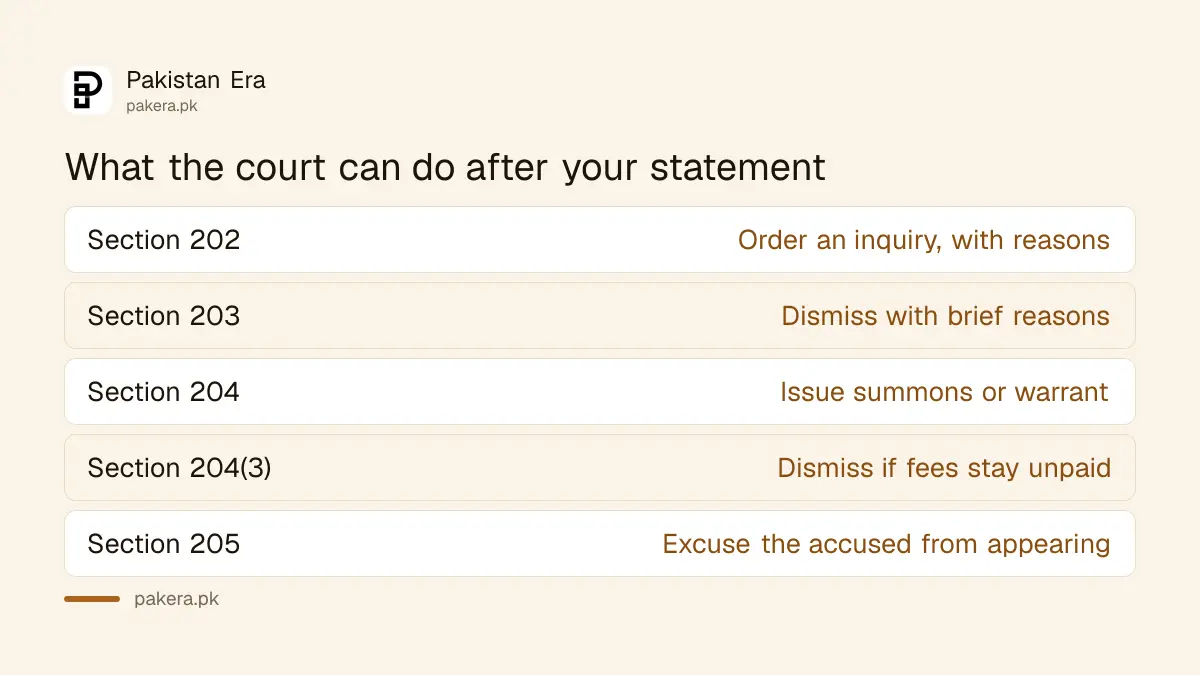
After your oath statement, the court has three paths. Under section 202 it may postpone issuing process and inquire itself, or direct an inquiry by a Justice of the Peace, a police officer or another person, giving reasons. Under section 203 it may dismiss. Under section 204 it may issue process.
Section 202 adds that, except where a court made the complaint, the court cannot send the matter for inquiry unless it first examined you on oath under section 200. Section 203 allows dismissal where, after your statement and any inquiry, there is no sufficient ground to proceed, and the court must briefly record its reasons.
Section 204 says that if there is sufficient ground, the court issues a summons or, in cases where the Second Schedule allows it, a warrant. Section 205 lets the Magistrate dispense with the accused's personal attendance and allow a pleader to appear.
| Section | What happens |
|---|---|
| 200 | Magistrate examines the complainant on oath at once |
| 201 | Wrong court returns a written complaint, or directs you to the right court |
| 202 | Court may postpone process and order an inquiry, with reasons |
| 203 | Court may dismiss with brief reasons if no sufficient ground |
| 204 | Summons or warrant issued if sufficient ground; process fees must be paid |
| 205 | Magistrate may excuse the accused from appearing in person |
Pay the process fee or the court may dismiss the complaint
Section 204(3) says that when
We did not find the amount of the fee in the Code, so we do not state one. It is set by court rules and may differ by province. Ask the reader or the clerk of the court.
Give the court copies and name your witnesses
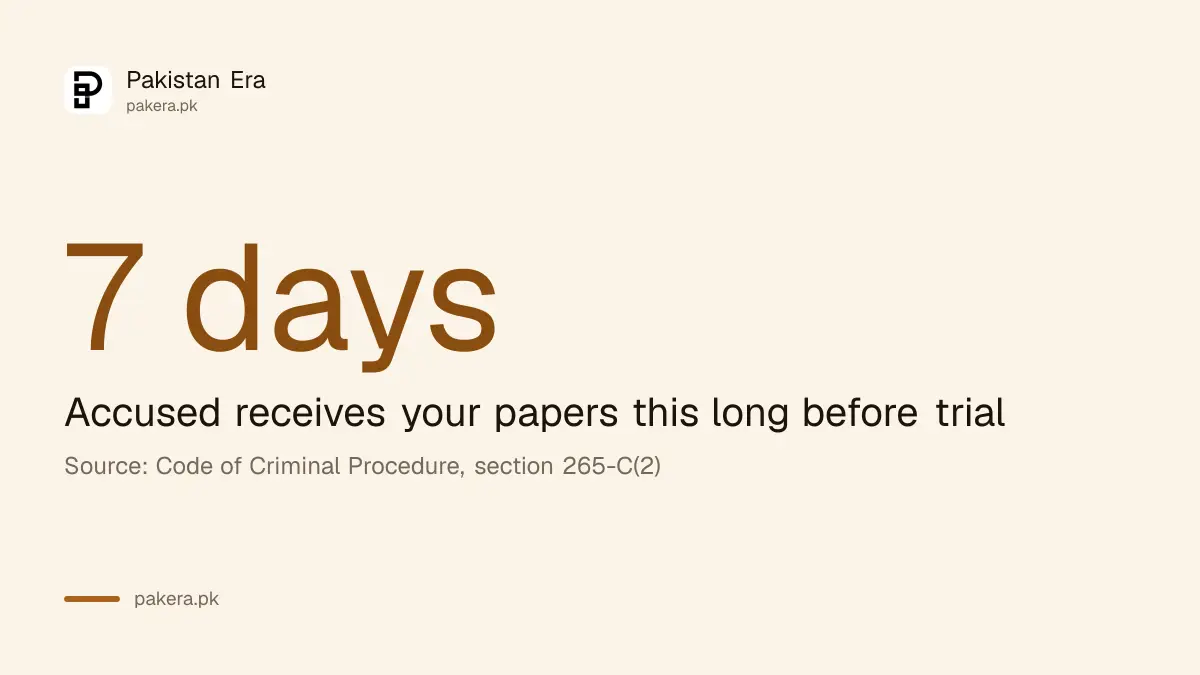
Section 265-C(2) says that in a case begun on a written complaint, you must state in your petition the substance of the accusation, the names of your witnesses and the gist of the evidence you expect to bring. Within three days of the order issuing process, you must file as many copies of the complaint and your documents as there are accused.
The same section says the accused are supplied copies of the complaint, your documents and your statements under sections 200 or 202, free of cost, not later than seven days before the trial begins. So nothing you file is kept secret from the accused.
Use this route for the right kind of problem. For a bounced cheque see what to do when a cheque bounces. For a false online post, see sending a defamation notice. Track your case after filing with our case status guide.
Common questions
Do I need a lawyer to file a complaint?
The sections we read do not say a lawyer is mandatory. A lawyer helps pick the right court, the right offence and the wording of the complaint.
Will the Magistrate always issue a summons?
No. Section 203 lets the court dismiss if there is no sufficient ground to proceed, and it must record brief reasons.
What does examined on oath mean?
You swear to tell the truth and answer the Magistrate's questions. The substance is written down and you sign it with him, under section 200.
Can I file the complaint if I lack money for the fee?
Section 204(3) allows dismissal if process fees stay unpaid for a reasonable time. Ask the court office what is payable and about legal aid options.
Does the accused see my documents?
Yes. Section 265-C(2) says copies of the complaint, documents and your sworn statements are supplied free of cost to the accused at least seven days before trial.
How we verified this
What we checked, where we read it, and what we could not confirm.
We read sections 200 to 205 and 265-C of the Code of Criminal Procedure, 1898 in the PDF on the Pakistan Code portal (pakistancode.gov.pk) on 14 October 2026. The file says it was last amended on 16 February 2017. We did not verify current process fee amounts or which court takes which offence in each province. Confirm both with the court office or a lawyer.
About the author

Senior Writer, Public Services and Technology
Shahid joined us in 2024 as an author. He is a senior contributor to Pakistan's leading technology websites. He writes detailed articles, mostly covering his expertise in the latest tech, mobiles, apps, gadgets, and step-by-step guides. His ideology is to help people understand the latest trends and explain complex methods through very easy-to-understand guides.