How a Woman Reports an Offence to Police in Pakistan: Female Officer and Home Recording
Know how police record a woman's FIR in Pakistan under section 154: a female officer or family member present, home recording if distressed, and legal aid.
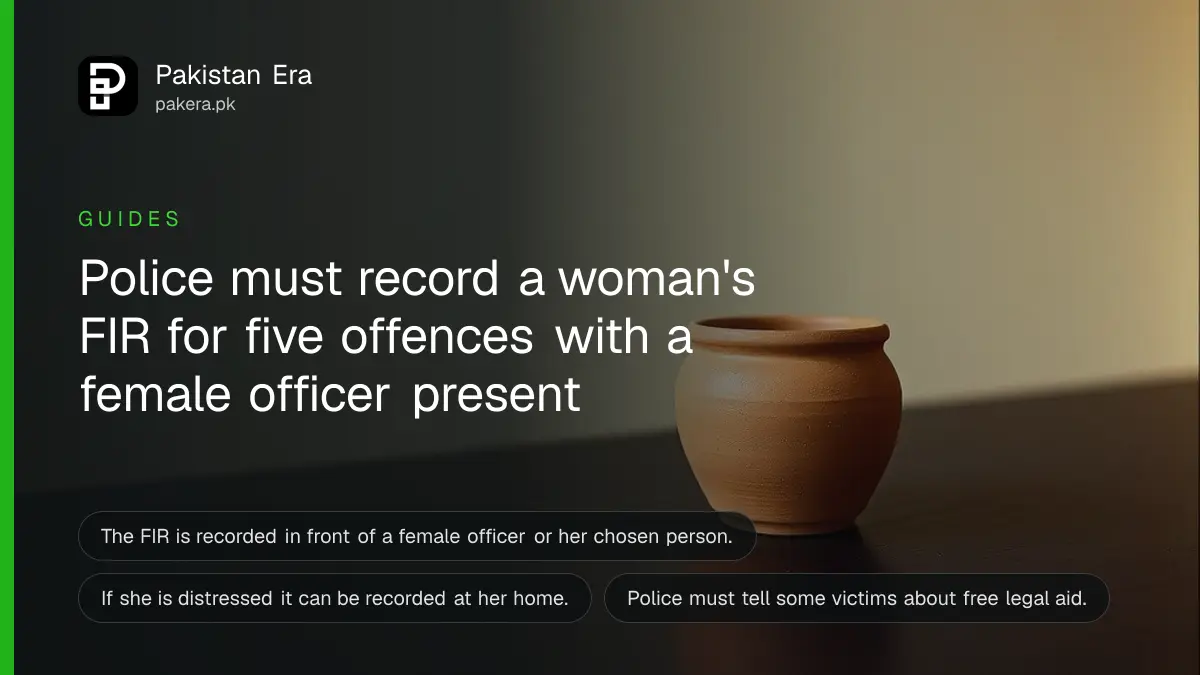
Short answer: Under section 154 of the Code of Criminal Procedure, when a woman reports acid attack, assault on her modesty, stripping, rape or insult to her modesty, the FIR must be recorded in the presence of a female police officer, a female family member or another person she consents to. If she is distressed, it can be recorded at her home.
Going to a police station to report a crime against your own body is hard. The law knows this. The Code of Criminal Procedure has special rules on how police must record a woman's report. You can ask for them by name.
We read sections 154, 161, 161A and 167 of the Code of Criminal Procedure, 1898 on the Pakistan Code portal (pakistancode.gov.pk) on 14 October 2026. The rules below follow that text. For how to push when police refuse any FIR, see our guide on what to do in Punjab when police refuse or delay your FIR.
The first proviso names five offences and who must be present
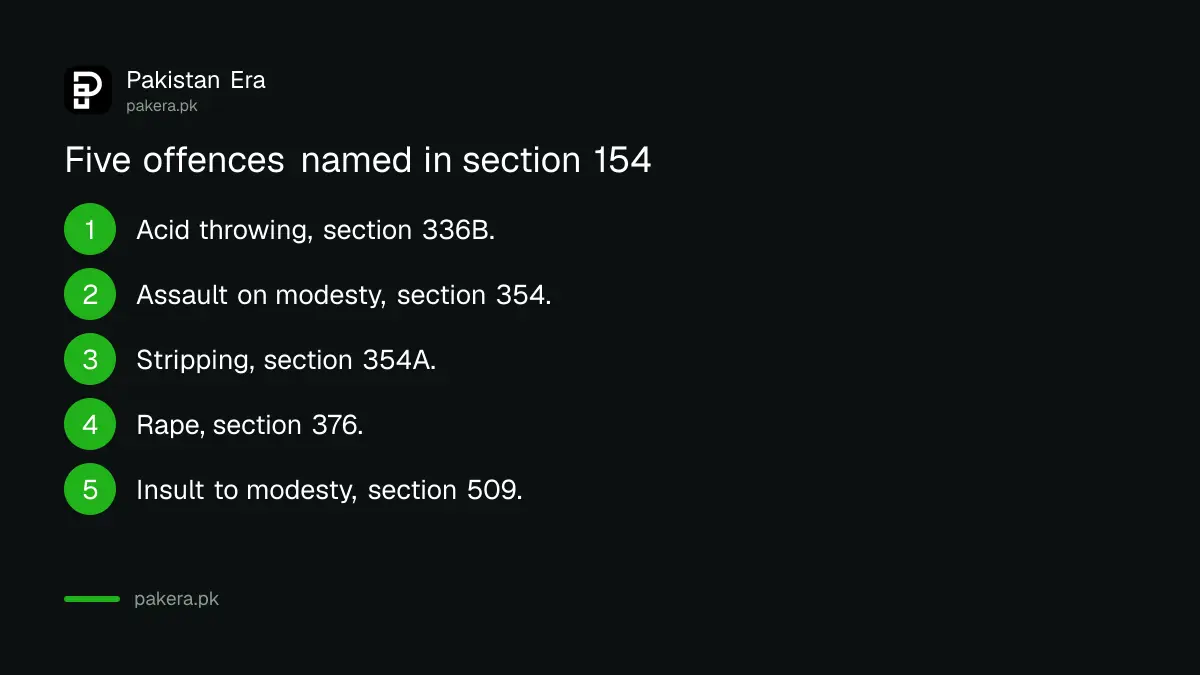
The first proviso to section 154 applies when the woman says an offence was committed or attempted against her under section 336B, 354, 354A, 376 or 509 of the Pakistan Penal Code. The investigating officer must record her information in the presence of a female officer, a female family member or another person with her consent.
These sections cover acid throwing (336B), assault or criminal force to outrage modesty (354), assault involving stripping (354A), rape (376) and words, gestures or intrusion meant to insult the modesty of a woman (509).
The choice of who sits with you is yours. You may pick a female officer, a woman from your family or another person you trust. Say it before the officer starts writing.
A distressed complainant can ask to be recorded at home
The second proviso says that if the woman is distressed, the information shall be recorded by an investigating officer at her residence, or at another convenient place of her choice. A police officer, a family member or another person she consents to must be present.
The text uses the word distressed and does not define it. We did not find a test or a form for it in the Code. You can state in your application that you are distressed and ask the station to send an officer to the place you name.
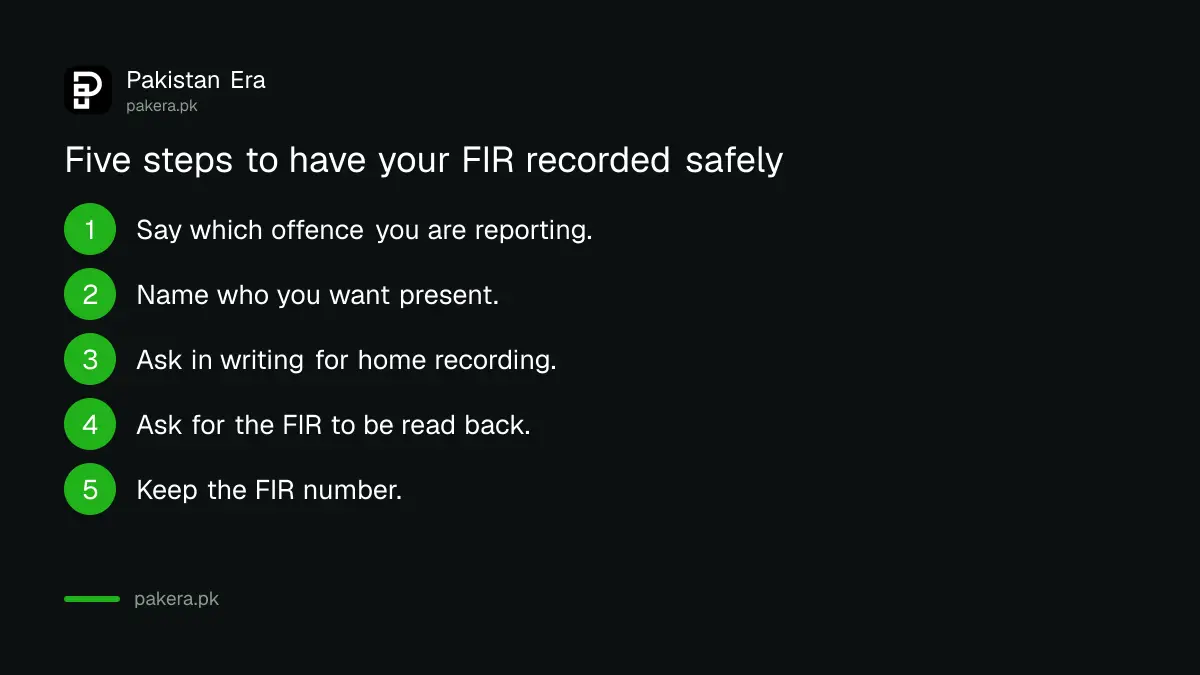
- Call the station or go with a family member and say which offence you are reporting.
- Name who you want present: a female officer, a woman from your family or another person.
- If you cannot come to the station, ask in writing for the officer to record the report at your home or another place you choose.
- Ask the officer to read the report back to you before you sign.
- Keep a copy of the FIR or the receipt number.
Your later police statement follows the same rule
Section 161 covers police questioning of witnesses. Its proviso says a statement of a woman against whom one of the same offences was committed or attempted must be recorded by the investigating officer in the presence of a female officer, a female family member or another person of her choice.
So the protection is not for the first report only. It follows you into the investigation. If an officer wants a statement from you with only male officers in the room, you can ask for one of the three persons named in the proviso.
Victims of some offences must be told about free legal help
Section 161A covers offences under sections 354A, 376, 377 and 377B. After recording the information under section 154, the police officer must inform the victim of her right to legal representation. If she needs free legal aid, he must give her the list of lawyers kept by the Provincial Bar Councils.
If this does not happen, ask for it. Our guides on free lawyers in Punjab and free lawyers in Khyber Pakhtunkhwa show other routes, and the Supreme Court helpline is covered in calling 1818 for free legal aid.
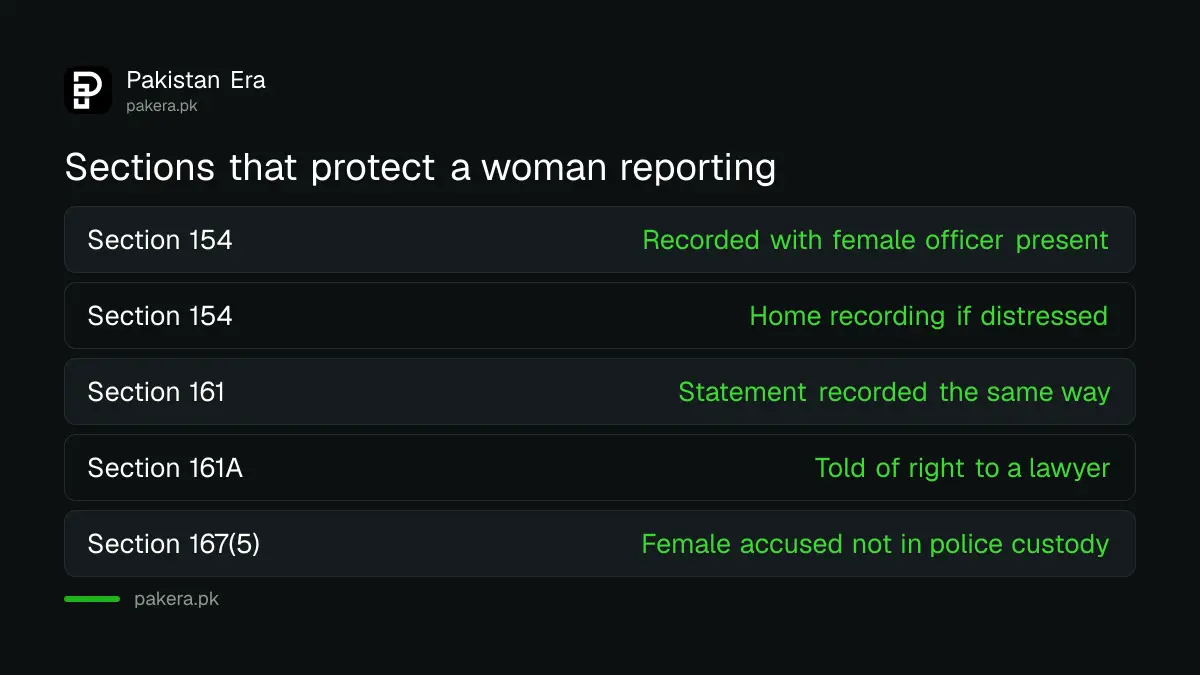
| Section | What it requires |
|---|---|
| 154, first proviso | FIR recorded with a female officer, female family member or a person she consents to |
| 154, second proviso | If distressed, recorded at her home or a place of her choice |
| 161, proviso | Her statement recorded the same way |
| 161A | Police must tell the victim of her right to a lawyer and give the Bar Council list |
| 167(5) | A woman accused is not held in police custody except in qatl or dacoity cases |
A woman who is the accused has her own safeguard
Section 167(5) says that when a female accused is sent to a Magistrate, he shall not authorise police custody, except in cases of qatl or dacoity and then only with written reasons. Police interrogate her in prison with a jail officer and a female police officer present.
This is a different situation from reporting a crime, but families often meet it too. Our guide on the 15 day police remand limit explains how remand works for other accused persons.
Common questions
Can I refuse to have a male officer record my report?
For the five named offences, the proviso says the report is recorded in the presence of a female officer, a female family member or a person you consent to. Name your choice when you start.
Does the home recording rule apply to all offences?
No. The text ties it to a woman against whom an offence under section 336B, 354, 354A, 376 or 509 is alleged to have been committed or attempted, and who is distressed.
Is a lawyer free for every victim?
Section 161A says the officer must tell certain victims of their right and give the Bar Council list if they need free legal aid. It does not itself pay a lawyer.
What if the police refuse to register my FIR?
The special recording rules do not remove the need for an FIR. Use the steps in our refused FIR guide for the next level.
Where can I get urgent help in Punjab?
The Punjab Women's Helpline 1043 is explained in our guide to the helpline.
How we verified this
What we checked, where we read it, and what we could not confirm.
We read sections 154, 161, 161A and 167 of the Code of Criminal Procedure, 1898 in the PDF on the Pakistan Code portal (pakistancode.gov.pk) on 14 October 2026. That file says it was last amended on 16 February 2017. We did not read police rules or provincial orders that may add steps, and we did not verify how each station applies these provisos. This guide is general information, not legal advice.
About the author

Tax, Bills and Technology Writer
Ali Akhtar is a young and curious voice here at Pakistan Era. He is currently pursuing his A-Levels and has a growing interest in Pakistan’s changing industrial landscape and educational trends. Ali likes to write in a way that helps him explain and explore the world around him. His writing reflects the perspective of the new generation navigating the evolving trends of Pakistan where technology, youth innovation, and shifting opportunities are reshaping the country’s future.