FBR Orders Video Cameras in Tea, Electronics, Ghee, Paper and Leather Factories by 15 October
FBR's STGO 27 of 2026 orders tea, electronics, ghee, paper and leather makers to install cameras on every line by 15 October. See who pays and what is required.
The Federal Board of Revenue (FBR) has ordered factories making packaged tea, household electronics, paper and paperboard, edible oil and ghee, and leather to install video cameras on every production line by 15 October 2026. FBR officers will be able to watch the live feed and the recordings at any time.
The order is Sales Tax General Order (STGO) 27 of 2026, dated 7 October 2026 and posted on fbr.gov.pk. A separate notification, S.R.O. 1751(I)/2026 of the same date, brings leather and paper makers under electronic production monitoring with immediate effect. We read both documents in full on the FBR website.
The aim is to count what a factory produces, so that sales tax is paid on all of it. After 15 October, goods made without a working camera system cannot legally leave the factory.
Five sectors must install cameras by 15 October 2026
STGO 27 names five groups of goods. Every person with sales tax registration who makes them is covered, whether the factory makes goods under its own name or for another brand on contract, which the order calls toll manufacturing.
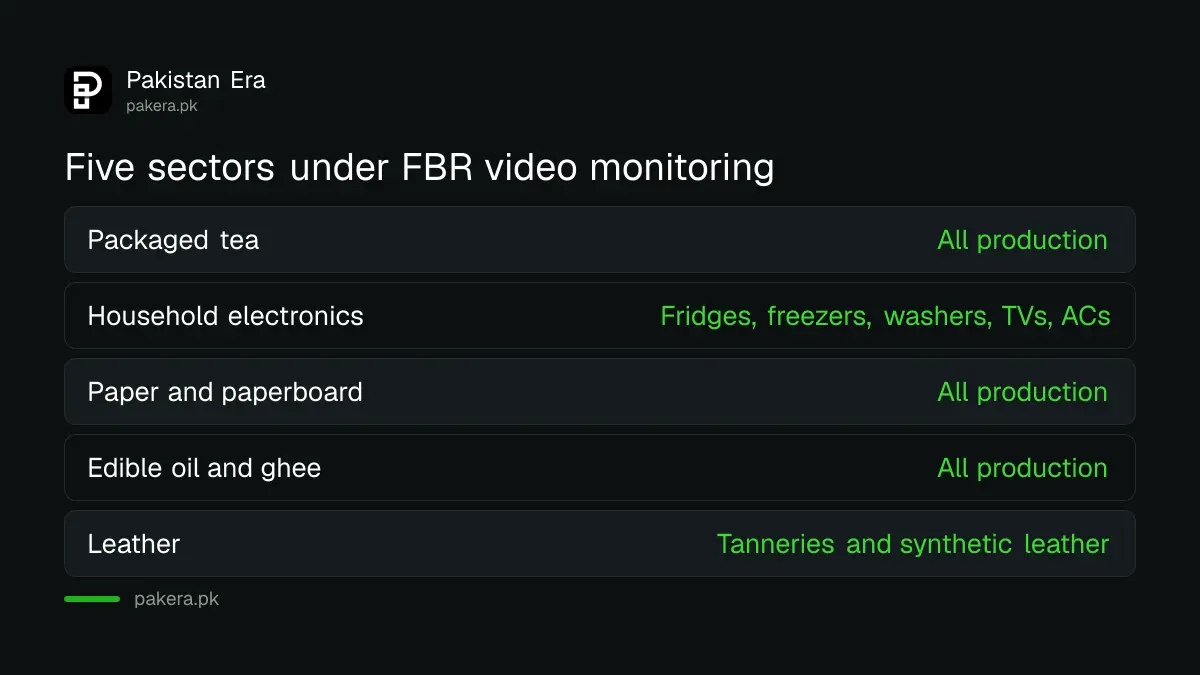
| Sector | What the order covers |
|---|---|
| Packaged tea | All packaged tea production |
| Household electronics | Refrigerators, deep freezers, washing machines, televisions and air conditioners |
| Paper and paperboard | All paper and paperboard production |
| Edible oil and ghee | All edible oil and ghee production |
| Leather | Tanneries and synthetic leather makers |
The legal base is section 40C of the Sales Tax Act, 1990, read with Chapter XIV-BA of the Sales Tax Rules, 2006. Section 40C lets the FBR monitor production electronically. The order says it applies "with immediate effect", and the camera deadline is 15 October.
Cameras must cover five points in every factory
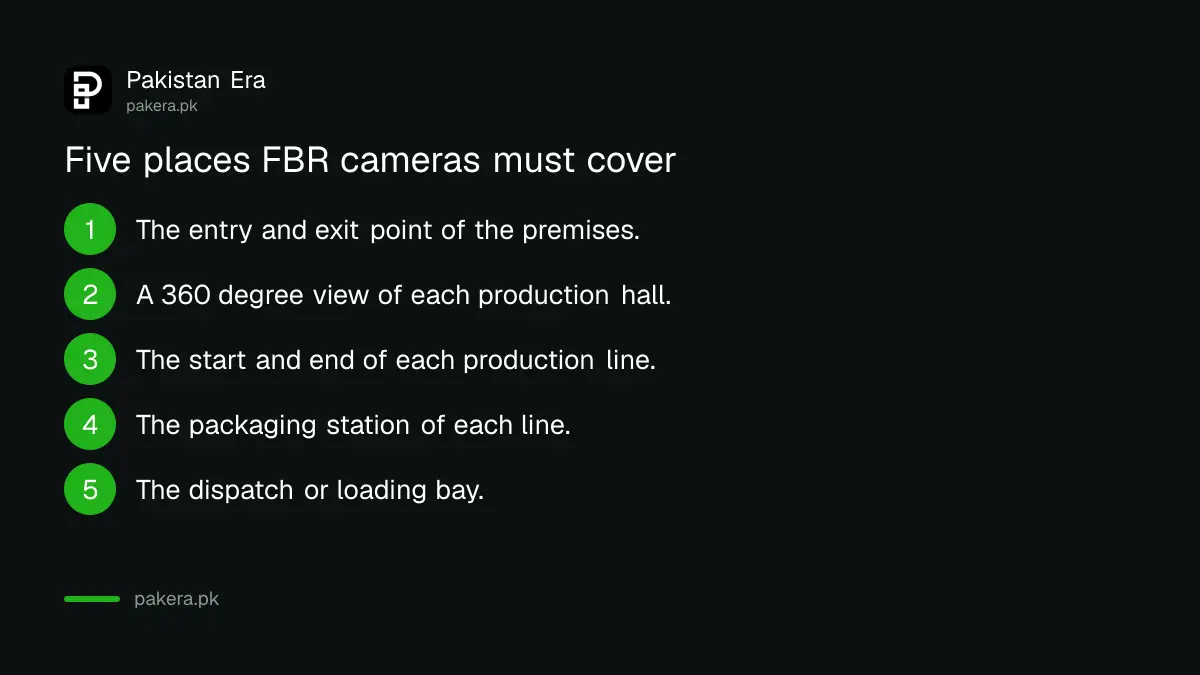
Annex A of the order lists the minimum places a camera must see. The FBR can add to them for any factory based on its layout.
- The entry and exit point of the premises.
- A 360 degree view of each production hall.
- The start and end of each production line.
- The packaging station of each production line.
- The dispatch or loading bay.
The cameras must stay fixed. They cannot be moved, blocked or switched off. Recordings must be kept for at least two months.
The equipment must meet set specifications
Annex B sets the minimum technical standard. Equipment of any make may be used as long as it meets these specifications.
| Equipment | Minimum specification |
|---|---|
| IP camera | 4 MP (2560 x 1440), H.265, 30 metre night vision, ONVIF, Power over Ethernet, IP67 if outdoors |
| Network video recorder | At least as many channels as cameras, remote access, synced to Pakistan Standard Time |
| Storage | Surveillance grade drives holding two months of full resolution footage |
| UPS | One hour of backup for cameras, recorder and network |
| Network | PoE switches and internet fast enough for remote viewing |
The system must be bought from one of four vendors that the FBR has authorised: Obsidian Technologies, Tollink Pakistan (Pvt.) Ltd, ISSM Labelling Solutions (Private) Limited and Authentik. The vendor supplies, installs, tests and maintains it. Each vendor's focal person and contact number are listed in the order itself.
The manufacturer pays, and the footage belongs to the FBR
The factory pays the vendor for buying, installing, running and maintaining the system. The order does not set a price. It also says no fee may be charged to the FBR or its field offices.
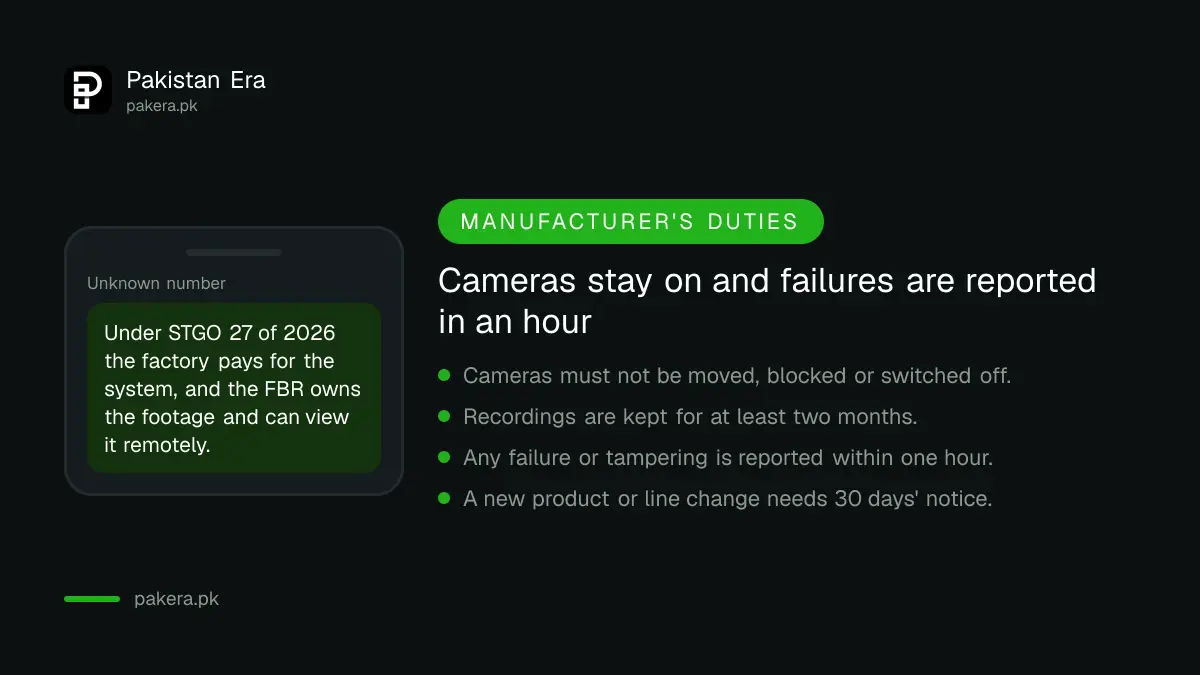
The FBR gets on-demand remote access to the live feed and the recordings. All footage is the FBR's property. It must be kept confidential and shared with no one unless the FBR directs it. Each manufacturer must also:
- provide the space, IT setup and internet connection the system needs, and let the vendor and FBR officers in;
- report any failure, damage, disruption or tampering to the FBR, its Central Control Unit and the local Commissioner Inland Revenue within one hour;
- give the FBR at least 30 days' notice before launching a new product or brand, or changing a production line.
Missing the deadline, or any act to avoid or tamper with the monitoring, makes the registered person liable to penal action under the Sales Tax Act and the rules. The order does not state a fine amount. Chief Commissioners Inland Revenue must name focal persons to help factories install on time.
What a factory owner should do before 15 October
Six days is a short window. If your business makes any of these goods, act now:
- Confirm the order is genuine on fbr.gov.pk. A fake FBR notice asking for payment is a known scam, and the steps to check whether an FBR circular or email is real apply here.
- Contact one of the four authorised vendors. Do not buy cameras from anyone else for this purpose.
- Count your production lines, halls, gates and loading bays, so the vendor can quote for all five camera points.
- Arrange a stable internet line and a one hour UPS.
- Ask your Regional Tax Office for its focal person, and keep a written record of your installation date.
Your monthly sales tax return is still due as normal. The camera system adds a check on production, it does not replace filing.
What it means for shoppers
The order does not change any tax rate or retail price. The FBR has not said whether the cost of the cameras will be passed on. Factories that were under-reporting output would now find that harder, which is the point of the order.
Common questions
Which factories must install FBR cameras?
Sales tax registered makers of packaged tea, refrigerators, deep freezers, washing machines, televisions, air conditioners, paper and paperboard, edible oil and ghee, and leather, including toll manufacturers.
What is the deadline to install the cameras?
15 October 2026. After that date the goods cannot leave the premises unless made under a working video surveillance system.
Who pays for the video surveillance system?
The manufacturer pays the authorised vendor. The order does not fix a price.
Can a factory use its own CCTV vendor?
No. The order says the system must be bought only from the four vendors the FBR has authorised, though equipment of any make meeting Annex B may be used.
How long must recordings be kept?
At least two months. The FBR has remote access to live and recorded footage, and the footage is its property.
What happens if a factory misses the deadline?
It becomes liable to penal action under the Sales Tax Act, 1990 and the rules. The order does not state a fine amount.
How we verified this
What we checked, where we read it, and what we could not confirm.
Last checked 9 October 2026 at about 6:00 am PKT.
- Federal Board of Revenue, Sales Tax General Order 27 of 2026, IR Operations, dated 7 October 2026: STGO 27 of 2026 (PDF)
- Federal Board of Revenue, S.R.O. 1751(I)/2026, dated 7 October 2026: S.R.O. 1751 (PDF)
- Federal Board of Revenue home page, SROs and orders listing: fbr.gov.pk
About the author

Global Affairs & Political Economy Writer
Muhammad Hatim is a book lover who started writing because he enjoys it. At Pakistan Era he writes about international relations, geopolitics and the global economy, with a particular interest in South Asia and the forces behind current events.