FBR Orders Electronic Monitoring of Day Old Chick Production at Hatcheries
FBR order FEGO 2 of 2026, dated 19 October, puts hatchery production of day old chicks under electronic monitoring at once. No deadline or penalty is stated.
Short answer: Federal Excise General Order (FEGO) 2 of 2026, dated 19 October 2026, says the Federal Board of Revenue (FBR) will monitor the production of day old chicks (DOC) at registered hatcheries electronically. The system may use video surveillance, video analytics, a "digital eye" or another FBR-approved tool. The order took effect at once.
We read the signed order on the FBR website. It is one scanned page from the Project Director of the Track and Trace system, and it names no deadline, no vendor and no penalty. Hatchery owners should read it with the earlier camera order for five other sectors, which we explain in our note on video surveillance in factories.
FEGO 2 of 2026 puts hatcheries under electronic production monitoring
The order is issued under sub-section (1) of section 45A of the Federal Excise Act, 2005, read with rules 73B, 73D, 73E and 73N of Chapter XIVA of the Federal Excise Rules, 2005. A day old chick is a chick hatched in the last 24 hours, which hatcheries sell to poultry farms.
The text says production of day old chicks "by registered persons in the hatcheries sector shall be electronically monitored through a production monitoring system". The system is meant to watch production as it happens, in real time.
The order lets FBR choose video, analytics or another system
Paragraph 2 says the production monitoring system "may comprise" video surveillance, video analytics, digital eye, or any other solution approved by the FBR for real-time monitoring of production. It does not choose one tool. It does not name approved suppliers, specifications or costs.
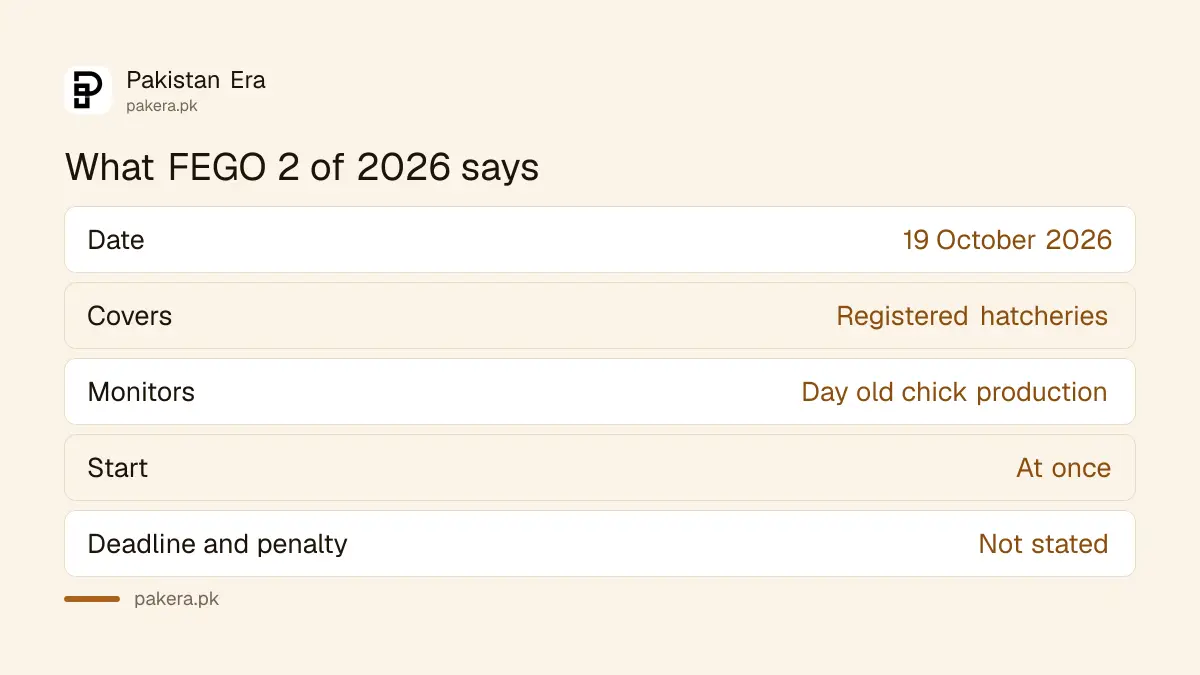
| Point | What the order says |
|---|---|
| Date of order | 19 October 2026 |
| Who is covered | Registered persons in the hatcheries sector |
| What is monitored | Production of day old chicks |
| Tools allowed | Video surveillance, video analytics, digital eye, other FBR-approved solution |
| Start | "Shall come into force at once" |
| Deadline, fee, penalty | Not stated |
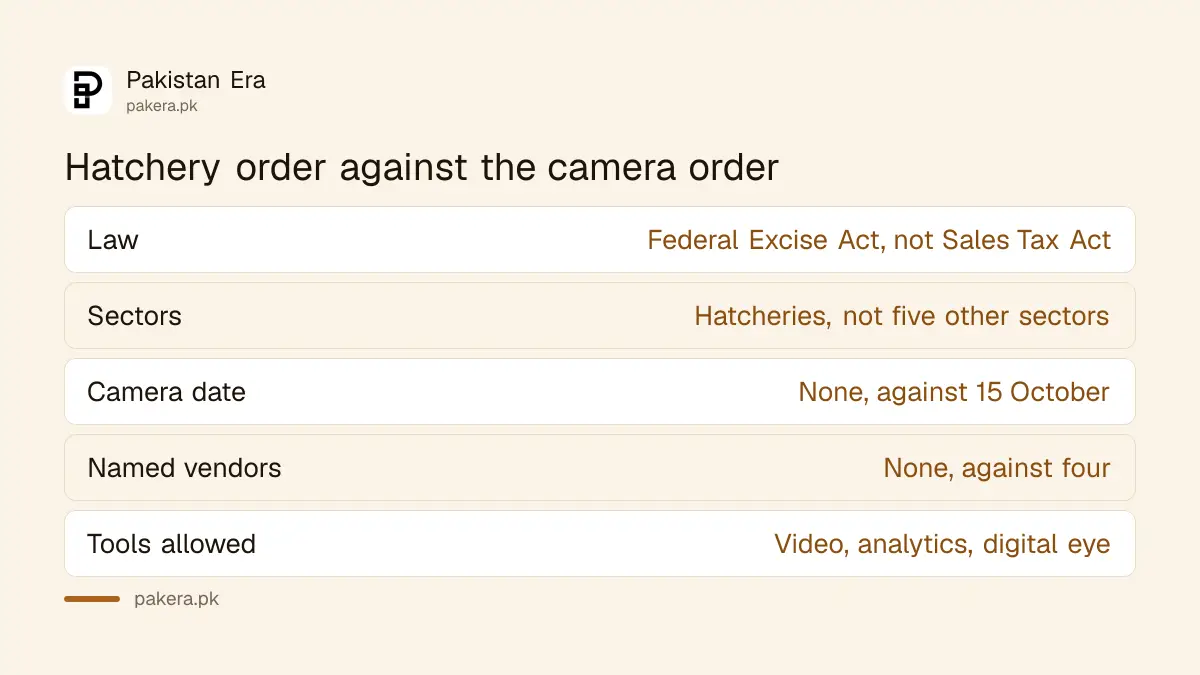
This is a federal excise order, not the sales tax camera order
The earlier camera order, Sales Tax General Order 27 of 2026, rests on the Sales Tax Act and covers tea, household electronics, paper, edible oil and ghee, and leather. FEGO 2 rests on the Federal Excise Act and covers hatcheries. The two have different rule chapters.
That difference matters. The sales tax order set a date of 15 October, named four authorised vendors and listed camera specifications. We saw none of these in the hatchery order. We cannot say that the same cameras, vendors or deadlines will apply to hatcheries.
The order leaves the hard questions to later FBR instructions
Four things are missing from the page. There is no installation date, so we do not know when a hatchery would be in breach. There is no list of approved systems. There is no penalty clause. And there is no statement of who pays for the equipment.
The rules the order names, 73B, 73D, 73E and 73N, may answer some of these. We did not read them, so we do not state what they say. A hatchery owner should ask the Commissioner Inland Revenue for the circle in charge to explain the next step in writing.
Hatchery owners should act on the order now rather than wait
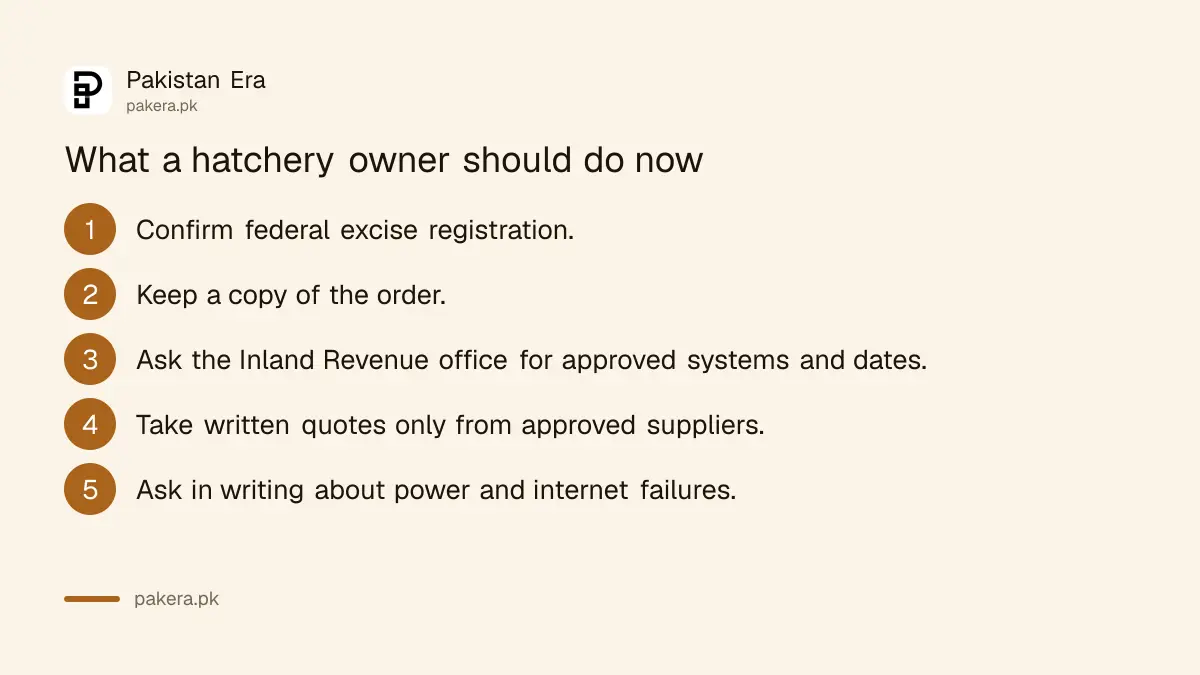
The order took effect at once, and FBR has used similar orders for other sectors with short dates. Owners who delay may face a hurried installation later. The steps below are a sensible plan, not a legal requirement.
- Confirm that your hatchery is registered under the Federal Excise Act, and note your registration number.
- Download FEGO 2 of 2026 from the FBR site and keep a copy with your records.
- Ask your Inland Revenue office which monitoring system is approved for hatcheries and by what date.
- Get written quotes only from suppliers FBR approves, and do not pay in advance.
- Ask the office in writing about the rules to follow for failures of power or internet.
Poultry farmers who buy chicks should know the order does not set a chick price. Chicken prices follow the market, as our chicken price report shows. Farm owners can also read the rules for registering a poultry farm in Punjab, which come from a different department.
Common questions
What is FEGO 2 of 2026?
It is a Federal Excise General Order dated 19 October 2026 that puts the production of day old chicks at registered hatcheries under electronic monitoring.
Who has to follow it?
Registered persons in the hatcheries sector. The page does not give a count or a list.
Do hatcheries have to install cameras?
The order says the system may include video surveillance, but it also allows video analytics, a digital eye or another FBR-approved tool. It does not say cameras are compulsory.
When must the system be running?
The order says it comes into force at once, but it gives no installation date. Ask your Inland Revenue office.
What is the penalty for not complying?
The page names none. The Federal Excise Act and Rules may contain penalties, which we did not read.
Does it raise the price of chicks or chicken?
The order does not set any price or tax rate. It covers monitoring only.
How we verified this
What we checked, where we read it, and what we could not confirm.
Last checked 23 October 2026. We found the order inside the file FBR posts with S.R.O. 1888(I)/2026 on its customs SRO page, together with a website request form for it. The handwriting on the form is hard to read, so we use the date on the order itself, 19 October 2026. We could not read the Federal Excise Rules cited, any later FBR instruction, or the Gazette, and we could not find the order as a separate item on FBR's list.
About the author

Tax, Bills and Technology Writer
Ali Akhtar is a young and curious voice here at Pakistan Era. He is currently pursuing his A-Levels and has a growing interest in Pakistan’s changing industrial landscape and educational trends. Ali likes to write in a way that helps him explain and explore the world around him. His writing reflects the perspective of the new generation navigating the evolving trends of Pakistan where technology, youth innovation, and shifting opportunities are reshaping the country’s future.