On-Grid, Hybrid or Off-Grid Solar in Pakistan: Which to Choose Under Net Billing
Choose on-grid, hybrid or off-grid solar in Pakistan under NEPRA's 2026 net billing rules: three phase needed, exports earn about Rs 11, load shedding counts.
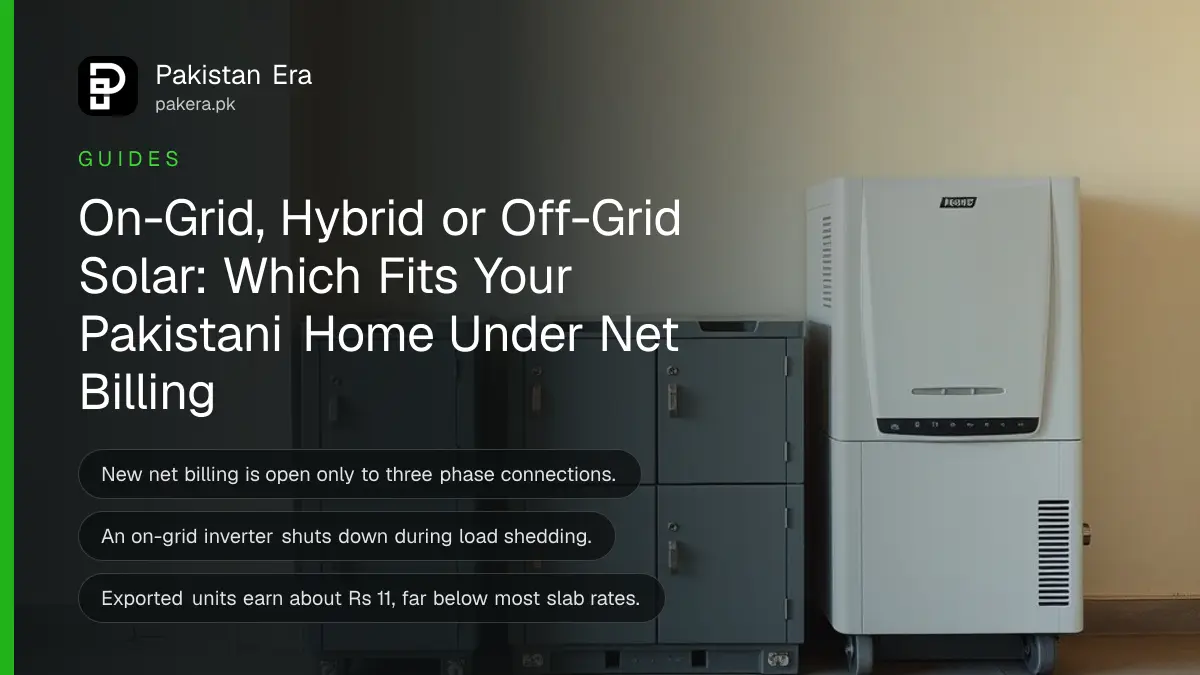
Choose on-grid solar in Pakistan if you have a three-phase connection, little load shedding and use most power in daylight. Choose hybrid if you face load shedding or want power at night. Choose off-grid only where there is no grid or supply is very poor. A single-phase home cannot get a new net billing connection under NEPRA's 2026 rules.
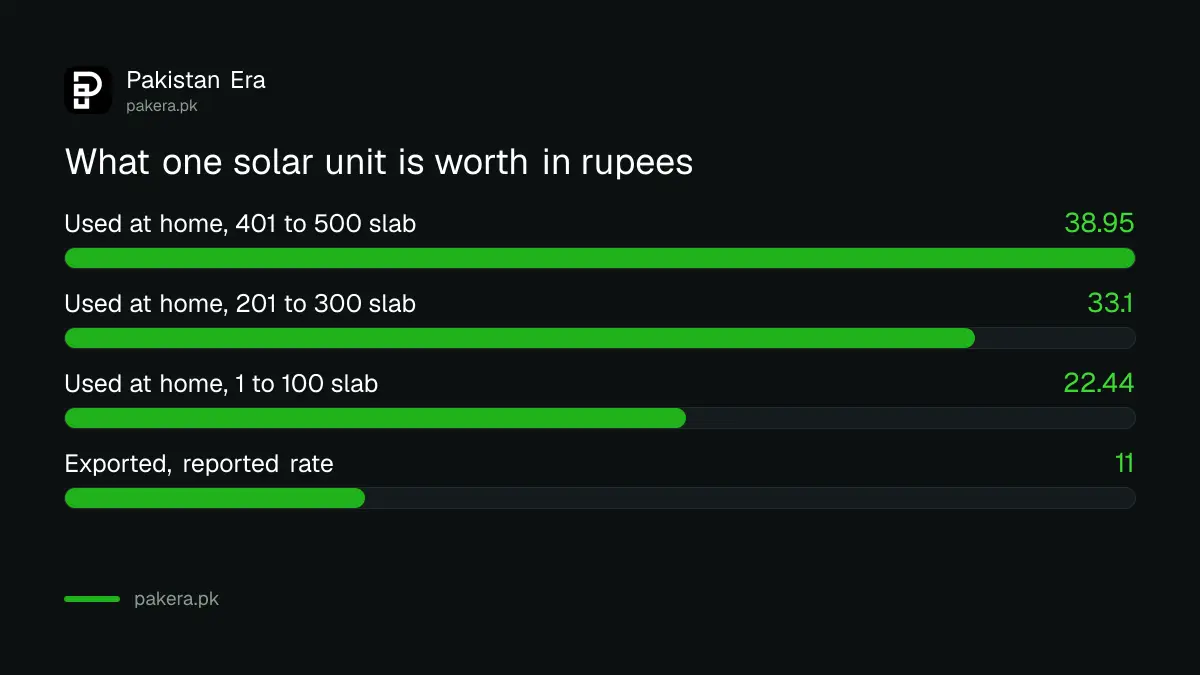
The choice changed in February 2026, when NEPRA replaced net metering with net billing. Units you export now earn the national average energy purchase price, reported at about Rs 11 a unit, while most homes pay Rs 22.44 to Rs 38.95 a unit to import. A unit you use yourself is now worth two to three and a half times a unit you sell.
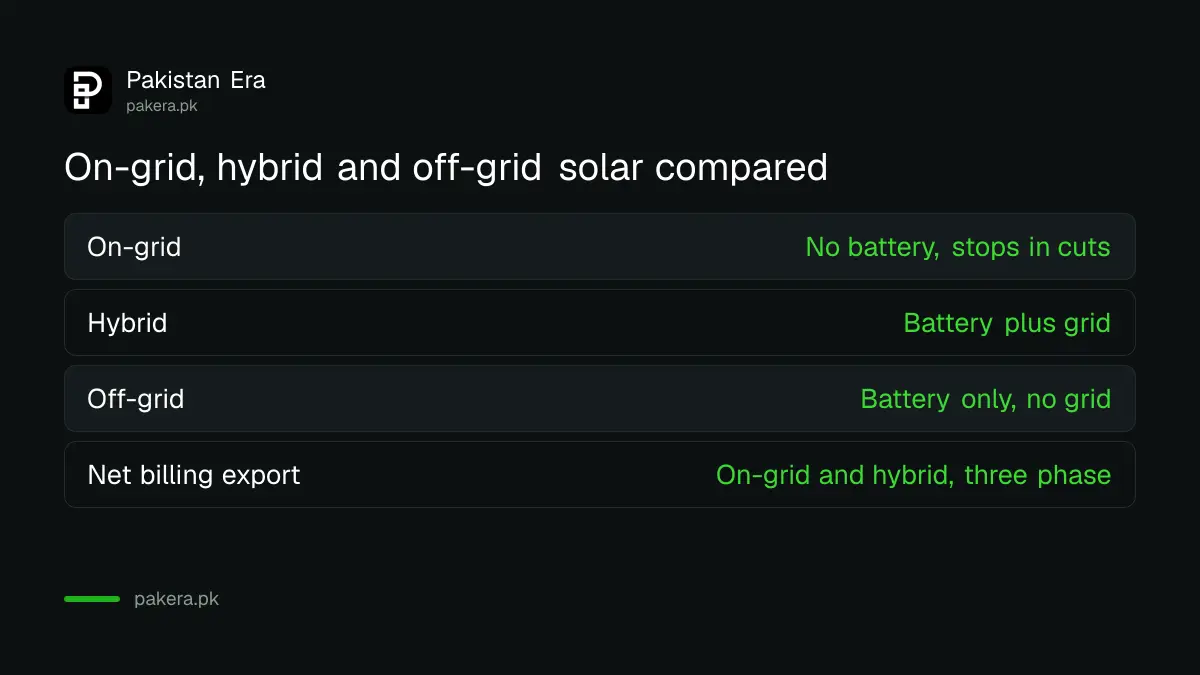
The three systems differ in batteries and grid link
An on-grid system has panels and an inverter tied to the grid, with no battery. A hybrid system adds batteries and can still use the grid. An off-grid system has panels and batteries and no grid link at all. Each suits a different home.
| Feature | On-grid | Hybrid | Off-grid |
|---|---|---|---|
| Batteries | None | Yes | Yes, and they must cover every night |
| Grid connection | Yes | Yes | No |
| Works in load shedding | No, the inverter shuts down | Yes, from the battery | Yes |
| Can export under net billing | Yes, on three phase | Yes, on three phase | No |
| Upfront cost | Lowest | Higher, because of batteries | Highest for the same comfort |
| Battery replacement | Not needed | Every few years, by battery type | Every few years, by battery type |
An on-grid inverter switches off when the grid goes down. That is a safety feature: it stops your panels feeding power into lines that workers may be repairing. So an on-grid system gives you nothing during load shedding, even at noon.
Net billing pays less for exports, so self-use matters more
Under NEPRA's Prosumer Regulations 2026, imported units are charged at your normal tariff and exported units are bought at the national average energy purchase price. Every unit you use from your own panels saves the full slab rate instead.
Take a Lahore home on the 201 to 300 unit slab, which costs Rs 33.10 a unit before taxes. A unit used in the house saves Rs 33.10. The same unit exported earns about Rs 11. So the best system is the one that lets you use the most of your own units, either by running heavy loads in daylight or by storing the surplus in a battery.
Excess export credit is carried to the next bill or paid every quarter. NEPRA can also change the export rate during your agreement, and the new rate then applies automatically. The full rule set is in the 2026 net billing rules. If you signed a net metering agreement before 9 February 2026, you keep the old terms until it expires, unless you change the system's maximum output.
Pick a system in five questions
Answer five questions about your connection, your load shedding, when you use power, your budget and your roof. The answers point to one system for most homes. Settle these before you ask an installer for a quote.
- Is your connection three phase? Check your bill or meter. If it is single phase, net billing is not open to you, so on-grid only saves units you use in daylight.
- How many hours of load shedding do you get? If you get regular cuts, an on-grid system will sit idle during them. Hybrid is the better fit.
- When do you use most power? Daytime use, such as an office at home, ACs in the afternoon or a water pump, suits on-grid. Evening and night use suits hybrid.
- What is your budget? Batteries are the most expensive part of a hybrid or off-grid system. If the budget is tight, start on-grid with a hybrid-ready inverter and add batteries later.
- Is your system size within your sanctioned load? A grid-linked system cannot be larger than your sanctioned load, and your transformer must have room for more solar.
Which system fits which Pakistani home
Most city homes with a three-phase connection and short cuts do well on-grid. Homes with long load shedding, or that need fans and lights at night, do better with hybrid. Off-grid suits farms, remote homes and places the grid does not reach.
| Your situation | Best fit | Why |
|---|---|---|
| Three phase, little load shedding, daytime use | On-grid | Lowest cost, exports surplus |
| Three phase, regular load shedding | Hybrid | Backup during cuts, exports surplus |
| Single phase, daytime use | On-grid without export, or hybrid | No net billing, so use units in daylight or store them |
| Single phase, night use or cuts | Hybrid | The battery keeps your own units for the evening |
| No grid, or a farm far from the lines | Off-grid | No connection to rely on |
Size the panels from your bill first, then choose the type. For the battery side, the watts, hours and amp-hours method in the steps to size a UPS battery for load shedding works for a hybrid battery too. Why so many homes are adding storage is covered in the figures on solar battery storage in Pakistan.
Check the paperwork and the installer before you buy
Whichever system you choose, check that the installer is certified, that the quote lists panel, inverter and battery ratings, and that a grid-linked system will be applied for through your DISCO. A system connected without approval cannot be billed under net billing.
Ask for the inverter's datasheet and check whether it is on-grid only, hybrid, or off-grid. Some inverters sold as "hybrid" cannot export. If you want net billing, the inverter must be able to sync with the grid. Check the installer on the PPIB certified solar installer list before paying any advance. NEPRA has also published draft rules for standalone systems in remote pilot areas, set out in the NEPRA standalone solar pilot draft, but they are a draft and apply only to areas a government notifies.
Before choosing, work out the system size you need from your monthly units.
Common questions
Which is better in Pakistan, on-grid or hybrid solar?
Hybrid if you face load shedding or use most power at night. On-grid if you have three phase, few cuts and high daytime use, because it costs less.
Does on-grid solar work during load shedding?
No. An on-grid inverter shuts down when the grid fails, as a safety measure. You need a hybrid or off-grid system with batteries for power during cuts.
Can I get net metering on single phase in 2026?
No new connection. NEPRA's 2026 regulations allow only three-phase 400 V or 11 kV consumers to apply. Older single-phase agreements keep their terms until they expire.
What is the export rate for solar units in 2026?
The national average energy purchase price, reported at about Rs 11 a unit. NEPRA can revise it during your agreement.
Is off-grid solar worth it in a city?
Rarely. Without the grid, the batteries must cover every night and every cloudy day, which costs far more than a hybrid system for the same comfort.
Can I change an on-grid system to hybrid later?
Yes, if the inverter supports batteries or you replace it with a hybrid one. Tell your DISCO if the change alters the system's maximum output.
How we verified this
What we checked and where we read it.
The net billing rules are NEPRA's Prosumer Regulations 2026 (SRO 251(I)/2026) and the amendment protecting older agreements (SRO 547(I)/2026), both listed on the NEPRA legal page, checked on 24 November 2026. The slab rates are from the federal tariff notification of 12 February 2026. The Rs 11 export figure is the rate reported for the national average energy purchase price; NEPRA's regulations name the price without printing a rupee figure.
About the author

Tax, Bills and Technology Writer
Ali Akhtar is a young and curious voice here at Pakistan Era. He is currently pursuing his A-Levels and has a growing interest in Pakistan’s changing industrial landscape and educational trends. Ali likes to write in a way that helps him explain and explore the world around him. His writing reflects the perspective of the new generation navigating the evolving trends of Pakistan where technology, youth innovation, and shifting opportunities are reshaping the country’s future.