NEPRA Standalone Solar Regulations 2026 Draft in Pakistan: Off-Grid Pilots for High-Loss Areas, Who Pays and How to Comment
NEPRA's draft Standalone Electric Power System Regulations 2026 allow two off-grid pilots per power company in high-loss areas. See who pays and how to comment.
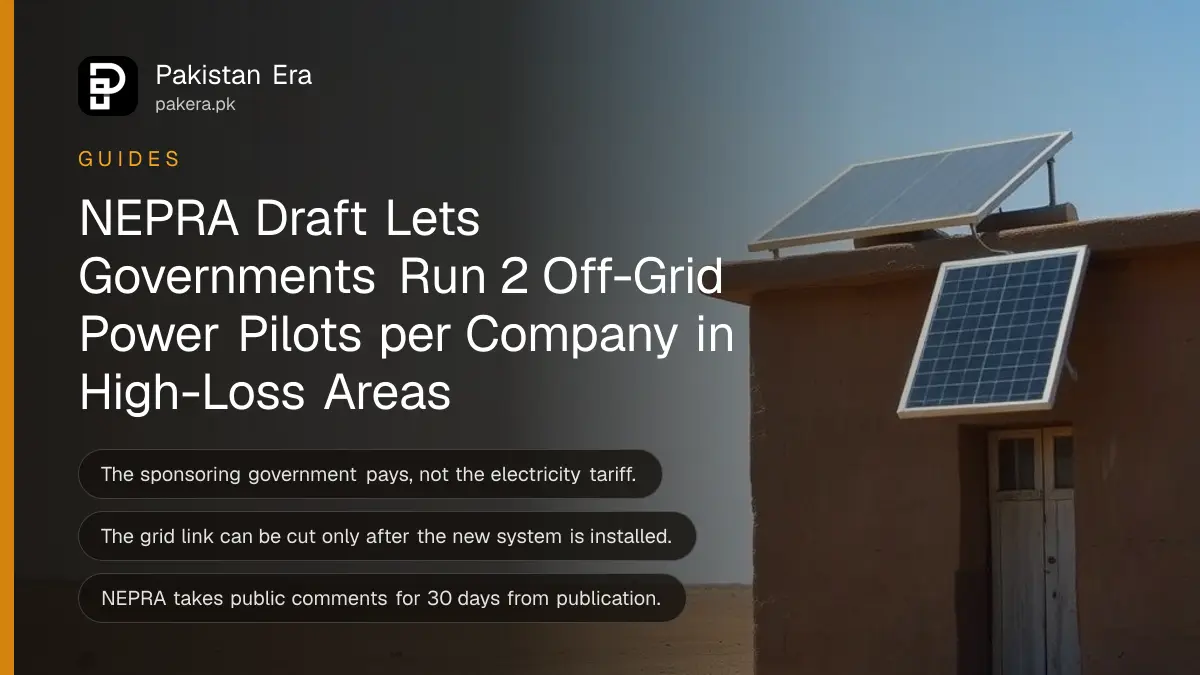
NEPRA has published draft regulations that would let the federal or a provincial government take selected high-loss or remote areas off the power grid and supply each home with its own standalone system, such as solar with or without batteries. The draft, called the NEPRA Standalone Electric Power System (Pilot Projects) Regulations 2026, allows two pilot projects per power company. Anyone can send comments to NEPRA's Registrar within 30 days of publication.
It is a short document of ten regulations, but it changes something basic. In a notified pilot area, the local power company would stop being responsible for supply, could cut the grid connection once the new system is in place, and could even dismantle its lines. We read the draft and NEPRA's notice on NEPRA's website on 31 October 2026.
The draft lets governments replace grid supply in pilot areas
Under the draft, a "sponsoring government" prepares a scheme and notifies it with the consent of the local power company. Once notified, that area is cut out of the company's distribution and supply licences, and homes get a standalone system instead of a grid connection.
The draft defines a standalone electric power system as a self-contained set of generation, with or without storage, supplying one premises, with no direct or indirect link to the national or provincial grid. The word solar does not appear in the definition, though the notice's file name refers to standalone solar.
| Draft rule | What it says |
|---|---|
| Who starts a scheme | Federal or provincial government, with the power company's consent |
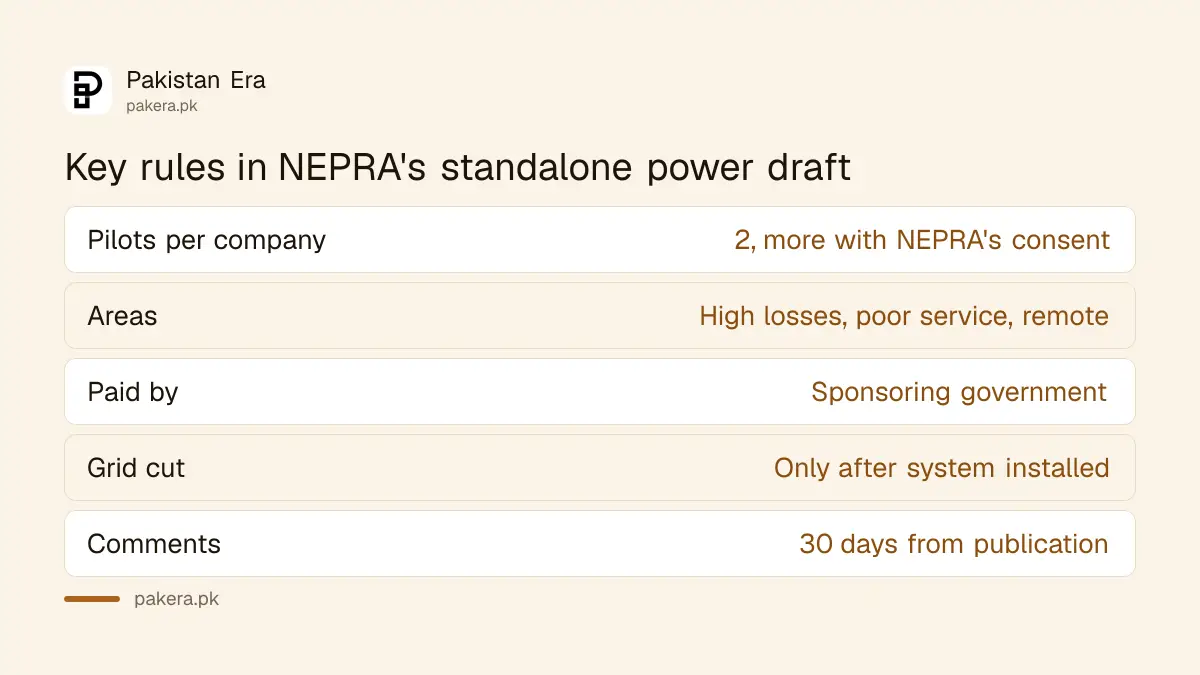
| How many pilots | Two per licensee, or more if NEPRA agrees |
| Which areas qualify | High distribution losses, high recovery loss, poor service, remote areas, or where the network is not economic |
| When the grid is cut | Only after the standalone system is installed |
| Who pays | The sponsoring government, not the tariff |
| Reconnection to the grid later | Cost borne by the sponsoring government, not consumers |
| Extra charges on consumers | None beyond those set in the scheme |
Pilots are aimed at areas with high losses and poor service
The draft limits pilots to areas with persistently high distribution losses, high recovery loss, poor service, remote locations, or where building and running the network is not economically justified. That describes parts of the service areas of several companies with the highest losses.
NEPRA's own loss targets show where that could bite. The gap between allowed and actual losses is large at companies such as SEPCO, set out in SEPCO's loss target in Sindh, and QESCO, set out in QESCO's loss target in Balochistan.
The draft does not name any area, company or province. Those choices would come in each government's scheme.
What a scheme must tell consumers
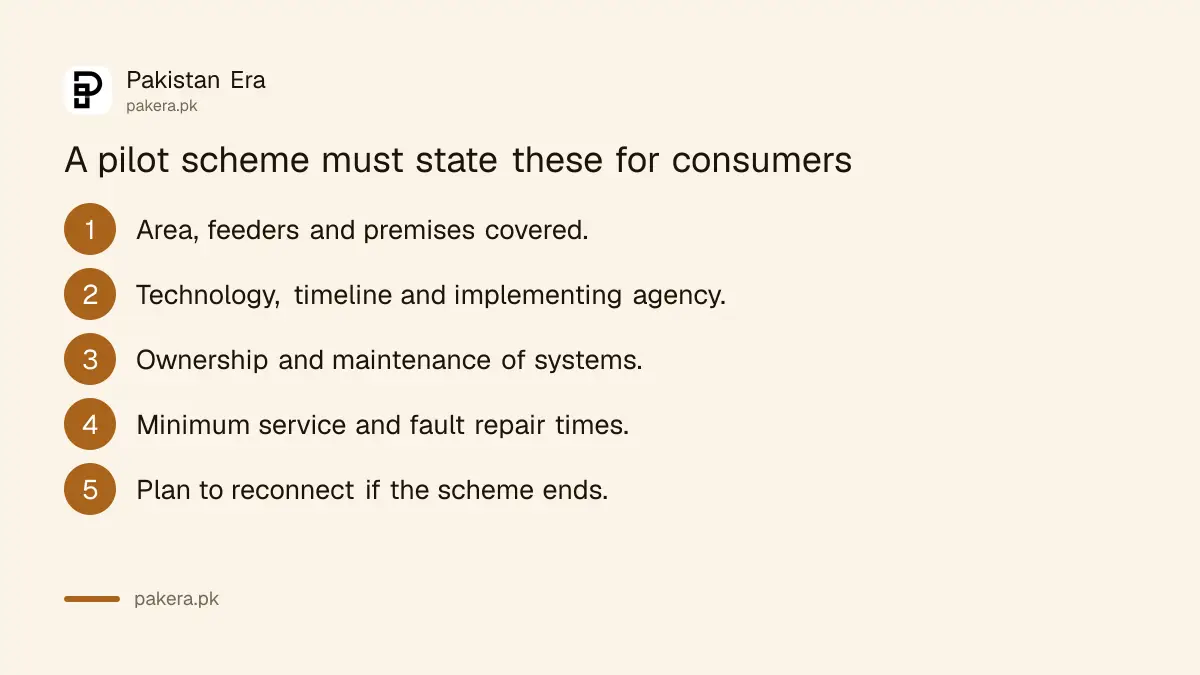
Every scheme must set out its aim, the exact area, feeders and premises, the technology and timetable, safety, ownership and maintenance, and the minimum service consumers will get. That includes capacity, energy available, time to fix faults and replace parts, and any complaint system.
- The objective and the public benefit of the scheme.
- The geographical area, feeders and premises covered.
- Technology, implementation plan, timelines and the implementing agency.
- Cost sharing and a cost benefit analysis.
- Safety aspects and evidence of consultation and notice to affected consumers.
- How future consumers in the area will be treated.
- Ownership, operation and maintenance of the systems.
- A plan to reconnect the area if the scheme is stopped.
- Minimum service levels and fault repair times.
The draft also asks the company to deal with arrears outstanding in the area under the existing rules. So unpaid bills do not disappear when the grid connection does.
The costs stay off your electricity bill
The draft says the standalone systems are funded by the sponsoring government, through a grant, subsidy or other money, and that cost cannot enter any company's revenue requirement. If an area later needs reconnection to the grid, that cost also falls on the government, not on consumers through the tariff.
Data protection is mentioned too. The implementing agency and the company must protect personal data collected for a pilot. NEPRA will receive reports three months after a scheme starts, and it will assess each pilot after one year.
For a household that already pays for its own panels and batteries, nothing in the draft changes that choice. Home battery and solar costs are covered separately in solar battery storage in Pakistan.
Send comments to NEPRA within 30 days
NEPRA's notice invites public opinion on the draft under section 47(3) of the NEPRA Act. Comments go to the Registrar, NEPRA Tower, Ataturk Avenue (East), G-5/1, Islamabad, within 30 days of publication.
The notice image on NEPRA's site is dated by the server to 24 October 2026. Counted from that day, 30 days end around 23 November 2026. That is our arithmetic; NEPRA counts from the newspaper publication, whose date we could not see. The notice carries the press number PID(I)3697/26.
- Read the draft on NEPRA's website in the news section.
- Name the regulation you are commenting on, for example regulation 4 on area selection.
- Give reasons and, if you live in a likely area, say how supply works there now.
- Post or deliver your comment to the Registrar and keep proof.
How NEPRA's public process works in general is explained in taking part in a NEPRA public hearing.
Common questions
What are NEPRA's standalone solar regulations?
A draft that lets governments run up to two pilot projects per power company, supplying homes from standalone systems instead of the grid.
Will my grid connection be cut?
Only if your area is in a notified pilot scheme, and only after a standalone system is installed at your premises.
Who pays for the standalone systems?
The sponsoring federal or provincial government. The draft says the cost cannot be added to any company's tariff.
Which areas can be chosen?
Areas with high losses, high non-payment, poor service, remoteness, or where the network is not economic. The draft names no specific area.
Are the regulations in force?
No. This is a draft published for comment. It would come into force only when NEPRA notifies the final version.
How do I comment?
Write to the Registrar, NEPRA, G-5/1 Islamabad, within 30 days of the notice's publication.
How we verified this
What we checked, where we read it, and what we could not confirm.
We read NEPRA's notice image and the draft regulations PDF, both linked from the NEPRA website home page, on 31 October 2026. The server dates both files to 24 October 2026. The 23 November date is our count from the posting date. We could not see the newspaper publication date, and we found no list of planned pilot areas.
About the author

Global Affairs & Political Economy Writer
Muhammad Hatim is a book lover who started writing because he enjoys it. At Pakistan Era he writes about international relations, geopolitics and the global economy, with a particular interest in South Asia and the forces behind current events.