How to Claim an Electronics Warranty in Pakistan When a Shop Refuses
A manufacturer's warranty and a shop's own guarantee are different things in Pakistan. See what the warranty card actually covers and how to claim a repair.
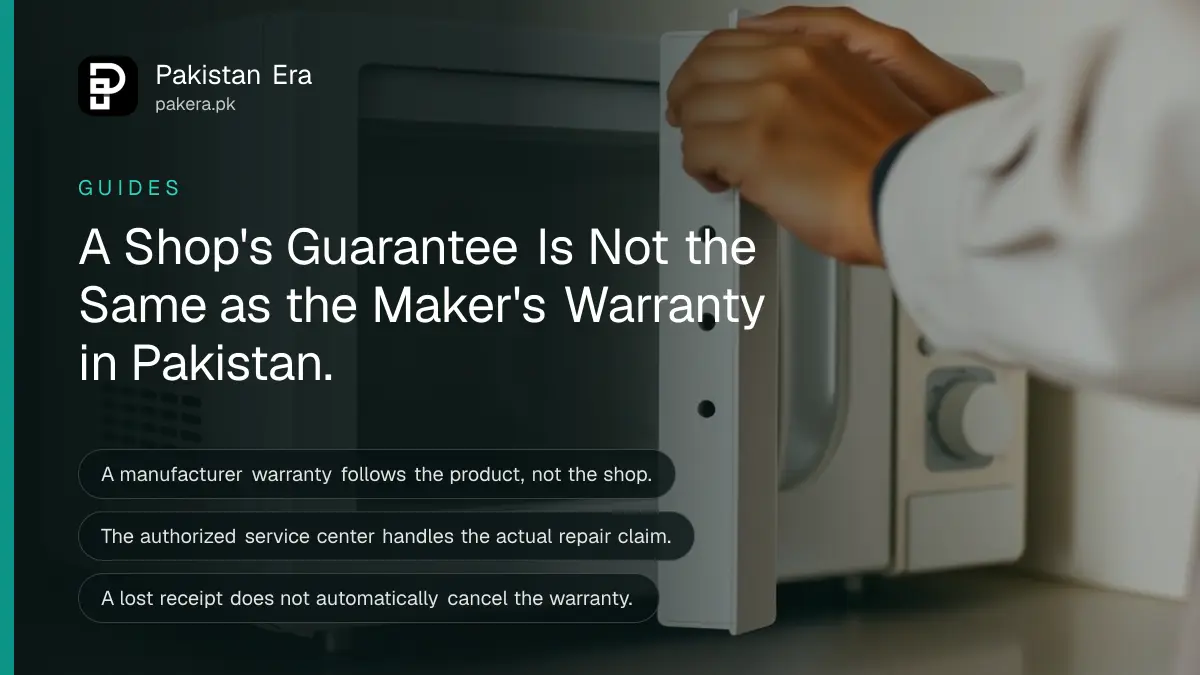
A manufacturer's warranty and a shop's own guarantee are not the same promise, and mixing them up is why most warranty claims in Pakistan start at the wrong counter. The warranty card tells you who actually owes you the repair: the maker's authorized service center, not the shop that sold it.
Update, 11 October 2026: Daraz also explains how to claim a warranty with the brand or seller.
Walk into most electronics shops with a broken appliance and the person at the counter will often point you back to "the company." That's usually correct, and it's also where people give up, because nobody explained which document actually controls what happens next.
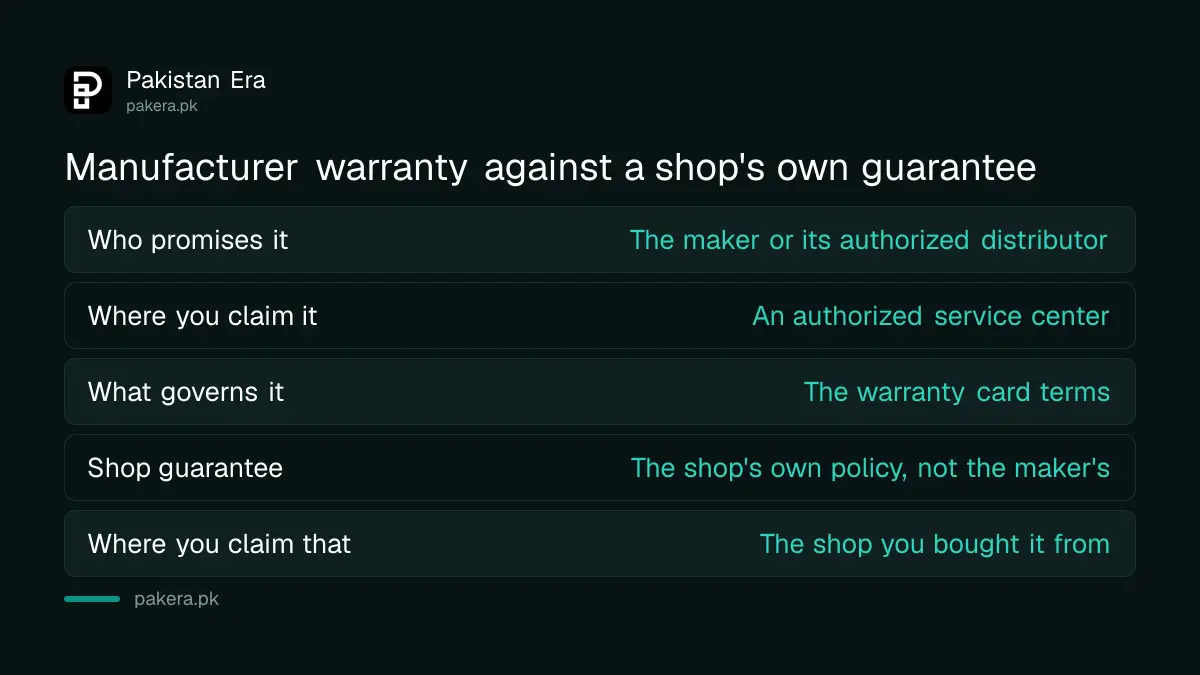
A manufacturer's warranty and a shop's guarantee are not the same thing
A manufacturer warranty is a written promise from the maker, printed on a card or e-warranty page, and it is claimed at that brand's authorized service center. A shop's own guarantee, sometimes just a verbal "seven din ki guarantee" at the till, is the seller's separate promise and it is claimed at the shop.
Both can exist on the same purchase. A fridge might carry a 12 month compressor warranty from the manufacturer and a 15 day exchange policy from the shop. If the compressor fails in month three, that's the maker's problem. If the fridge arrived with a dent on day two, that's the shop's problem under its own return policy, which Punjab law actually requires sellers to display. We cover that seller side separately in the shop receipt and return policy rules.
The warranty card decides what is covered, not the shop
Read the card before you argue with anyone. It states the length of cover, what parts it includes, and what cancels it. Most major electronics and appliance brands in Pakistan run a 12 month warranty on the main unit as a typical figure, with shorter cover on batteries, accessories or cables, though the exact length is whatever that specific brand's card says, not a number fixed by law.
There is no federal or provincial law in Pakistan that sets a minimum warranty length for an appliance or a gadget. The length, the parts covered and the exclusions are a private promise from the maker. What the law does step in on is a broken promise: if the product does not do what the written warranty said it would, that mismatch itself counts as a defect under the Punjab and Sindh consumer protection laws, which is a different and stronger claim than simply quoting the warranty card back at someone.
Start the claim at the authorized service center, not back at the shop
Going back to the shop first is the most common wasted trip. Once the sale is done, a manufacturer warranty claim belongs with that brand's own service network, and a shop assistant usually cannot approve a repair even if they want to help you.
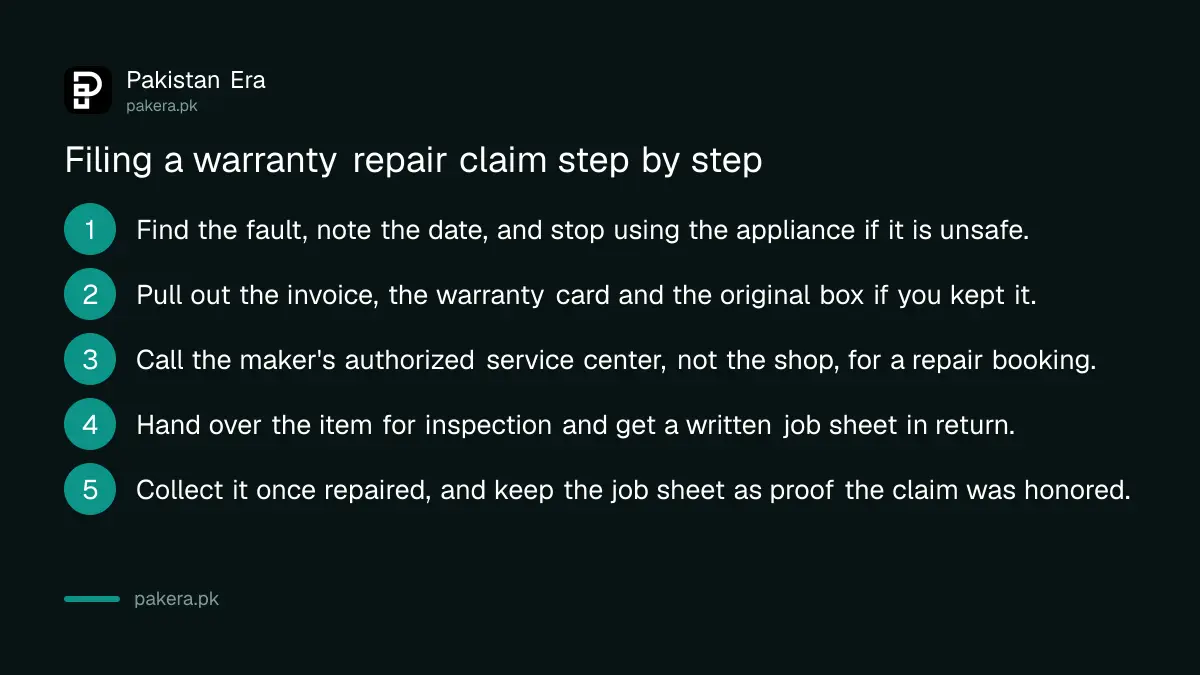
- Find the fault, note the date it started, and stop using the appliance if it looks unsafe.
- Pull out the invoice, the warranty card and the box if you still have it.
- Call the maker's authorized service center directly and book an inspection.
- Hand the item over and get a written job sheet, not just a verbal "we'll call you."
- Collect the repaired item and keep the job sheet as proof the claim was honored.
A phone is the one common exception worth a separate check, because several big brands let you confirm live warranty status by IMEI before you even leave the house, which we walk through in checking a phone's warranty by IMEI.
Common reasons shops and service centers refuse, and whether they hold up
Some refusals are legitimate. Others are a counter policy that has nothing to do with the actual warranty card.
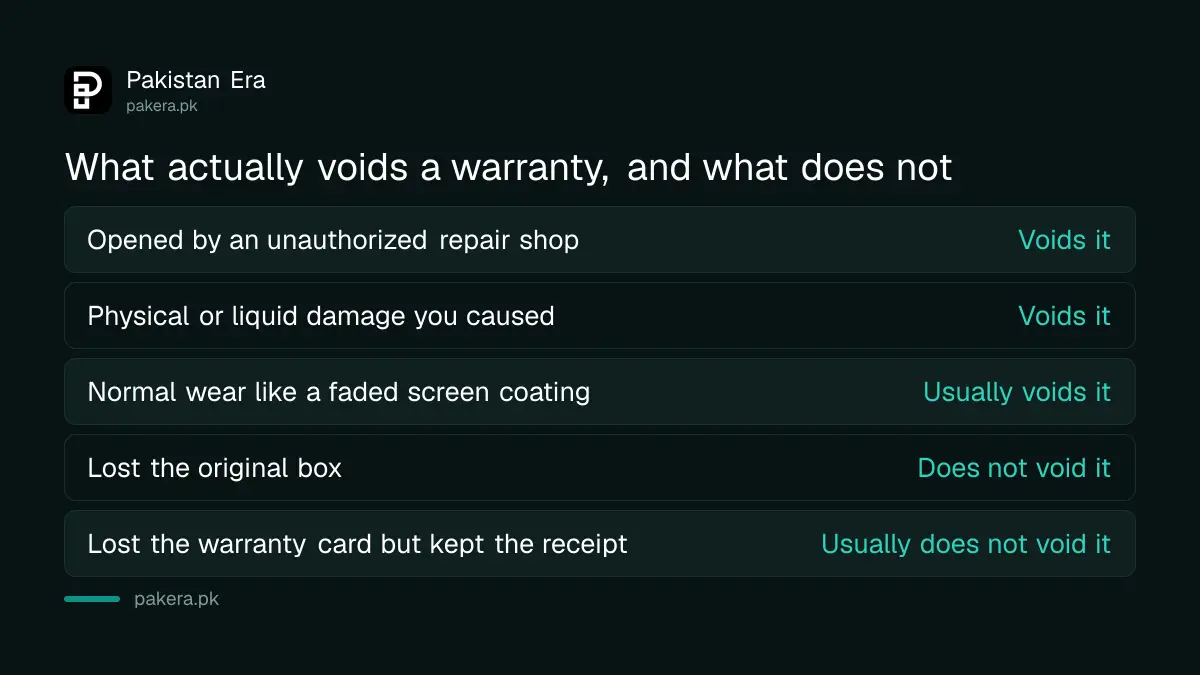
| Reason given | Does it actually void the warranty |
|---|---|
| Opened by an outside repair shop first | Yes, almost always |
| Physical damage, a crack or liquid exposure | Yes, in most warranty cards |
| Lost the original box | No, the box is packaging, not proof of purchase |
| Lost the warranty card but kept the invoice | Usually no, the invoice alone often still works |
| Bought on sale or at a discount | No, a discounted price does not reduce warranty cover |
If a service center quotes you a reason that is not actually printed on your warranty card, ask them to point to the exact clause. A verbal house rule from one staff member is not the same as a written exclusion.
If the service center still refuses, the law gives you a route past them
A refusal at the desk is not the end of a genuine claim. Section 8 of the Punjab Consumer Protection Act 2005 treats a product that does not match the maker's own written warranty as a defective product, which puts you on the same legal footing as someone with a faulty item from day one.
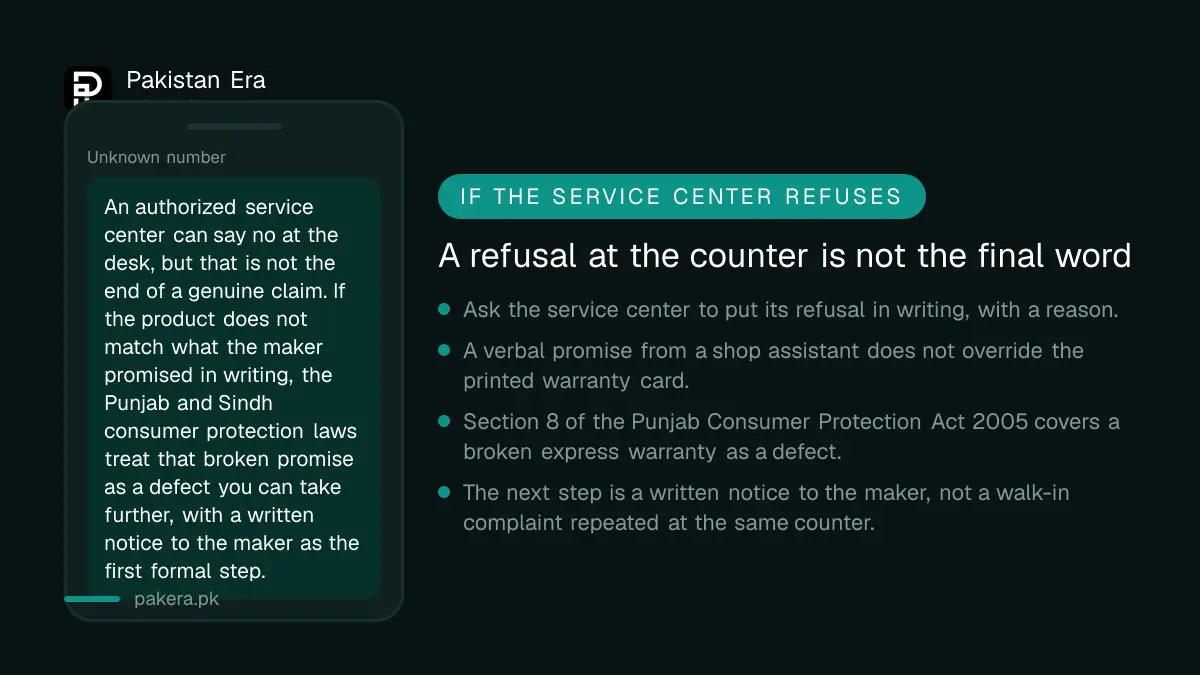
From here, the process is the same one we cover in full in returning or replacing a faulty appliance in Punjab or Sindh: a written notice to the maker first, a short reply window, then a consumer court claim if nothing happens. There is no separate "warranty court." It is the same consumer court that hears any defective goods case, and the consumer court filing process itself needs no lawyer and no court fee.
Keep this paperwork from day one, or the claim doesn't work
Warranty claims fail on missing paper far more often than on the actual fault. None of this is complicated, but all of it has to exist when you walk in.
- The original invoice. It proves the date, the price and where you bought it. Treat it as more important than the box.
- The warranty card or e-warranty confirmation. Some brands register the warranty online at the time of sale, so check your email or the shop's app, not just a paper card.
- A written job sheet every time you hand the item in. Verbal promises at a counter are forgotten by the time you come back.
- Photos or video of the fault, dated, especially for anything intermittent that might not show up during a quick desk inspection.
Common questions
What is the difference between a manufacturer warranty and a shop guarantee?
A manufacturer warranty is the maker's own promise, claimed at an authorized service center. A shop guarantee is the seller's separate promise, claimed at the shop you bought it from.
Can a shop refuse a warranty claim because I lost the box?
No. The box is packaging. Your invoice and warranty card, or the e-warranty record, are what actually prove the claim.
Does opening the product myself void the warranty?
In almost every warranty card we have read, yes. Opening it outside the authorized service network is one of the most common valid grounds for refusal.
Who should I contact first, the shop or the service center?
The authorized service center, once the sale itself is done and the fault appears later. The shop is only the right first stop for a return under its own guarantee, not a manufacturer repair.
What if the authorized service center also refuses my claim?
Ask for the refusal in writing with a reason. If the product genuinely does not match its own written warranty, that is a defect claim you can escalate through a written notice and, if needed, the consumer court.
Does an extended warranty I paid for separately work differently?
It can. An extended warranty is usually a separate paid contract with its own terms and its own provider, so read that document on its own rather than assuming it mirrors the original manufacturer warranty.
How we verified this
What we checked, where we read it, and what we could not confirm.
Last checked on 5 October 2026. The consumer protection law references here rely on our prior direct reading of sections 4 and 8 of the Punjab Consumer Protection Act 2005 and section 29 of the Sindh Consumer Protection Act 2014, both verified at source and already cited in full in returning or replacing a faulty appliance in Punjab or Sindh. There is no Pakistani law fixing a minimum warranty length for electronics, and the 12 month figure here is reported as typical of major brands rather than a legal requirement. This is general information, not legal advice for a specific claim.
About the author

Public Services and Education Journalist
Fajr Riaz is a journalist and content writer at Pakistan Era, based in Lahore. She covers the questions people meet in everyday life in Pakistan: how a public service works, what a change in the rules means, and where to find a reliable answer.