Punjab Shops Must Display Prices and Give a Receipt
A shop must display prices, issue a receipt with four details, and show its refund policy at the till before the sale is completed.
A shop in Punjab must display its prices, give you a receipt with four specific things on it, and tell you its refund policy with a sign at the till before you pay. Most shops do none of the three.
Update, 11 October 2026: Punjab also has a Deputy Commissioner route with a Rs 50,000 fine.
These are not customer service ideas. They are duties in the Punjab Consumer Protection Act 2005, and breaking them carries up to two years in prison or a fine up to one hundred thousand rupees.
We read the Act on 6 September 2026 in the text published by the Law and Parliamentary Affairs Department, Government of the Punjab, including the amendments made in 2025.
The four duties a seller owes you
| Duty | What the Act requires |
|---|---|
| Display prices | A prominent notice of retail or wholesale price, unless a price catalogue is available |
| Give a receipt | Date, description, quantity and price, and the seller name and address |
| Disclose refunds | A sign at the point of purchase, before the sale is completed |
| Advertise honestly | No sale price the seller cannot actually supply |
Each of these is a separate section, and each one is separately punishable.
The receipt has a required contents list
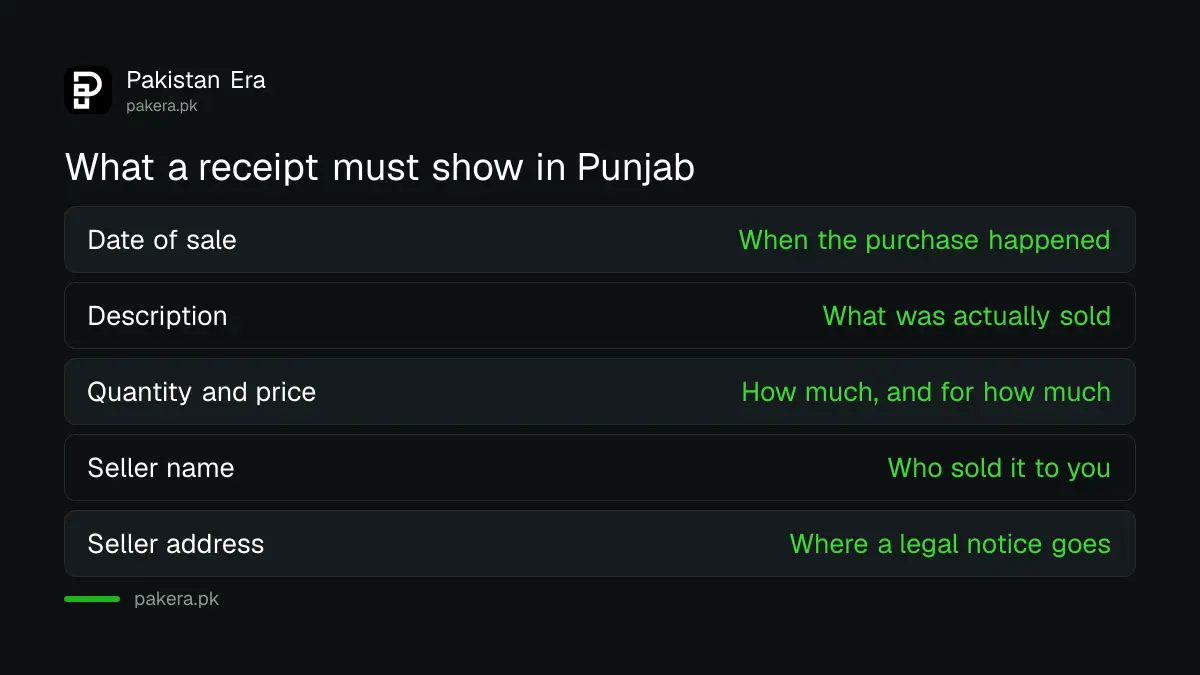
Section 19 says every manufacturer or trader who sells goods shall issue a receipt to the purchaser showing the date of sale, a description of the goods sold, the quantity and price, and the name and address of the seller.
A handwritten slip with a number on it is not that. Neither is a printed strip with no seller name.
The seller name and address matter more than they look. If you later need to send a legal notice, that address is where it goes, and a receipt without it makes the first step of a claim harder than it should be.
The refund policy must be on a sign, before you pay
Section 20 is one sentence, and it is stricter than most shops behave.
The return and refund policy of a seller shall be disclosed to the buyer clearly before the transaction is completed by means of a sign at the point of purchase.
So a shop is free to have a no-refund policy. What it is not free to do is keep that policy quiet until after your money has gone, then point at a line printed on the back of the bill.
If there was no sign at the till, the disclosure the Act requires did not happen.
Sale prices that are not really available
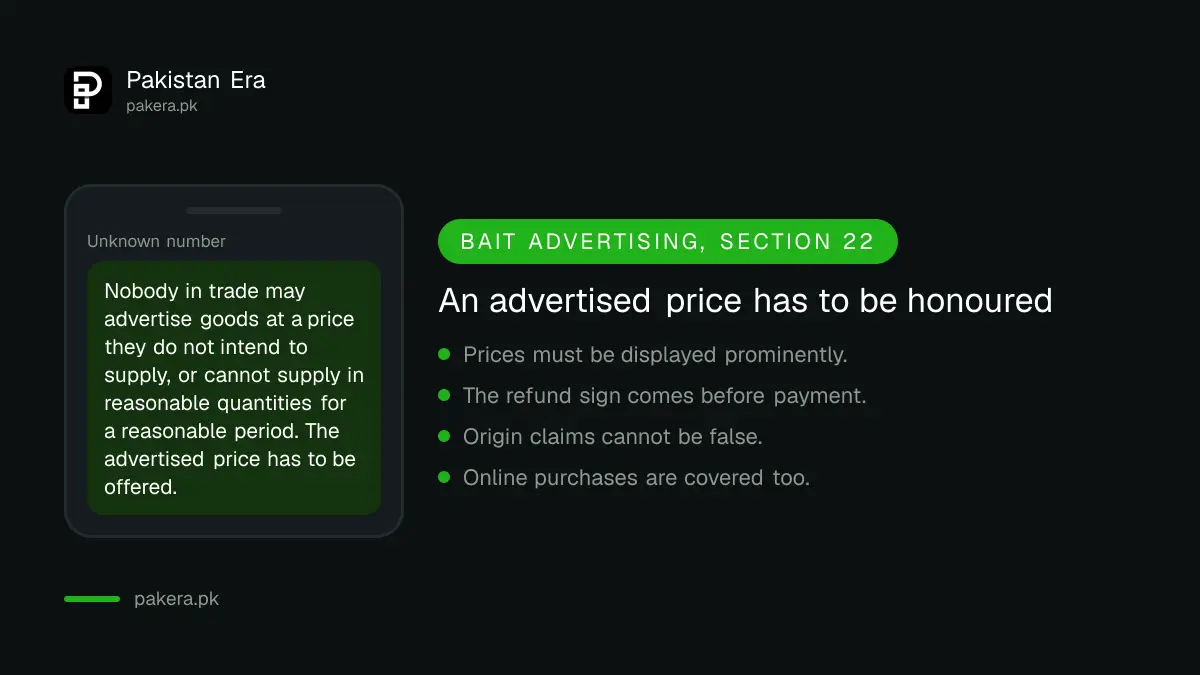
Section 22 deals with what it calls bait advertisement, and it covers a familiar experience.
Nobody in trade may advertise or supply products or services at a stated price which that person does not intend to offer, or has no reasonable grounds for believing can be supplied at that price, in reasonable quantities and for a reasonable period.
Subsection 2 then puts the duty positively. Anyone who has advertised at a specified price shall offer the goods at that price, for a reasonable period and in reasonable quantities.
The advertised item being out of stock on the first morning is exactly what the section is aimed at.
False claims about the goods themselves
Section 21 lists eleven kinds of representation that nobody may make falsely. They cover the claims sellers actually make.
- That the goods are of a particular kind, standard, quality, grade or model.
- That the goods are new, or reconditioned, or used for only a certain time.
- That a service is provided by somebody with a stated skill or qualification.
- That the goods carry a sponsorship, approval or endorsement.
- That the goods come from a particular place of origin.
The place of origin clause is the one worth remembering when a shop tells you an item is imported.
What it costs the seller
Section 32 sets the penalty for breaking any of sections 18 to 22, along with several others. It is imprisonment which may extend to two years, or a fine up to one hundred thousand rupees, or both, in addition to any damages or compensation the court awards.
That is the criminal side. Separately, a Consumer Court can order the seller to remove the defect, replace the goods, return the price, pay compensation, pay your actual costs including lawyer fees, or stop providing the service until it meets the standard.
Our guide to taking a shop to consumer court covers how a claim is filed. Two points from the Act are worth knowing before you start.
First, you must send a written notice to the seller before filing, and they have fifteen days to reply. A claim will not be entertained without proof that the notice was delivered. Second, the claim itself is due within thirty days of the cause of action arising, and an extension cannot run beyond sixty days after the warranty expires, or one year from purchase where no warranty period was stated.
Online shopping is inside this Act now
The 2025 amendment settled a question that used to be argued. The definition of a consumer now carries an explanation saying that buying goods and hiring services includes offline or online transactions through electronic means, teleshopping, direct selling and multi-level marketing.
The same amendment also confirmed that buying something for your own livelihood as a self-employed person is not a commercial purpose, so a person who buys a machine to work with is still a consumer.
Our guide to selling on Daraz covers the platform side of online trade, and our guide to a payment that failed while money left your account covers the separate problem of a card transaction going wrong.
Common questions
Does a shop have to give me a receipt in Punjab?
Yes. Section 19 requires a receipt showing the date, description, quantity, price, and the seller name and address.
Can a shop refuse a refund?
It can have a no-refund policy, but section 20 requires that policy to be disclosed by a sign at the point of purchase before the sale is completed.
Do prices have to be displayed?
Section 18 requires a prominent notice of the retail or wholesale price, unless a price catalogue is available to give the customer.
Is an advertised sale price binding?
Section 22 requires the seller to offer the goods at the advertised price for a reasonable period and in reasonable quantities.
Does this cover online shopping?
Yes. The 2025 amendment states that the definition includes online transactions, teleshopping, direct selling and multi-level marketing.
What is the penalty for the seller?
Up to two years imprisonment, or a fine up to one hundred thousand rupees, or both, in addition to damages or compensation.
How we verified this
What we checked, where we read it, and what we could not confirm.
Last checked 6 September 2026. We downloaded the Punjab Consumer Protection Act 2005 from the Punjab Code portal at punjablaws.punjab.gov.pk, in the text published by the Law and Parliamentary Affairs Department, Government of the Punjab, and read it. Section 18 on display of prices, section 19 on the contents of a receipt, section 20 on disclosure of the return and refund policy by a sign at the point of purchase, section 21 listing false, deceptive or misleading representations, section 22 on bait advertisement, section 28 on the written notice and the fifteen day reply and the thirty day filing period with its outer limits, section 31 listing the orders a Consumer Court may make, and section 32 setting imprisonment up to two years or a fine up to one hundred thousand rupees or both for contravention of sections 4 to 8, 11, 13, 14, 16 and 18 to 22, are all taken from that text. The explanation extending the definition of consumer to offline or online transactions through electronic means, teleshopping, direct selling and multi-level marketing, and the clarification that use for a self-employed person's livelihood is not a commercial purpose, were substituted by the Punjab Consumer Protection (Amendment) Act 2025, published in the Punjab Gazette (Extraordinary) dated 25 June 2025. Consumer protection is a provincial subject and this is the Punjab Act, so check the law that applies where you live. Nothing here is legal advice.
About the author

Tax, Bills and Technology Writer
Ali Akhtar is a young and curious voice here at Pakistan Era. He is currently pursuing his A-Levels and has a growing interest in Pakistan’s changing industrial landscape and educational trends. Ali likes to write in a way that helps him explain and explore the world around him. His writing reflects the perspective of the new generation navigating the evolving trends of Pakistan where technology, youth innovation, and shifting opportunities are reshaping the country’s future.