What You Actually Keep Selling on Daraz
Commission is the first of five deductions, and the zero commission offer expires. How to work a real order before you commit stock.
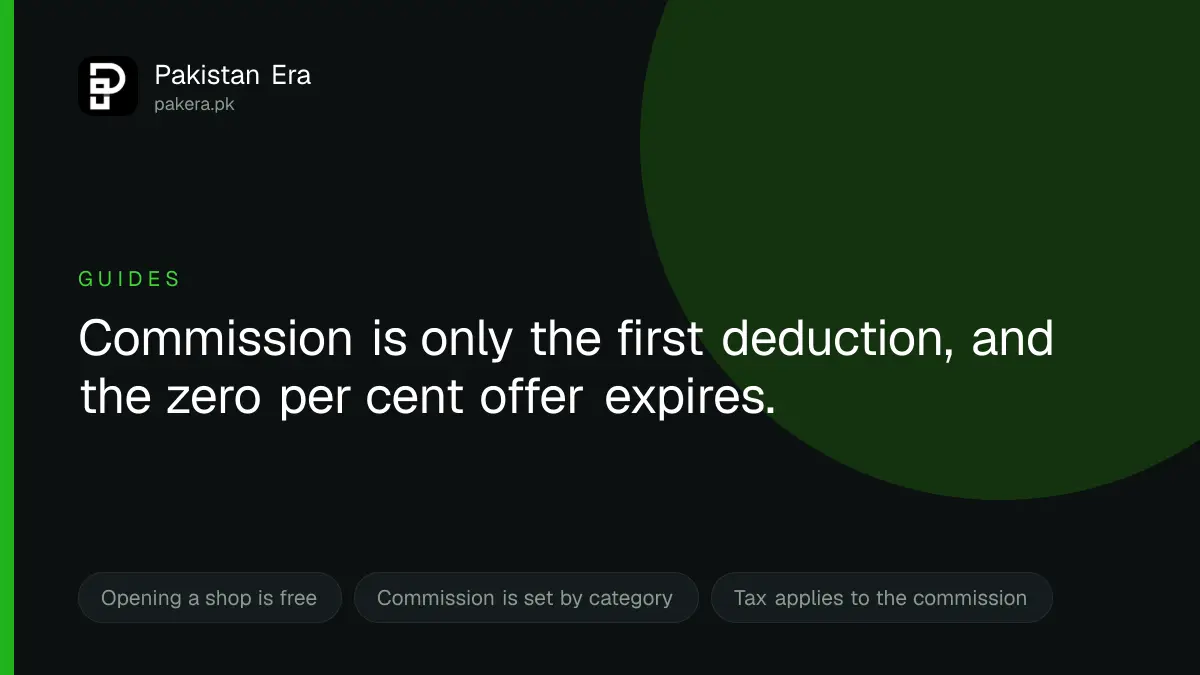
The commission is only the first thing taken out of your order. New sellers price a product against the commission rate, watch the first month go well on a zero commission offer, and then find the margin has gone once the deductions stack up and the promotion ends.
Daraz's own seller page, which we read on 28 August 2026, says opening a shop is free, that commission differs by category, and advertises a period of zero platform commission for new sellers. All three of those are true and none of them is the whole picture.
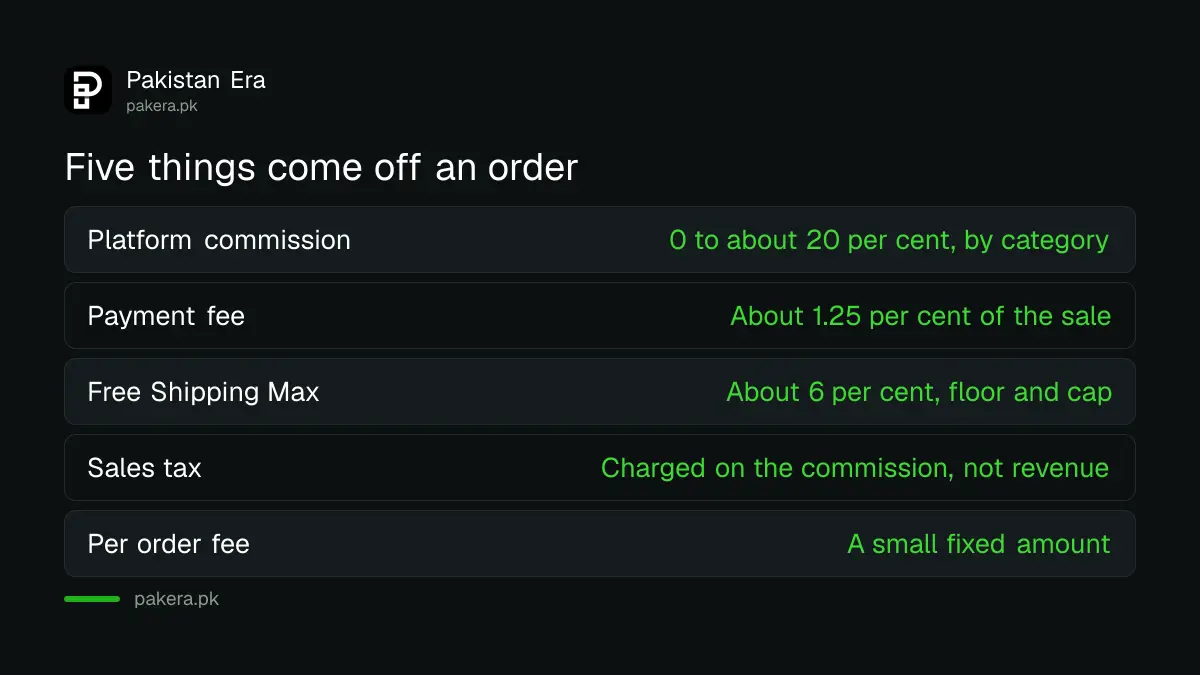
What comes off an order
| Deduction | Reported amount |
|---|---|
| Platform commission | 0 to about 20 per cent, set by category |
| Payment fee | About 1.25 per cent of the sale |
| Free Shipping Max | About 6 per cent, with a floor and a cap per order |
| Sales tax on the commission | Around 13 to 16 per cent, depending on province |
| Per order fixed fee | A small fixed amount |
Only the first line is the one most people plan around. The tax line catches nearly everyone, because it is charged on the commission rather than on the sale, so it is a tax on a fee rather than a tax on your revenue.
The zero commission offer is a start, not a baseline
Daraz promotes zero platform commission for new sellers for an introductory period. That is a genuine offer and worth taking. The problem is what people do with it.
Sellers set their prices during the promotion, see a workable margin, and build a plan on it. When the introductory period ends the commission for their category arrives and the margin they were counting on was never the real one.
So price for the rate that applies after the offer, from day one. If the numbers only work at zero commission, the numbers do not work.
Category is the single biggest variable
Because commission is set per category, two sellers with identical revenue can keep very different amounts. Reported ranges put many everyday goods at the low end and fashion considerably higher.
Check your own category before you commit stock. Daraz points sellers at its category commission list, and the rate that applies to what you actually sell is the only one that matters. A general figure from a blog is not a substitute for your own category.
Work an actual order, not a percentage
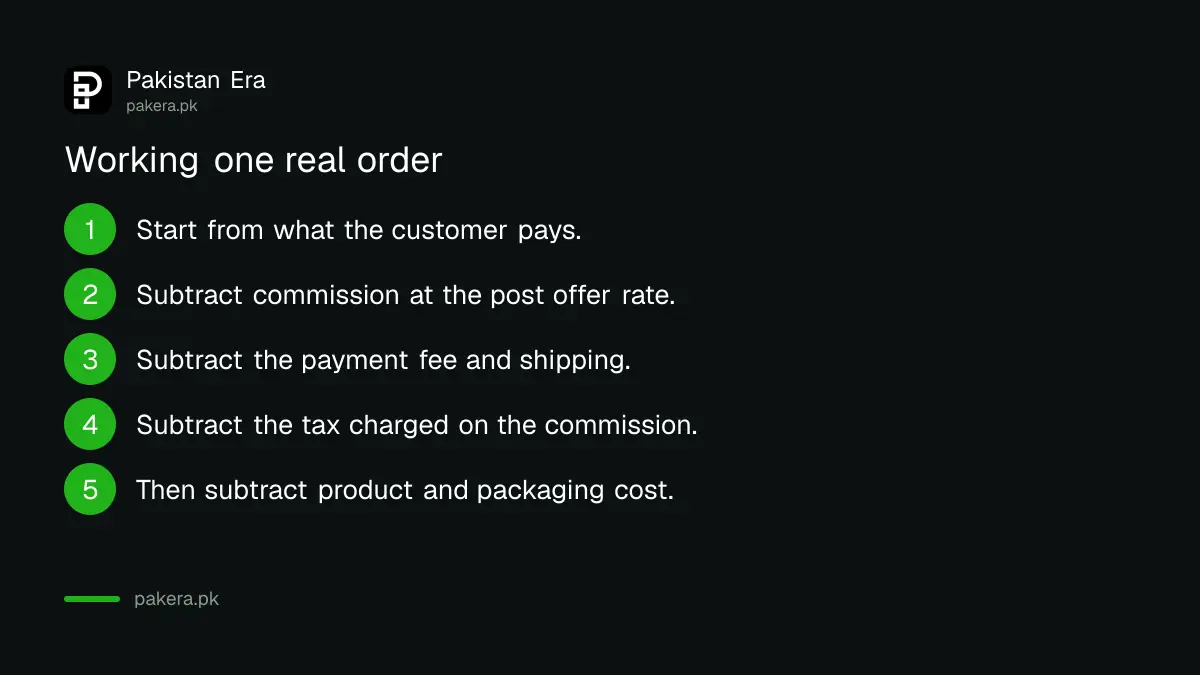
- Start with what the customer pays, not your list price.
- Subtract the commission for your category, after the offer ends.
- Subtract the payment fee and the shipping charge.
- Subtract the tax charged on the commission.
- Then subtract what the product and the packaging cost you.
What is left is your margin, and it should survive a return. Do that arithmetic on one real product before listing fifty, because the answer often changes what you decide to sell rather than how you price it.
Returns and cash on delivery change the maths
A margin that works on a completed sale can still lose money across a batch if returns are frequent. Cash on delivery is normal in Pakistan and carries a refusal rate, and a parcel that travels out and back has cost you handling either way.
Build that into the price rather than discovering it at the end of the month. Categories with high refusal rates need a wider margin than the fee table alone suggests, and clothing sizing is the classic example.
Register properly before the volume arrives
Selling online is business income, and once you are turning over real money the tax position stops being optional. Getting registered while the numbers are small is far easier than catching up later.
Our guides to sales tax registration with FBR and to filing a monthly sales tax return cover that side, including the monthly obligation registration creates. Keep the receiving account in your own name, and opening a bank account covers what the branch will want.
What this is worth against the alternatives
Daraz gives you traffic you do not have to buy, which is the real product. The fees are what that traffic costs, and judged that way they are not unreasonable. What is unreasonable is planning as though they are not there.
If you are choosing between selling on a marketplace and other online income, the honest comparison is against work somebody pays you directly for, which carries no platform cut at all. Our guide to freelancer payments in Pakistan covers that side.
Common questions about Daraz seller fees
Is it free to open a Daraz shop?
Daraz's own seller page says opening a shop is free. The costs come per order, not upfront.
How much commission does Daraz take?
It depends on your category, with reported ranges running from nothing up to about 20 per cent. Check the category list for what you actually sell.
How long does the zero commission offer last?
Daraz's page advertises an introductory period for new sellers. Treat it as a start, and price for the rate that follows it.
Is tax charged on my sales or on the fee?
Reported practice is that sales tax applies to the commission rather than to your revenue, which is a smaller amount than sellers fear but an easy one to forget.
When do I get paid?
Payouts run on a cycle rather than per order. We could not confirm the current cycle, so check your own Seller Center, which shows the schedule that applies to you.
How we verified this
What we checked, where we read it, and what we could not confirm.
Last checked 28 August 2026. We read Daraz's own seller page at daraz.pk on that date, where it states that opening a shop is free, that commission differs by category with a link to the category list, and that new sellers get an introductory period of zero platform commission. Everything else is reported rather than read at source: the commission range, the payment fee, the shipping charge and its floor and cap, the fixed per order fee, and the sales tax charged on commission. We could not read the current fee schedule or the payout cycle, both of which sit inside Seller Center, and that is the authority for your own account. We do not sell on Daraz, so nothing here reports margins we achieved.
About the author

Tax, Bills and Technology Writer
Ali Akhtar is a young and curious voice here at Pakistan Era. He is currently pursuing his A-Levels and has a growing interest in Pakistan’s changing industrial landscape and educational trends. Ali likes to write in a way that helps him explain and explore the world around him. His writing reflects the perspective of the new generation navigating the evolving trends of Pakistan where technology, youth innovation, and shifting opportunities are reshaping the country’s future.