Return or Replace a Faulty Appliance in Punjab or Sindh: Legal Steps
Faulty appliance in Punjab or Sindh? Send a written notice, wait 15 days, then file in consumer court within 30 days. See what the court can order for you.
To get a faulty appliance repaired, replaced or refunded in Punjab or Sindh, send the seller or maker a written notice first. They have 15 days to reply. If they do not fix it, file a claim in the district consumer court within 30 days. There is no court fee, and the court can order a repair, a new product or your money back.
The rules are almost word for word the same in both provinces. We read section 28 of the Punjab Consumer Protection Act 2005 and section 29 of the Sindh Consumer Protection Act 2014 on the provinces' own law websites. The one step people skip, the written notice, is the step that decides whether the court will hear you at all.
Consumer law in Punjab and Sindh covers a faulty appliance
Both Acts make a maker liable for a product that is badly built, badly designed, sold without proper warnings, or that breaks its own written warranty. A fan that burns out, a fridge that will not cool, or an iron that sparks can all count.
Section 4 of the Punjab Act lists four kinds of defect. The product is faulty in how it was made, in its design, because it came without an adequate warning, or because it does not match the maker's express warranty. Section 8 deals with the warranty case: if the maker promised something that turned out untrue and you relied on it, the product counts as defective.
The law does not cover damage you caused, or a purchase you simply regret. It also does not force a shop to take back a working item, unless the shop's own policy says it will. Punjab sellers must show that return policy on a sign before you pay, which is one of the shop receipt and refund rules in the same Act.
Send a written notice first, because the court needs proof of it
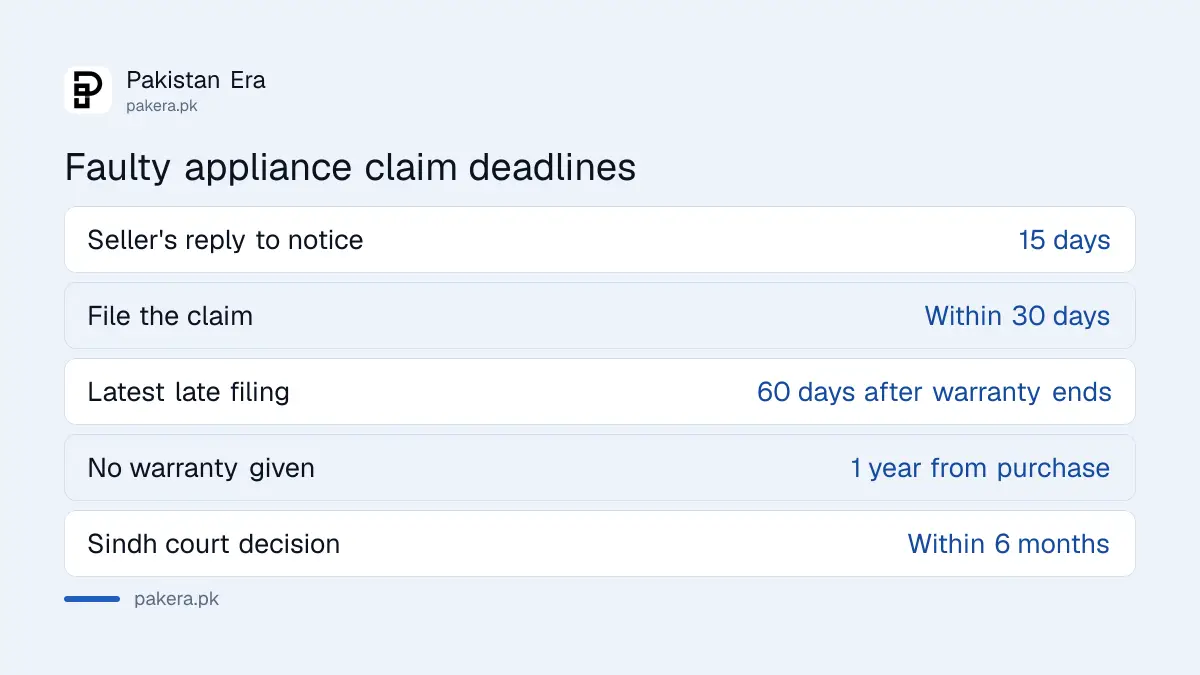
The law says no consumer court will hear your claim unless you first sent a written notice and can prove it was delivered. The seller or maker then has 15 days to reply. Send it by courier or registered post and keep the receipt.
Your notice should say, in plain words:
- what you bought, when, where and for how much,
- what is wrong with it and when it started,
- what you want: repair, replacement or refund,
- that you will go to the consumer court if they do not act.
Address it to the shop and, if you can, the maker too. The maker's address is usually on the box or warranty card. A proper receipt matters here, because it carries the seller's name and address. If you bought online, keep the order page and chats, and run the seller through the online store checks before you spend money on a courier.
Punjab's Directorate of Consumer Protection Council publishes a legal notice guide in English and Urdu on consumerservice.punjab.gov.pk. Its filing procedure says the same thing in one line: "15 days legal notice must be served".
File a consumer court claim within 30 days
A claim must be filed within 30 days of the problem arising. The court can allow a late claim for good reason, but never later than 60 days after the warranty ends, or one year after purchase if there was no warranty. Do not wait.
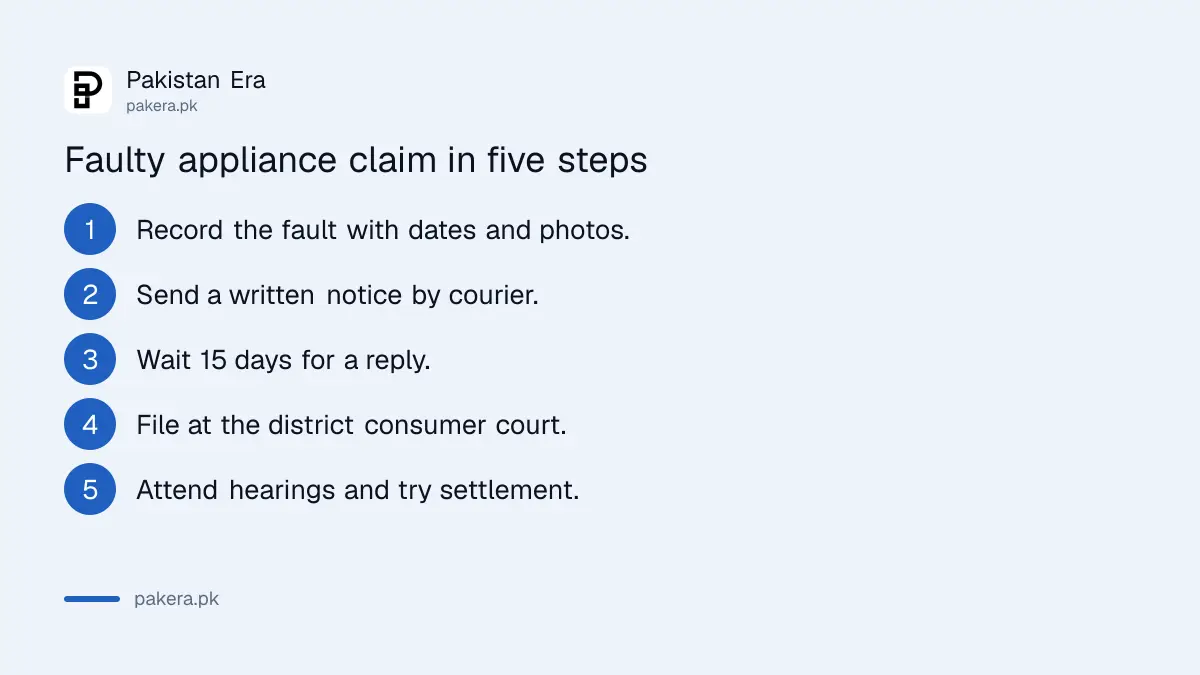
Here is the order of steps:
- Write down the fault with dates, and take photos or a short video.
- Send the written notice to the seller and maker. Keep the courier receipt.
- Wait 15 days for a reply.
- File the claim at the district consumer court, attaching the receipt, warranty card, notice, delivery proof and any reply.
- Attend the hearings. The defendant gets 15 days to answer, with one extension of up to 15 days, and the court first tries a settlement.
In Punjab you can also register a complaint and search your case on the consumer protection portal, which lists every district of Punjab. A consumer court claim needs no lawyer, and you can write it on plain paper.
One thing that helps a claimant: if the fault needs testing, the court can send a sealed sample to a laboratory for a report within 30 days. You may be asked to deposit the lab fee, but the maker pays it if the test supports you.
Repair, replacement, refund and more: what the court can order
If the court finds the product defective, it can order the maker to fix it, replace it with a new one, or return the price. It can also order compensation, damages and your actual legal costs, including lawyer's fees, and can recall a faulty product from the market.
| What the court can order | Punjab Act section | Sindh Act section |
|---|---|---|
| Remove the defect (repair) | 31(a) | 32(a) |
| Replace with a new product | 31(b) | 32(b) |
| Return the price paid | 31(c) | 32(c) |
| Compensation and damages | 31(e) and (f) | 32(e) and (f) |
| Actual costs, including lawyer's fees | 31(g) | 32(g) |
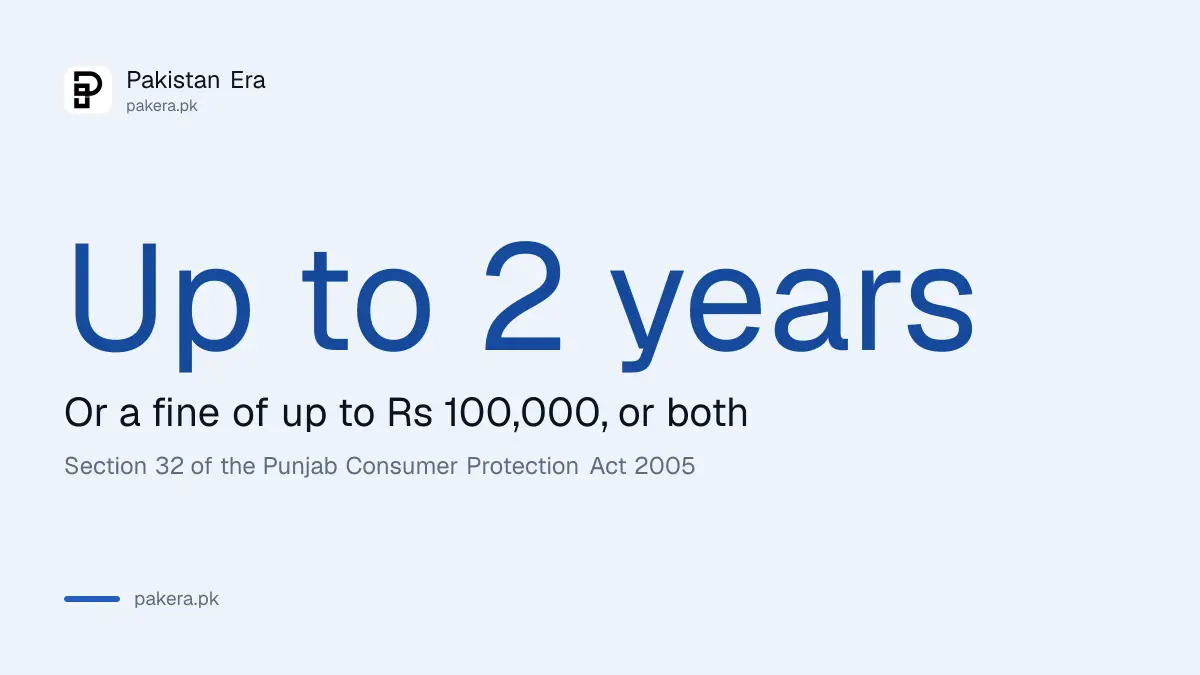
Makers who ignore the law face more than a refund. Under section 32 of the Punjab Act, a maker who breaks the product duties can get up to two years in jail, a fine of up to Rs 100,000, or both. Anyone who ignores the court's order faces one month to three years, or a fine of Rs 5,000 to Rs 20,000.
Sindh's Act adds a time limit for the court itself: section 31 says it should decide the claim within six months of serving the summons.
Mistakes that sink a faulty appliance claim
Most claims fail on paperwork, not on the fault. Missing the written notice, losing the receipt, filing after 30 days, or opening the appliance at an unofficial shop all give the seller an easy defence. A false claim can also cost you a fine.
- No notice, no case. A phone call to the shop is not a notice.
- Keep the box and receipt. They prove the date, price and seller.
- Use the authorised service centre while under warranty. Read the warranty card for what cancels it before anyone opens the appliance. For phones, checking phone warranty by IMEI shows whether cover is still live.
- Be honest. Section 35 of the Punjab Act lets the court fine a claimant up to Rs 10,000 for a false claim.
- Appeal on time. In Punjab, an appeal against the final order goes to the Lahore High Court within 30 days.
Common questions
Can a shop refuse to replace a faulty appliance in Punjab?
It can refuse at the counter, but the consumer court can still order a repair, replacement or refund if the product is defective. Send a written notice first.
How many days does a seller get to reply to my notice?
15 days, in both Punjab and Sindh. The court will not hear your claim until you prove the notice was delivered.
What is the time limit to file a consumer court claim?
30 days from when the problem arose. The court can extend it, but not beyond 60 days after the warranty ends.
Is there a fee to file in consumer court?
No court fee is charged on a consumer claim, and you do not need a lawyer. You may be asked to deposit a lab testing fee.
Can I claim my lawyer's fees back?
Yes. Both Acts let the consumer court award actual costs, including lawyer's fees, if you win.
Does consumer law cover items bought online?
In Punjab, yes. A 2025 amendment brought online and electronic purchases inside the Punjab Consumer Protection Act.
How we verified this
What we checked, where we read it, and what we could not confirm.
Last checked at about 5:10 am PKT on 2 October 2026. We read the Punjab Consumer Protection Act 2005 on punjablaws.punjab.gov.pk (sections 4 to 8, 28, 30 to 33 and 35), the Sindh Consumer Protection Act 2014 on sindhlaws.gov.pk (sections 29, 31 and 32), and the Punjab Directorate of Consumer Protection Council portal and its filing procedure PDF. The Punjab legal notice guide is a scanned file we could not read in full. The 2025 Punjab amendment on online sales is as recorded from the Punjab Gazette in our earlier reading of the Act. This is general information, not legal advice for a specific claim.
About the author

Tax, Bills and Technology Writer
Ali Akhtar is a young and curious voice here at Pakistan Era. He is currently pursuing his A-Levels and has a growing interest in Pakistan’s changing industrial landscape and educational trends. Ali likes to write in a way that helps him explain and explore the world around him. His writing reflects the perspective of the new generation navigating the evolving trends of Pakistan where technology, youth innovation, and shifting opportunities are reshaping the country’s future.