Federal Employee Leave Rules in Pakistan: 4 Days Earned a Month, 120 Days at a Time and Leave Without Pay Up to 5 Years
Leave rules for federal employees in Pakistan: 4 days earned a month, 120 or 180 days at a time, 5 years without pay, 130 days widow's leave, and your rights.
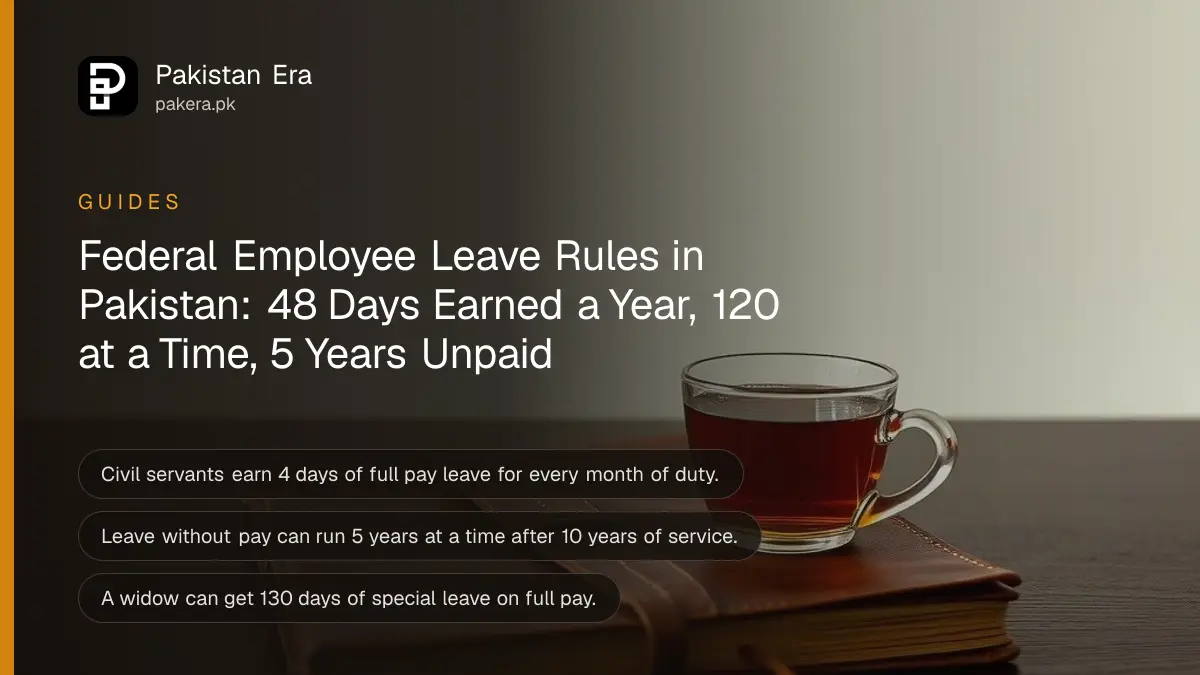
Short answer: A federal civil servant in Pakistan earns 4 days of leave on full pay for every month of duty, with no limit on how much builds up. At one time you can take up to 120 days on full pay without a medical certificate, or 180 days with one. Leave without pay can run up to 5 years after 10 years of service. These rules are in the Revised Leave Rules 1980.
The Finance Division publishes an updated edition of the rules, dated 4 May 2018, on its website. This guide sets out each type of leave, how long it lasts and what it pays. Retirement leave is covered separately in our guide to LPR encashment for federal employees.
You earn 4 days of leave on full pay each month
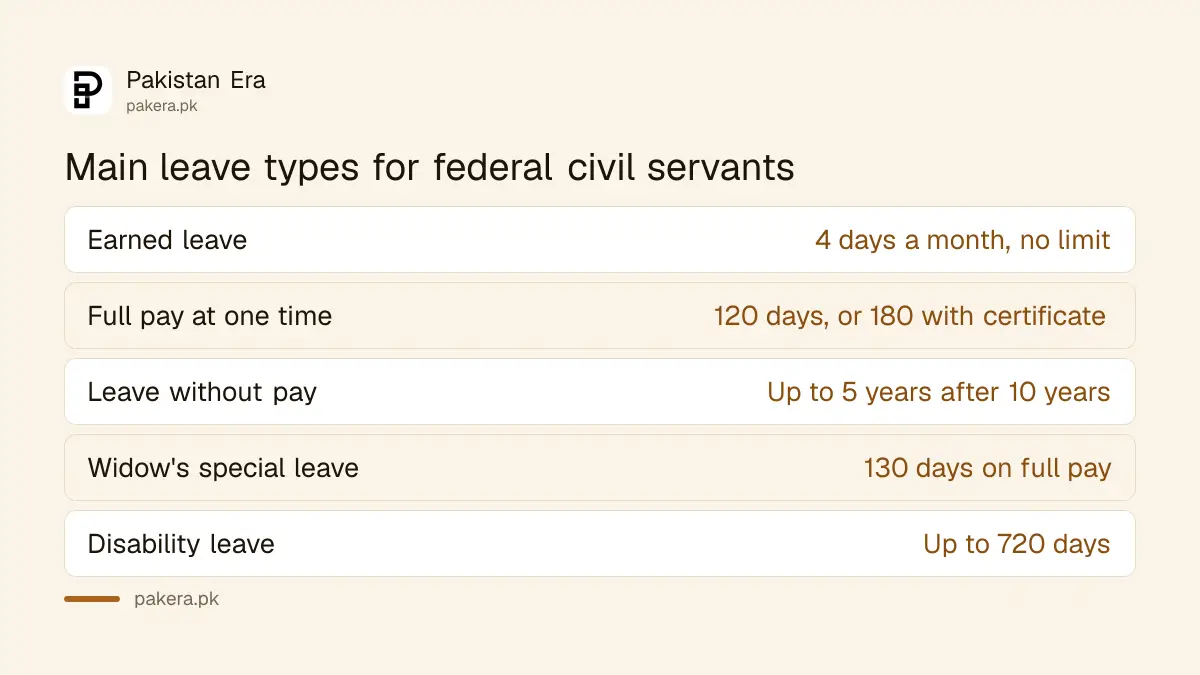
Under Rule 3, every federal civil servant earns leave on full pay at 4 days for each calendar month of duty. A month with more than 15 days of duty counts as a full month, and 15 days or less is ignored. There is no maximum on how much leave you can save.
That works out to 48 days a year. Staff in vacation departments, such as teaching posts with long breaks, earn less: 1 day a month when they take the full vacation, under Rule 4. Your leave account is kept as part of your service book by the accounts office, under Rule 30.
All unused leave lapses when you leave service, under Rule 31. The exceptions are the retirement and death payments explained in the LPR guide.
Leave on full pay and half pay
Leave on full pay is the normal leave you draw from your account. Rule 5 sets how much you can take at one time. You can also turn full pay leave into twice as many days on half pay, under Rule 6.
| Type of leave | How long | Pay | Rule |
|---|---|---|---|
| Full pay, without medical certificate | Up to 120 days at a time | Full pay | Rule 5(a) |
| Full pay, with medical certificate | Up to 180 days at a time | Full pay | Rule 5(b) |
| Full pay on medical certificate, whole career | Up to 365 days in all | Full pay | Rule 5(c) |
| Half pay | No limit while leave is in the account | Half pay, 1 day of account for 2 days off | Rule 6 |
| Recreation leave | 15 days once a calendar year | Full pay, 10 days debited | Rule 10 |
| Leave not due | Up to 365 days in a career, 90 in the first 5 years | Full pay, set against future leave | Rule 11 |
Leave pay on full pay is the higher of two figures, under Rule 32: your average monthly pay over the last 12 complete months, or the pay you drew the day before the leave began. On half pay, both figures are halved. If a pay revision or annual increment falls during your leave, you get the new rate.
Leave without pay can last up to 5 years
Extraordinary leave is leave without pay. Under Rule 9, it can be granted on any ground for up to five years at a time, if you have at least 10 years of continuous service. With less than 10 years, the head of your office can allow up to two years.
The five years shrink by any full pay or half pay leave you join to it. Permanent and temporary staff are treated the same. Extraordinary leave can also be granted later, to cover a period of absence without leave.
- Use it for study, a long family need or work abroad when your full pay leave is used up.
- Ask for it in writing well ahead, with dates.
- Remember that no pay is drawn for those days.
Special, disability and other leave
Some leave sits outside your normal account, so it does not use up your saved days. Three types matter most. Each has its own limit and its own proof.
- Special leave for a widow (Rule 12): a female civil servant whose husband dies can get up to 130 days on full pay, not taken from her leave account. It starts from the date of death and needs the death certificate.
- Disability leave (Rule 14): up to 720 days for each injury or illness caused by duty, on medical advice. It is on full pay for the first 180 days and half pay after that.
- Leave ex-Pakistan (Rule 15): leave spent abroad follows the same limits as other leave, and leave pay for time abroad is capped at 120 days at a time.
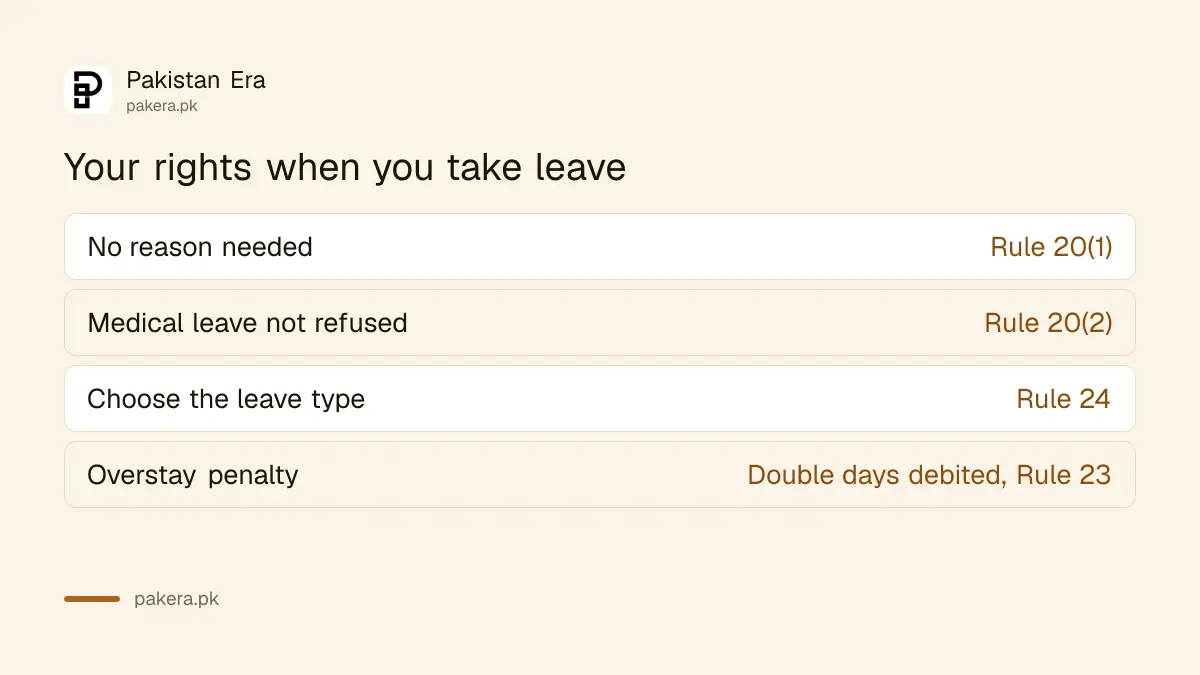
Leave on a medical certificate cannot be refused, under Rule 20(2), though the office can ask a civil surgeon or Medical Board for a second opinion.
Your rights when you apply for leave
The rules protect your choice. Under Rule 20(1), you do not have to give a reason for leave that is due and admissible. Under Rule 24, your office cannot refuse the type of leave you ask for just because it thinks another type fits better.
- Combine leave: one type of leave can be joined with another, under Rule 25. LPR is the exception and cannot be combined.
- Coming back early: you cannot return before your leave ends without the sanctioning authority's permission, under Rule 26.
- Recall: if you are recalled from leave away from headquarters, you get the return fare and daily allowance as on tour, under Rule 22.
- Overstaying: staying away after leave ends, without an extension, means no pay for those days and double the days taken off your leave account, under Rule 23.
Pension rules for when you finish service are in our guide to federal pension calculation, and the early exit route is in our page on voluntary retirement for federal employees.
Common questions
How much earned leave does a federal employee get in Pakistan?
Four days on full pay for every month of duty, or 48 days a year, under Rule 3 of the Revised Leave Rules 1980. There is no limit on saving it.
How long can I take leave without a medical certificate?
Up to 120 days at a time on full pay. With a medical certificate, up to 180 days at a time.
How long can leave without pay last?
Up to five years at a time after 10 years of continuous service. With less service, up to two years at the head of office's discretion.
Do I have to give a reason for my leave?
No. Rule 20(1) says reasons need not be given for leave that is due and admissible.
What happens if I come back late from leave?
You get no pay for the extra days, and double those days are taken from your leave account, under Rule 23. Disciplinary action can also follow.
Does unused leave get paid when I resign?
No. Under Rule 31, leave at your credit lapses when you quit service. Retirement and death have separate rules for payment.
How we verified this
What we checked and where we read it.
We checked every rule on 14 November 2026 in the Finance Division's updated edition of the Revised Leave Rules 1980, dated 4 May 2018: Rules 3 to 6, 9 to 12, 14, 15, 20 and 22 to 32. Maternity leave is left out here because federal maternity and paternity leave is also governed by later legislation outside these rules.
About the author

Global Affairs & Political Economy Writer
Muhammad Hatim is a book lover who started writing because he enjoys it. At Pakistan Era he writes about international relations, geopolitics and the global economy, with a particular interest in South Asia and the forces behind current events.