Buying Property Above Rs 5 Million in Cash in Pakistan: FBR Penalty Is 5% of the Value
Buying property worth more than Rs 5 million with cash or a bearer cheque carries a 5% penalty on FBR's table. See which value counts and how to pay safely.
Short answer: Pay for property worth more than Rs 5 million through your bank, never in cash or with a bearer cheque. FBR's penalty table sets a 5% penalty on the buyer for a cash or bearer cheque purchase. It is charged on the higher of FBR's value or the provincial value used for stamp duty.
Cash still moves in many property deals in Pakistan. A seller asks for part of the price "in hand", and the buyer agrees to save time. This is the mistake FBR's table targets. The penalty falls on the person who buys, not on the seller.
We read the penalty table in section 182 of the Income Tax Ordinance on FBR's website on 13 October 2026. The rule that creates the duty is section 75A. We did not read the text of 75A itself, so the details of which payment methods are allowed are marked below.
The penalty is 5% of the property value
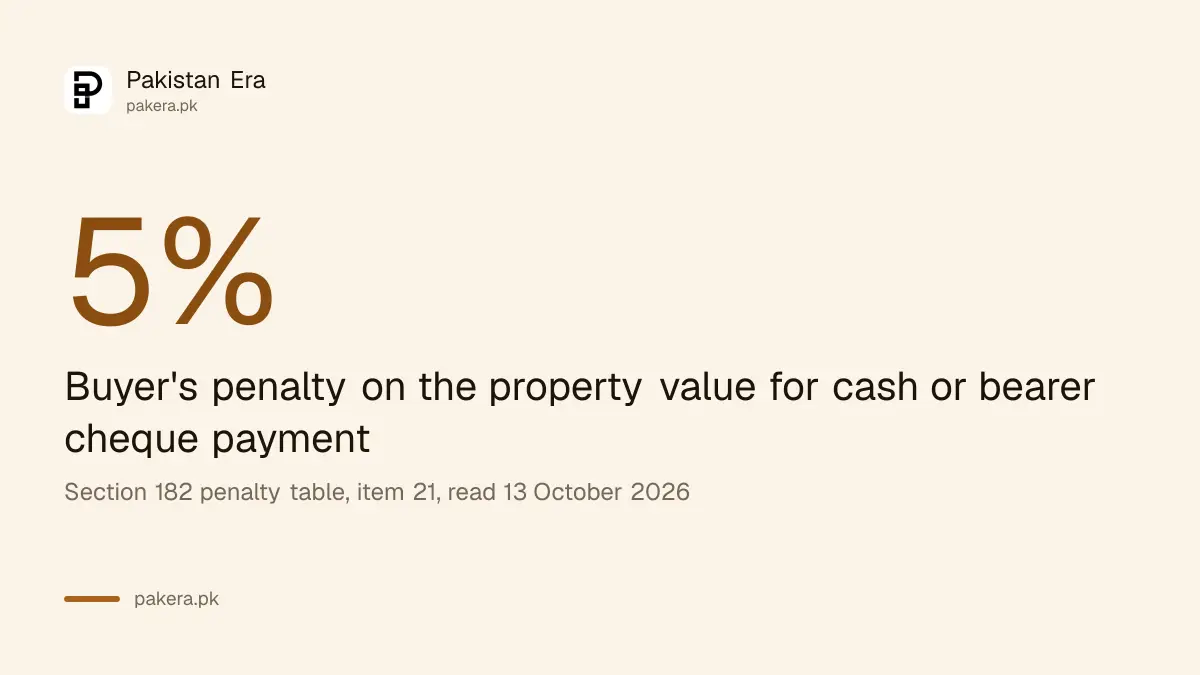
Item 21 of the table covers any person who buys immovable property with a fair market value above Rs 5 million through cash or a bearer cheque. The penalty is 5% of the property value.
The value is the higher of two figures. One is the value set by the Board under section 68(4). The other is the value set by the provincial authority for stamp duty. Whichever is higher is used.
Here is what that means in rupees. These are our own examples, not FBR figures.
| Property value used | 5% penalty |
|---|---|
| Rs 6 million | Rs 300,000 |
| Rs 10 million | Rs 500,000 |
| Rs 25 million | Rs 1,250,000 |
| Rs 50 million | Rs 2,500,000 |
The value that counts may be higher than your deal price
The penalty is not worked out on what you wrote in the sale deed. It uses the higher of FBR's value and the provincial stamp duty value. If your deal price is lower than either, the penalty is still charged on the higher figure.
Check FBR's valuation before you agree a price, using the steps in the guide to checking the FBR property valuation. Also read how transfer taxes are worked out in the page on property transfer tax in Pakistan.
Ask the seller to state the full price in the deed. A lower figure in the deed does not remove the duty to pay by bank. It only makes the paper record weaker.
Pay through a bank and keep proof of every payment
The table names cash and bearer cheques as the problem. Reported summaries of section 75A say that a crossed cheque, pay order, demand draft or other transfer from one bank account to another is the safe route. We could not read 75A at source, so confirm the list with your lawyer or the registrar.
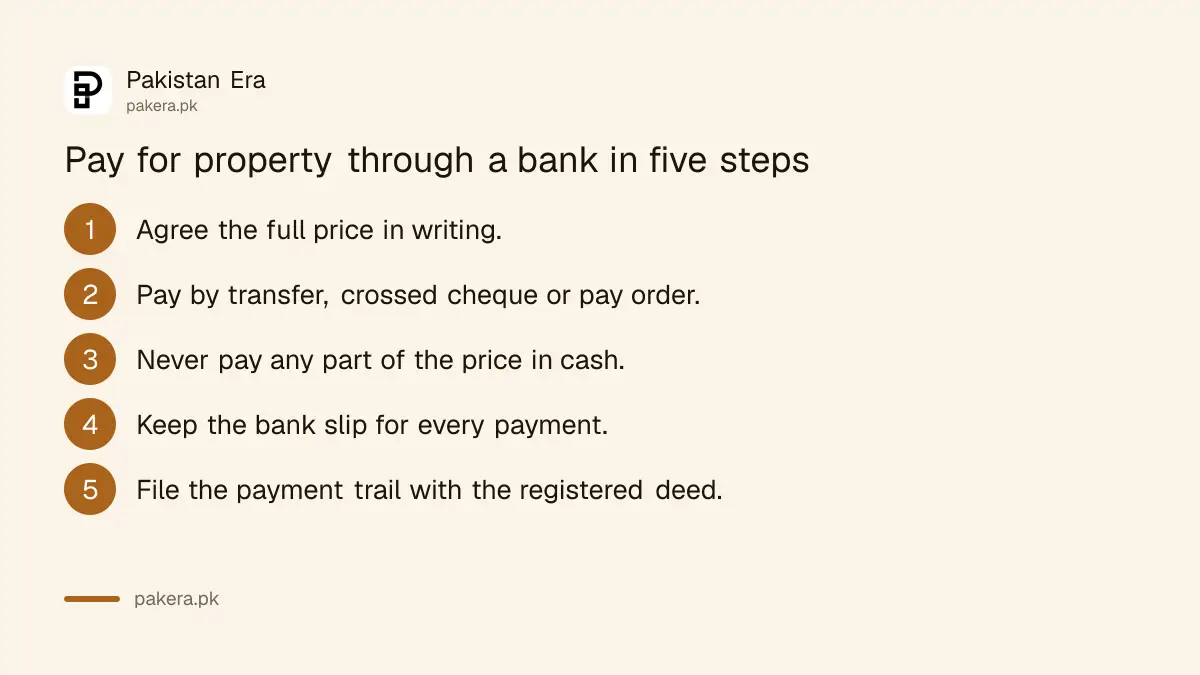
- Agree the full price in writing and note the date of each payment.
- Pay by a bank transfer, crossed cheque or pay order drawn from your own account.
- Do not hand over cash for any part of the price, even a small part.
- Keep the bank slip or statement showing the seller's account name for every payment.
- Put the payment trail in your files next to the registered deed.
If you are paying from savings, the source must also be clear. Your wealth statement should show where the money came from. The guide to filling the wealth statement explains how.
A cash payment can also cause problems later
When you sell the property, gains tax is worked out using your cost. How a cash purchase is treated for that cost is a technical point. The guide to capital gains tax on property explains the basic rules, and a tax adviser should check your case.
The penalty also needs an order. Under section 182(2), no penalty is payable unless a written order is passed after you are heard. If you receive a notice, answer by the date on it. A reply to a show cause notice is explained in the guide to replying to FBR under section 122.
Smaller purchases are outside this penalty, but keep records
Item 21 applies to property with a fair market value above Rs 5 million. A purchase below that limit is not covered by this row. That does not make cash a good idea. A bank trail protects you in a dispute with the seller, in a tax review and in your own wealth statement.
Common questions
What is the penalty for buying property in cash in Pakistan?
It is 5% of the property value, under item 21 of the section 182 table. It applies to property above Rs 5 million bought with cash or a bearer cheque.
Who pays the penalty, the buyer or the seller?
The table says "any person who purchases" the property, so it falls on the buyer.
Which value is used to work out the 5%?
The higher of the value set by the Board under section 68(4) and the value set by the provincial authority for stamp duty.
Can I pay part of the price in cash if the rest goes by bank?
It is risky. The table refers to a purchase through cash. We could not read section 75A to see how part payments are treated, so use the bank for the full price.
Does the penalty apply to a plot or a house?
The row says immovable property, which in plain terms covers land, plots and buildings. Check your exact case with a lawyer.
How we verified this
What we checked, where we read it, and what we could not confirm.
Last checked on 13 October 2026, Pakistan time. We read FBR's page for section 182 of the Income Tax Ordinance, item 21. The copy was stamped 23 June 2026, so a change from the Finance Act 2026 could be missing. We did not read section 75A itself, so the allowed payment methods come from reported summaries and are marked as such. This page is general information, not legal advice.
About the author

Public Services and Education Journalist
Fajr Riaz is a journalist and content writer at Pakistan Era, based in Lahore. She covers the questions people meet in everyday life in Pakistan: how a public service works, what a change in the rules means, and where to find a reliable answer.