What It Costs to Charge an Electric Car in Pakistan: Home Rates vs the Rs 23.57 Station Tariff
EV charging stations in Pakistan pay Rs 23.57 a unit and set their own margin. See what a full charge costs at home, and how an EV can push your bill up a slab.
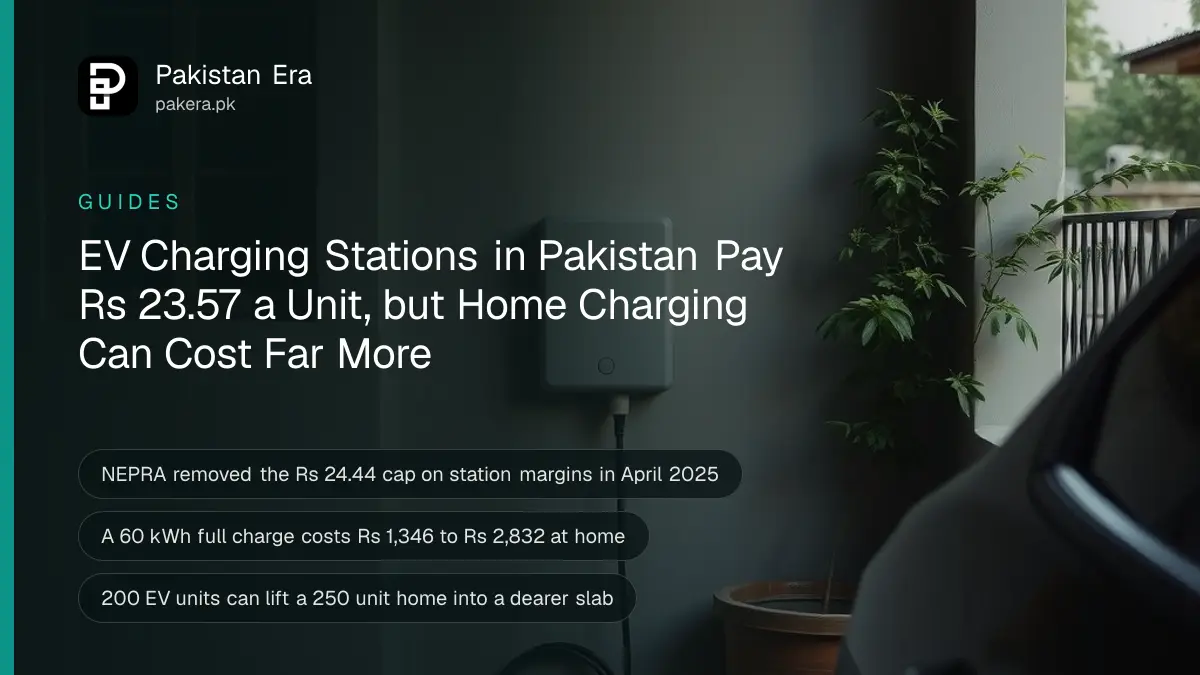
Public EV charging stations in Pakistan buy electricity at a fixed Rs 23.57 a unit, then add their own margin, which NEPRA stopped capping in April 2025. At home, you pay your normal slab rate of Rs 22.44 to Rs 47.20 a unit, and an electric car can push a house into a much dearer slab.
That second point is the one most new EV owners miss. We read NEPRA's tariff decisions and the 2026 rate schedule, and worked out what a full charge, a month of charging and 100 km of driving really cost.
Charging stations pay Rs 23.57 a unit for electricity
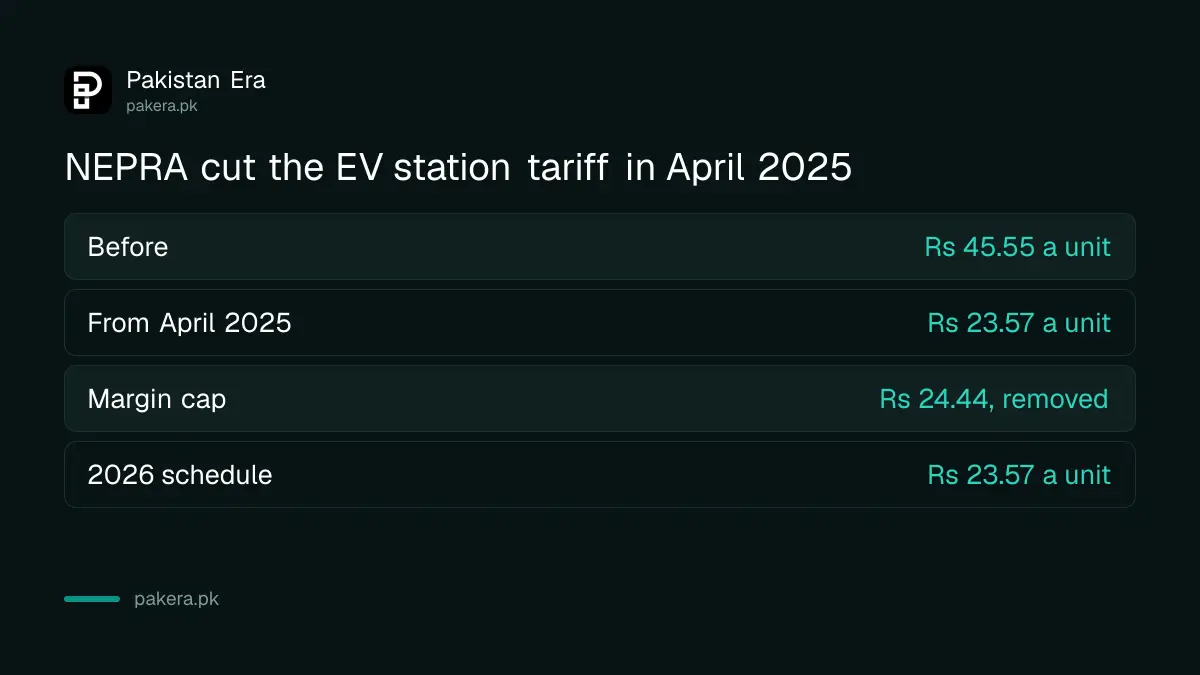
NEPRA cut the tariff for EV charging stations from Rs 45.55 to Rs 23.57 a unit in its decision of 15 April 2025. The February 2026 rate schedule keeps the station rate at Rs 23.57, for the state companies and K-Electric alike.
This is the price the station pays the electricity company. It is not the price on the screen when you plug in. Taxes and the station's own margin come on top.
The same decision removed the old cap of Rs 24.44 a unit on the margin. NEPRA decided to remove it, "allowing the market to determine the margin", after the Ministry of Energy argued that the cap had not attracted investment. So each station now sets its own price.
The rule that stations show their price may be deleted
NEPRA's Consumer Service Manual says a public charging station must display its per unit margin on the premises and online, so you know the price before using it. That duty sits in clause 16.4, which NEPRA proposed to delete in September 2026.
The deletion would bring the manual in line with the 2025 decision to drop the cap. But the written duty to post the margin goes with it, unless NEPRA moves it elsewhere. Clause 16.5, which makes stations meter each user's charge accurately, is not on the list. Comments were invited for 30 days from the notice of 25 September 2026.
Before you plug in, look for three things:
- The price per unit (kWh), shown clearly.
- A meter reading or app record of the units delivered.
- A receipt showing units and amount.
Where stations actually work today is covered in EV charging stations in Pakistan.
What a full charge costs at each rate
A full charge costs the battery size times the rate per unit. For a 60 kWh battery charged from empty, that is Rs 1,346 at the lowest home slab and Rs 2,832 at the top one, before taxes.
| Where and which rate | Rate per unit (Rs) | 60 kWh full charge (Rs) |
|---|---|---|
| Home, 1 to 100 units slab | 22.44 | 1,346 |
| Home, 201 to 300 units slab | 33.10 | 1,986 |
| Home, 401 to 500 units slab | 38.95 | 2,337 |
| Home, above 700 units | 47.20 | 2,832 |
| Home on Time of Use, off-peak | 34.53 | 2,072 |
| Station's own cost, before margin | 23.57 | 1,414 |
The 60 kWh battery is our example, not any one model. Check your own car's battery size in its manual. Real charging also loses a few per cent as heat, so the bill is a little higher than the battery size alone suggests.
Home charging can push your whole bill into a higher slab
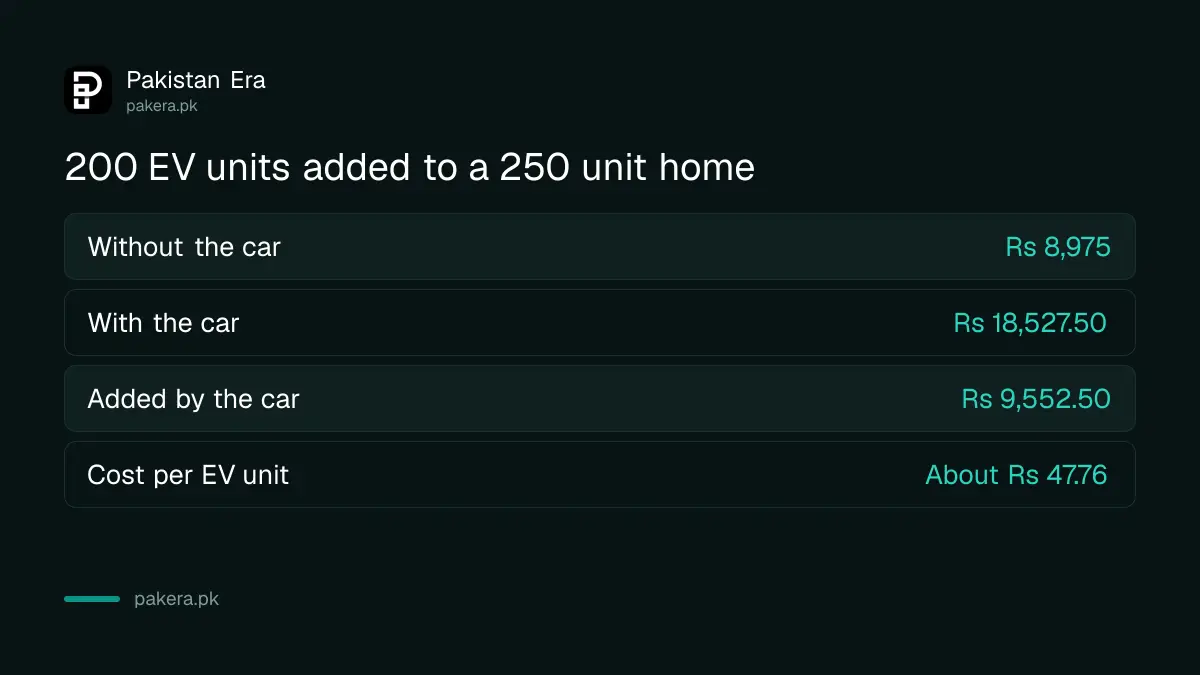
An unprotected home pays every unit at the rate of the slab it lands in. So 200 extra units for an EV can move a 250 unit house from Rs 33.10 to Rs 38.95 a unit on all 450 units, not just the new ones.
Here is that example in full, on the 2026 rates with a 2 kW sanctioned load, before taxes:
- Without the car: 250 units at Rs 33.10, plus Rs 700 fixed charges, is Rs 8,975.
- With the car: 450 units at Rs 38.95, plus Rs 1,000 fixed charges, is Rs 18,527.50.
- The car added Rs 9,552.50 for 200 units.
- That is about Rs 47.76 for each unit the car used, higher than the top home slab.
The full slab table and the fixed charges are set out in electricity unit prices for 2026. Homes with 5 kW or more are on Time of Use billing, where overnight off-peak charging at Rs 34.53 a unit is the cheaper habit.
Per 100 km, an EV still costs far less than petrol
Even at the costly home rate, driving 100 km on electricity costs a fraction of petrol. At 15 kWh per 100 km, the example above works out to about Rs 716, against about Rs 2,644 for a petrol car doing 15 km a litre.
| How you fuel 100 km | Cost (Rs) |
|---|---|
| EV at the station's base tariff, before margin | 354 |
| EV at home, Time of Use off-peak | 518 |
| EV at home, slab jump example | 716 |
| Petrol car at 15 km a litre | 2,644 |
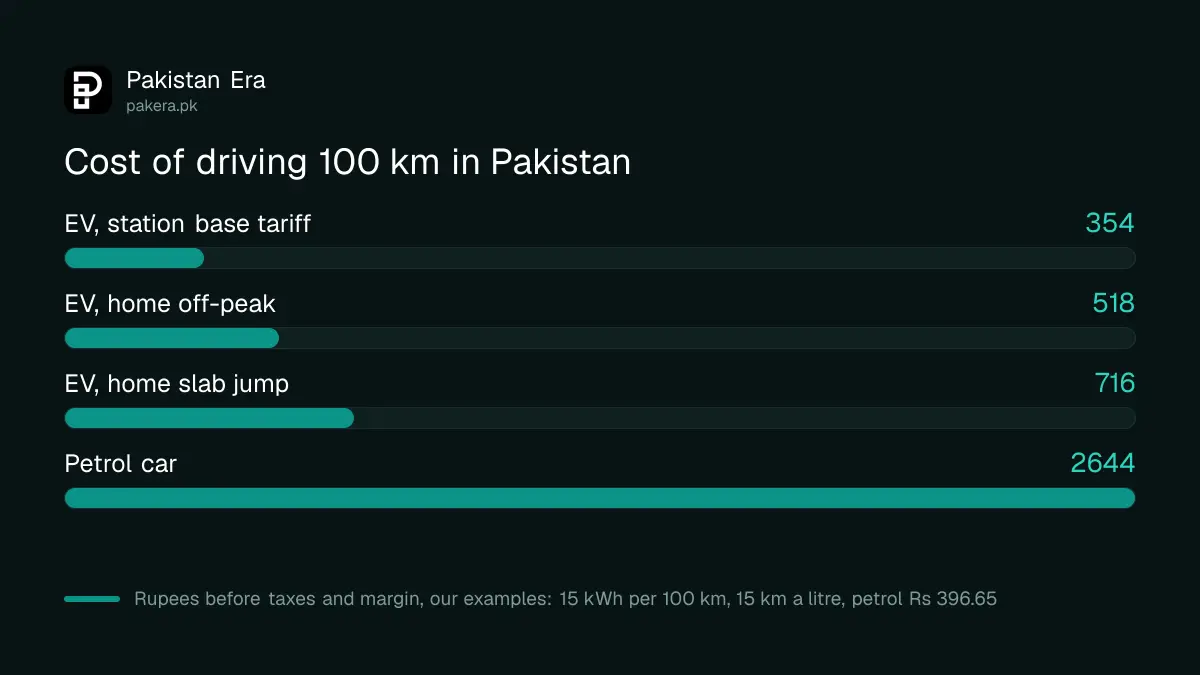
The petrol figure uses Rs 396.65 a litre, the price on 8 October 2026. The 15 kWh and 15 km a litre figures are our round examples; your car will differ. Registration and token tax for EVs are far lower too, as set out in registering an electric car in Pakistan.
Common questions
What is the EV charging rate in Pakistan?
Charging stations pay Rs 23.57 a unit to the electricity company. Drivers pay that plus the station's margin and taxes, which each station sets for itself.
Is there a maximum price for EV charging stations?
No. NEPRA removed the Rs 24.44 a unit margin cap in April 2025, leaving the margin to the market.
Is it cheaper to charge an EV at home or at a station?
It depends on your slab. A home on a low slab can beat a station, but heavy charging that pushes the house into a higher slab can cost more per unit than a station.
How much does a full EV charge cost at home?
For a 60 kWh battery, from about Rs 1,346 to Rs 2,832 before taxes, depending on your slab.
Can I charge my EV on a Time of Use meter?
Homes with a sanctioned load of 5 kW or more are billed on Time of Use, where off-peak charging costs Rs 34.53 a unit before taxes.
How we verified this
What we checked, where we read it, and what we could not confirm.
Last checked on 9 October 2026. The Rs 45.55 to Rs 23.57 cut and the removal of the Rs 24.44 margin cap are from NEPRA's decision of 15 April 2025. Home rates and the 2026 station rate are from S.R.O. 279(I)/2026 of 12 February 2026. The display and metering rules are from chapter 16 of NEPRA's Consumer Service Manual, and the proposal to omit clause 16.4 is from NEPRA's public notice of 25 September 2026. Every cost example is our own arithmetic.
About the author

Tax, Bills and Technology Writer
Ali Akhtar is a young and curious voice here at Pakistan Era. He is currently pursuing his A-Levels and has a growing interest in Pakistan’s changing industrial landscape and educational trends. Ali likes to write in a way that helps him explain and explore the world around him. His writing reflects the perspective of the new generation navigating the evolving trends of Pakistan where technology, youth innovation, and shifting opportunities are reshaping the country’s future.