How to Register an Electric Car in Pakistan: Fees and Token Tax by Province
Registering an electric car in Pakistan? Islamabad waives the fee and token tax, Punjab cuts both by 95%, KP exempts EVs to 2028. Check your province here.
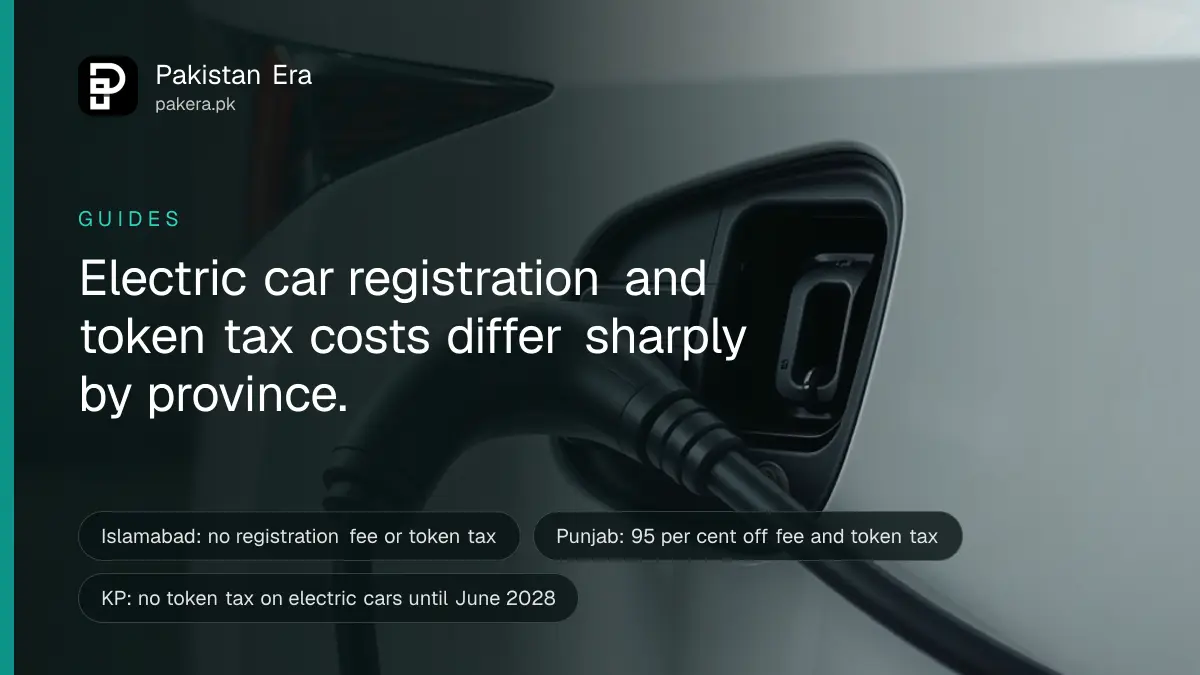
An electric car in Pakistan is registered with the Excise and Taxation office of your province, like any other car, but it pays far less. Islamabad charges no registration fee and no token tax. Punjab waives 95 per cent of both. Khyber Pakhtunkhwa charges no token tax until 30 June 2028. Balochistan taxes an EV as if it were a petrol car of matching size.
The rules differ a lot by province, so the figure you hear depends on where you register. We read the published fee schedules of Excise in Islamabad, Punjab and Balochistan, and the Khyber Pakhtunkhwa Finance Act 2025. Sindh has not published its EV rates on its Excise website, so we mark its figures as reported.
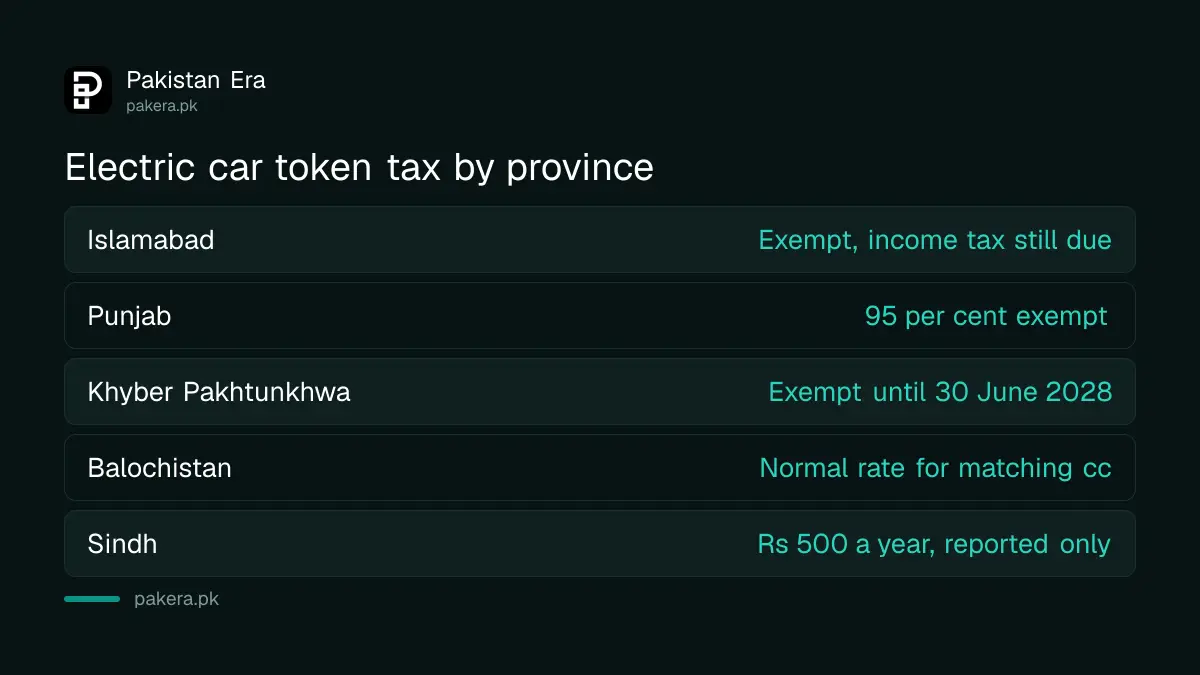
Electric car registration fee and token tax by province
Islamabad exempts electric vehicles from both the registration fee and token tax. Punjab exempts 95 per cent of each. Khyber Pakhtunkhwa exempts electric four-wheelers from token tax until 30 June 2028. Balochistan charges the normal rate after converting motor power into an engine size.
| Where you register | Registration fee | Token tax | Status |
|---|---|---|---|
| Islamabad | Exempt | Exempt (income tax still payable) | Published by Islamabad Excise |
| Punjab | 95% exempt | 95% exempt | Published by Punjab Excise |
| Khyber Pakhtunkhwa | Not covered by the EV note | Exempt until 30 June 2028 | In the KP Finance Act 2025 |
| Balochistan | Normal rate for the matching cc | Normal rate for the matching cc | Published by Balochistan Excise |
| Sindh | Rs 1,000, as reported | Rs 500 a year, as reported | Not on Sindh Excise's website |
Token tax is the yearly motor vehicle tax that you pay to keep a car on the road. The registration fee is paid once, when the car first gets its number. Both are provincial. Federal income tax collected by Excise is a separate charge and still applies in Islamabad, which says so on its page.
Islamabad: no registration fee or token tax for EVs
Islamabad's Excise fee schedule says electric vehicles are exempt from the registration fee and from token tax, but income tax is payable. Electric cars above 50 kWh pay 1 per cent capital value tax for five financial years, and transfers cost Rs 2,500 to Rs 10,000.
The capital value tax (CVT) is charged on the value of the car at registration and at each transfer. Islamabad applies it to electric vehicles greater than 50 kWh. It falls away after five financial years, and the value drops by 10 per cent each year for the sum.
The transfer fee for an electric vehicle in Islamabad depends on motor power:
- Up to 50 kW: Rs 2,500
- 51 kW to 100 kW: Rs 5,500
- Above 100 kW: Rs 10,000
The rest of the process, from biometrics to the smart card, is the same as for a petrol car. We set it out step by step for Islamabad vehicle registration.
Punjab: 95 per cent off registration and tax
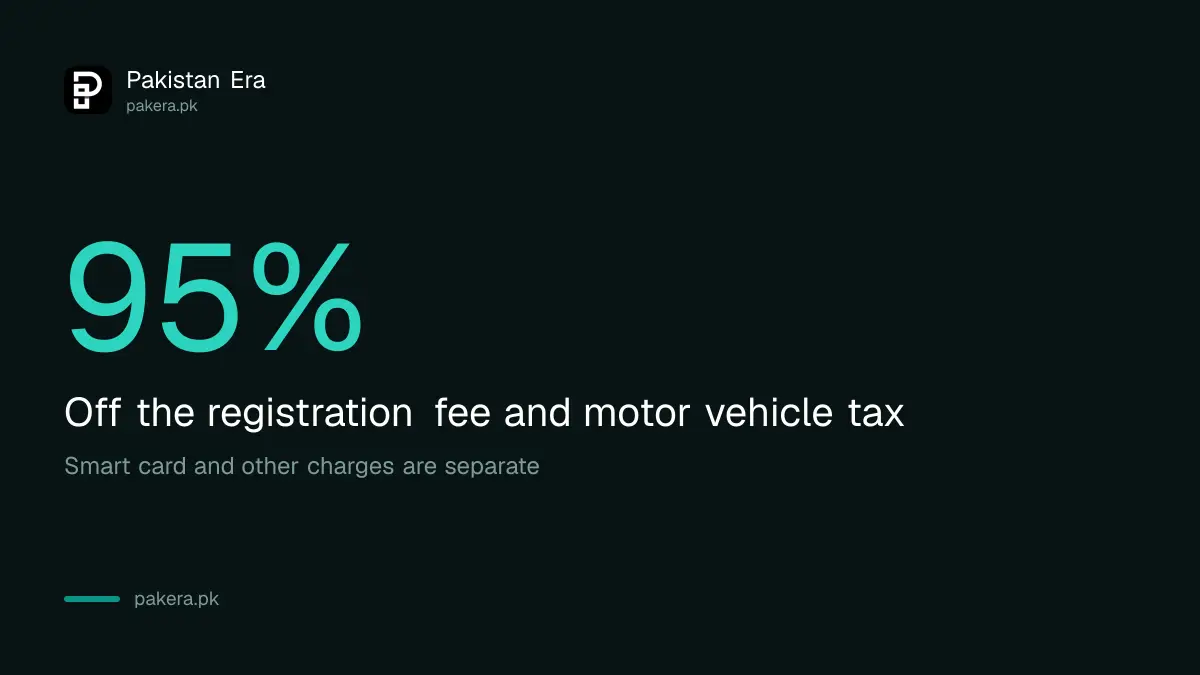
Punjab Excise's motor vehicle tax page says 95 per cent of the registration fee and 95 per cent of motor vehicle tax are exempted for electric vehicles. So an EV owner in Punjab pays 5 per cent of the normal amounts. The page does not set an end date for the concession.
The normal registration fee for a private car in Punjab is a share of its value: 1 per cent up to 1000cc, 2 per cent up to 2000cc, and 4 per cent above that. The page does not say how an EV's motor power is matched to these engine bands. Ask the Excise counter which band your car falls in before you pay, and check the amount on the payment slip.
Other charges on the same page, such as the smart card fee of Rs 1,300, withholding income tax and capital value tax, are not mentioned in the 95 per cent note. Expect to pay those in full unless the counter tells you otherwise. Yearly payments go through the same channels as any car, which we explain for Punjab token tax online.
Khyber Pakhtunkhwa, Balochistan and Sindh rules
Khyber Pakhtunkhwa sets EV token tax at Rs 2,000 to Rs 8,000 a year by motor power, but exempts all electric four-wheelers until 30 June 2028. Balochistan converts motor power to an engine size and charges that rate. Sindh's reported rates have not appeared on its Excise website.
Khyber Pakhtunkhwa. The KP Finance Act 2025 replaced the province's token tax schedule. It lists electric four-wheelers by motor power: Rs 2,000 up to 50 kWh, Rs 3,000 above 50 up to 65 kWh, Rs 4,000 above 65 up to 75 kWh, Rs 5,000 above 75 up to 124 kWh, and Rs 8,000 above 124 kWh. A note under the table exempts all electric four-wheelers until 30 June 2028. The note covers four-wheelers only, so electric motorcycles pay the normal KP token tax.
Balochistan. The Excise schedule says taxes and the registration fee for electric vehicles are charged in the category where they fall, after converting the motor's power from kilowatts to an equivalent engine capacity. It adds that a rebate is allowed subject to the Electric Vehicle Policy, without giving the amount. The online system cannot work out an EV's tax, so Balochistan token tax for an EV is paid at the district Excise office.
Sindh. Press reports from about 1 September 2026 say the Sindh cabinet extended EV concessions from 30 May 2026 to 29 May 2028: a fixed Rs 1,000 registration fee, Rs 500 a year in tax for non-commercial EVs, Rs 500 once for electric motorcycles, and Rs 5,000 luxury tax on EVs equal to 2,000cc or more. We could not find this on excise.gos.pk, whose motor vehicle tax page has no EV entry. Treat these as reported until the department publishes them.
How to register an electric car, step by step
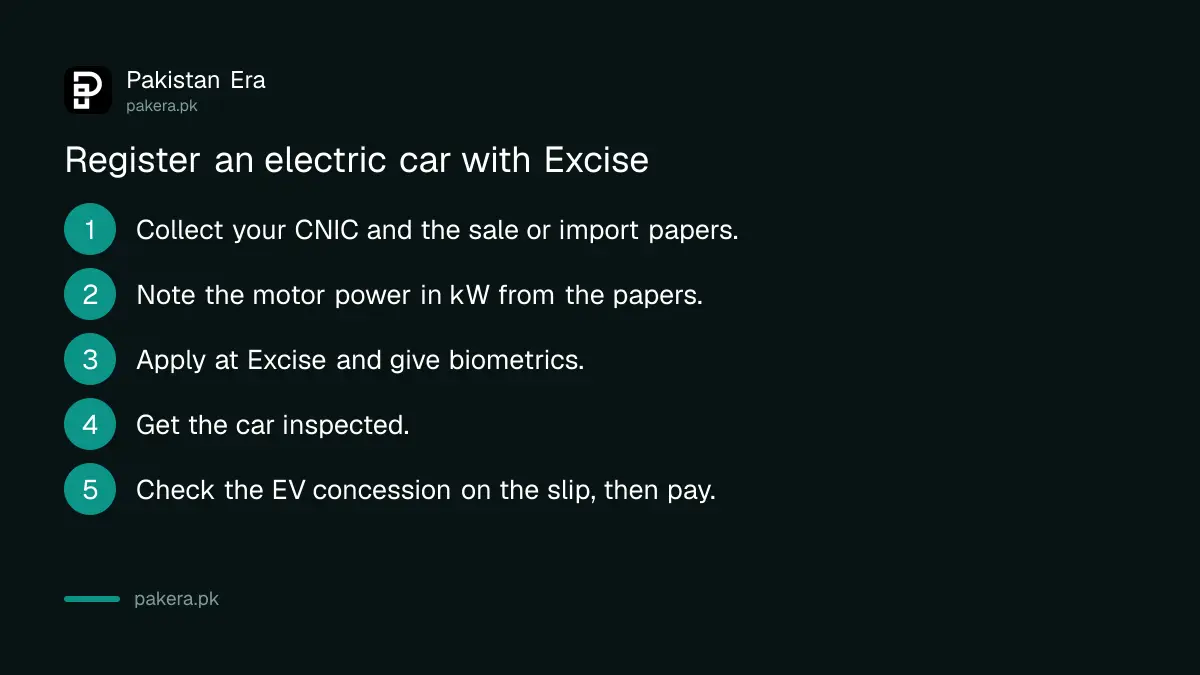
Register the car at the Excise office of the province where you live, with your CNIC, the sale invoice or import papers and proof of address. Ask for the EV concession at the counter, then check that the payment slip reflects it before you pay.
- Collect the papers. Your original CNIC, the sale invoice or sale certificate from the dealer, and the bill of entry and customs papers for an imported car.
- Check the motor power. Find the kW rating on the car's papers. Islamabad and KP set EV rates by kW or kWh, and Balochistan converts it into cc.
- Visit Excise and Taxation. Submit the registration form and give biometrics where the province asks for them.
- Get the car inspected. An inspector checks the chassis number against the papers.
- Read the payment slip before paying. Make sure the EV exemption has been applied to the registration fee and token tax.
- Collect the number plates and smart card once the payment clears.
If you are buying a used EV, the same rules apply at transfer. Follow the normal steps to transfer vehicle ownership, and check the transfer fee for EVs in your province.
Common questions
Do electric cars pay token tax in Pakistan?
It depends on the province. Islamabad exempts them, Punjab charges 5 per cent of the normal tax, KP exempts four-wheelers until 30 June 2028, and Balochistan charges the normal rate for the matching engine size.
Is the registration fee free for electric cars in Punjab?
Not fully. Punjab Excise exempts 95 per cent of the registration fee, so you pay 5 per cent. Smart card and other charges are separate.
How is an electric car's engine size worked out?
Balochistan converts the motor's kilowatts into an equivalent cc and taxes that category. Islamabad and KP use kW or kWh bands instead of cc.
What are Sindh's electric vehicle registration charges?
Reported at Rs 1,000 for registration and Rs 500 a year for non-commercial EVs until 29 May 2028. Sindh Excise has not published them on its website.
Do electric motorcycles get the same concession?
In Punjab, the 95 per cent note covers electric vehicles in general. In KP, the token tax exemption names four-wheelers only.
Does an electric car still pay income tax at registration?
In Islamabad, yes. Its schedule says income tax is payable even though token tax is exempt. Check the slip in other provinces.
How we verified this
What we checked, where we read it, and what we could not confirm.
Last checked on 2 October 2026. Islamabad's rules are from the Islamabad Excise fee schedule. Punjab's 95 per cent exemptions are from the Punjab Excise motor vehicle tax page. KP's rates and the 30 June 2028 exemption are from the Khyber Pakhtunkhwa Finance Act 2025 on kpcode.kp.gov.pk. Balochistan's rule is from its Excise schedule of taxes and fees. Sindh's figures are reported in the press and were not on excise.gos.pk when we checked. None of the provinces publishes how long an EV registration takes.
About the author

Senior Writer, Public Services and Technology
Shahid joined us in 2024 as an author. He is a senior contributor to Pakistan's leading technology websites. He writes detailed articles, mostly covering his expertise in the latest tech, mobiles, apps, gadgets, and step-by-step guides. His ideology is to help people understand the latest trends and explain complex methods through very easy-to-understand guides.