NEPRA Proposes Six-Month Detection Bills for Tampered Home Meters
NEPRA proposes six changes to the Consumer Service Manual, including six-month detection bills for tampered home meters. Read what changes and how to comment.
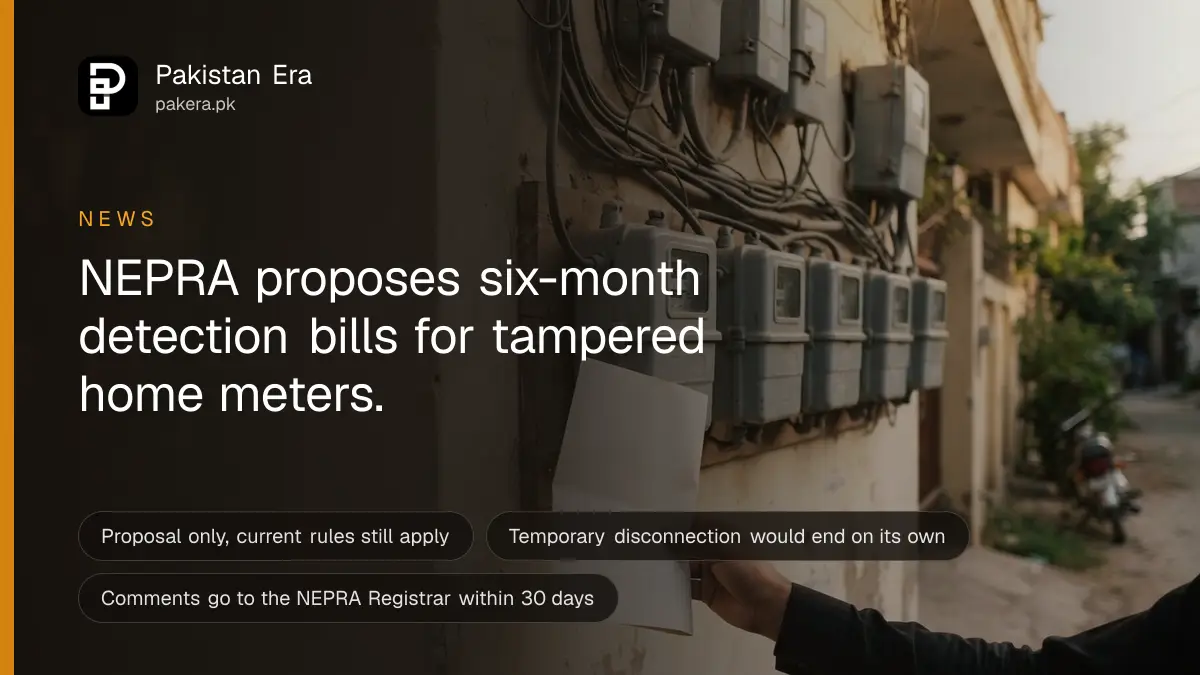
NEPRA has proposed six changes to the Consumer Service Manual, the rulebook every electricity company in Pakistan must follow. The one most households should read is about detection bills: for meter tampering, the proposal would let a company bill a home for up to six months, on the basis of its connected load.
The National Electric Power Regulatory Authority (NEPRA) posted the public notice and a two-page table of amendments on its news page on 25 September 2026. We downloaded and read both. Nothing has changed yet. These are proposals, and the public has 30 days to comment.
Six changes are proposed, and none is in force yet
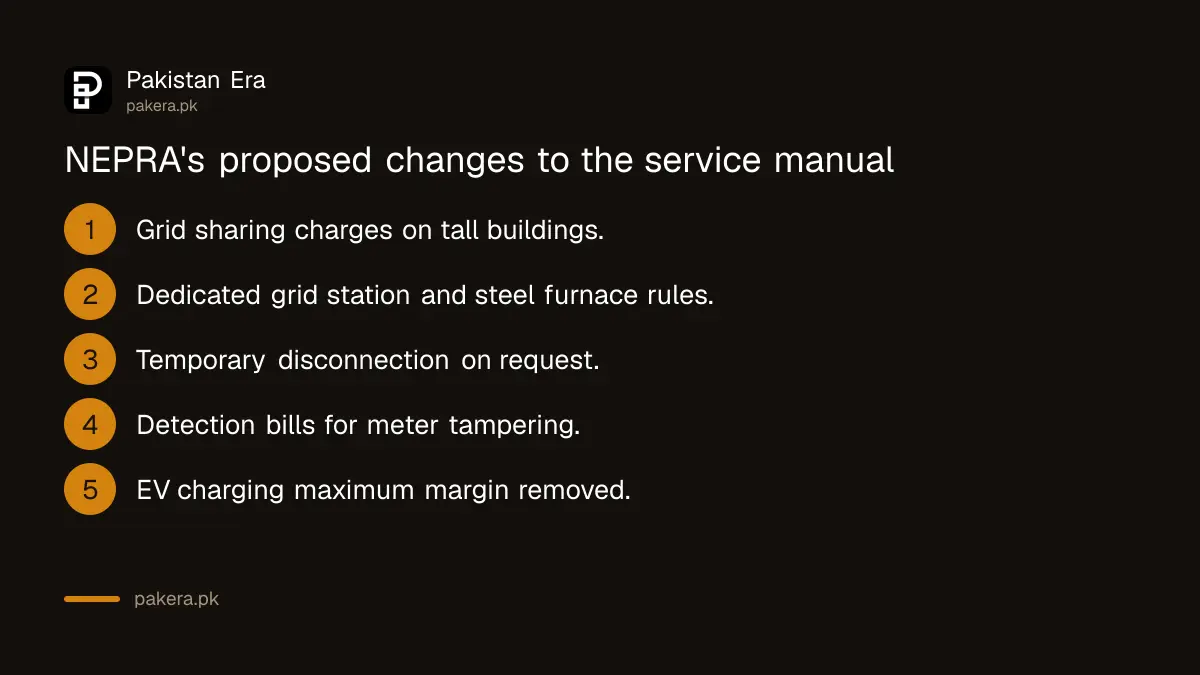
NEPRA's notice lists six proposed amendments to the Consumer Service Manual. They cover detection bills, temporary disconnection, grid sharing charges on tall buildings, large industrial connections, steel furnaces and electric vehicle charging. The current rules apply until NEPRA approves and notifies any change.
Here is the list, in the notice's order:
- Grid sharing charges on multistorey and high-rise buildings.
- When a dedicated grid station is required for a large connection.
- A dedicated transformer or feeder for steel furnaces.
- Temporary disconnection at the consumer's own request.
- Illegal abstraction of electricity by registered consumers, which means detection bills for tampering.
- Removal of the maximum margin for electric vehicle charging stations.
The Consumer Service Manual sets how companies such as LESCO, IESCO, MEPCO and PESCO give connections, bill, disconnect and charge for theft. So a small wording change in it reaches millions of bills.
Detection bills for meter tampering could reach six months for homes
Under the current clause, a detection bill for a household is limited to three billing cycles, extendable to six months only with the approval of the company's chief executive. The proposal sets six months for households in specific tampering cases, charged on load.
A detection bill is an extra bill for electricity the company says you used but was not recorded on the meter. The proposed text names four situations where the longer period would apply to a registered consumer:
- using a bogus meter;
- freezing the load profile or changing the billing meter through software;
- reversing the meter reading with a Bluetooth device;
- a security breach of the billing meter.
In those cases the bill would be worked out on the connected load, not on your past or future use. That matters. A load based bill assumes your sanctioned load ran for set hours, which can come out higher than what a family actually used.
| Point | Current rule (clause 9.2.3(c)) | Proposed |
|---|---|---|
| Households (A-1, A-2, A-3) | 3 billing cycles, up to 6 months with CEO approval | Up to 6 months for the four tampering cases |
| Other categories | Up to 6 billing cycles | Up to 12 months, based on theft and evidence |
| How the units are worked out | Past or future use, by priority | Connected load, in tampering cases |
| Status | In force | Proposal, open for comments |
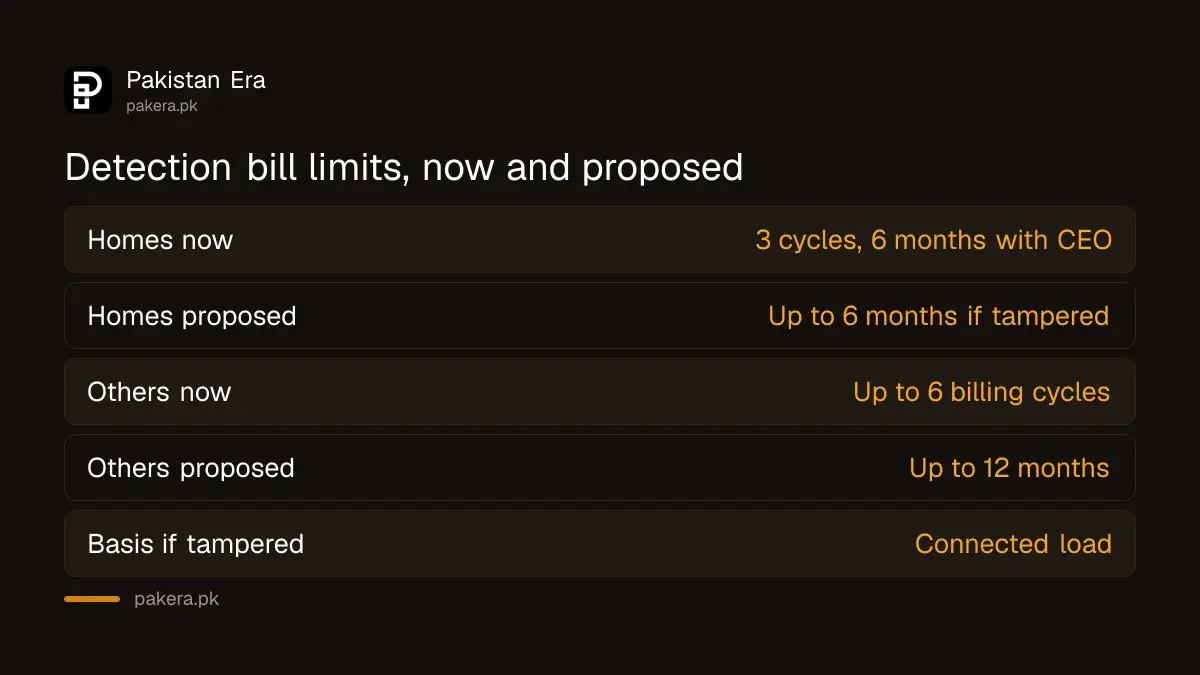
The proposal drops the CEO approval step for homes where one of the four tampering methods is found. If you get a detection bill, the steps to challenge it are in how to dispute an electricity detection bill.
Temporary disconnection would end on its own
At present, fixed charges start once a temporary disconnection period ends, even if you never ask to be reconnected. The proposal says you must approach the company before the period ends, and if you do not, the connection is treated as reconnected.
Charges would then apply from the day after the temporary period ends. The good news is in the second half of the clause. The current rule makes anyone who wants two temporary disconnections in a row pay fixed charges for at least one month in between. The proposal says there is no limit on how many temporary disconnections you take, but the same one month of fixed and other charges must be paid before each new one.
This affects people who lock a house for months, such as families abroad or owners between tenants.
Grid sharing charges would follow transformer size, not storeys
Today a building of ground plus three storeys is not treated as multistorey, so it pays no grid sharing charges. The proposal drops the storey test. Any building that needs a dedicated transformer above 500 kVA would pay grid sharing charges instead.
Grid sharing charges are a builder's share of the cost of the grid station that feeds a large new load. The change moves the test from the number of floors to the size of the electricity demand. Buyers of flats in new towers may see that cost built into prices, though the notice does not say so.
For factories, the proposal allows up to three feeders and 15 MW on one premises. Load above 5 MW would pay Rs 8.948 million per MW for grid sharing and transmission, plus Rs 0.855 million per MW for land. Above 15 MW, a dedicated grid station would be needed. Steel furnaces get new tiers up to 5 MW.
The last change is short. Clause 16.4, which sets a maximum margin for public electric vehicle charging stations, would be omitted. The table does not say what, if anything, replaces it.
You have 30 days to send NEPRA your comments
Anyone can comment. The notice gives 30 days from its publication and asks for written comments to the Registrar at NEPRA Tower in Islamabad, or by email. If counted from 25 September, the window closes around 25 October 2026.
The notice counts from the date the notice is published, and we could not confirm the newspaper date, so send comments early. Here is how:
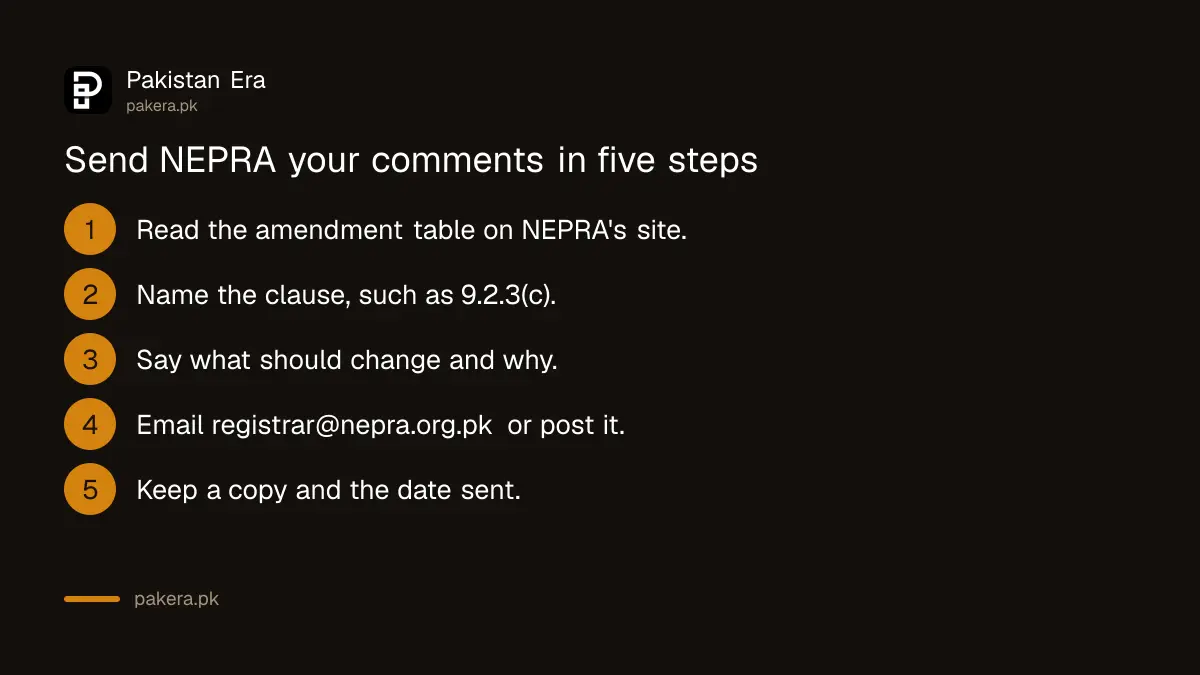
- Read the two-page amendment table on NEPRA's news page.
- Write which clause you are commenting on, for example 9.2.3(c) for detection bills.
- Say what you want changed and why, with your consumer reference number if you have a personal case.
- Email it to registrar@nepra.org.pk, or post it to the Registrar, NEPRA Tower, Ataturk Avenue (East), G-5/1, Islamabad.
- Keep a copy and the date you sent it.
The Registrar's phone numbers on the notice are 051-9206500 and 051-2013200. A comment is not a complaint. For a wrong bill today, use NEPRA's complaint route instead, and remember the separate service deadlines NEPRA set in August already bind every company.
Common questions
Has NEPRA changed the detection bill rules?
No, not yet. NEPRA has only proposed the change and asked for public comments. The current limit of three billing cycles for households still applies.
How long could a detection bill be for a house under the proposal?
Up to six months, and only where a bogus meter, software tampering, Bluetooth reading reversal or a meter security breach is found.
What happens if I forget to ask for reconnection after a temporary disconnection?
Under the proposal, the connection would be treated as reconnected and charges would start after the temporary period ends.
How do I comment on the NEPRA proposal?
Email registrar@nepra.org.pk or write to the Registrar at NEPRA Tower, G-5/1, Islamabad, within 30 days of the notice.
Will electric vehicle charging prices change?
That is not clear yet. The proposal deletes the clause that sets a maximum margin for public charging stations, but does not say what replaces it.
How we verified this
What we checked, where we read it, and what we could not confirm.
Last checked on 27 September 2026. We read NEPRA's public notice seeking comments on the Consumer Service Manual and the two-page scanned table of proposed amendments, both posted on NEPRA's news page on 25 September 2026. The current and proposed wording of clauses 2.6(3), 2.6(6), 2.6(7), 8.3, 9.2.3(c) and 16.4, the Rs 8.948 million and Rs 0.855 million per MW figures, the 30-day comment period and the Registrar's contact details are all from those two documents. The around 25 October date is our own count from the posting date. The date of newspaper publication could not be confirmed.
About the author

Tax, Bills and Technology Writer
Ali Akhtar is a young and curious voice here at Pakistan Era. He is currently pursuing his A-Levels and has a growing interest in Pakistan’s changing industrial landscape and educational trends. Ali likes to write in a way that helps him explain and explore the world around him. His writing reflects the perspective of the new generation navigating the evolving trends of Pakistan where technology, youth innovation, and shifting opportunities are reshaping the country’s future.