Check How Well Your Electricity Company Recovers Its Costs in Pakistan: QESCO 0.55, FESCO 1.06
See how your electricity company did in July to December 2025: QESCO 0.55, SEPCO 0.69, FESCO 1.06. We read the Finance Division table and show where yours is.
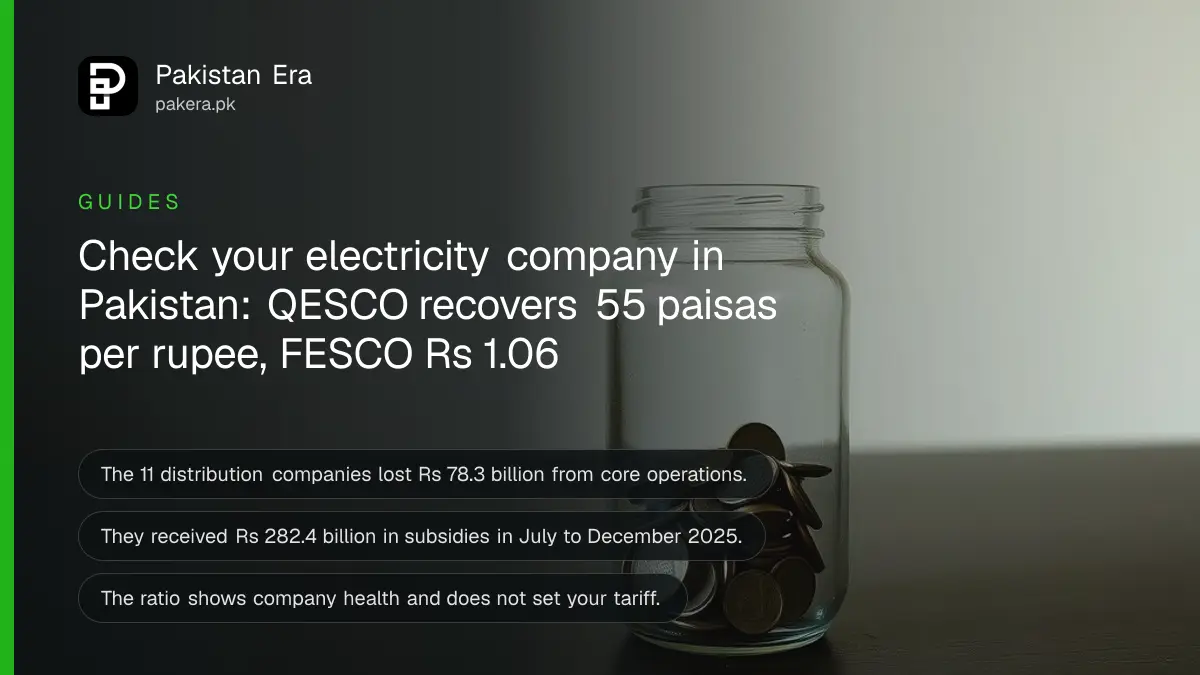
QESCO recovered only Rs 0.55 of every Rs 1 it spent on running its business in July to December 2025. FESCO recovered Rs 1.06. Pakistan's 11 electricity distribution companies (DISCOs) together lost Rs 78.3 billion from core operations while receiving Rs 282.4 billion in subsidies. You can read your own company's number in the Finance Division report.
The number is called the operating cost recovery ratio (OCRR). It does not change your bill by itself. It tells you whether the company that sends your bill can pay its own way. We downloaded and read the report on 13 October 2026.
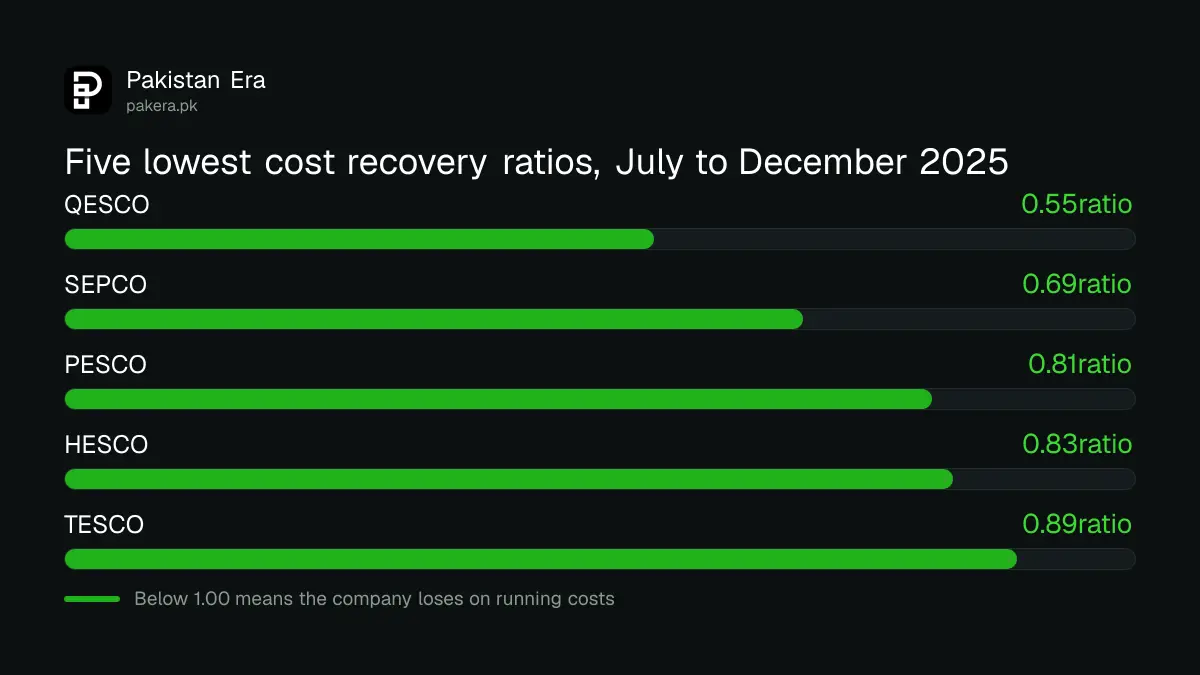
A ratio below 1.00 means the company loses on running costs
The OCRR divides a company's operating revenue by its operating cost. At 1.00 it breaks even. At 0.55 it earns 55 paisas for each rupee spent. The core EBIT column in the report is the profit or loss from core operations before interest and tax.
The report says the weakest companies remain low because of technical losses above NEPRA benchmarks, weak bill recovery and circular debt. See the Finance Division economy update for September 2026 for the wider fiscal picture.
Find your company in the table
Match your bill's company name to the row. The bill carries the name of your DISCO at the top. Not sure which one you have? We tested every electricity company website and listed the names.
| DISCO | Core EBIT, Rs million | OCRR | Subsidy, Rs million |
|---|---|---|---|
| LESCO (Lahore) | -10,254 | 0.97 | 33,722 |
| MEPCO (Multan) | 10,952 | 1.04 | 50,174 |
| FESCO (Faisalabad) | 14,226 | 1.06 | 42,120 |
| GEPCO (Gujranwala) | 7,913 | 1.04 | 16,944 |
| TESCO (Tribal areas) | -3,244 | 0.89 | 4,519 |
| HESCO (Hyderabad) | -17,960 | 0.83 | 23,585 |
| IESCO (Islamabad) | 2,397 | 1.01 | 47,824 |
| SEPCO (Sukkur) | -19,408 | 0.69 | 11,896 |
| PESCO (Peshawar) | -29,864 | 0.81 | 28,246 |
| QESCO (Quetta) | -35,278 | 0.55 | 16,661 |
| HAZECO (Hazara) | 2,233 | 1.06 | 6,696 |
| All 11 companies | -78,287 | Not given | 282,387 |
Five companies covered their running costs and six did not
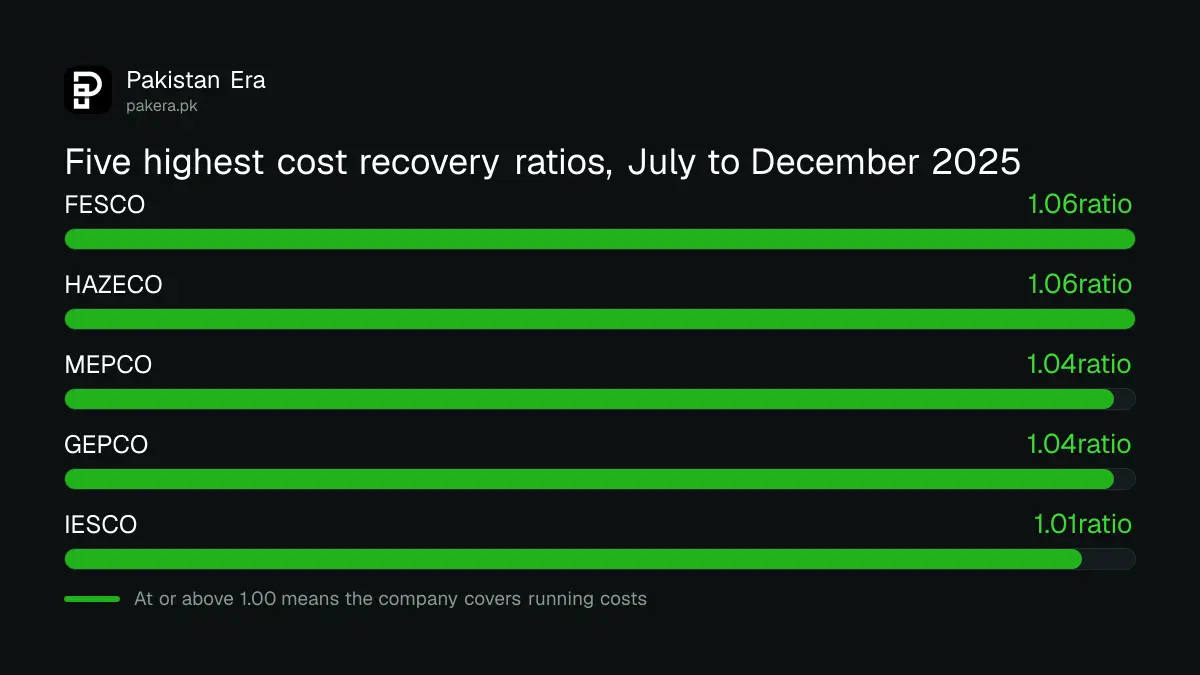
MEPCO, FESCO, GEPCO, IESCO and HAZECO are at or above 1.00. LESCO is close at 0.97. The companies below 0.90 are TESCO, HESCO, SEPCO, PESCO and QESCO. On the five weakest, the report points to technical losses, under-recoveries and circular debt.
FESCO, GEPCO and IESCO are the three companies being offered for sale, as set out in the Privatisation Commission pages. The Commission's board met on 5 October 2026.
What the ratio means for you and what it does not
A low ratio does not mean your bill is wrong, and a high ratio does not mean your tariff is lower. Tariffs are set by NEPRA and apply by consumer slab, as shown in the 2026 home slab rates.
The ratio matters because losses of a DISCO are paid for in other ways: subsidies, circular debt and government support. The IMF asks Pakistan for timely tariff adjustments to stop circular debt returning, so the weak companies are where pressure is highest.
If your power supply or bill is the problem, use the complaint routes, not this table: the NEPRA app for urgent complaints.
The subsidy column shows who gets the most support
The last column of the table is the subsidy each company received in the six months. MEPCO received the most, Rs 50.2 billion. IESCO received Rs 47.8 billion and FESCO Rs 42.1 billion. All 11 companies together received Rs 282.4 billion.
A high subsidy next to a ratio above 1.00 is not a contradiction. A subsidy pays for the gap between the tariff the regulator sets and the cost of supply, so it can be large even when a company runs well. A low ratio with a small subsidy, as at QESCO, shows a company that is losing money on top of the subsidy it gets.
The core EBIT figure is the profit or loss from the main business before interest and tax. Five companies have positive EBIT: MEPCO, FESCO, GEPCO, IESCO and HAZECO. The other six have negative EBIT, and the weakest are QESCO (minus Rs 35.3 billion) and PESCO (minus Rs 29.9 billion).
The report puts the whole sector at minus Rs 78.3 billion of core EBIT. That is the number the weak companies pull down, and it is why the Finance Division watches them closely.
How to check your DISCO in the report
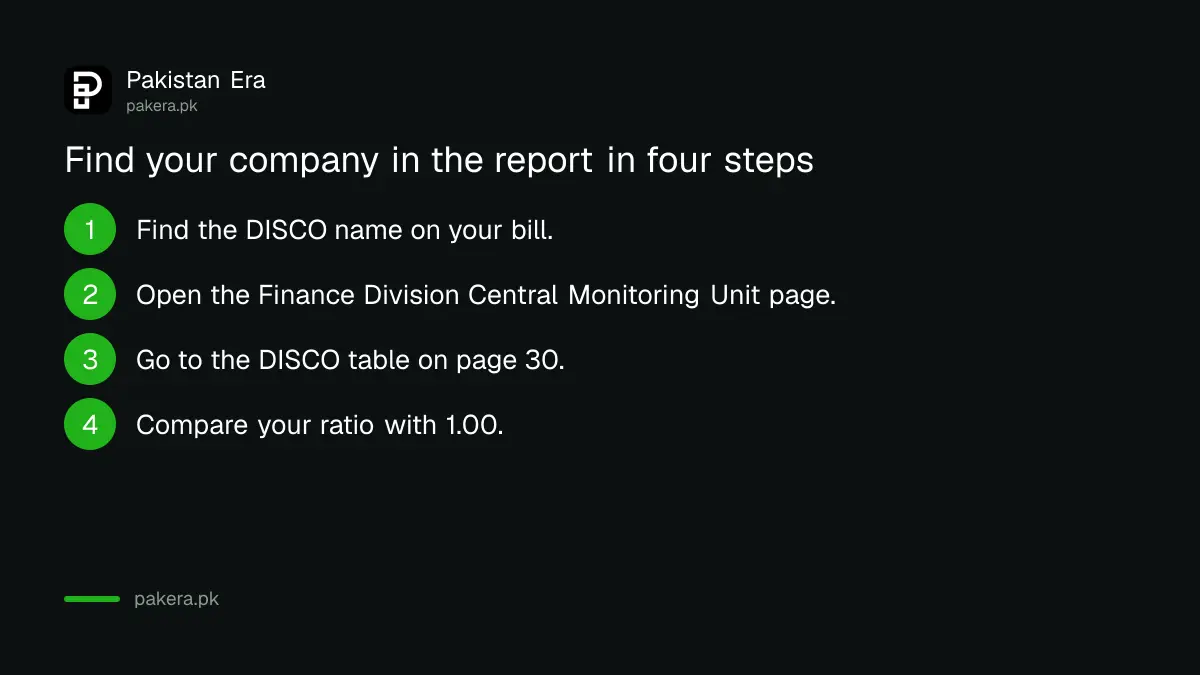
- Find the DISCO name on your electricity bill.
- Open the Finance Division Central Monitoring Unit page and download the H1 FY2026 report.
- Go to "DISCO Core Operational Analysis (OCRR)" on page 30 of the report.
- Read your company’s OCRR, core EBIT and subsidy. Compare it with 1.00.
Common questions
What does an OCRR of 0.55 mean?
The company earned Rs 0.55 in operating revenue for every Rs 1 of operating cost. QESCO had this ratio in July to December 2025.
Which electricity company recovers its costs best?
FESCO and HAZECO both had an OCRR of 1.06, followed by MEPCO and GEPCO at 1.04.
Does a low ratio change my bill?
Not directly. NEPRA sets tariffs. A low ratio shows the company loses money on running costs, which adds to subsidies and circular debt.
What period does the table cover?
July to December 2025, the first half of FY2026. The report was posted by the Finance Division in October 2026.
How much subsidy did the 11 companies get?
Rs 282,387 million, about Rs 282.4 billion, in the same six months. MEPCO received the most at Rs 50.2 billion.
Where is KE in this table?
K-Electric is not in this table. It is a privately owned company.
How we verified this
What we checked, where we read it, and what we could not confirm.
Last checked on 13 October 2026, Pakistan time. We read the Finance Division Central Monitoring Unit's bi-annual report on federal state-owned enterprises for July to December 2025, page 30. The PDF table lays out columns oddly, so we rechecked that the EBIT and subsidy columns add up to the totals shown. We did not read any company's own accounts.
About the author

Global Affairs & Political Economy Writer
Muhammad Hatim is a book lover who started writing because he enjoys it. At Pakistan Era he writes about international relations, geopolitics and the global economy, with a particular interest in South Asia and the forces behind current events.