Pakistan's Economy in September 2026: Inflation 11.1% in August, July Deficit Rs 596.6 Billion
The Finance Division's September 2026 update puts inflation at 11.1%, the July deficit at Rs 596.6 billion and names oil as the risk. See the main figures.
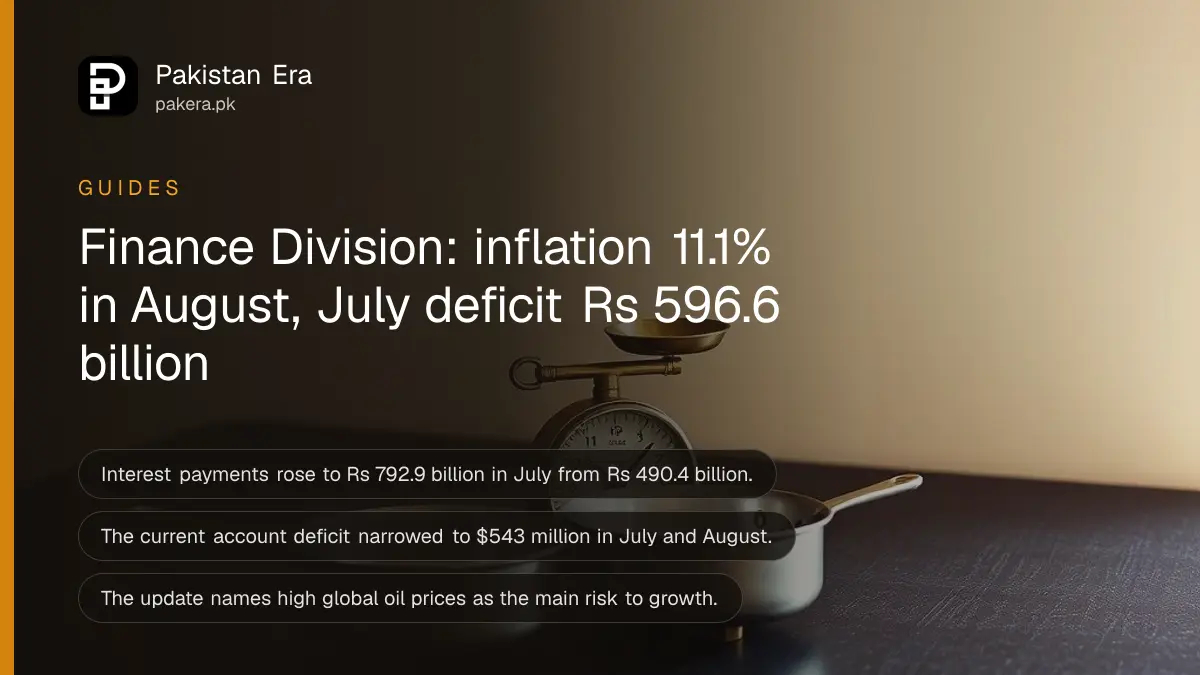
Short answer: The Finance Division's September 2026 economic update says inflation was 11.1 per cent in August, the July budget deficit was Rs 596.6 billion and the current account deficit for July and August was $543 million. It calls recovery "gradual" and names high oil prices as the main risk.
The Finance Division's Economic Adviser's Wing put the Monthly Economic Update and Outlook online on 30 September 2026. We read all eight pages. This is the government's own reading of its own numbers, so we say whose view each point is.
Inflation was 11.1 per cent in August and food drove it
The update says inflation rose to 11.1 per cent in August from 9.2 per cent in July and 3.1 per cent a year earlier. Prices rose 1.2 per cent in the month. Food added 4.9 percentage points to the headline rate. Core inflation was 8.8 per cent in urban areas and 8.5 per cent in rural areas.
The Finance Division expected 10 to 11 per cent for September. The Pakistan Bureau of Statistics later reported 10.3 per cent, as our September inflation report shows. If the terms CPI and core inflation are new to you, our explainer on price indices sorts them out.
| Indicator | Last year | This year | Change |
|---|---|---|---|
| Inflation, August | 3.1% | 11.1% | Up 8.0 points |
| Large-scale manufacturing, July | 8.9% growth | 3.03% growth | Slower |
| FBR net tax, July and August | Rs 1,661.5 billion | Rs 1,722.4 billion | Up 3.7% |
| Current account, July and August | -$853 million | -$543 million | Narrower |
| Remittances, July and August | $6.3 billion | $7.29 billion | Up 14.7% |
| Goods imports, July and August | $10.4 billion | $11.6 billion | Up 11.4% |
Factories grew 3.03 per cent in July and car output jumped
Large-scale manufacturing, the survey of big factories, grew 3.03 per cent year on year in July 2026 and 9.5 per cent from June. Vehicle production rose 27.6 per cent and sales 29.9 per cent in July and August. Cement dispatches rose 2.8 per cent to about 8.5 million tonnes, with exports down 16.7 per cent.
Farm indicators were also positive, the update says. Agricultural credit rose 16.4 per cent to Rs 271.9 billion in July. Urea offtake was up 2.9 per cent, but DAP fertiliser offtake was down 24.5 per cent. The document calls the wider picture a recovery that is "gradually becoming more broad-based".
The July deficit was Rs 596.6 billion because interest spending jumped
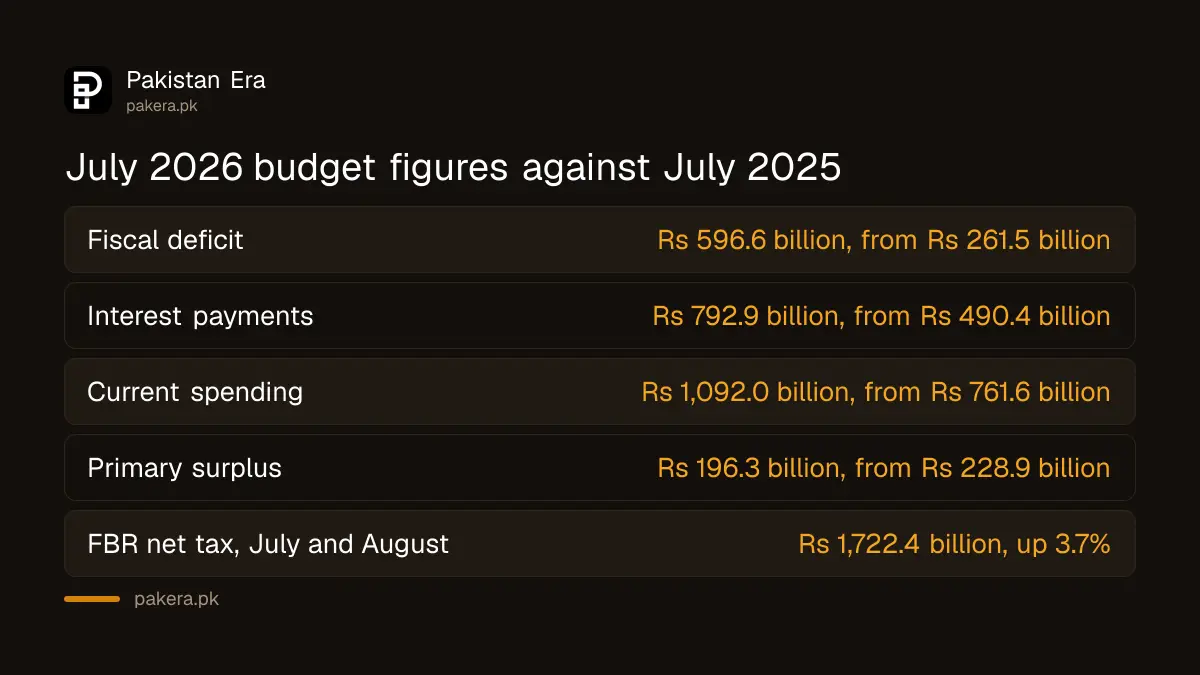
The consolidated fiscal deficit in July was Rs 596.6 billion, or 0.4 per cent of GDP, against Rs 261.5 billion a year before. Interest payments rose to Rs 792.9 billion from Rs 490.4 billion. The primary balance, which leaves interest out, stayed in surplus at Rs 196.3 billion.
Federal current spending was Rs 1,092.0 billion in July, up from Rs 761.6 billion. Interest was most of that. FBR net tax was Rs 1,722.4 billion for July and August. Sales tax rose 13.8 per cent, but direct tax fell 2.9 per cent and customs duty fell 4.0 per cent. The update says overall revenue growth came mainly from sales tax.
The external position improved on remittances and a Eurobond
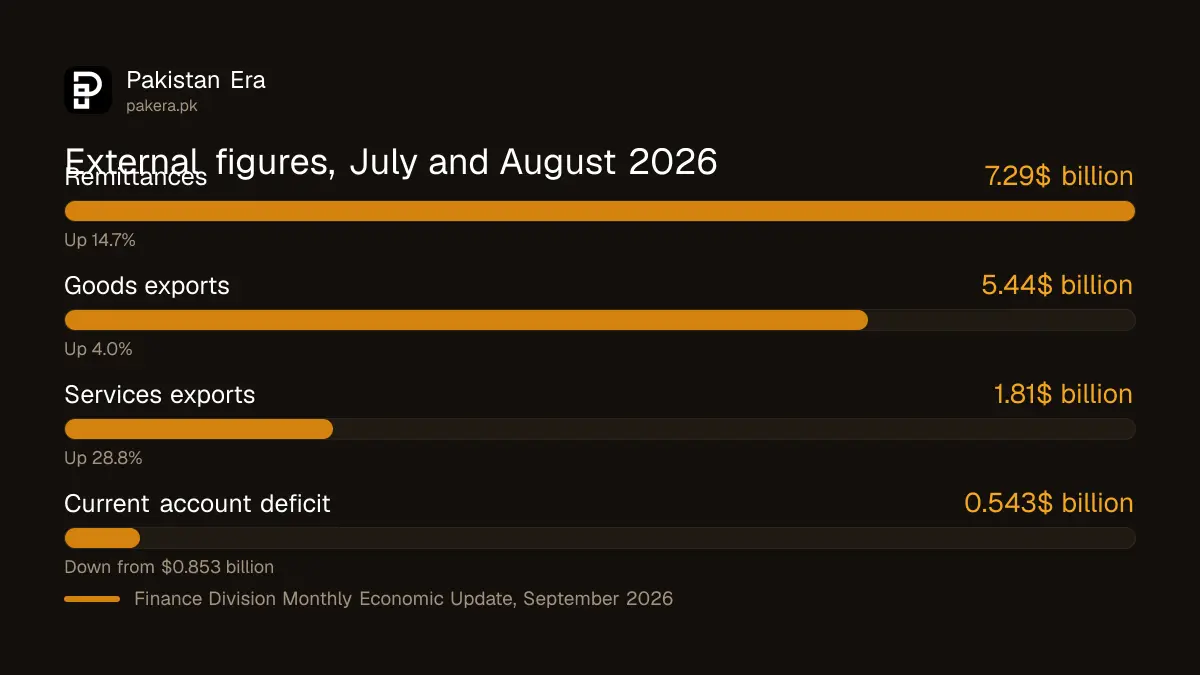
The current account deficit narrowed to $543 million in July and August from $853 million. Remittances rose 14.7 per cent to $7.29 billion, more than the whole $6.75 billion goods and services deficit. Total foreign investment rose 80.2 per cent to $562 million. A $3.0 billion Eurobond in September lifted reserves.
The SBP's own reserves were $21.39 billion on 18 September and total liquid reserves were $26.8 billion. For the current account in full, read our current account check, and for the bond, the list of Pakistan's Eurobonds.
Money supply shrank and the policy rate held at 11.5 per cent
Broad money fell 5.3 per cent between 1 July and 11 September, against a 2.8 per cent fall a year earlier, the update says. Private sector credit saw a net repayment of Rs 364.5 billion, which the Finance Division ties to seasonal loan repayments. The stock of private credit was still 13.0 per cent higher than a year ago.
The Monetary Policy Committee held the policy rate at 11.5 per cent on 14 September. The KSE-100 gained 882 points in August to close at 176,976. For the full vote, see the SBP rate decision.
Oil prices are the risk the Finance Division names
The update names high global oil prices as the principal risk to growth, inflation and the import bill. To soften it, it lists a Prime Minister's Fuel Relief Scheme, which sends help to lower-income households through a digital system, and a 50 per cent cut in fuel for official vehicles on non-operational duties.
It also says the petroleum levy was not cut. Our page on the oil shock and the household budget shows what that means at the pump.
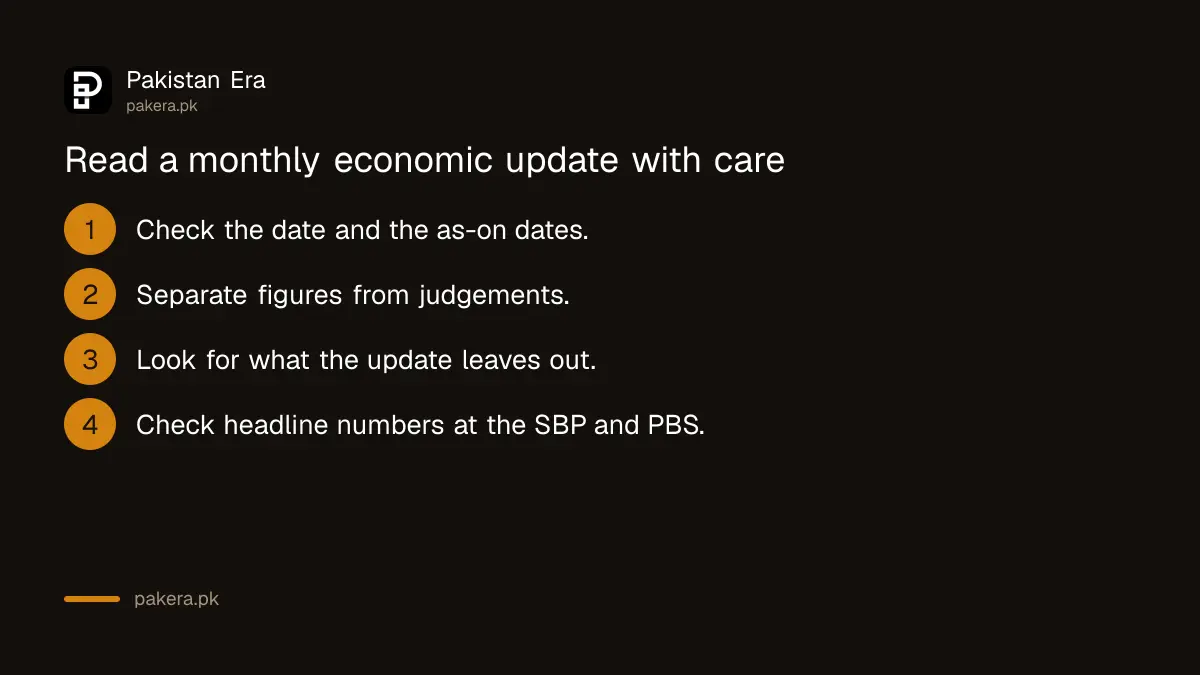
How to read a monthly update like this one
- Check the date on the cover and the "as on" date in the tables. Figures for different months sit side by side.
- Separate figures from judgements. "Remittances rose 14.7 per cent" is a figure. "Recovery is broad-based" is a view.
- Look for what is left out. The update says reserves help Pakistan meet "upcoming external debt obligations" but gives no amount.
- Check the headline numbers against the primary releases at the SBP and the Pakistan Bureau of Statistics.
Common questions
What did the Finance Division say about inflation?
It said inflation was 11.1 per cent in August and expected 10 to 11 per cent in September, depending on international oil prices.
How big was the July budget deficit?
It was Rs 596.6 billion, or 0.4 per cent of GDP, against Rs 261.5 billion in July 2025.
Did the current account improve?
Yes. The deficit for July and August was $543 million, down from $853 million a year earlier.
Is the update an independent view?
No. It is the government's own summary, written by the Economic Adviser's Wing of the Finance Division, so check the main figures against the SBP and PBS.
When is the next update due?
The Finance Division publishes it monthly, so an October edition should follow, but it has not announced a date.
How we verified this
What we checked, where we read it, and what we could not confirm.
Last checked on 11 October 2026. We read the Finance Division's Monthly Economic Update and Outlook for September 2026, which carries data to 30 September 2026. We compared the inflation figure with the Pakistan Bureau of Statistics September release and the policy rate with the State Bank of Pakistan's own homepage. Every figure above is the Finance Division's, unless we name another source. The 8.0-point change in inflation is our arithmetic.
About the author

Global Affairs & Political Economy Writer
Muhammad Hatim is a book lover who started writing because he enjoys it. At Pakistan Era he writes about international relations, geopolitics and the global economy, with a particular interest in South Asia and the forces behind current events.