Pakistan's Current Account Deficit Is $543 Million for July and August 2026: How to Read It on the SBP Site
Pakistan's current account deficit was $543 million in July and August 2026, down from $853 million. See what moved it and how to open the SBP table yourself.
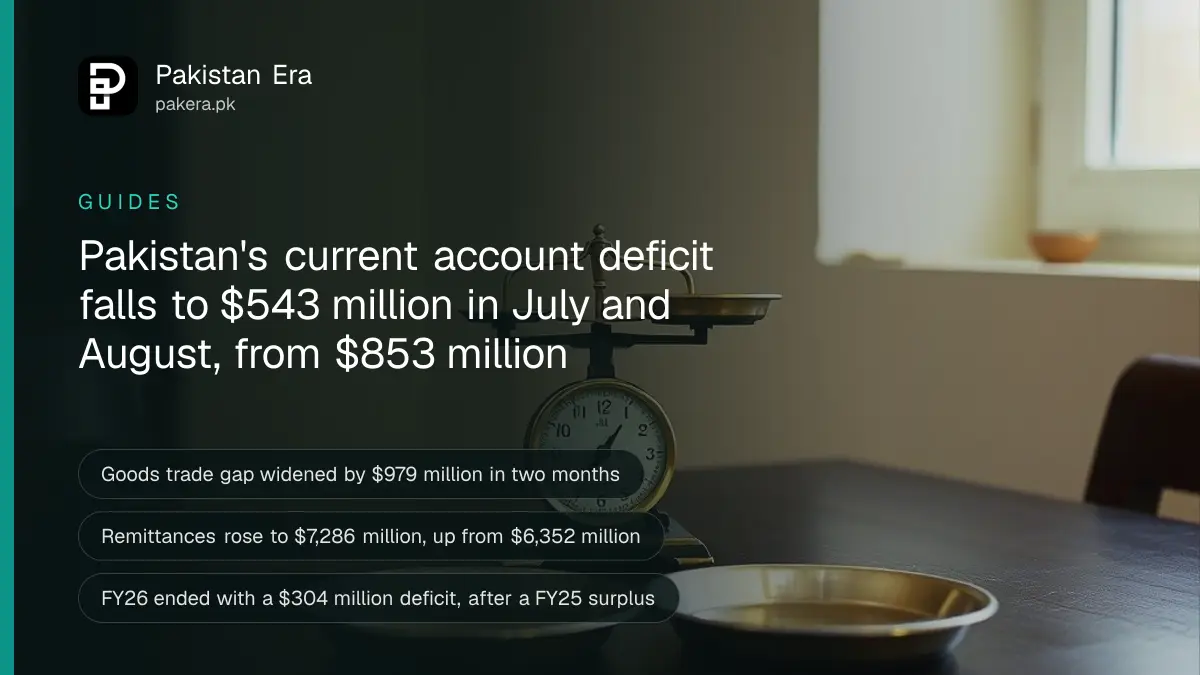
Pakistan's current account was $543 million in deficit in July and August 2026, against a $853 million deficit a year earlier. The State Bank of Pakistan (SBP) published the figures on 16 September 2026. The deficit shrank because money sent home by workers abroad grew faster than the goods trade gap.
A current account is the broadest score of how many dollars Pakistan earns from the world, against how many it pays out. When it is in deficit, the country needs to borrow or use reserves to fill the gap. The next SBP release should land in mid-October, so now is a good time to learn where the number comes from and how to read it.
We downloaded the SBP's own table and checked every figure below against it. Here is what the table says, and how you can open it yourself.
The July and August deficit fell from $853 million to $543 million
The SBP's summary shows a deficit of $543 million for the first two months of FY27, which began on 1 July 2026. A year earlier the same two months showed a deficit of $853 million. That is a fall of about 36 per cent.
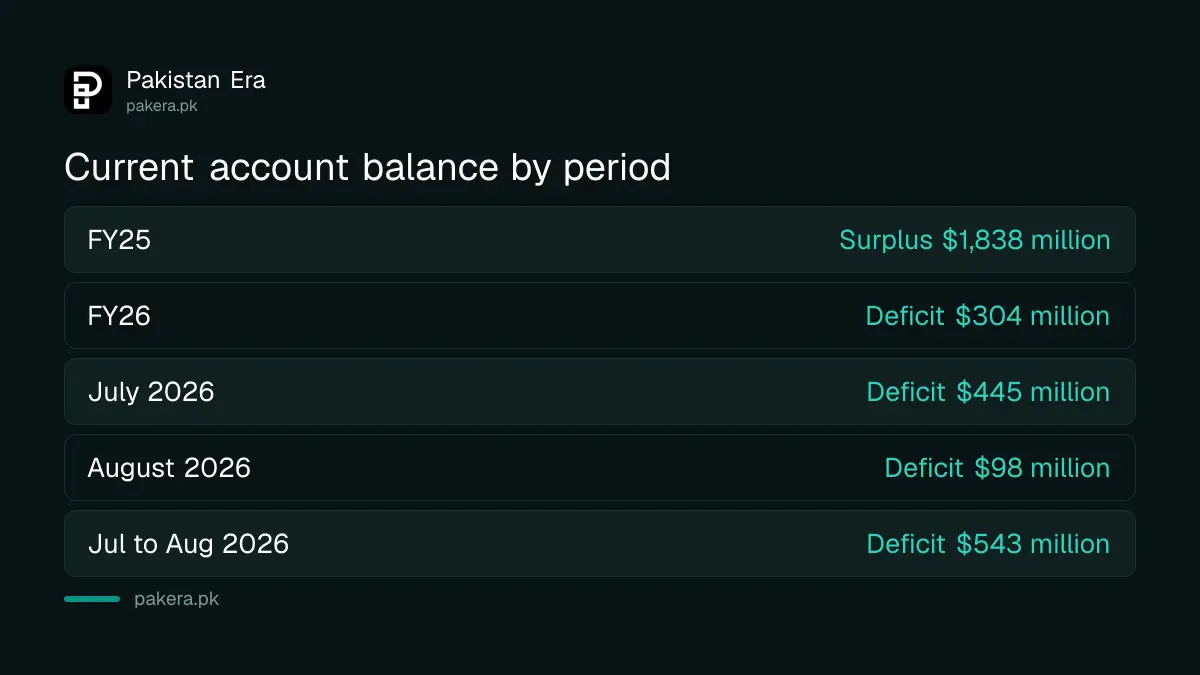
| Period | Current account balance |
|---|---|
| FY25 (July 2024 to June 2025) | Surplus of $1,838 million |
| FY26 (July 2025 to June 2026) | Deficit of $304 million |
| July 2026 | Deficit of $445 million (revised) |
| August 2026 | Deficit of $98 million (provisional) |
| July and August 2026 | Deficit of $543 million |
Two details matter. The SBP marks July as revised, at $445 million, and August as provisional, meaning it can change in the next release. Also, the full year FY26 ended in a $304 million deficit, a swing from the FY25 surplus.
Remittances closed the gap that imports opened
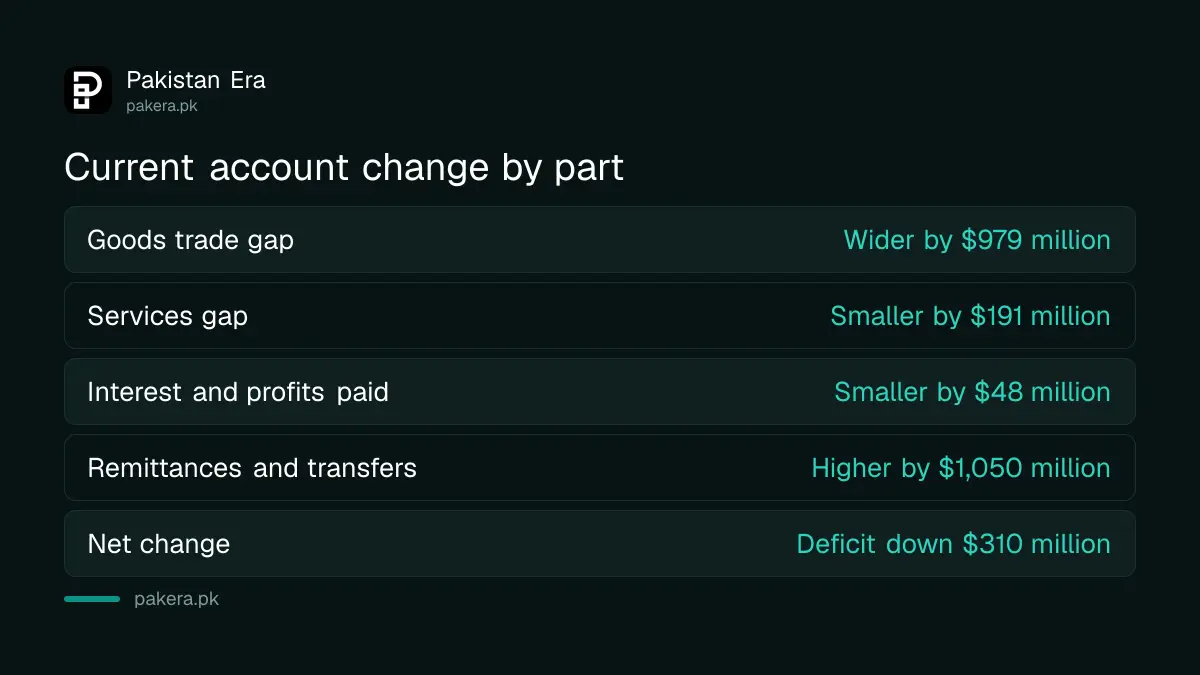
The deficit narrowed by $310 million between the two years. Four parts of the account moved, and two of them pulled in opposite directions. The goods trade gap grew by $979 million. Workers' remittances and the other income lines more than made up for it.
| Part of the account | Jul to Aug FY26 | Jul to Aug FY27 |
|---|---|---|
| Goods trade balance | -$5,211 million | -$6,190 million |
| Services trade balance | -$753 million | -$562 million |
| Primary income (profits and interest paid abroad) | -$1,569 million | -$1,521 million |
| Secondary income (mostly remittances) | +$6,680 million | +$7,730 million |
| Current account balance | -$853 million | -$543 million |
Workers' remittances alone were $7,286 million in the two months, up from $6,352 million. The monthly detail is in our reports on August remittances and on September remittances.
The goods gap grew because imports rose faster than exports
In the SBP's table, exports of goods were $5,445 million in July and August, up from $5,238 million. Imports were $11,635 million, up from $10,449 million. Imports grew by about 11 per cent, exports by about 4 per cent.
This is the weak spot. Pakistan still buys far more than it sells, and higher oil prices make that worse. The Bureau of Statistics counts trade on a different basis and reported stronger export growth for September, as we set out in our report on the September trade deficit. Do not mix the two sources in one sum.
Foreign direct investment, which is money foreign firms put into Pakistan, was a gross $495 million in July and August, against $399 million a year before. That is the line under "Direct Investment in Pakistan" in the same table.
How to open the SBP table yourself
You can see the same table in about two minutes. It is free and needs no login.
- Open sbp.org.pk and go to Publications and Data, then Economic Data.
- Scroll to the external sector section and find "Summary of Balance of Payments as per BPM6".
- Open the PDF. The first row, "Current Account Balance", is the headline.
- Read the column header. "P" means provisional and "R" means revised.
- Check the date beside the file. The SBP showed 16 September 2026 when we looked.
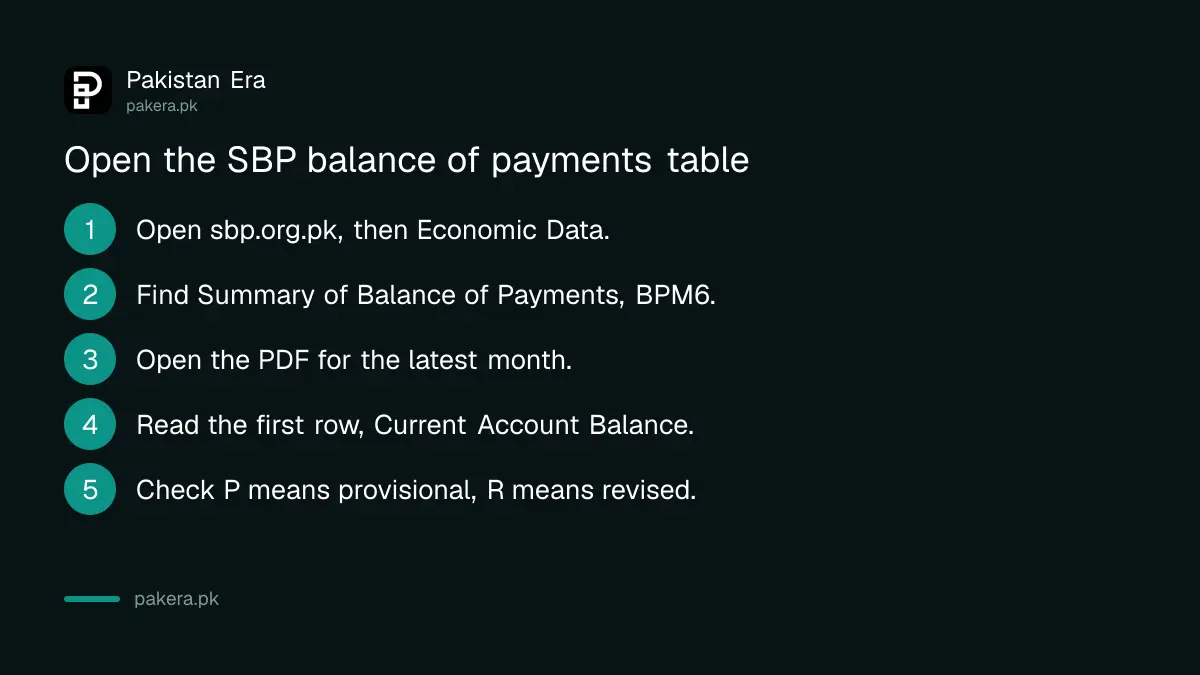
A minus sign means a deficit. A plus sign means a surplus. All amounts are in millions of US dollars. The same page has the foreign investment tables, if you want the detail behind the investment line.
For the other monthly numbers, such as reserves and inflation, see our walk through of the official SBP and Bureau of Statistics pages.
What a smaller deficit means for you
A smaller deficit means Pakistan needs fewer borrowed dollars to pay its bills. That eases pressure on the rupee and on the reserves. It does not lower petrol or flour prices on its own, because those follow world prices and local costs.
It is also not a safe margin yet. Two months is a short run, August is provisional, and the goods gap is wider. The September figure, due in mid-October if the usual pattern holds, will show whether remittances keep carrying the account. The SBP has not published a date that we could confirm, so treat mid-October as our expectation, not an announcement.
Common questions
What is Pakistan's current account deficit for July and August 2026?
It is $543 million, by the SBP's summary published on 16 September 2026. A year earlier it was $853 million.
Did Pakistan have a surplus in FY26?
No. FY26 ended with a $304 million deficit, by the same SBP table. FY25 had a surplus of $1,838 million.
Why is the August figure marked provisional?
The SBP can revise it in the next release. The table already marks July as revised, so changes do happen.
Does a smaller deficit lower prices?
Not directly. It eases pressure on the rupee and reserves, but fuel and food prices follow other costs.
When is the next current account figure due?
The SBP has not given a date we could confirm. Past releases came in mid-month, so mid-October is likely.
How we verified this
What we checked, where we read it, and what we could not confirm.
Last checked 11 October 2026, about 4 am PKT. We read the SBP's Economic Data page and downloaded its "Summary of Balance of Payments as per BPM6 - August 2026" PDF. Every dollar figure is from that table. The percentage changes and the breakdown of the $310 million change are our own arithmetic on the table.
About the author

Global Affairs & Political Economy Writer
Muhammad Hatim is a book lover who started writing because he enjoys it. At Pakistan Era he writes about international relations, geopolitics and the global economy, with a particular interest in South Asia and the forces behind current events.