What the Oil Shock Means for Your Household Budget in Pakistan
Brent peaked near $110 this year. See how that reaches your pump, electricity bill and food prices in Pakistan, with worked examples from OGRA price data.
When Brent crude peaked at about $110 a barrel this year, Pakistani households did not feel it as a barrel price. They felt it at the pump, in transport fares, in the electricity bill and in the price of food. Petrol costs Rs 396.65 a litre from 8 October 2026, and about Rs 85 of that is government levy, not oil.
This guide follows one rupee of oil shock from the Gulf to your household budget. It uses official figures only: the Oil and Gas Regulatory Authority (OGRA) price sheet, the Pakistan Bureau of Statistics, the State Bank of Pakistan and the World Bank. Where a number is our own arithmetic, we say so.
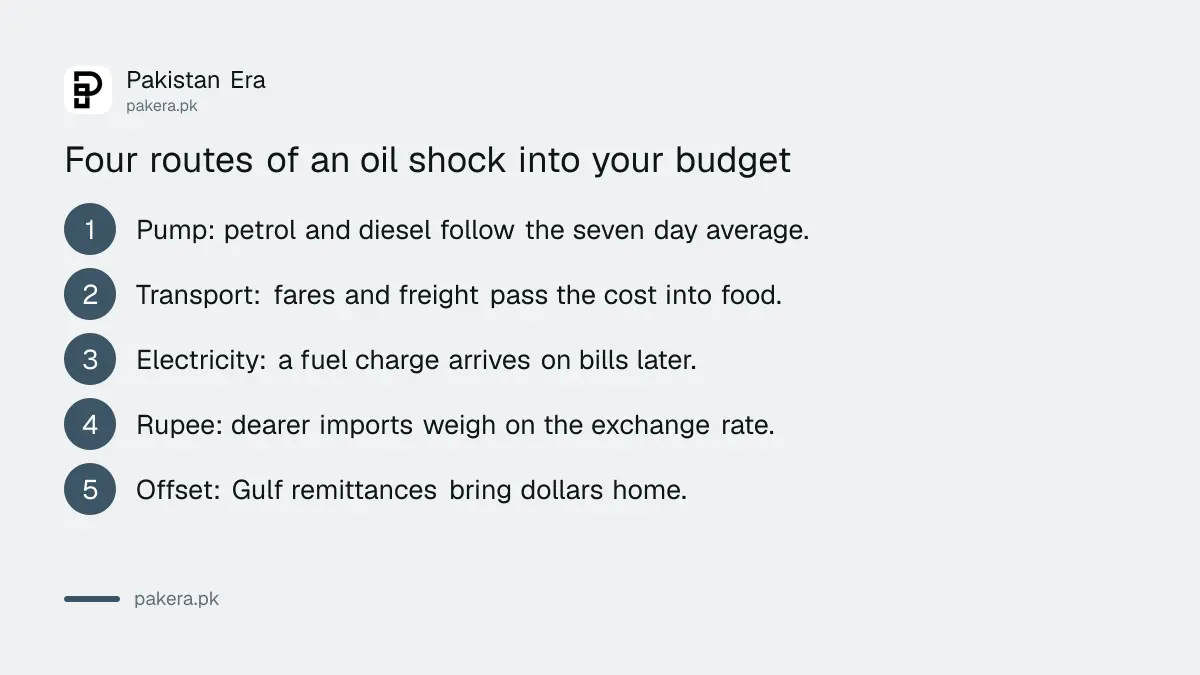
An oil shock reaches your budget through four routes
An oil price rise reaches a Pakistani household through the pump, transport and food, the electricity bill, and the rupee. A fifth route runs the other way: money sent home by workers in the Gulf, which helps families cope.
The World Bank's October 2026 South Asia report says shipping through the Strait of Hormuz has been disrupted since the conflict in the Middle East. It says the strait carries roughly 20 per cent of global petroleum consumption and 20 per cent of global LNG trade. For background on that route, see our explainer on the Iran war, Hormuz and Pakistan's role.
Rs 396.65 of petrol is mostly product cost and levies
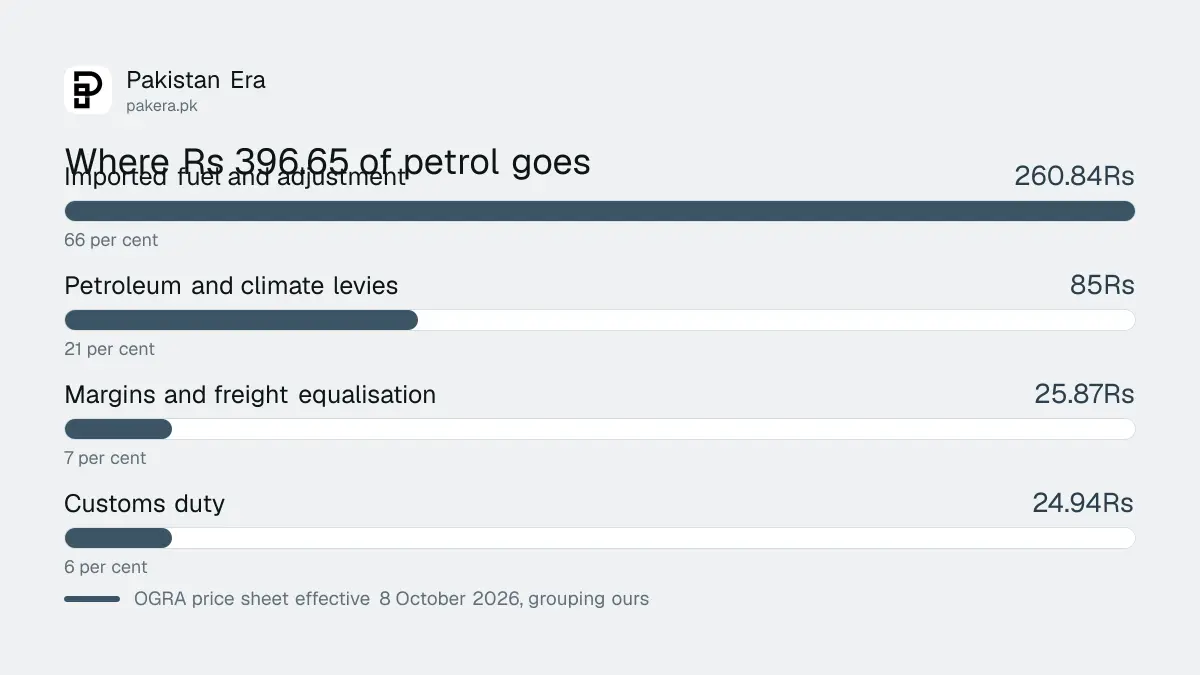
Most of the petrol price is the imported fuel itself, followed by government levies. We read OGRA's price sheet for 8 October 2026. It splits the Rs 396.65 into four groups, shown below. The grouping is ours, and the figures are OGRA's.
| Part of the petrol price | Rs a litre | Share |
|---|---|---|
| Imported fuel at Karachi port, plus exchange adjustment | 260.84 | 66% |
| Petroleum levy (80.00) and climate support levy (5.00) | 85.00 | 21% |
| Customs duty | 24.94 | 6% |
| Margins and freight equalisation | 25.87 | 7% |
| Total, excluding secondary freight | 396.65 | 100% |
The shares are rounded. "Secondary freight" is the cost of carrying fuel from the depot to your pump, and OGRA's total leaves it out. The freight equalisation margin is a charge that spreads the cost of moving fuel across the country.
Two lessons follow. If oil rises $10, it is mainly the first row that moves. And the Rs 85 in levies is fixed per litre, so it does not shrink when oil falls. That is why a cheaper barrel does not give you a proportionally cheaper litre. We explain the lag in why petrol does not fall with oil.
Daily pricing passes the change on within seven working days
OGRA's own note on the sheet says "Full impact of revision in daily international price is passed-on in seven working days." The fuel cost uses a seven-working-day rolling average of international prices and of the State Bank's exchange rate, which was Rs 277.22 on the 8 October sheet.
So a spike in oil takes about a week to arrive in full, and a fall takes the same time to arrive. Our daily reports, such as the one for 7 October, track each step.
A worked example for a motorbike and a car
Petrol was Rs 387.40 a litre on 1 October and Rs 396.65 on 8 October, according to OGRA sheets read for our daily reports. That is Rs 9.25 more a litre in a week. The two examples below are illustrations, not averages.
- A rider who uses 10 litres a week pays Rs 92.50 more a week, or about Rs 400 more over a month.
- A family car that uses 40 litres a week pays Rs 370 more a week, or about Rs 1,600 more a month.
- A household that spends Rs 20,000 a month on fuel and fares, if prices rose by the same 2.4 per cent, would pay about Rs 480 more.
These sums use only the fuel. They leave out the knock-on effect on fares and food, which is harder to measure and is the part most households actually notice.
Bills and prices carry the oil shock into everything else
The Pakistan Bureau of Statistics reported consumer inflation of 10.3 per cent in September 2026, down from 11.1 per cent in August. In its month-on-month list for September, it names electricity charges up 15.28 per cent and motor fuel up 10.76 per cent. Our September inflation report has the detail.
Electricity follows fuel with a delay, through a fuel charge added to bills. Our report on the October electricity fuel charge explains it. We cannot say how much of September's inflation came from oil alone. The Bureau does not split it that way.
Remittances cushion the shock, but they come from the same region
Pakistanis abroad sent $3.66 billion in August 2026, the State Bank's country-wise file shows. Saudi Arabia, the UAE and the other Gulf states sent about 53 per cent of it, which is our arithmetic from that file. The same region is where the oil shock began. We break down the corridors in our August remittances report.
That means a family can be hit twice: once by higher prices, and again if a Gulf job is at risk. The World Bank names strong remittance inflows as one reason South Asian demand has held up. So far the data is reassuring: in August, Saudi Arabia sent 18.6 per cent more than a year earlier and the UAE 16.6 per cent more, by our arithmetic from the same file.
What you can do about it
You cannot change the world price. You can change how much of it you pay. Check whether you qualify for the government's fuel relief, explained in our guide to petrol relief with code 9771. Pool trips. Compare your bills month by month so a rise stands out. If you send or receive money from abroad, use a bank channel, so the transfer is on record.
What is still unknown
Nobody can say where oil goes next. The World Bank's report lists persistently high energy prices as a risk to inflation, and it does not forecast a price. The IMF's October outlook, which may add a view, had not been released when we checked.
Common questions
How much of the Pakistani petrol price is tax?
On OGRA's 8 October sheet, the petroleum levy is Rs 80 and the climate support levy Rs 5, so Rs 85 of Rs 396.65. Customs duty adds Rs 24.94 more.
Why did petrol go up when oil did not rise that day?
OGRA uses a seven-working-day rolling average, so today's price reflects the past week, not today's oil price.
Does a higher oil price raise my electricity bill?
Yes, with a delay, through the fuel charge on bills. We cannot say the exact share, because the bill does not separate it.
How high did Brent crude go this year?
The World Bank's October 2026 report says it peaked at about $110 a barrel.
Do remittances protect Pakistan from an oil shock?
They help by bringing in dollars, but about 53 per cent of August's total came from Gulf states, so the protection is not independent of the region.
How we verified this
What we checked, where we read it, and what we could not confirm.
Last checked on 8 October 2026 at about 12:30am PKT. We read the OGRA petrol and diesel price sheet effective 8 October 2026, the Pakistan Bureau of Statistics Monthly Review of Price Indices for September 2026, the State Bank of Pakistan's country-wise workers' remittances file and its 9 September 2026 press release, and the World Bank's South Asia Economic Update of October 2026. The 1 October petrol price comes from our own daily report, which read the OGRA sheet of that date. The weekly litre examples and the shares are our own arithmetic.
About the author

Global Affairs & Political Economy Writer
Muhammad Hatim is a book lover who started writing because he enjoys it. At Pakistan Era he writes about international relations, geopolitics and the global economy, with a particular interest in South Asia and the forces behind current events.