October Electricity Bills in Pakistan to Carry a Rs 1.73 a Unit Fuel Charge
CPPA-G wants Rs 1.7267 a unit for August fuel costs, likely on October bills. NEPRA hears it on 29 September. See what 100, 200 and 300 units would add.
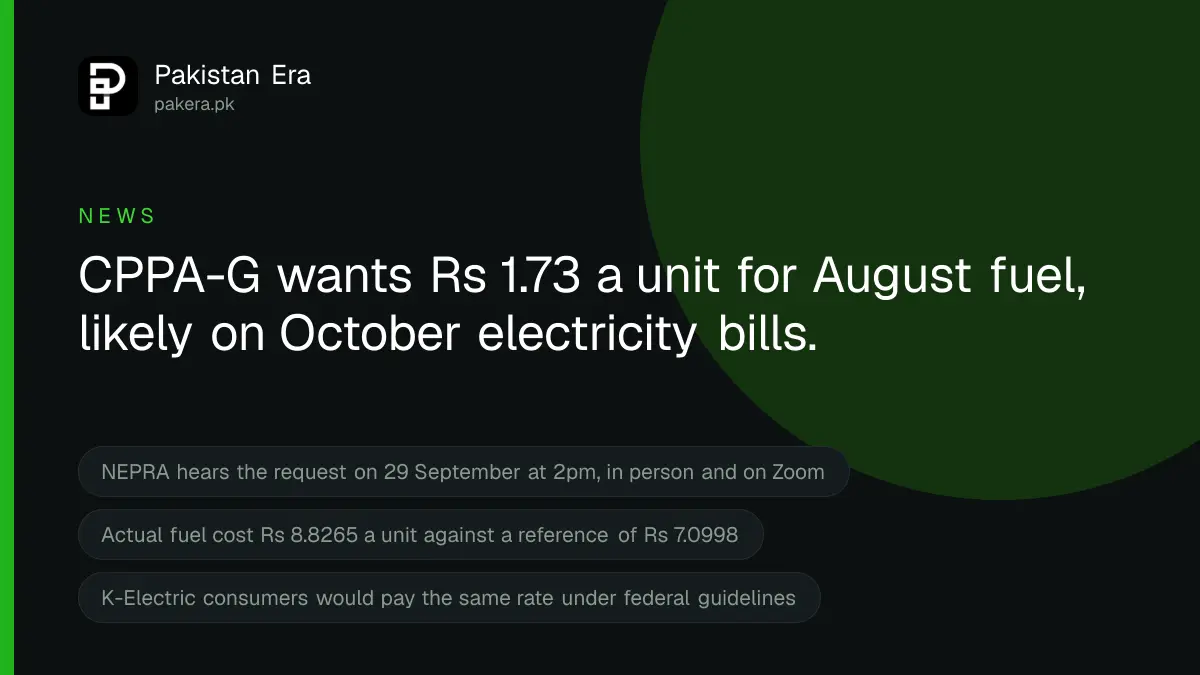
October electricity bills in Pakistan may carry a new fuel charge of Rs 1.7267 a unit. CPPA-G, the agency that buys power for the distribution companies, has asked NEPRA for it to cover August 2026 fuel costs. It is a request, not a decision. NEPRA hears it on Tuesday 29 September 2026 at 2pm, and K-Electric consumers would pay the same rate.
We read NEPRA's hearing notice, dated 19 September 2026, and the data CPPA-G sent to the regulator on 15 September. Both are on nepra.org.pk. So the figures below come from the documents themselves, not from a summary of them.
There is one piece of good news hidden in the request. It is smaller than the July charge now on September bills, which NEPRA set at Rs 2.0581 a unit. If NEPRA approves the full Rs 1.7267, the fuel line on your October bill should be a little lower than September's, not higher.
CPPA-G has asked for Rs 1.7267 a unit for August
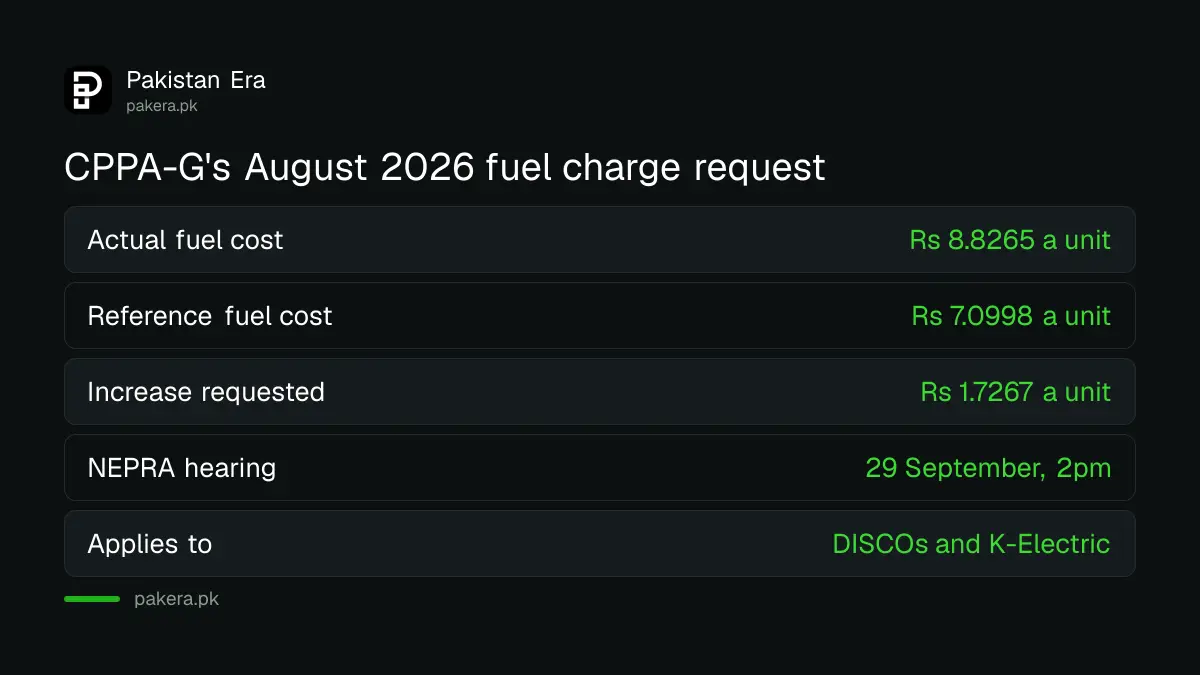
CPPA-G says fuel for power delivered to the ex-WAPDA distribution companies cost Rs 8.8265 a unit in August 2026. The tariff had assumed Rs 7.0998. The gap of Rs 1.7267 a unit is what it wants to recover from consumers, as NEPRA's own notice states.
A fuel charges adjustment, usually shortened to FCA or FPA, is a monthly correction. Your tariff includes a fixed guess of what fuel will cost. After the month ends, the real cost is worked out. If fuel cost more than the guess, consumers pay the difference later. If it cost less, they get money back.
The notice gives these figures for August 2026:
| Item | Figure in NEPRA's notice |
|---|---|
| Electricity generated | 14,943 GWh |
| Fuel cost of that electricity | Rs 149,596 million |
| Previous adjustment (a deduction) | Rs 10,097 million |
| RLNG fuel rate adjustment (a deduction) | Rs 10,617 million |
| Delivered to distribution companies | 14,464 GWh |
| Actual fuel cost per unit delivered | Rs 8.8265 |
| Reference fuel cost per unit | Rs 7.0998 |
| Increase requested | Rs 1.7267 a unit |
GWh means gigawatt hours. One GWh is one million units, so 14,943 GWh is about 14.9 billion units.
The two deductions matter more than they look
The request already subtracts two large amounts. One is Rs 10,097 million from earlier months. The other is Rs 10,617 million for a lower RLNG fuel rate. RLNG is imported gas, turned back from liquid into gas for power plants.
Together they take about Rs 20.7 billion off the bill. We did the sum ourselves: without those two deductions, the request would have been close to Rs 3.16 a unit, not Rs 1.73. That is our arithmetic from the notice's own table, not a figure NEPRA or CPPA-G has published.
RLNG made 9 per cent of the power and 40 per cent of the fuel bill
RLNG produced 8.78 per cent of the electricity in August but cost Rs 60,230 million, about 40 per cent of the Rs 149,596 million fuel bill. Hydel, wind and solar made about 44 per cent of the power at no fuel cost at all.
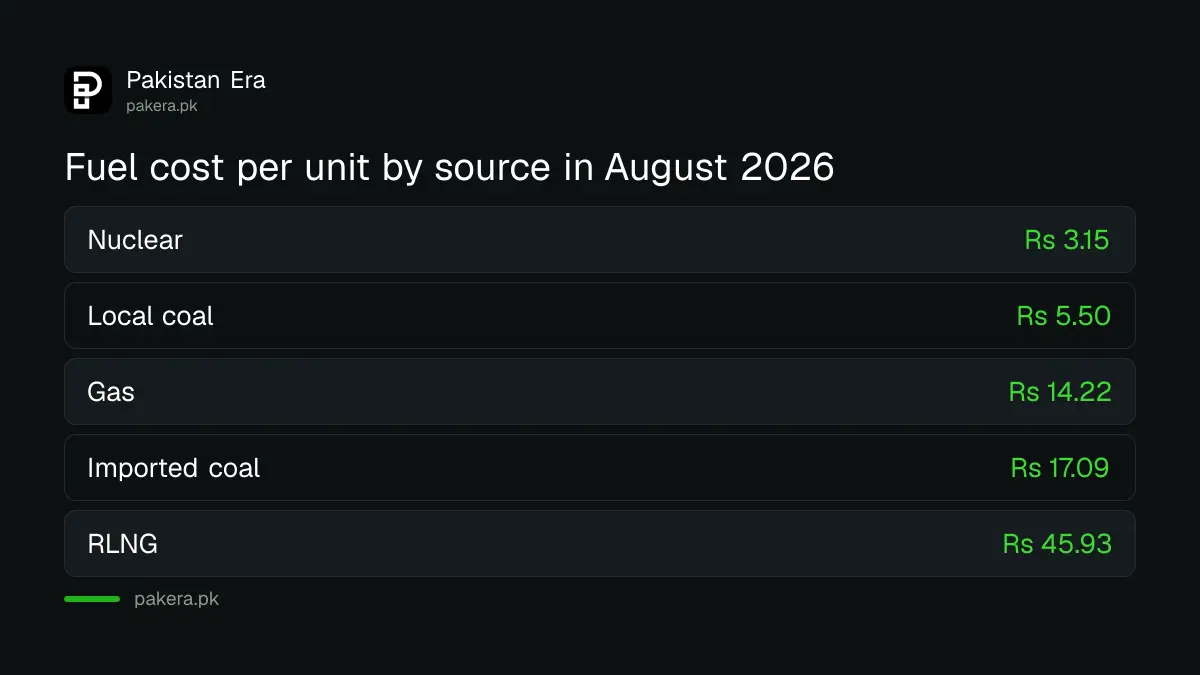
The per unit costs in the notice show why. Nuclear power cost Rs 3.15 a unit in fuel. Local coal cost Rs 5.50. RLNG cost Rs 45.93, and furnace oil (RFO) cost Rs 45.25. A small amount of expensive fuel moves the whole average.
The pattern is the same as July. In the July fuel adjustment hearing, RLNG made about a tenth of the power and nearly half the fuel cost. The percentages above are our own division of the notice's figures.
What Rs 1.73 a unit adds for 100, 200 and 300 units
At the full requested rate, 100 units would add about Rs 173, 200 units about Rs 345 and 300 units about Rs 518, before taxes. These are our own sums from the Rs 1.7267 figure. NEPRA has not approved anything yet.
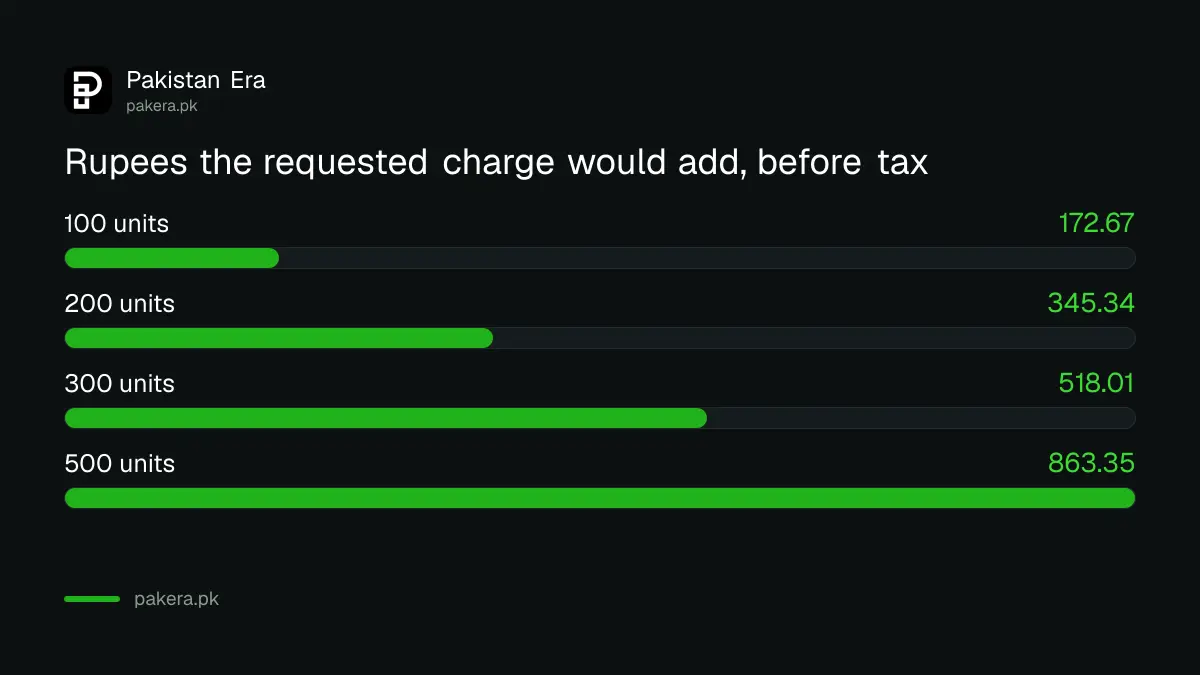
| Units in August | Requested August FCA at Rs 1.7267 | July FCA on September bill at Rs 2.0581 | Change in the fuel line |
|---|---|---|---|
| 100 | Rs 172.67 | Rs 205.81 | Rs 33.14 lower |
| 200 | Rs 345.34 | Rs 411.62 | Rs 66.28 lower |
| 300 | Rs 518.01 | Rs 617.43 | Rs 99.42 lower |
| 500 | Rs 863.35 | Rs 1,029.05 | Rs 165.70 lower |
The last column assumes the same units in July and August. Real bills rarely work that way. August is a hot month, so many homes used more power, and the fuel charge is worked on the units billed in the month it covers.
Two other things to keep in mind. First, general sales tax and other duties sit on top of these charges, so the final rise is higher. Second, the quarterly adjustment of Rs 0.5194 a unit, which NEPRA spread over September to November, stays on the October bill as well. Both charges are explained line by line in the September 2026 electricity bill increase.
NEPRA can approve less than CPPA-G asked for
A petition is only a request. NEPRA checks each power plant's claim after the hearing and then issues its own decision. In July, CPPA-G asked for Rs 2.5182 a unit and NEPRA allowed Rs 2.0581, about 82 per cent of the request.
The process usually runs in these steps:
- CPPA-G sends the month's fuel data to NEPRA. For August, the letter is dated 15 September 2026.
- NEPRA publishes a hearing notice. This one went up on 19 September 2026.
- NEPRA holds the public hearing, on 29 September 2026 at 2pm at NEPRA Tower in Islamabad and on Zoom.
- NEPRA issues a written decision with the approved rate and any exemptions.
- The distribution companies and K-Electric add the charge as a separate line on the bill.
The notice does not name a billing month. It is our reading of the pattern that this charge would land on October bills: July's charge was billed in September, two months later. NEPRA's decision will set the month, and if bills are printed before it is notified, the charge can move to the next month.
The notice also says "all the interested/affected parties are invited to raise written/oral objections" at the hearing. Every electricity consumer is affected. You can join on Zoom or write to the Registrar at registrar@nepra.org.pk.
Lifeline, prepaid and EV charging consumers were exempt last time
The August hearing notice does not list exemptions. NEPRA sets them in its decision. In its July decision, the fuel charge applied to every category except lifeline consumers, electric vehicle charging stations and prepaid consumers. Protected and agricultural consumers were not on that list.
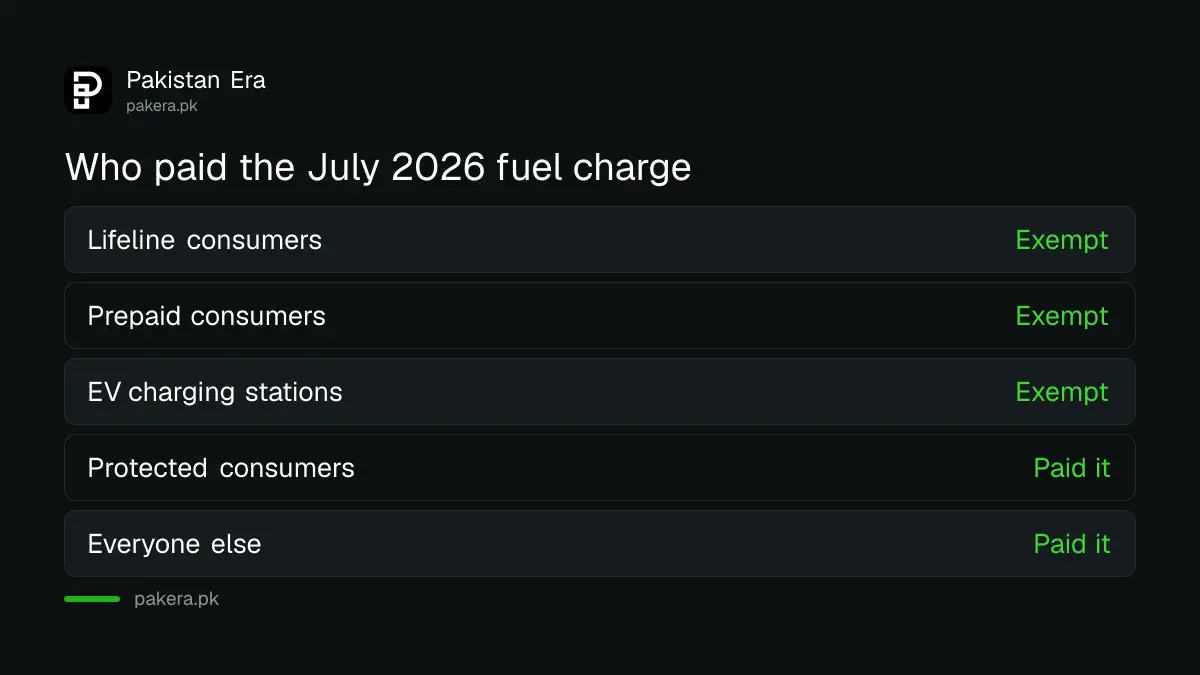
Lifeline is the separate category for the lowest-usage homes, shown as such on the bill. Protected is a different group: homes that used 200 units or less in each of the last six months. The two are often mixed up. Under the July decision, a protected home still paid the fuel charge; only lifeline homes were left out.
The six month rule for protected status may itself change. A proposal to end the six month penalty for crossing 200 units is under discussion, but it deals with base rates, not fuel charges. We will update this article if NEPRA's August decision changes the exemption list.
How to check the fuel line on your October bill
Find the line labelled FPA or fuel price adjustment. Multiply your August units by the rate NEPRA finally approves. If the two numbers match, the bill is right. If they do not, or a lifeline or prepaid bill shows the charge, it is a billing error.
You will need your August units, which are on your September bill. If you have lost the paper, you can check your electricity bill online and see past months there. The meaning of every other line, from the quarterly adjustment to the TV fee, is set out in what each electricity bill line means.
A wrong charge goes to your distribution company first. If it is not fixed, a complaint to NEPRA is the next step.
Common questions
Will electricity bills go up in October 2026?
Possibly. CPPA-G has asked for Rs 1.7267 a unit for August fuel costs. NEPRA hears the request on 29 September 2026 and can approve it in full, in part, or not at all.
Is the October fuel charge higher than September's?
No, if approved in full. September bills carry Rs 2.0581 a unit for July. The August request is Rs 1.7267, which is Rs 0.3314 a unit less.
Does the increase apply to K-Electric?
Yes. NEPRA's notice says that under federal policy on uniform fuel charges, the rate it sets for the distribution companies will also apply to K-Electric consumers.
Do protected consumers pay the fuel charge?
They did last time. NEPRA's July decision exempted only lifeline consumers, prepaid consumers and EV charging stations. The August exemptions will be in NEPRA's decision.
How much will 200 units cost extra?
About Rs 345 before tax at the full requested rate. That is our sum of 200 times Rs 1.7267, not an official figure.
Can I object to the increase?
Yes. NEPRA's notice invites all affected parties to raise written or oral objections at the hearing, in person at NEPRA Tower or on Zoom.
How we verified this
What we checked, where we read it, and what we could not confirm.
Last checked 25 September 2026 at about 14:50 PKT. We read NEPRA's advertisement "Hearing regarding Fuel Charges Adjustment for the month of August 2026 for Ex-WAPDA Distribution Companies", listed on NEPRA's news page on 19 September 2026. It gives the generation table, the requested increase of Rs 1.7267 a unit over the reference of Rs 7.0998, the application to K-Electric, and the hearing on 29 September 2026 at 2pm at NEPRA Tower and online. We also read CPPA-G's covering letter to NEPRA dated 15 September 2026 and its energy purchase data for August 2026, published on the same page. The exemption list is from NEPRA's decision on the July 2026 fuel charges adjustment dated 4 September 2026. The unit examples, the Rs 3.16 figure without deductions, and the RLNG share are our own arithmetic, exclude taxes, and assume the same units in both months. NEPRA had not decided this request when we checked.
About the author

Senior Writer, Public Services and Technology
Shahid joined us in 2024 as an author. He is a senior contributor to Pakistan's leading technology websites. He writes detailed articles, mostly covering his expertise in the latest tech, mobiles, apps, gadgets, and step-by-step guides. His ideology is to help people understand the latest trends and explain complex methods through very easy-to-understand guides.