Gestational Diabetes Test in Pakistan: WHO's OGTT Values for Pregnancy in mg/dl
WHO gestational diabetes values: fasting 92 to 125 mg/dl, 1 hour 180 or above, 2 hours 153 to 199 on a 75 g OGTT. One high value is enough. How the test works.
Short answer: Gestational diabetes is found with a 75 g glucose tolerance test (OGTT) during pregnancy. By World Health Organization (WHO) criteria, any one of these results means gestational diabetes: fasting 92 to 125 mg/dl, one hour 180 mg/dl or above, or two hours 153 to 199 mg/dl. Higher values, such as fasting 126 or above, mean diabetes in pregnancy.
WHO says gestational diabetes is found through screening at antenatal check-ups, not through symptoms. Most women with it feel completely well. That is why the test matters, and why the numbers are lower than the ones used outside pregnancy. Pakistani labs report in mg/dl, so the values below are given in mg/dl first, with WHO's mmol/L in brackets. Ask your doctor or lady health visitor about the test at your antenatal visit.
Gestational diabetes test values by WHO criteria
WHO uses a 75 g OGTT with three readings. Gestational diabetes is diagnosed if the fasting value is 92 to 125 mg/dl, the one hour value is 180 mg/dl or above, or the two hour value is 153 to 199 mg/dl. One abnormal value is enough.
| OGTT reading | Gestational diabetes | Diabetes in pregnancy |
|---|---|---|
| Fasting | 92 to 125 mg/dl (5.1 to 6.9 mmol/L) | 126 mg/dl (7.0 mmol/L) or above |
| 1 hour after 75 g glucose | 180 mg/dl (10.0 mmol/L) or above | No separate one hour value |
| 2 hours after 75 g glucose | 153 to 199 mg/dl (8.5 to 11.0 mmol/L) | 200 mg/dl (11.1 mmol/L) or above |
| Random, with symptoms | Not used | 200 mg/dl (11.1 mmol/L) or above |
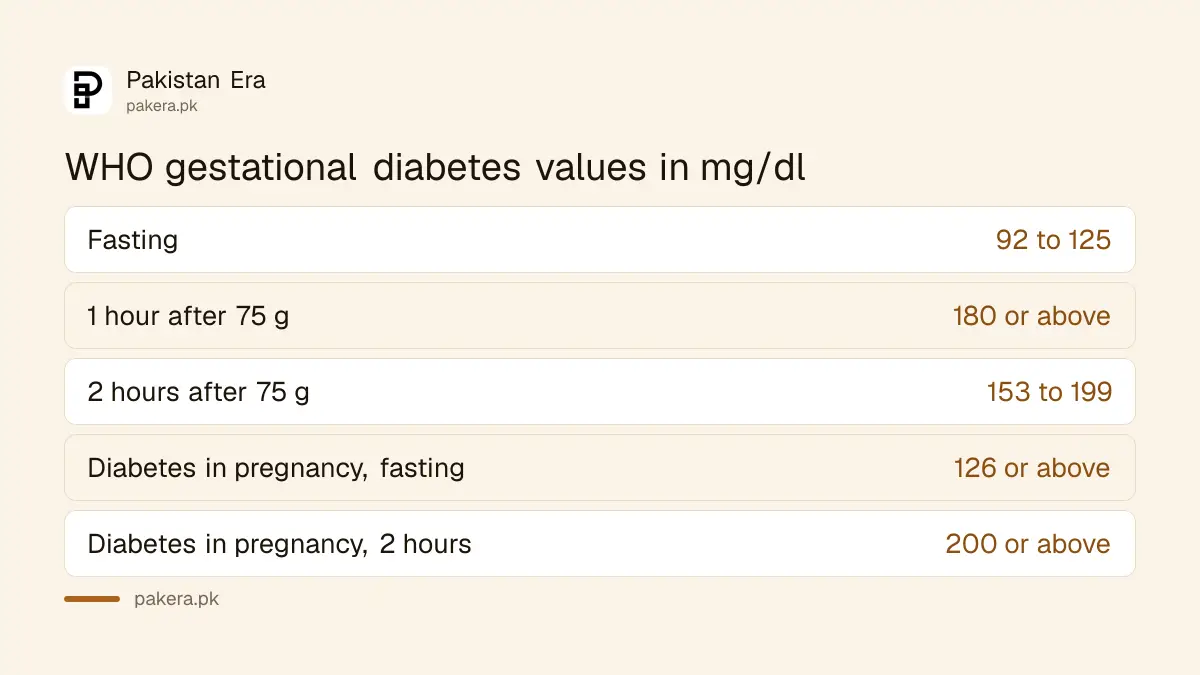
The mg/dl figures are WHO's mmol/L values multiplied by 18 and rounded, which is how Pakistani labs convert them. Your lab may print slightly different cut-offs, because some follow other guidelines. If your report shows a value near a line, ask the doctor which standard the lab used.
Gestational diabetes and diabetes in pregnancy are different
WHO splits high blood sugar first found in pregnancy into two groups. Gestational diabetes means sugar above normal but below the diabetes line. Diabetes in pregnancy means sugar high enough to meet the ordinary diabetes criteria, which often means type 2 diabetes that was there before.
The difference matters for care. Gestational diabetes often settles after delivery, though it needs close watching until then. Diabetes in pregnancy usually needs treatment that continues after the baby is born, and the woman stays under a doctor's care for diabetes for life.
WHO's 2019 classification says diabetes in pregnancy uses the same criteria as outside pregnancy: fasting 126 mg/dl or above, two hours 200 mg/dl or above, or a random 200 mg/dl or above with symptoms. Gestational diabetes uses the lower 2013 cut-offs in the table above.
How the OGTT is done in pregnancy
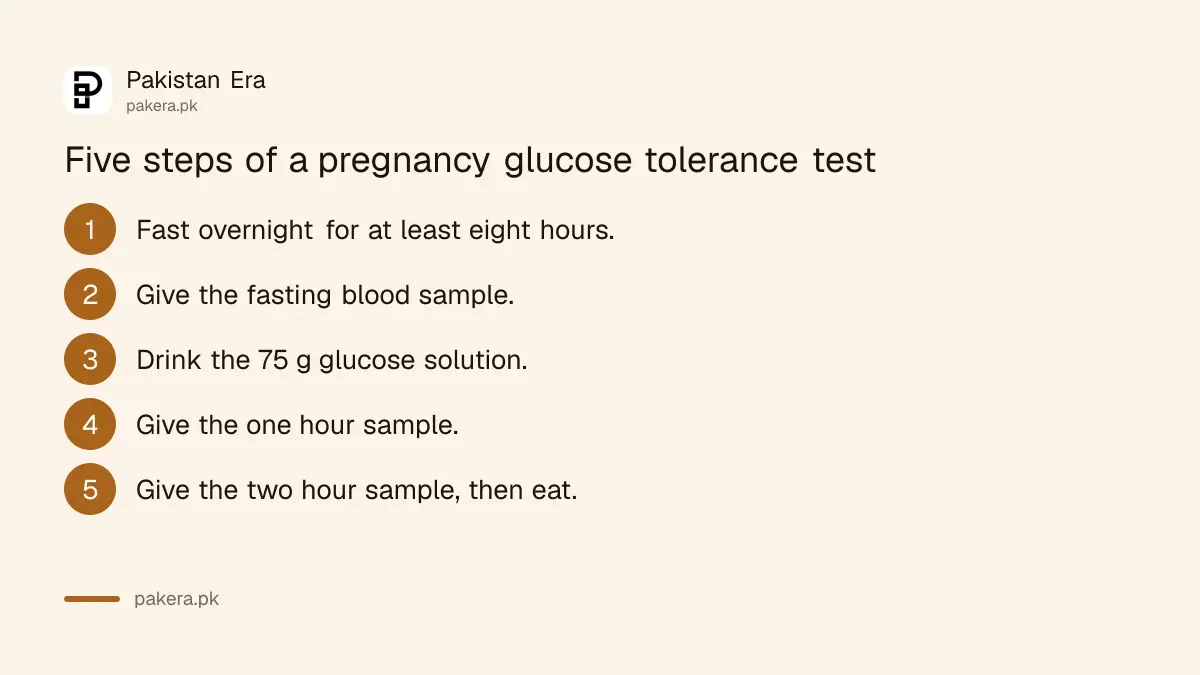
The test needs an overnight fast and three blood samples over two hours. You drink a 75 g glucose solution after the first sample, then give blood again at one hour and at two hours, staying at the lab and not eating in between.
- Fast overnight for at least eight hours. Water is allowed.
- Give the fasting blood sample at the lab in the morning.
- Drink the 75 g glucose solution the lab gives you.
- Give the second sample at one hour, staying seated at the lab.
- Give the third sample at two hours, then eat.
The glucose drink is very sweet and some women feel sick after it. Tell the lab staff if you vomit, because the test may need to be repeated on another day. Bring something to eat for after the last sample.
Gestational diabetes raises risks for mother and baby
WHO says women with gestational diabetes face a higher risk of complications in pregnancy and at delivery. It adds that these women, and possibly their children, are more likely to get type 2 diabetes later in life. Early testing gives time to control sugar.
WHO also lists earlier gestational diabetes as one of the factors that raise the risk of type 2 diabetes, alongside age, weight and unhealthy habits. It notes that South Asian populations have a higher occurrence of type 2 diabetes. For a woman in Pakistan, that makes the test more useful, not less.
After delivery, ask your doctor when to have your blood sugar checked again. Our guide to spotting type 2 diabetes early lists the signs to watch for in the years that follow.
What to do if your result is high
A high result is a reason to act, not to panic. Your doctor will usually start with diet changes and regular sugar checks, and add medicine if sugar stays high. Do not start or stop any medicine on your own, and keep every antenatal appointment.
Bring all your results to each visit. If you were given a home glucose meter, write down each reading with the date and time, and take the list to your doctor.
Free care for pregnant women is available at government hospitals and health centres. In Sindh, the Mamta programme pays mothers for keeping antenatal check-ups; see how to register for Sindh's Mamta programme. Families on BISP can also register for Benazir Nashonuma, which supports pregnant women with nutrition and stipends. For free diabetes clinics in Punjab, see free diabetes care in Punjab.
Common questions
What is a normal sugar level in pregnancy?
On a 75 g OGTT, WHO's lines mean a fasting value below 92 mg/dl, a one hour value below 180 and a two hour value below 153 mg/dl are below the gestational diabetes cut-offs.
Is one high reading enough to diagnose gestational diabetes?
Yes. WHO's 2013 criteria count gestational diabetes if any one of the three readings meets its cut-off.
Does gestational diabetes have symptoms?
Usually not. WHO says it is diagnosed through antenatal screening rather than reported symptoms.
Will gestational diabetes go away after delivery?
It often does, but WHO says these women are at higher risk of type 2 diabetes later. Ask your doctor when to test again after the birth.
Is fasting 95 mg/dl in pregnancy gestational diabetes?
By WHO criteria, a fasting value of 92 to 125 mg/dl counts as gestational diabetes, so 95 would. Your doctor confirms the diagnosis.
How we verified this
What we checked and where we read it.
Checked on 14 November 2026. Cut-offs are from the World Health Organization's Classification of Diabetes Mellitus 2019, which restates WHO's 2013 criteria for gestational diabetes and the diabetes criteria used in pregnancy. Risks and screening are from the WHO diabetes fact sheet. The mg/dl figures are our conversion of WHO's mmol/L values.
About the author

Public Services and Education Journalist
Fajr Riaz is a journalist and content writer at Pakistan Era, based in Lahore. She covers the questions people meet in everyday life in Pakistan: how a public service works, what a change in the rules means, and where to find a reliable answer.