Unpaid Wages in Punjab: When Your Case Goes to a Labour Court
When an employer in Punjab disputes unpaid wages or withholds them after a dismissal, the case moves to a Labour Court. The grievance step, courts and appeal.
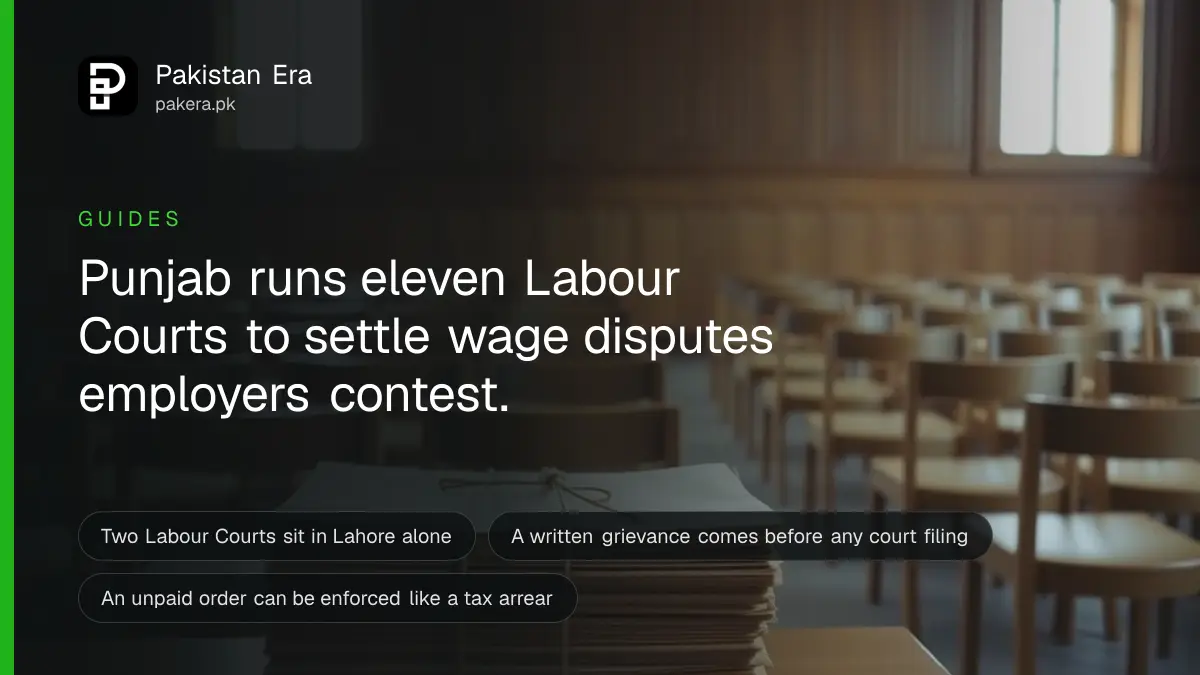
If your employer in Punjab disputes an unpaid wages claim, withholds wages tied to a dismissal, or ignores an order to pay, the case moves to a Punjab Labour Court under the Punjab Industrial Relations Act 2010. Start with a written grievance to your employer, then petition the Labour Court for your district if it is not resolved.
Most unpaid wage cases in Punjab never see a courtroom. A worker files with the Payment of Wages Authority, the employer pays, and that is the end of it. We cover that simpler route in full in our guide to claiming unpaid salary in Punjab. This article is for the harder case: the employer refuses to pay, disputes that anything is owed, or the wages are tangled up with a dismissal.
We read the Punjab Industrial Relations Act 2010 (Act XIX of 2010) through a 2025 amendment bill filed in the Provincial Assembly, and the Punjab Labour Department's own site, labour.punjab.gov.pk, on 4 October 2026. Where the Act's own grievance and limitation sections were not available to us in a form we could quote directly, we say so and mark the detail as reported rather than confirmed.
A dismissal changes which forum hears your wages claim
Simple non-payment while you are still employed goes to the Payment of Wages Authority. Once your job ends in a dispute, such as a dismissal you say was unfair, or wages the employer refuses to release after termination, the claim becomes an individual grievance under the Punjab Industrial Relations Act 2010 and can end up at a Labour Court instead.
The Act, cited officially as XIX of 2010, applies to every establishment and industry in Punjab and sets up Labour Courts to hear these disputes. It also sets up the separate Payment of Wages Authority machinery we cover elsewhere, so the two systems run side by side rather than replacing each other.
Write to your employer before you write to the court
A grievance case starts with you, not the court. Put your complaint about the unpaid or withheld wages to your employer in writing, state what you are owed and why, and give them a reasonable chance to reply. Keep a copy of your letter and of anything they send back.
We could not load the Act's own text closely enough to quote the exact number of days the law allows for this step or for filing afterwards, and different legal summaries of Punjab's industrial relations law give different figures, so we report this as a written-grievance-first process rather than naming a day count we cannot stand behind. Ask the Labour Court registrar for the current limitation period when you file.
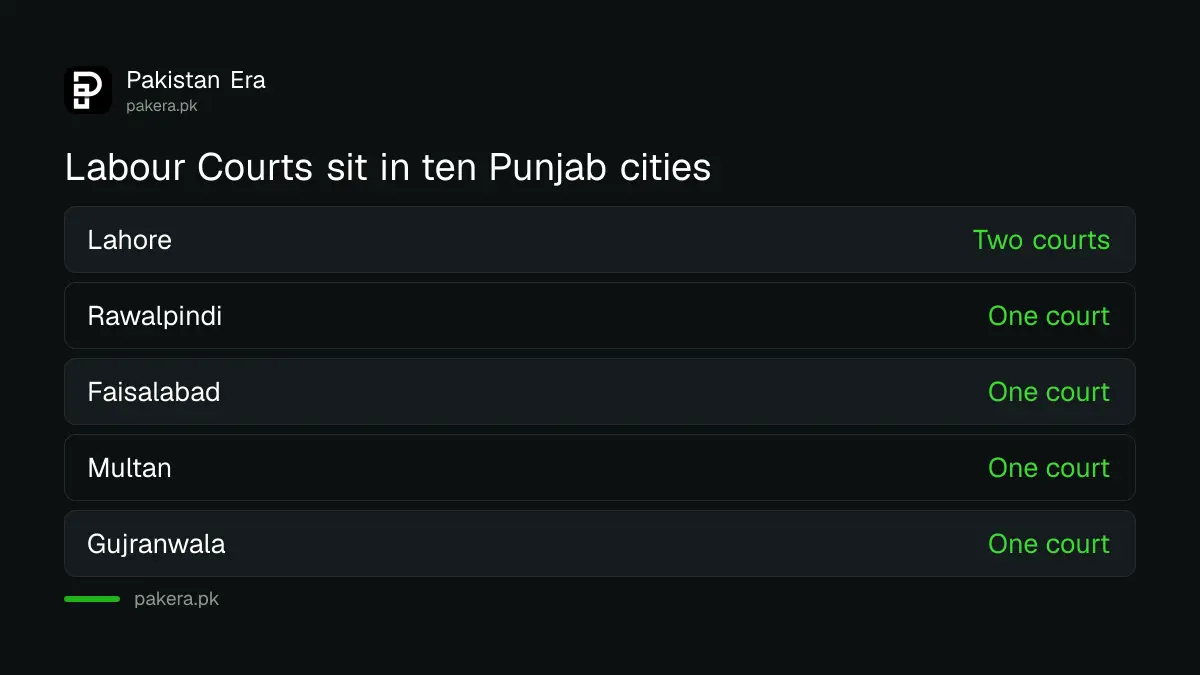
- Write to your employer stating the exact amount owed and the dates it covers.
- Keep a dated copy of your letter, by email or a receipt if posted.
- Wait for a written reply, and keep that too.
- If the employer refuses or stays silent, prepare a grievance petition.
- File the petition at the Labour Court covering your district.
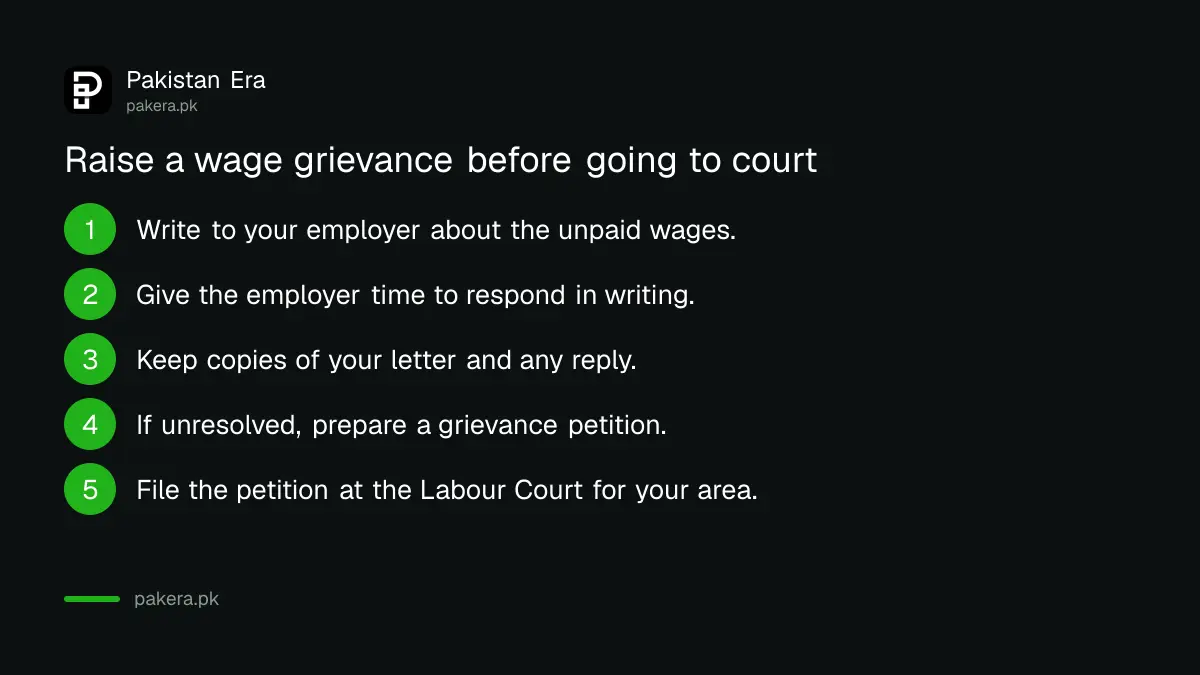
Punjab runs Labour Courts in ten cities, two of them in Lahore
Punjab's Labour Courts sit under the same Labour Department that runs the Payment of Wages Authority, specifically its Directorate General of Labour Welfare. Published case records point to eleven Labour Courts across the province: two in Lahore, and one each in Ferozewala in Sheikhupura district, Faisalabad, Sargodha, Rawalpindi, Gujranwala, Bahawalpur, Multan, Sahiwal and Dera Ghazi Khan. We read this list in a legal case database rather than on a Labour Department page naming current judges and addresses, so treat it as reported and confirm your own court's address with the Labour Department before you travel.
| City | Labour Courts, as reported |
|---|---|
| Lahore | Two |
| Rawalpindi | One |
| Faisalabad | One |
| Multan | One |
| Gujranwala | One |
The remaining courts sit in Ferozewala, Sargodha, Bahawalpur, Sahiwal and Dera Ghazi Khan, one each, by the same reported count. The Labour Department's head office is at 26-Main Gulberg, Lahore, on 042-99263671 or 042-99263672, which is the number to call if your own district's court address is unclear.
Compare the two routes before you choose one
Picking the wrong route costs time you may not have. The table below sets out when the simpler Payment of Wages Authority applies against when the dispute belongs at a Labour Court.
| Situation | Where it goes |
|---|---|
| Employer is late paying running wages | Payment of Wages Authority |
| Employer disputes the claim outright | Can move to a Labour Court |
| Wages withheld after a dismissal | Grievance, then Labour Court |
| Dispute involves a union or unfair treatment | Labour Court under the 2010 Act |
| An order is issued but ignored | Enforced through the issuing forum |
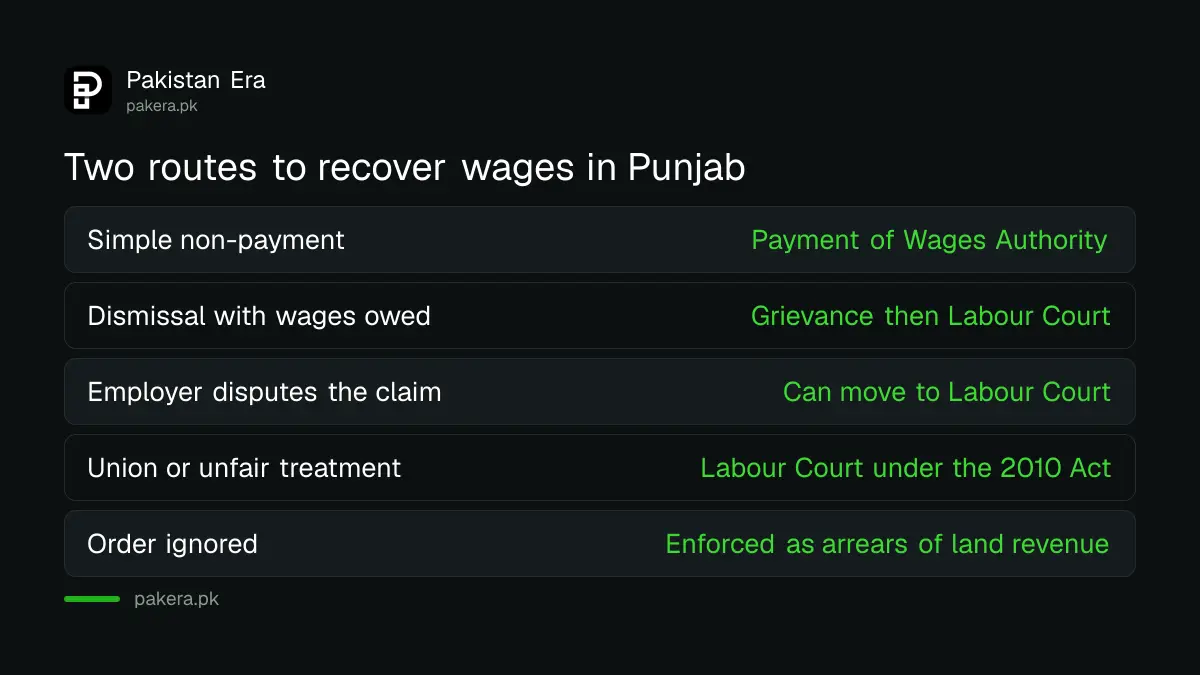
If you are not sure which box your case falls into, say so plainly when you first write to the Labour Department or a Labour Court registrar. Describing what actually happened, rather than guessing at the legal label, is what gets a case sent to the right forum the first time.
A Labour Court order against your employer can still be appealed
Once a Labour Court decides a grievance, either side can take the dispute further. Pakistan's provincial industrial relations laws, of which the Punjab Act is one, generally route an appeal from a Labour Court to a Labour Appellate Tribunal, and from there a further appeal can reach the High Court on a point of law. We were not able to confirm the exact appeal window in days from the Act's own text on this check, so ask the court registrar for the current deadline when you collect your order.
- Get a certified copy of the Labour Court's order.
- Ask the registrar for the current appeal window.
- File the appeal at the Labour Appellate Tribunal.
- Attend the hearing with your documents and the original order.
- A further appeal on a point of law can go to the High Court.
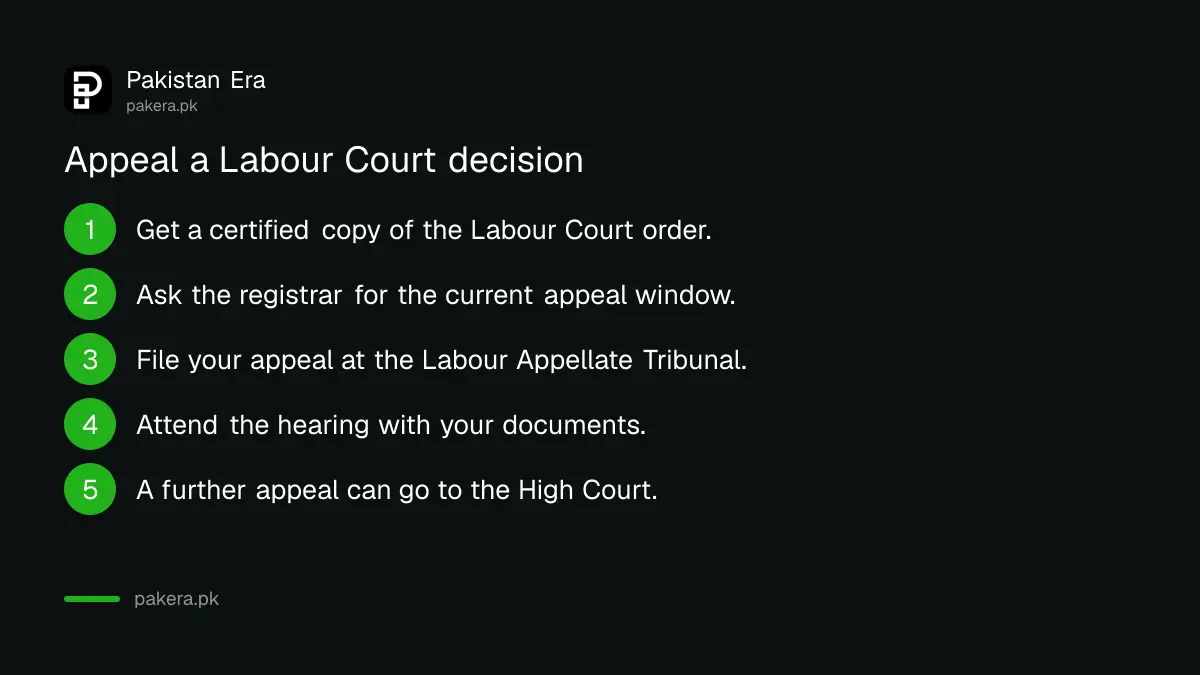
An order that an employer simply ignores is not the end of the matter either. The Payment of Wages Authority side of Punjab's labour law lets an unpaid order be recovered as an arrear of land revenue, which is a different enforcement path from an appeal, and is worth asking about if your employer has gone quiet rather than contesting the case.
Get help before you file, the paperwork is unforgiving
A grievance petition is a formal document, not a letter of complaint, and a court will not fix it for you if it is filed wrong or filed late. Punjab runs a free legal aid service for people who cannot afford a lawyer, and it is worth calling before you draft anything yourself.
Bring everything from day one: your appointment letter, pay slips showing whether you were paid at least the current minimum wage, the termination letter if you were dismissed, your written grievance to the employer and any reply, and a clear note of the exact amount you say is owed and for which months. A Labour Court that can see the whole paper trail moves faster than one piecing it together from memory.
Common questions
Do I have to write to my employer before going to court?
Yes. A grievance case starts with a written complaint to your employer. Only once that gets no result, or is refused, should you prepare a petition for the Labour Court.
Which court hears my case if I work in Lahore?
Punjab's reported count gives Lahore two Labour Courts. Confirm the exact one covering your workplace with the Labour Department before filing.
Is this the same as the Payment of Wages Authority?
No. The Payment of Wages Authority handles straightforward non-payment of running wages. The Labour Court under the Punjab Industrial Relations Act 2010 handles disputes the employer contests, or wages tied to a dismissal.
Can I appeal if I lose at the Labour Court?
Generally yes, to a Labour Appellate Tribunal, with a further appeal on a point of law possible at the High Court. Confirm the current appeal deadline with the court registrar, since we could not verify the exact number of days.
What if my employer ignores the court's order?
Ask the issuing forum about enforcement. Orders under the Payment of Wages Authority machinery can be recovered as an arrear of land revenue, which is a government debt collection method rather than a fresh lawsuit.
How we verified this
What we checked, where we read it, and what we could not confirm.
Last checked on 4 October 2026. The citation Punjab Industrial Relations Act 2010, Act XIX of 2010, and its application to every establishment in Punjab are read from a 2025 amendment bill filed at the Provincial Assembly of the Punjab and from a law firm's published summary of the Act. The Labour Department's structure, including Labour Court administration under the Directorate General of Labour Welfare, and the head office address and phone numbers, are read on labour.punjab.gov.pk. The count and location of eleven Labour Courts across Punjab came from a legal case law directory rather than a Labour Department page we could load directly, so we report it rather than confirm it as current. The exact grievance timeline, limitation period and appeal window inside the 2010 Act were not available to us in quotable form on this check, despite repeated attempts at punjablaws.punjab.gov.pk and other sources, so the article tells readers to confirm these with the court registrar rather than stating a figure we have not read at the source. The enforcement of unpaid orders as arrears of land revenue is read in our own reporting on the Payment of Wages Authority, linked above. No press or news outlets were used as sources.
About the author

Tax, Bills and Technology Writer
Ali Akhtar is a young and curious voice here at Pakistan Era. He is currently pursuing his A-Levels and has a growing interest in Pakistan’s changing industrial landscape and educational trends. Ali likes to write in a way that helps him explain and explore the world around him. His writing reflects the perspective of the new generation navigating the evolving trends of Pakistan where technology, youth innovation, and shifting opportunities are reshaping the country’s future.