How to Claim Unpaid Salary From Your Employer in Punjab
Employer in Punjab not paying your salary? File with the Payment of Wages Authority within 3 years. The due dates, proof to collect, steps and compensation.
If your employer in Punjab has not paid your salary, you can file a claim with the Payment of Wages Authority in your district. You have three years from the date the salary was due. The Authority can order the employer to pay, and add compensation on top.
A late salary is common. Two or three months of no salary, with promises every Friday, is a legal problem, and Punjab law treats it as one. The claim does not go to a civil court. It goes to a labour officer who has the powers of a court.
We read the Punjab Labour Code 2026, the Payment of Wages Act 1936 and the Standing Orders Ordinance 1968 on the Punjab Code, the provincial government's statute website, on 1 October 2026. The steps below work under both the new Code and the older laws.
When your salary counts as unpaid in Punjab
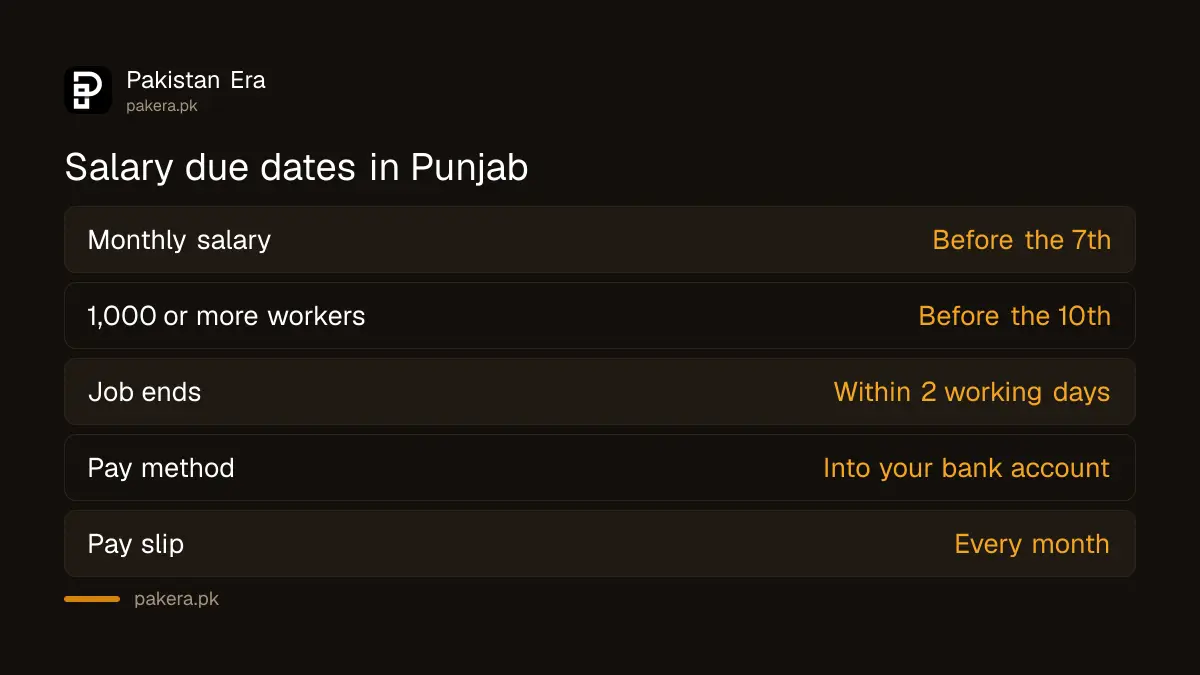
A monthly salary must be paid before the seventh day of the next month. When a job ends, all wages and dues must be paid within two working days. A salary paid after those dates is delayed, and you can claim for the delay.
Both laws agree on these dates. Section 165 of the Labour Code says monthly pay is due "before the expiry of the seventh day of the succeeding month", and no wage period can be longer than one month. Section 5 of the 1936 Act gives the same seventh day for workplaces with fewer than 1,000 workers, and the tenth day for larger ones.
| Situation | Pay is due by | Law we read |
|---|---|---|
| Monthly salary | Before the 7th day of the next month | Labour Code s.165, Payment of Wages Act s.5 |
| Monthly salary, 1,000 or more workers | Before the 10th day (old Act only) | Payment of Wages Act s.5 |
| Job ends, for any reason | Within 2 working days | Labour Code s.165, Standing Order 12(4) |
| Unpaid leave at the end of a job | Within 2 working days | Standing Order 12(4) |
The Labour Code also says all pay must go into your bank account, and that you must get an itemised pay slip every month. Both help you later. A bank statement with a missing salary credit is strong evidence. If your employer pays below the legal floor, the Punjab minimum wage of Rs 40,000 has its own claim route.
Who decides an unpaid salary claim
The Payment of Wages Authority hears these claims. It is a labour officer named by the Punjab government for your area, with the powers of a civil court. It can order payment and recover the money like land revenue.
Under section 293 of the Labour Code, the Authority is an Employees' Compensation Commissioner or an officer of at least grade 17 in the Directorate General of Labour Welfare. Under section 15 of the 1936 Act, it is a Commissioner for Workmen's Compensation or an officer with experience as a civil judge or magistrate. In practice, ask at your district labour office which officer is the Authority for your area.
The Authority does not only hear missing salary. Section 293 lists underpayment, illegal deductions, unpaid overtime, leave encashment, notice pay, bonus, travel allowance, and provident fund or gratuity dues. So one claim can cover everything you are owed. If your employer also held back gratuity and provident fund, put them in the same claim.
How to file an unpaid salary claim, step by step
Collect proof of your job and the missing pay, ask the employer in writing, then file an application with the Payment of Wages Authority. A lawyer, a registered union official or a labour inspector can file it for you.
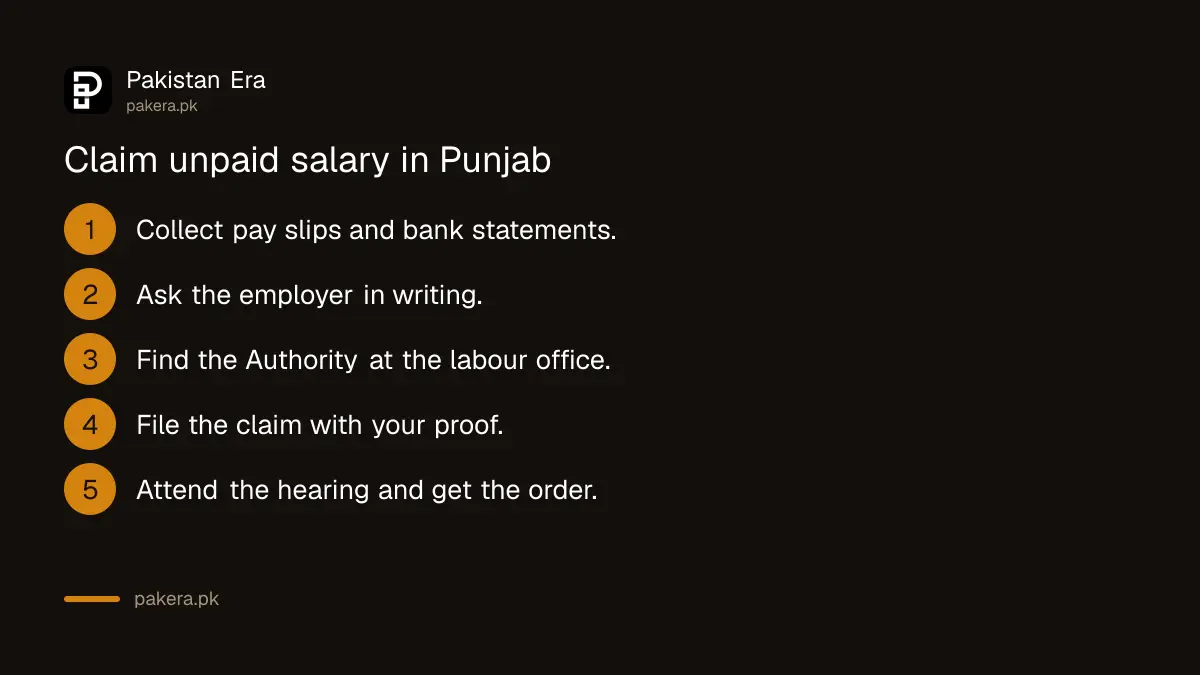
- Collect your proof. Appointment letter, office ID card, old pay slips, and bank statements showing when salary stopped.
- Ask in writing. Send a short letter or email listing the months unpaid and the amount. Keep proof that you sent it.
- Find the Authority. Visit your district labour office, or use the Labour Department's online complaint form, and ask which officer is the Payment of Wages Authority for your area.
- File the application. State your name, the employer's name and address, your post, your monthly salary, the months unpaid and the total. Attach copies of your proof.
- Attend the hearing. The Authority hears you and the employer, and can call witnesses and documents.
- Get the order enforced. If the employer does not pay after the order, the Authority can recover the amount as an arrear of land revenue.
If many workers at one place are unpaid for the same month, the 1936 Act allows one application for the whole group.
Time limit and compensation for an unpaid salary claim
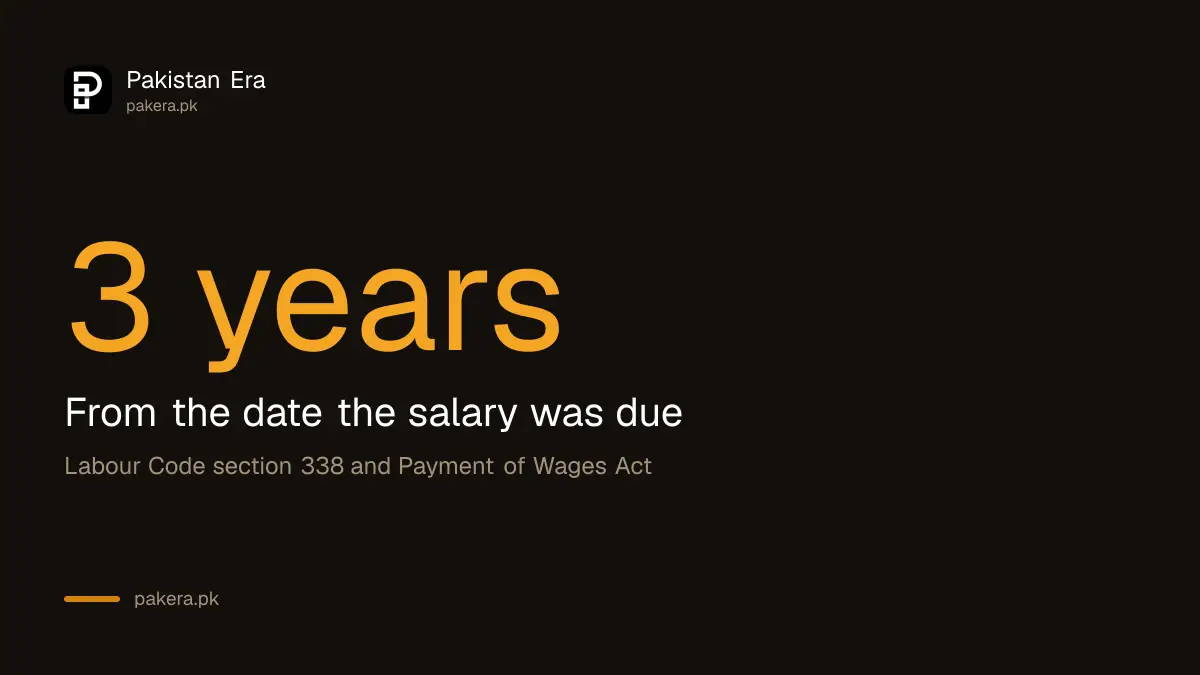
You must file within three years of the date the salary was due. A late claim can still be heard if you show a good reason. On top of the salary, the Authority can order compensation of up to three times the delayed amount.
The three years and the late filing rule are in section 338 of the Labour Code. The 1936 Act, as amended, also uses three years. The compensation differs between the two laws, so check which one your case is under.
| Point | Punjab Labour Code 2026 | Payment of Wages Act 1936 |
|---|---|---|
| Time to file | 3 years | 3 years |
| Compensation for an illegal deduction | Up to 10 times the deduction | Up to 10 times the deduction |
| Compensation for delayed salary | Up to 3 times the delayed amount | Up to Rs 1,000 |
No compensation is ordered if the delay came from a genuine dispute about the amount, or from an emergency that stopped the employer paying. A claim the Authority finds malicious can also go against the worker, so claim only what your records show.
That assumes the employer simply hasn't paid. If the employer disputes you are owed anything, or the unpaid wages are tangled up with a dismissal the employer is defending, the matter can end up before a labour court instead of the Payment of Wages Authority.
Which law applies, and your right to stop work
The Labour Code was published on 10 February 2026 but starts on a date the government notifies. Reports differ on whether that has happened. If the Code applies, it adds a strong new right: you may stop work while salary stays unpaid.
Section 1(3) of the Code ties its start to a notification in the Gazette. Press reports in May 2026 said it was in force. We could not find that notification on the Punjab Code or the Labour Department's website, and the 1936 Act is still listed there as current law.
Section 153 of the Code works like this. If pay is more than 14 days late, you can apply to the Authority or tell a labour inspector. If the pay is still unpaid 14 days after that, you may stop work until you are paid. The employer cannot sack you for stopping, and your service continues. Before you stop work, get the Code's status confirmed at your district labour office in writing. The wider rules when a job in Pakistan ends apply if the employer lets you go instead.
When the job ends you are also owed a service record; see how to get an experience certificate in Punjab.
Common questions
My employer has not paid salary for three months. What do I do first?
Write to the employer listing the months and the amount, keep proof, and then file a claim with the Payment of Wages Authority through your district labour office.
How long do I have to claim unpaid salary in Punjab?
Three years from the date the salary was due. The Authority can accept a later claim if you had a sufficient reason for the delay.
Do I need a lawyer?
No. You can apply yourself. A lawyer, a registered union official or a labour inspector can also file it for you.
Can I claim my final salary after I resign?
Yes. When a job ends for any reason, wages and dues are due within two working days. Claim them like any other unpaid salary.
Where is the Labour Department's office in Lahore?
The Labour and Human Resource Department lists 26-Main Gulberg, Lahore, with phones 042-99263671 and 042-99263672 and the email info@punjablabour.gov.pk.
How we verified this
What we checked, where we read it, and what we could not confirm.
Last checked 1 October 2026. We read the Punjab Labour Code 2026 for sections 1, 153, 165, 293 and 338, and the Payment of Wages Act 1936 for sections 5, 15 and 16, both on the Punjab Code. We read Standing Order 12(4) of the 1968 Ordinance there too. We also read the Labour Department's complaint form and contact details. We could not find the Code's commencement notification on any Punjab government site, and reports on its status differ. The Labour Department does not publish a list of Payment of Wages Authorities by district that we could find, so ask your district labour office. This is general information, not legal advice.
About the author

Public Services and Education Journalist
Fajr Riaz is a journalist and content writer at Pakistan Era, based in Lahore. She covers the questions people meet in everyday life in Pakistan: how a public service works, what a change in the rules means, and where to find a reliable answer.