How to Register as an Exporter in Pakistan: WeBOC and TDAP
WeBOC alone does not make you an exporter. See the NTN, sales tax, WeBOC and TDAP steps FBR and TDAP actually require, in the right order, with documents.
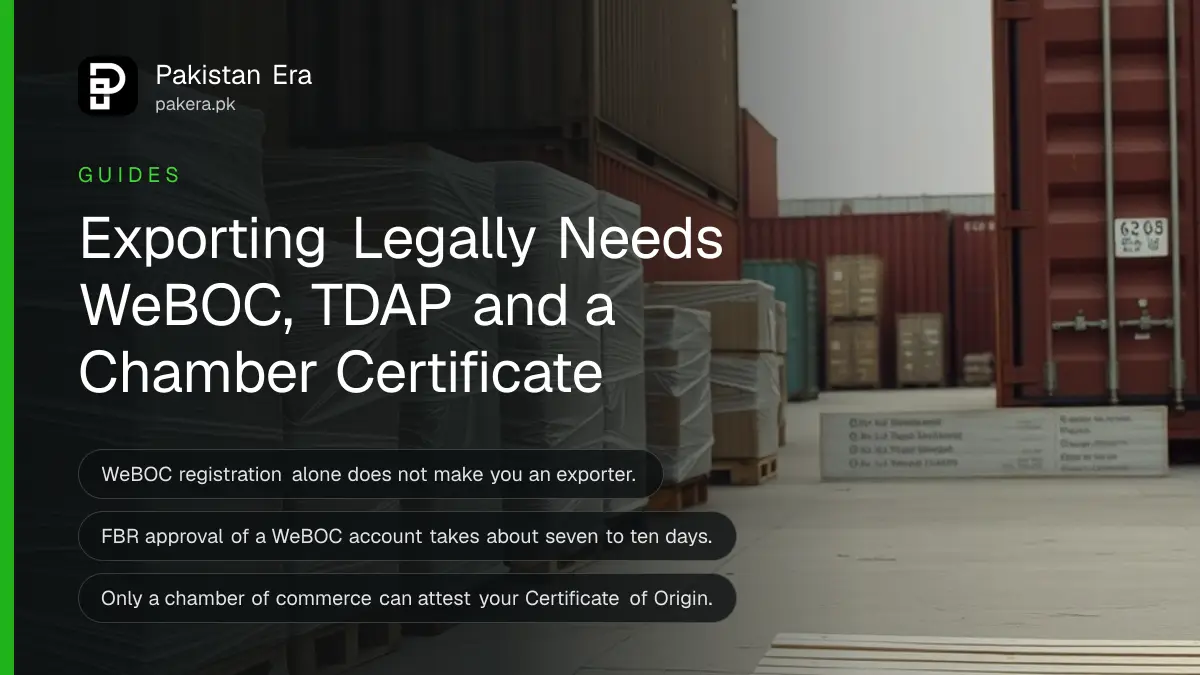
WeBOC registration alone does not make you a legal exporter in Pakistan. It is one of at least three separate registrations, with FBR, a chamber of commerce and TDAP, and missing any one of them stalls your first shipment.
Update, 11 October 2026: Traders can compare WeBOC and PSW for filing a goods declaration.
Update, 11 October 2026: FBR has drafted duty-free import of live animals for fattening and export as meat.
New exporters usually start by googling WeBOC, open an account, and then discover at the port that a Certificate of Origin needs a chamber's stamp that WeBOC has nothing to do with.
We read FBR's own customs registration page and researched TDAP's published guidance on 5 October 2026 to lay the actual sequence out in order.
Exporting runs through three separate bodies, not one
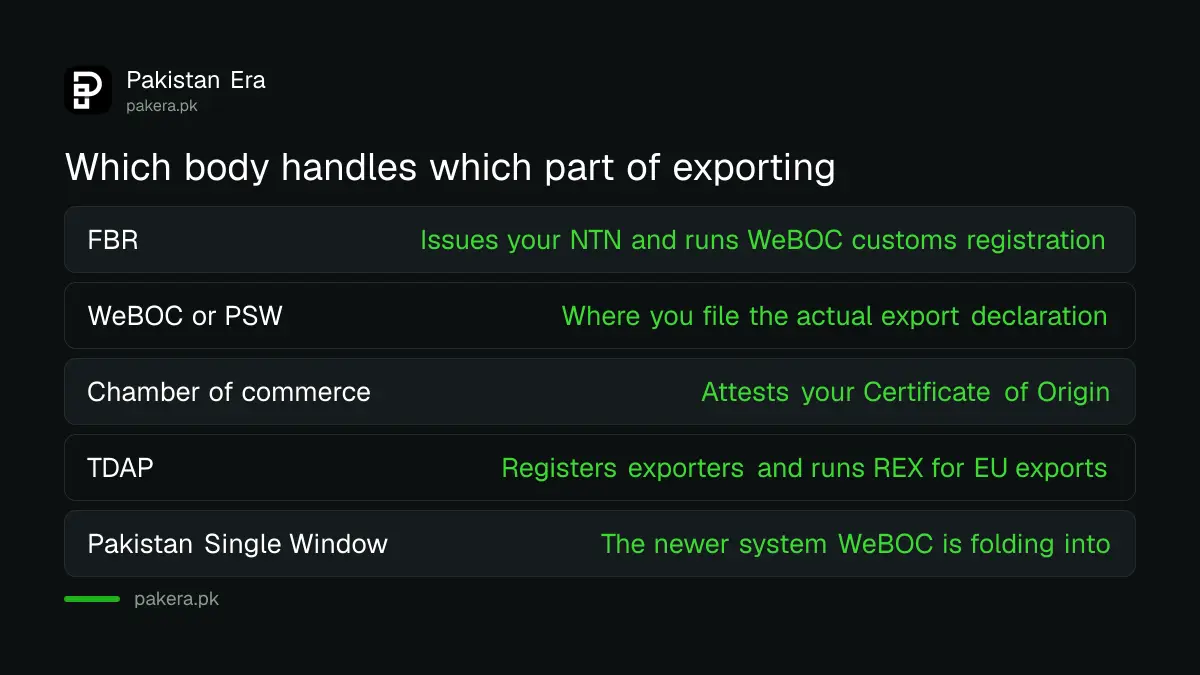
Each body does a distinct job, and none of them covers what the others do.
| Body | What it handles |
|---|---|
| FBR | NTN, sales tax registration and WeBOC customs access |
| Chamber of commerce | Membership and attesting your Certificate of Origin |
| TDAP | Exporter registration and the REX scheme for EU preference |
| Pakistan Single Window | The system WeBOC is gradually folding into |
Skip the chamber step and you can hold a working WeBOC login and still be unable to ship, because customs at the other end wants a Certificate of Origin nobody authorised you to issue.
Start with FBR, since everything else needs your NTN
You need a National Tax Number and sales tax registration before WeBOC will take you seriously, because the WeBOC external user registration form itself asks for your NTN and STRN alongside your business name, address and bank account details.
If your business is not yet incorporated, our guide to registering a private limited company with SECP covers that first step, and our guide to FBR sales tax registration covers the documents FBR asks for. A manufacturing unit may also need the local council trade license before any of this, depending on where it operates.
WeBOC registration itself has a real, in-person step
FBR's own registration page sets out a sequence that is not purely online. You submit your application with supporting documents to the Deputy or Assistant Collector covering your jurisdiction, then appear in person with your original CNIC for verification.
- Submit your WeBOC external user registration form with supporting documents.
- Appear in person with your original CNIC for verification.
- Have your digital photograph and fingerprints captured.
- Expect a site inspection of your business premises in some cases.
- Receive your User ID and login by automated email once approved.
That personal appearance and the possible site inspection are the two steps people skip over when they describe WeBOC as "just an online form." Budget about a week to ten days for the approval to come through rather than expecting same-day access.
A chamber of commerce does something WeBOC cannot
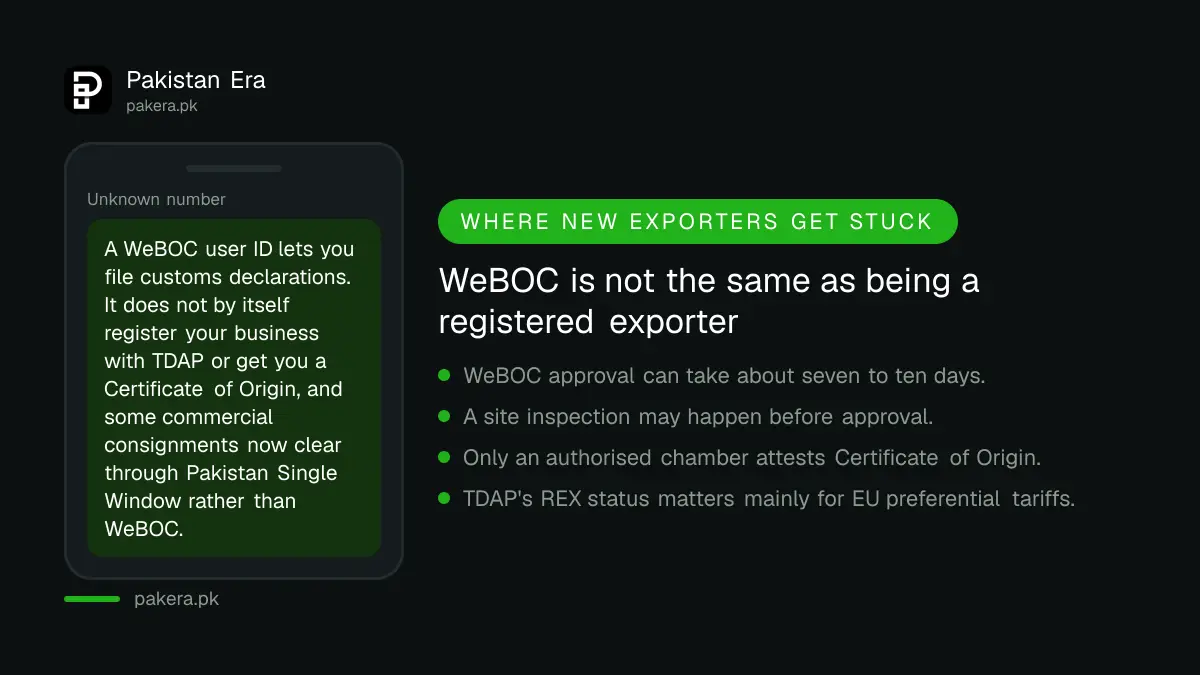
Customs authorities abroad generally require a Certificate of Origin to apply preferential tariffs or to confirm where goods actually came from. Only an authorised chamber of commerce can attest that certificate, and WeBOC has no role in it at all.
So join the chamber that covers your sector or your city as part of setting up, not as an afterthought once a buyer's bank asks for the certificate and your shipment is already sitting at the port.
TDAP registration opens incentives WeBOC does not touch
The Trade Development Authority of Pakistan runs a separate registration that gives your business a unique exporter number and access to trade facilitation support, market access programmes and participation in government-led trade delegations.
TDAP also runs the Registered Exporter System, known as REX, which matters specifically if you are exporting to the European Union under its GSP Plus scheme. REX status lets you self-certify the origin of your goods for preferential tariff access, instead of relying on a separate certificate for every shipment to that market.
WeBOC is not the last system you will need to learn
Pakistan Customs has been moving trade declarations toward the Pakistan Single Window, which goes further than WeBOC by linking customs with other regulatory bodies, ports and banks in one system. Both systems can currently take a declaration where no extra regulatory approval is needed, but PSW's own declaration becomes mandatory wherever a regulatory requirement applies, and clearance for a wide range of commercial goods has already shifted to PSW at some dry ports.
A new exporter registering today should not assume WeBOC is the permanent, final interface, and should expect PSW's own registration and filing screens to matter within the life of the business.
Common questions
Does WeBOC registration alone let me export legally?
No. WeBOC gives you customs filing access. You also need a chamber of commerce membership for your Certificate of Origin and, in most cases, TDAP registration.
What do I need before I can register for WeBOC?
A National Tax Number and sales tax registration from FBR, since the WeBOC external user form itself asks for both.
How long does WeBOC approval take?
Based on FBR's own published sequence, expect roughly seven to ten days, including an in-person CNIC verification and a possible site inspection.
Why do I need a chamber of commerce?
Only an authorised chamber can attest a Certificate of Origin, which many destination customs authorities require before they apply preferential tariffs.
What does TDAP's REX status actually do?
It lets a registered exporter self-certify the origin of goods for preferential tariff access into the European Union under the GSP Plus scheme.
Is WeBOC being replaced?
It is gradually folding into the Pakistan Single Window, which is already mandatory for declarations involving certain regulatory requirements.
How we verified this
What we checked, where we read it, and what we could not confirm.
Last checked 5 October 2026. We read FBR's own customs registration page at fbr.gov.pk, confirming the WeBOC external user registration sequence, the documents and NTN or STRN requirement, the in-person CNIC verification, biometric capture, possible site inspection, and automated credential delivery on approval. TDAP's registration role and its Registered Exporter System for EU GSP Plus preference were confirmed through research summarising TDAP's own published step-by-step guide and REX Operational Guide, though we could not extract the exact text of those PDFs directly, so no specific TDAP fee is stated as fact. The chamber of commerce's role in attesting a Certificate of Origin is drawn from secondary trade-advisory sources rather than a chamber's own tariff page, so no membership fee is quoted. The transition from WeBOC toward Pakistan Single Window is drawn from research describing PSW's own published material on the current dual-system arrangement. Nothing on this page is legal or customs advice, and a licensed customs clearing agent should be consulted for an actual shipment.
About the author

Senior Writer, Public Services and Technology
Shahid joined us in 2024 as an author. He is a senior contributor to Pakistan's leading technology websites. He writes detailed articles, mostly covering his expertise in the latest tech, mobiles, apps, gadgets, and step-by-step guides. His ideology is to help people understand the latest trends and explain complex methods through very easy-to-understand guides.