FBR Drafts Duty-Free Import of Live Animals for Fattening and Export as Meat
FBR's draft S.R.O. 1752 would let feedlots and meat exporters import live cattle, sheep and goats duty-free for fattening. See the two tracks and who can apply.
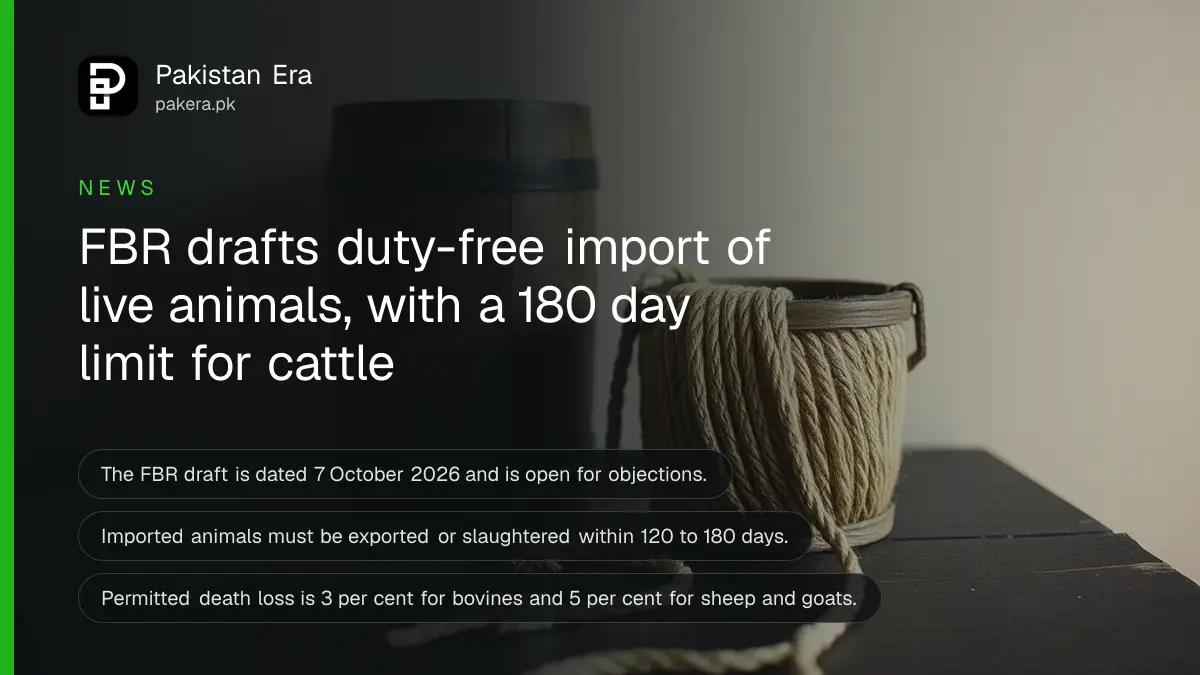
Short answer: The Federal Board of Revenue (FBR) has published a draft in S.R.O. 1752(I)/2026, dated 7 October 2026, that would let approved feedlots and meat exporters import live cattle, sheep and goats without customs duty or sales tax, fatten them, and export them live or as meat. It is a draft. People affected may send objections within seven days of its Gazette publication.
We read the full notification on the FBR website. It adds a new Sub-Chapter II to Chapter XL of the Customs Rules, 2001, which today covers the Export Facilitation Scheme (EFS). This piece explains who can use it, what the two tracks mean and which limits apply.
The draft adds two tracks for imported live animals
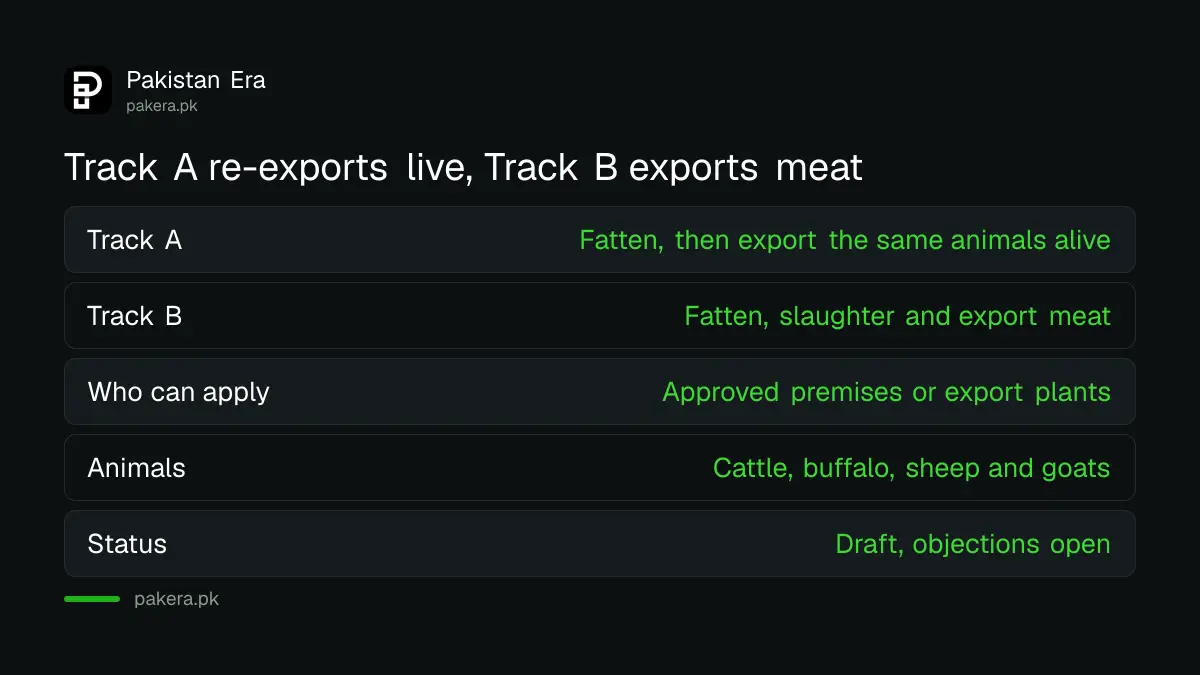
Track A is for fattening imported animals and re-exporting the same animals alive. Track B is for fattening, slaughtering, processing and exporting meat and meat products. Both tracks sit inside the existing export facilitation scheme, so the animals are treated as input goods.
The draft covers live bovine animals (cattle and buffalo) and live sheep and goats. Pure-bred breeding animals are left out. It also does not apply to animals born in Pakistan.
| Point | Track A | Track B |
|---|---|---|
| What happens | Fatten imported animals, export them live | Fatten, slaughter, process, export meat |
| Who runs it | Operator of approved premises | Registered export establishment |
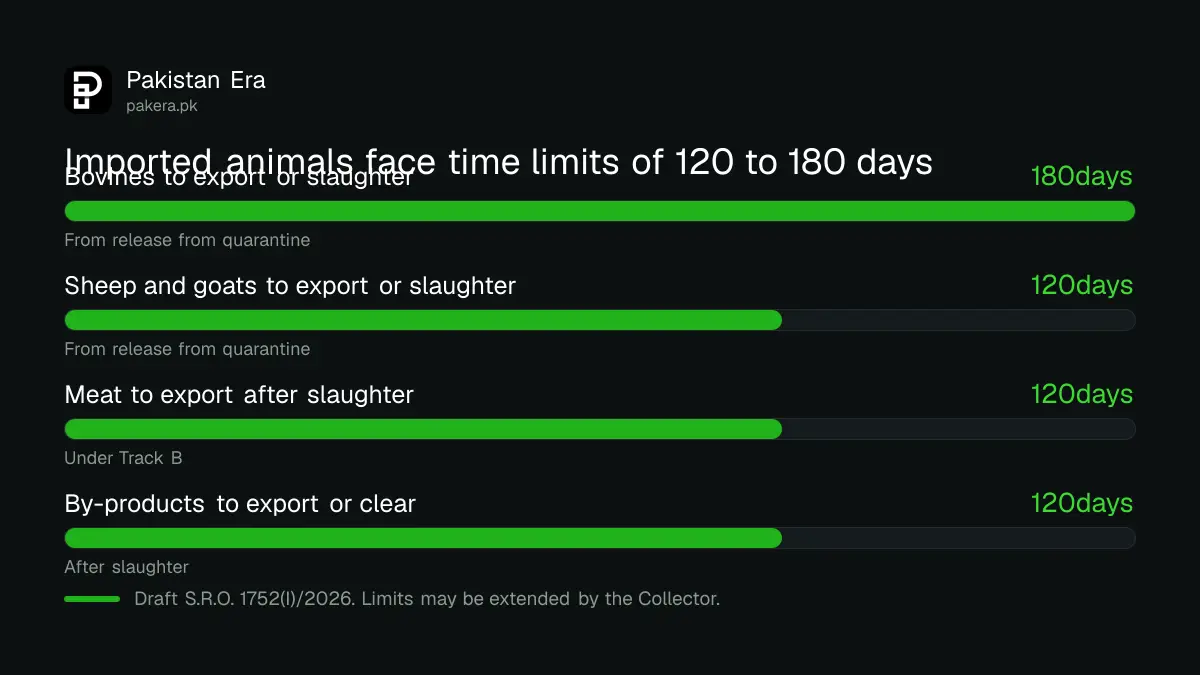
| Time limit | 180 days for bovines, 120 days for sheep and goats | Same time to slaughter, then 120 days to export the meat |
| Starts | On a date the FBR notifies later, species by species | On the date of the final notification |
Imports would be free of duty but guarded by security
The draft exempts imported animals from customs duty, additional customs duty, regulatory duty, sales tax, federal excise duty and withholding tax under section 148. The tax is not forgiven for good. It is recorded as a deferred liability against the importer's security.
The user must hold a bond, a bank guarantee or an insurance guarantee for the duty and taxes on the approved quantity. Animals must also be insured against death, with the Collector of Customs named as loss payee to the extent of the deferred tax.
Fattening inputs such as feed, premixes, vaccines and medicines can also come in without duty, but only for use on the imported animals. If inputs are not used within eighteen months of purchase, or are used on other animals, duty and taxes become payable with surcharge.
Who can apply and how long the Collector has
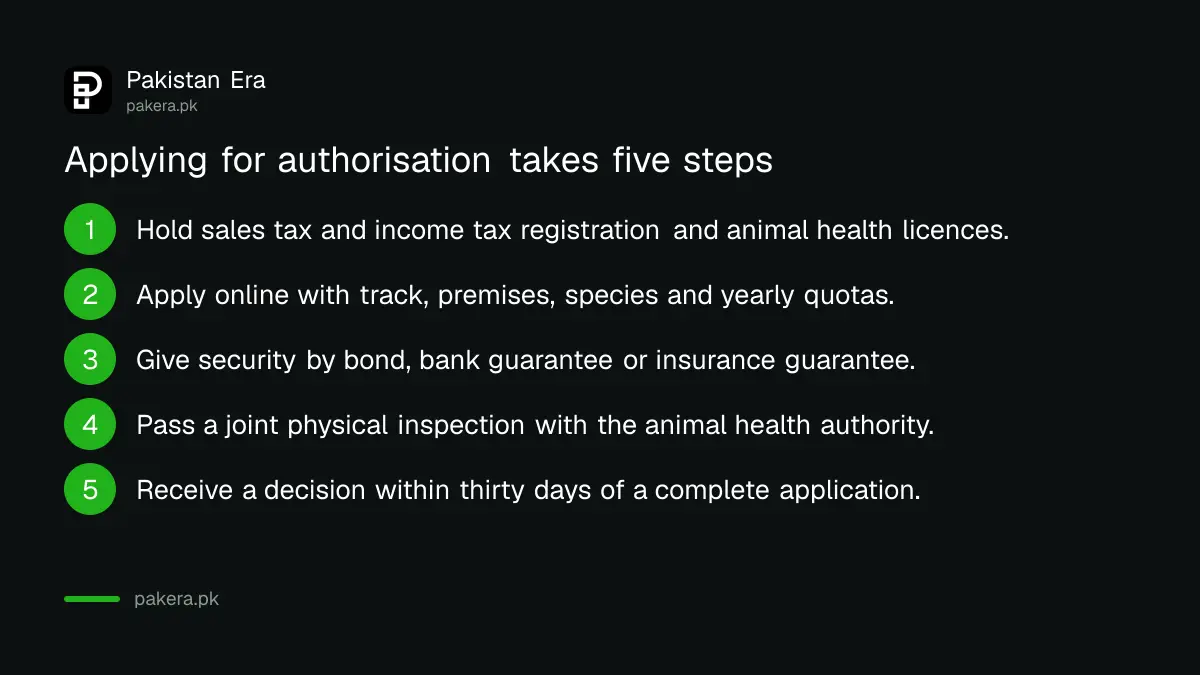
A person with sales tax registration and income tax registration, who runs approved premises or a registered export establishment, can apply online to the Regulatory Collector. The Collector must decide within thirty days of a complete application and record reasons for any refusal.
- Hold sales tax and income tax registration, and the licences of the animal health authority and the province.
- Apply online with the track, premises, species, yearly animal quota and yearly input quantities.
- Give security: an indemnity bond for Category A users, a bond with a post-dated cheque for Category B1, or a bank or insurance guarantee for others.
- Pass a physical inspection done jointly with the animal health authority.
- Receive the authorisation within thirty days, kept as a separate account in WeBOC or the Pakistan Single Window (PSW).
New feedlots and plants can apply for a project authorisation. They get 24 months to commission, extendable by up to 12 months, and must export at least 80 per cent of production in their first full financial year. The registration steps are the same ones exporters already follow in WeBOC export registration.
Strict tracking applies to every animal
Each animal must carry a unique identifier, applied before shipment and listed in the import permit. It is entered in a traceability register as a foreign-origin animal and read again at the port of exit or at slaughter. An animal that does not match the register cannot be exported under the scheme.
Imported animals must be kept apart from local animals, and they cannot be sold, bred or used for dairy or draught work. Weights must be recorded at least every thirty days.
The draft allows some losses. Certified deaths up to three per cent of imported bovines, and five per cent of sheep and goats, in a financial year are permitted. Above that, duty and taxes become payable unless the loss comes from a disease outbreak or a calamity. Up to ten per cent of imported heads can be cleared for local sale if duty and taxes are paid at that time.
The draft does not override animal health or export policy
The draft says it does not relax any rule of the Import Policy Order, the Export Policy Order, animal quarantine, traceability or food safety law, or any provincial livestock law. Re-export of live animals only starts once the Export Policy Order allows export of foreign-origin animals of that species.
So the tax relief and the policy permission are separate. A feedlot would need both. The FBR also says it will issue a customs general order for forms, ports, feed and yield norms and system functions, so details remain to be set. Importers already planning shipments should compare this with the bank and price checks on the PSW portal.
Common questions
Is the livestock import scheme in force yet?
No. S.R.O. 1752(I)/2026 is a draft published for objections, and the FBR will consider them before a final notification.
Which animals does it cover?
Live cattle and buffalo (heading 01.02) and live sheep and goats (heading 01.04). Pure-bred breeding animals and animals born in Pakistan are excluded.
Does the draft remove sales tax and withholding tax on the animals?
It exempts them at the time of import, but records the amount as a deferred liability that is discharged when the animals or meat are exported.
Can a small farmer use it?
Only a person registered for sales tax and income tax who runs approved premises or a registered export establishment can apply, and security is required.
What happens to by-products such as hides?
By-products must be exported or cleared on payment of duty and taxes within 120 days of slaughter. Hides supplied to a registered tannery for export processing are treated as supplied under the scheme.
How long do objections stay open?
The draft allows seven days from publication in the official Gazette. We could not confirm the Gazette date, so check the FBR notice for the exact day.
How we verified this
What we checked, where we read it, and what we could not confirm.
Last checked on Sunday 11 October 2026. We read S.R.O. 1752(I)/2026 on the FBR SROs page and the list of customs notifications. We did not read a Gazette copy, so the objection deadline is stated as seven days from Gazette publication, not as a calendar date. This is a draft and its terms can change.
About the author

Senior Writer, Public Services and Technology
Shahid joined us in 2024 as an author. He is a senior contributor to Pakistan's leading technology websites. He writes detailed articles, mostly covering his expertise in the latest tech, mobiles, apps, gadgets, and step-by-step guides. His ideology is to help people understand the latest trends and explain complex methods through very easy-to-understand guides.