Prepare for the Bank's Import and Export Price Check in Pakistan
Banks in Pakistan were told to be ready by 31 July 2026 to check import and export prices on the PSW portal. See what it means and which papers to keep.
Since 31 July 2026, Pakistani banks have been told to be ready to check import and export prices on a Pakistan Single Window (PSW) Price Verification Portal. If you trade across borders, keep the paperwork that proves your invoice price is fair, so your bank can clear your payment without delay.
We read the State Bank of Pakistan (SBP) circular behind this, EPD Circular Letter No. 13 of 2026 dated 20 July 2026, on 8 October 2026. It is a letter to banks, not to traders. This guide explains what it means for an importer, an exporter or a freelancer who is paid from abroad.
Know what the Price Verification Portal is
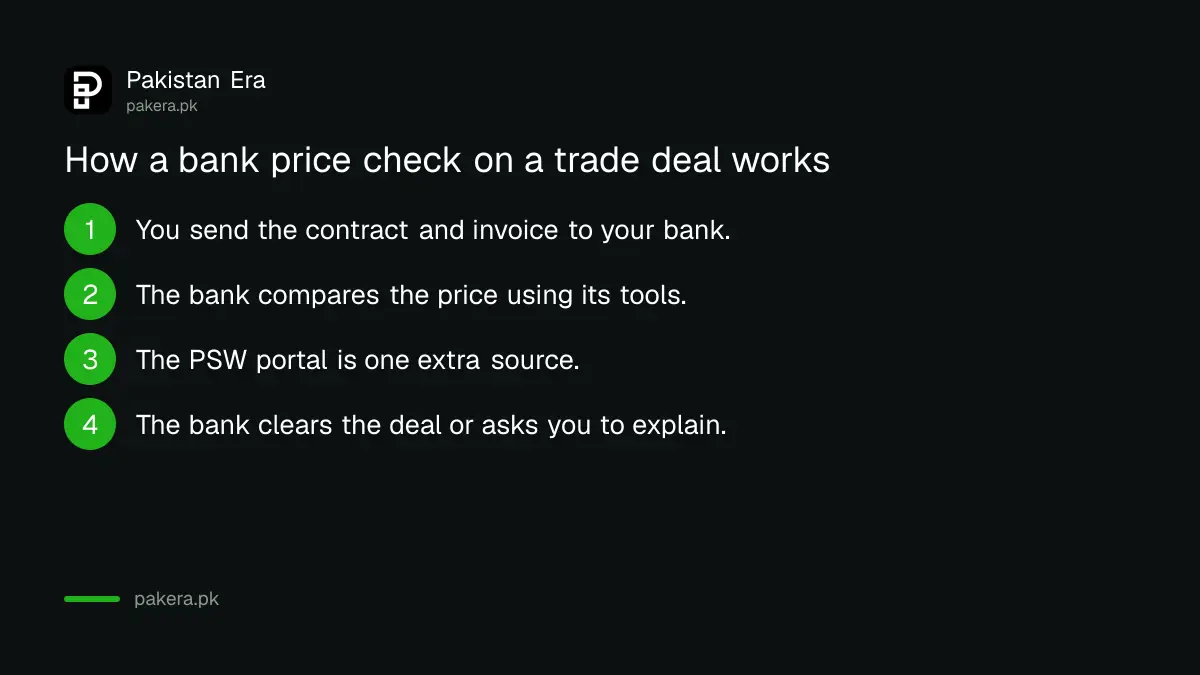
The portal is an online tool built by the Pakistan Single Window for banks. Banks, called authorised dealers in foreign exchange, can use it to check whether the price on a trade deal looks right. It is an extra tool and does not replace the checks banks already do.
SBP says it supports the bank's duty under its framework for managing the risk of trade based money laundering and terrorist financing, or TBML&TF. Trade based money laundering means hiding illegal money by writing a false price on an import or export bill.
The circular says banks may also keep using in-house and third-party price tools. The portal does not set prices, and it does not tell a trader what to charge. It helps the bank judge whether a price is reasonable.
See what banks were ordered to do and by when
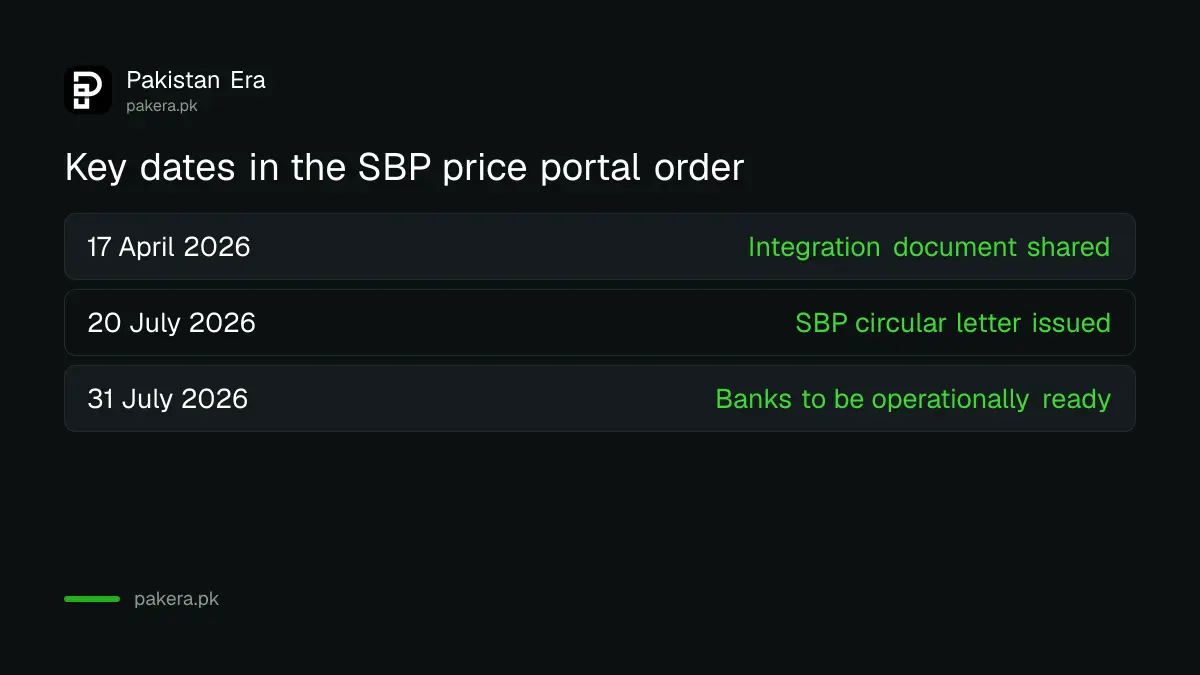
SBP told all authorised dealers to build the system links needed to connect to the portal. They had to follow the technical document that SBP shared with them on 17 April 2026, and be ready to operate by 31 July 2026.
| Date | What happened |
|---|---|
| 17 April 2026 | SBP shared the portal's integration document with banks |
| 20 July 2026 | SBP circular letter told banks to connect |
| 31 July 2026 | Banks had to be operationally ready |
The circular warns that banks which do not comply can face action under the Foreign Exchange Regulation Act, 1947. That is why a bank may ask more questions about your price than before. The bank carries the risk, not you, but you carry the delay.
Keep the papers that prove your price
The circular does not list documents for traders. From how a price check works, a bank will want proof that the price is genuine. Having these ready is our practical advice, and your bank may ask for others.
- A signed sales contract or purchase order with the unit price.
- The commercial invoice, matching the contract.
- The packing list and shipping papers.
- Proof of the market price, such as a supplier quote or price list.
- A short note explaining any discount, bulk rate or special grade.
Keep the same price in every document. A mismatch between the invoice and the customs declaration is the easiest way to attract questions. Our guide to registering as an exporter on WeBOC covers the customs declaration side.
Explain unusual prices before the bank asks
A price far above or far below the usual market rate is the likeliest to be questioned. If your price is unusual for a good reason, say so in writing when you submit the deal. A new buyer, a trial order, damaged stock or a clearance sale are normal reasons.
Do not change an invoice to fit a number. If a bank queries your price, answer with the contract and the quote, and never with a new invoice made after the fact. False documents can bring far bigger trouble than a delay.
If you ship small parcels, the rules differ. See our guide to customs duty on courier parcels in Pakistan. If you file customs paperwork late, read about customs late filing penalties.
What this does not change
We did not find a rule in the circular that fixes prices, adds a fee for traders or blocks any payment. It says the portal supplements checks that banks already run. So your first step is the same as before: keep clean records.
If you are an exporter claiming the State Bank's rebate on growth, your bank also needs your realisation certificates. Our guide to claiming the PRIE export rebate lists what to prepare.
Common questions about the price verification portal
Do I have to register on the portal?
The circular is addressed to banks and does not ask traders to register. We found no trader login in the circular, so ask your bank before you assume one is needed.
Will the portal stop my payment?
The circular does not say so. It calls the portal an additional facility for the bank's due diligence. A bank may ask you questions before it releases a payment.
Does it apply to freelancers paid from abroad?
The circular speaks of the price of imported and exported goods in trade deals. We did not find that it names freelancer income, so do not assume it applies.
Who runs the portal?
The Pakistan Single Window developed it, according to the SBP circular.
Where can I read the circular?
On the SBP website, under Circulars, as EPD Circular Letter No. 13 of 2026, dated 20 July 2026.
How we verified this
What we checked, where we read it, and what we could not confirm.
Last checked 8 October 2026. The portal's purpose, the 17 April 2026 document, the 31 July 2026 readiness date and the warning about the Foreign Exchange Regulation Act, 1947 come from SBP's EPD Circular Letter No. 13 of 2026. We did not open the portal or the integration document, and found no trader guide. The list of papers to keep is our own advice, not an SBP rule.
About the author

Senior Writer, Public Services and Technology
Shahid joined us in 2024 as an author. He is a senior contributor to Pakistan's leading technology websites. He writes detailed articles, mostly covering his expertise in the latest tech, mobiles, apps, gadgets, and step-by-step guides. His ideology is to help people understand the latest trends and explain complex methods through very easy-to-understand guides.