Late Customs Filing Will Cost Rs 25,000 a Day From October
Two SROs take effect on 1 October. Penalties start at Rs 25,000 a day and the customs system will now calculate and serve them automatically.
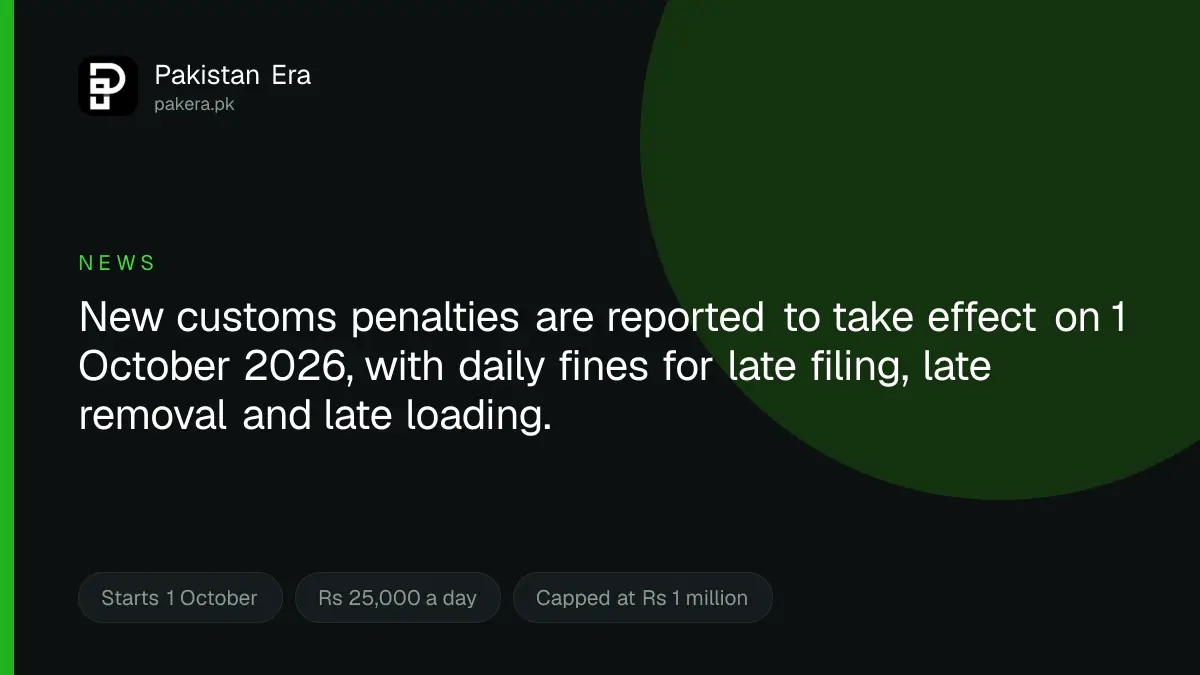
New customs penalties are reported to take effect on 1 October 2026. If you import or export anything, the numbers are worth reading now rather than in October.
Update, 11 October 2026: The notified process lets you contest an overstayed cargo penalty.
You may have seen this reported as a flat Rs 25,000 a day for filing late. The actual structure is more expensive than that.
The full schedule
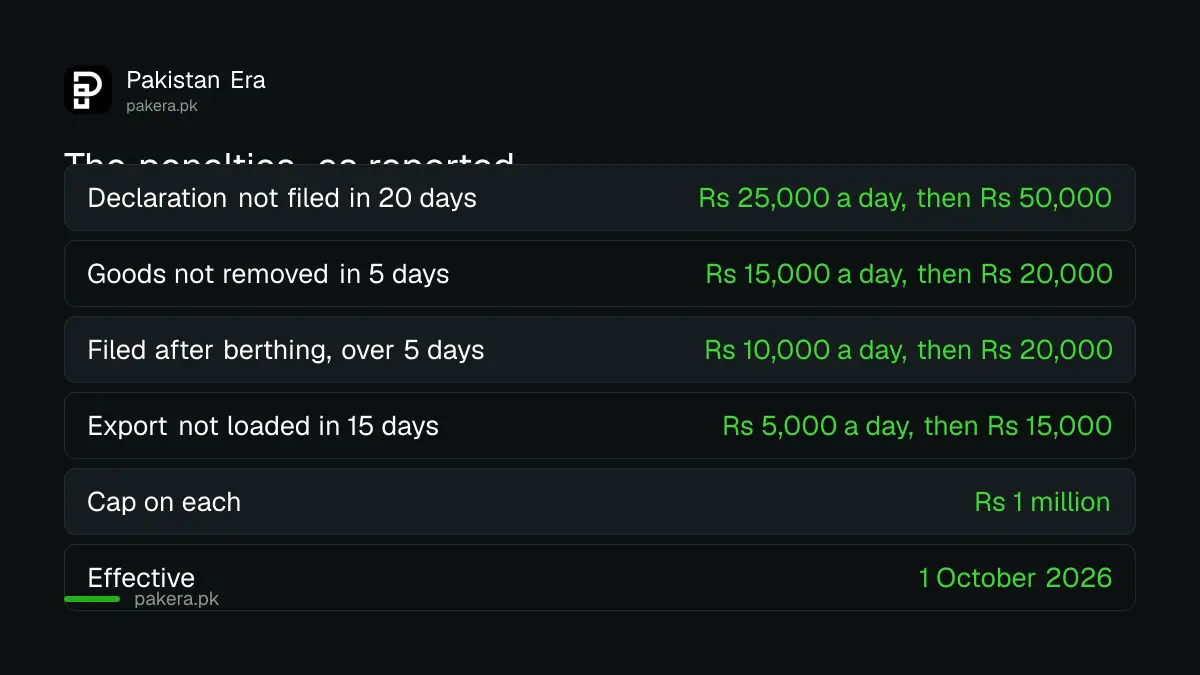
| What triggers it | First 5 days | After that |
|---|---|---|
| Declaration not filed within 20 days of arrival | Rs 25,000 a day | Rs 50,000 a day |
| Goods not removed within 5 days of assessment and berthing | Rs 15,000 a day | Rs 20,000 a day |
| Declaration filed after berthing, clearance over 5 days | Rs 10,000 a day | Rs 20,000 a day |
| Export not loaded within 15 days of port entry | Rs 5,000 a day | Rs 15,000 a day |
Each of those is capped at Rs 1 million.
The detail that gets lost in the summary is the second column. The daily rate doubles after five days on the filing penalty, and rises on the others. A business planning against a flat Rs 25,000 would underestimate its exposure from day six onward.
How the clock actually runs
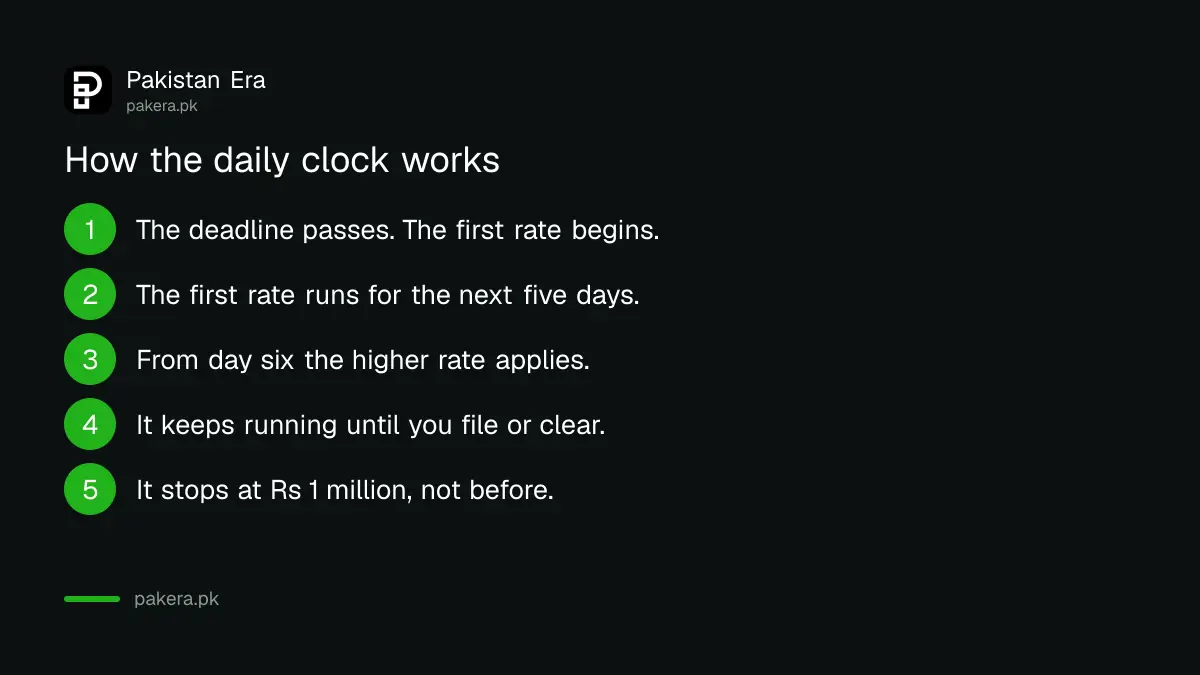
- The deadline passes and the first daily rate starts.
- That rate runs for five days.
- From day six the higher rate applies, and on the filing penalty that is double.
- It keeps running until you file, remove or load, depending on which penalty you are in.
- It stops at Rs 1 million and not before.
Take the worst case on filing. Five days at Rs 25,000 is Rs 125,000. Then Rs 50,000 a day. It does not take long at that rate to reach the cap, and the cap is per consignment rather than per company.
Penalties are described as being enforced through adjudication proceedings or by voluntary deposit.
Nothing is payable yet
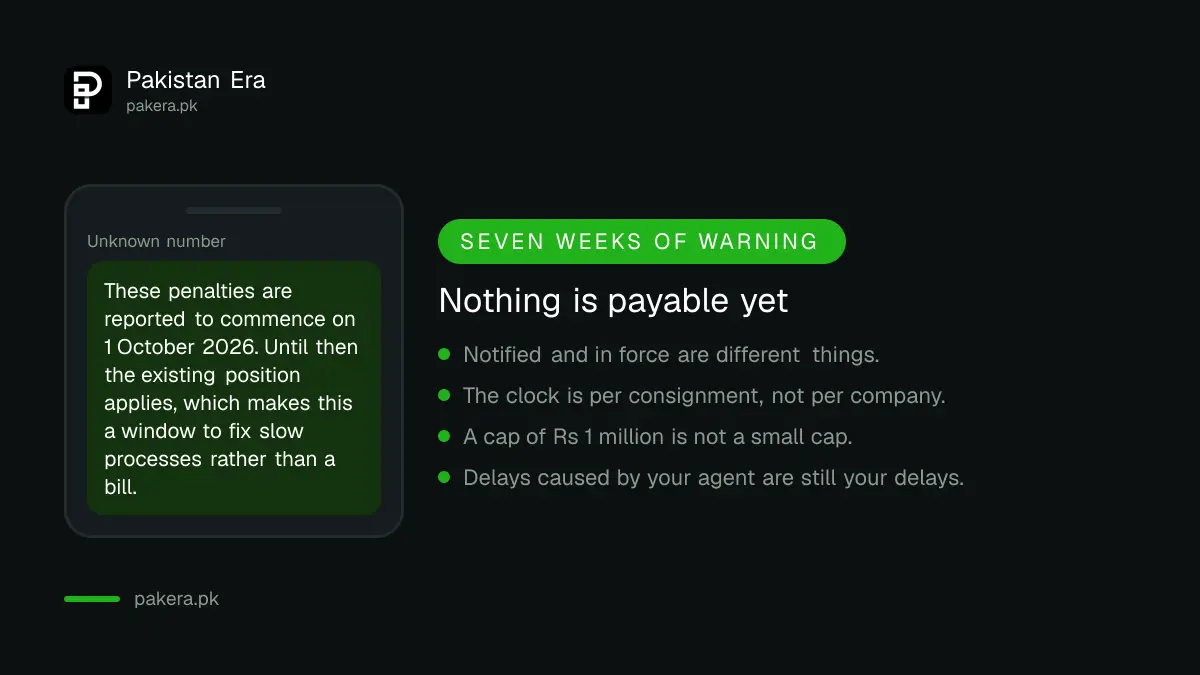
This is reported to commence on 1 October 2026, which is about seven weeks away.
So this is not a bill. It is notice. And that distinction is the useful part, because seven weeks is enough time to fix the process problems that would otherwise cost you, and not enough to leave until September.
We make this distinction on every measure we cover, because notified and in force are different things and a great deal of coverage runs them together. Something announced today can still change before it commences.
What to do with the seven weeks
The penalties all punish the same thing: delay between a document and a movement. So the fixes are about process rather than paperwork.
Find out who actually files your declarations, and on what day relative to arrival. Many businesses do not know, because a clearing agent handles it and nobody has ever asked. A delay caused by your agent is still your delay.
Look at your slowest consignment from the last six months, not your average. The average never triggers a penalty. The outlier does.
Check what causes your removals to slip past five days. If it is funds, transport or storage, that is a planning problem with seven weeks to solve.
Exporters, count from port entry. Fifteen days sounds generous until a booking is rolled.
Update: we can now name the rules, and there are two
When we published this we could not locate the instrument. That gap is now closed, and it turns out we were describing half of what changes on 1 October.
SRO 1346(I)/2026 is the one covered above. It notifies the penalties under section 82(1) of the Customs Act, 1969, and it was issued on 13 August 2026.
SRO 1347(I)/2026 was issued alongside it and adds a new chapter to the Customs Rules, 2001, called the Overstayed Cargo Management Rules, 2026. It also takes effect on 1 October 2026, and it is the part that changes how the penalties above actually reach you.
The penalties will be issued by computer
This is the substantive change, and it is why the two rules were published together.
Under the new chapter, Pakistan's Customs Computerised System calculates the penalty automatically, either when a Goods Declaration is filed or before the cargo is released. It then generates an electronic show-cause notice to the owner of the goods or their authorised agent.
From there you have two routes.
- Pay the assessed penalty through the WeBOC payment module.
- Contest it through adjudication, in which case the file goes to the relevant collector.
A contested case carries a clock. The collector has five working days to rule, extendable by a further five at the discretion of the chief collector of customs, with the reasons recorded.
The practical shift is that nobody has to notice your delay and decide to act on it. The system notices, prices it, and serves the notice.
What the automated rules do not cover
The exclusions are worth knowing, because they are wide enough to take many consignments out of scope entirely.
The chapter does not apply at land customs stations or airports. It is a seaport mechanism.
It also excludes goods imported under Chapter 99 of the First Schedule to the Customs Act, goods in transit or under international transshipment, personal baggage, less-than-container-load export cargo, and bulk cargo.
So if you import by air, or move LCL export consignments, the automated penalty chapter is not aimed at you. The penalty schedule under SRO 1346 is a separate question from whether this automation applies.
One thing still outstanding: the rules apply rates that FBR sets separately, so the automation and the amounts are not published in the same place.
What we could not verify
We did not read the SRO itself. FBR's website responded, but we could not locate the document, and a direct download path returned an error.
Every figure above is therefore taken from reporting and marked as reported. We think it is reliable, and it is specific enough to be useful. But before you make a filing decision or price a contract on these numbers, confirm them against the SRO text or with your customs agent.
We are also not interpreting the adjudication or voluntary deposit routes, because those have procedural detail we have not read, and getting that wrong would matter more than getting a daily rate wrong.
Where this sits with the rest of the tax picture
This lands in a year of tightening on filing generally. The surcharge for late income tax filers rose sharply, which we covered in the Rs 25,000 ATL surcharge, and the pattern is the same: deadlines that were once soft now carry a price.
If you are trading and not yet registered properly, the starting points are registering as a sole proprietor and verifying an NTN. Filing itself is covered in our return filing guide.
Questions readers are asking
When do the new customs penalties start?
They are reported to take effect on 1 October 2026. Nothing is payable before then.
How much is the fine for filing a goods declaration late?
Rs 25,000 a day for the first five days after the 20 day deadline, then Rs 50,000 a day, capped at Rs 1 million.
Is there a maximum?
Each penalty is capped at Rs 1 million, and the cap applies per consignment rather than per business.
Do exporters face penalties too?
Yes. If a consignment is not loaded within 15 days of port entry, Rs 5,000 a day for five days and Rs 15,000 a day after that.
My clearing agent handles filing. Am I still liable?
The obligation sits with the importer or exporter. A delay at your agent is still a delay on your consignment, which is why it is worth knowing their actual timings.
Where can I read the rule itself?
It is reported as SRO 1346 of 2026. We could not locate the document on FBR's site, so ask your customs agent or check with FBR directly before relying on any figure.
Could this change before October?
It is possible. Measures are sometimes amended between notification and commencement, which is another reason to confirm nearer the date.
About the author

Public Services and Education Journalist
Fajr Riaz is a journalist and content writer at Pakistan Era, based in Lahore. She covers the questions people meet in everyday life in Pakistan: how a public service works, what a change in the rules means, and where to find a reliable answer.